Inovação e economia circular no sistema prisional: uma análise dos 10r’s
DOI:
https://doi.org/10.47456/bjpe.v11i3.49080Keywords:
Circular Economy, Prison System, Innovation, Sustainability, 10RsAbstract
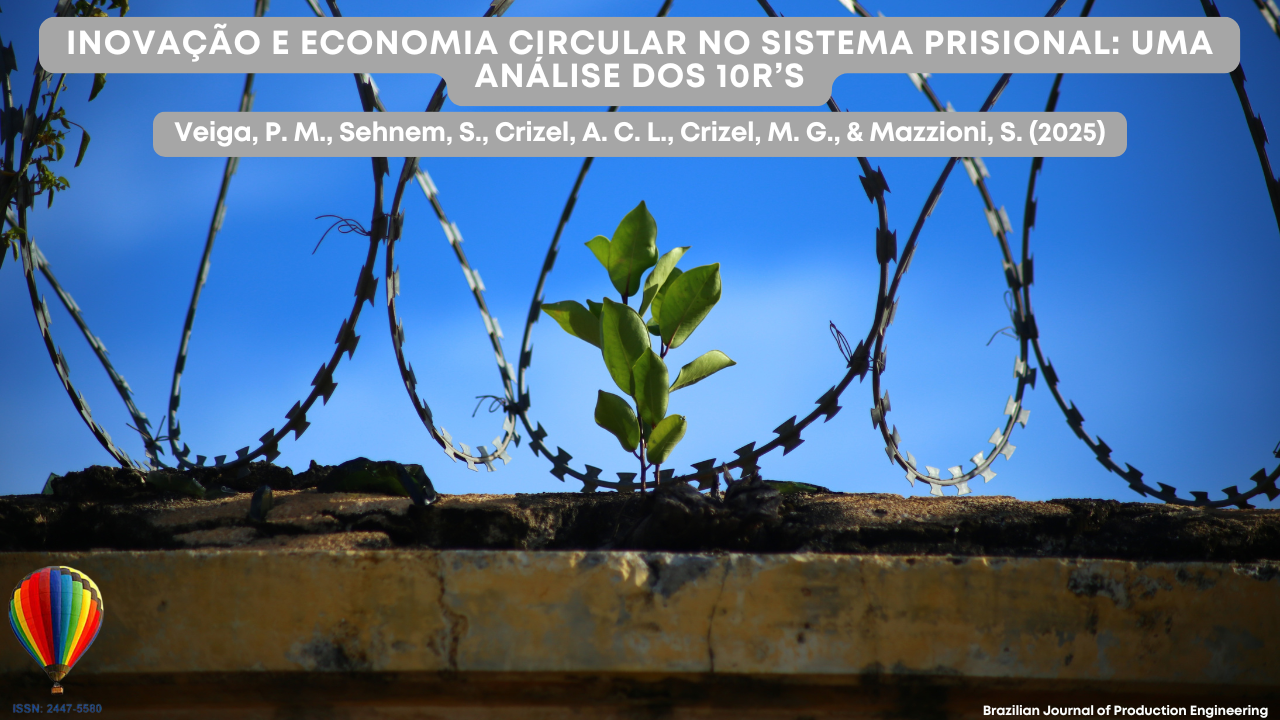
Este estudo investiga a aplicação das estratégias dos 10R como alternativa impulsionada por inovação para o avanço da economia circular em penitenciárias estaduais de Santa Catarina. Adota-se um estudo de caso único e qualitativo, triangulando dados de revisão sistemática da literatura, 16 entrevistas semiestruturadas com gestores prisionais e observações diretas. Os resultados indicam que, embora existam práticas sustentáveis isoladas, há carência de coordenação institucional, sensibilização de stakeholders e capacitação técnica. A inovação tecnológica, ferramentas digitais e a reorganização de rotinas organizacionais são identificadas como facilitadores da circularidade. Conclui-se que a transição para a economia circular requer abordagem sistêmica com infraestrutura tecnológica e engajamento contínuo.
Downloads
References
Allwood, J. M., Ashby, M. F., Gutowski, T. G., & Worrell, E. (2011). Material efficiency: a white paper. Resources, Conservation and Recycling, 55(3), 362-381. https://doi.org/10.1016/j.resconrec.2010.11.002
Bardin, L. (2011). Análise de conteúdo. São Paulo, SP: Edições 70.
Blackburn, R. (2004). Remanufacturing in the UK: A significant contributor to sustainable development? Journal of Cleaner Production, 12(8–10), 1129–1140. https://doi.org/10.1016/j.jclepro.2004.02.020
Braungart, M., & McDonough, W. (1998). The next industrial revolution. The Atlantic Monthly, 282(4), 82–92.
Brasil. (1984). Lei nº 7.210, de 11 de julho de 1984 (Lei de Execução Penal). Dispõe sobre a execução penal. Recuperado de https://www.planalto.gov.br/ccivil_03/leis/l7210.htm
Brasil. (1940). Decreto-Lei nº 2.848, de 7 de dezembro de 1940 (Código Penal Brasileiro). Recuperado de https://www.planalto.gov.br/ccivil_03/decreto-lei/del2848compilado.htm
Brasil. (2005). Resolução nº 3, de 23 de setembro de 2005. Diretrizes básicas para arquitetura penal. Recuperado de https://www.gov.br/depen/pt-br/composicao/cnpcp/resolucoes/2011/diretrizes-basicas-para-arquitetura-penal.pdf
Brundtland, G. H. (1987). Our common future: Report of the World Commission on Environment and Development. Oxford: Oxford University Press.
Cossu, R., & Williams, I. D. (2015). Urban mining: Concepts, terminology, challenges. Waste Management & Research, 33(6), 478–479. https://doi.org/10.1177/0734242X15588305
Ellen MacArthur Foundation. (2013). Towards the circular economy: Opportunities for the consumer goods sector. https://www.ellenmacarthurfoundation.org
Ellen MacArthur Foundation. (2015). Towards the circular economy: The business rationale to accelerate the transition. https://www.ellenmacarthurfoundation.org
Francis, C. A., Lieblein, G., Gliessman, S. R., Breland, T. A., Creamer, N. G., Harwood, R. R., ... & Wiedenhoeft, M. H. (2003). Agroecology: The ecology of food systems. Journal of Sustainable Agriculture, 22(3), 99–118. https://doi.org/10.1300/J064v22n03_10
Geissdoerfer, M., Savaget, P., Bocken, N. M. P., & Hultink, E. J. (2017). The Circular Economy–A new sustainability paradigm? Journal of Cleaner Production, 143, 757–768. https://doi.org/10.1016/j.jclepro.2016.12.048
Ghisellini, P., Cialani, C., & Ulgiati, S. (2016). A review on circular economy: The expected transition to a balanced interaction of environmental and economic systems. Journal of Cleaner Production, 114, 11–32. https://doi.org/10.1016/j.jclepro.2015.09.007
Ghisellini, P., Ripa, M., & Ulgiati, S. (2014). Sustainable waste management: A case study of Italy. Journal of Cleaner Production, 33, 58–66. https://doi.org/10.1016/j.jclepro.2012.09.013
Goodman, J., Korsunova, A., & Halme, M. (2017). Our collaborative future: Stakeholder roles and agendas in sustainability innovation. Business Strategy and the Environment, 26(6), 731–753. https://doi.org/10.1002/bse.1941
Hultman, J., & Corvellec, H. (2012). The European waste hierarchy: From the sociomateriality of waste to a politics of consumption. Environment and Planning A, 44(10), 2413–2427. https://doi.org/10.1068/a44668
Kirchherr, J., Reike, D., & Hekkert, M. (2017). Conceptualizing the circular economy: An analysis of 114 definitions. Resources, Conservation and Recycling, 127, 221–232. https://doi.org/10.1016/j.resconrec.2017.09.005
Kruglianskas, I., & Pinsky, V. (2018). Inovação tecnológica para a sustentabilidade: lições de sucessos e fracassos. Estudos Avançados, 31(90), 107–126. https://doi.org/10.1590/s0103-40142017.3190008
Lieder, M., & Rashid, A. (2016). Towards circular economy implementation: A comprehensive review in context of manufacturing industry. Journal of Cleaner Production, 115, 36–51. https://doi.org/10.1016/j.jclepro.2015.12.042
Merli, R., Preziosi, M., & Acampora, A. (2018). How do scholars approach the circular economy? A systematic review of the literature. Journal of Cleaner Production, 178, 703–722. https://doi.org/10.1016/j.jclepro.2017.12.112
Mies, A., & Gold, S. (2021). Mapping the social dimension of the circular economy. Journal of Cleaner Production, 321, 128960. https://doi.org/10.1016/j.jclepro.2021.128960
Murray, A., Skene, K., & Haynes, K. (2017). The circular economy: An interdisciplinary exploration of the concept and application in a global context. Journal of Business Ethics, 140(3), 369–380. https://doi.org/10.1007/s10551-015-2693-2
Reike, D., Vermeulen, W. J. V., & Witjes, S. (2018). The circular economy: New or refurbished as CE 3.0? Exploring controversies in the conceptualization of the circular economy through a focus on history and resource value retention options. Resources, Conservation and Recycling, 135, 246–264. https://doi.org/10.1016/j.resconrec.2017.08.027
Rodwell, M. K. (1994). Social work constructivist research. New York: Garland Publishing.
Roper, S., Hopkinson, P., Zils, M., & Hawkins, P. (2018). Managing a complex global circular economy business model: Opportunities and challenges. California Management Review, 60(3), 71–94. https://doi.org/10.1177/0008125618764692
Santa Catarina. (2019). Lei Complementar nº 741, de 12 de junho de 2019. Dispõe sobre a estrutura organizacional básica da Administração Pública Estadual. Recuperado de http://leis.alesc.sc.gov.br/html/2019/741_2019_lei_complementar.html
Santa Catarina. (2021). Lei Complementar nº 774, de 27 de outubro de 2021. Dispõe sobre o Estatuto da Polícia Penal do Estado de Santa Catarina. Recuperado de http://leis.alesc.sc.gov.br/html/2021/774_2021_lei_complementar.html
Santa Catarina. (2022). Decreto nº 2.379, de 28 de dezembro de 2022. Aprova o Regimento Interno da Secretaria de Estado da Administração Prisional e Socioeducativa. Recuperado de https://leisestaduais.com.br/sc/decreto-n-2379-2022-santa-catarina-aprova-o-regimento-interno-da-secretaria-de-estado-da-administracao-prisional-e-socio-educational
Santa Catarina. (2007). Lei nº 14.003, de 3 de maio de 2007. Dispõe sobre o Conselho Penitenciário Estadual. Recuperado de http://leis.alesc.sc.gov.br/html/2007/14003_2007_Lei.html
Secchim, A. B., Freitas, R. R., & Gonçalves, W. (2018). Mapeamento e análise bibliométrica da utilização da análise envoltória de dados (DEA) em estudos de engenharia de produção. Brazilian Journal of Production Engineering, 4(2), 87–108. https://doi.org/10.47456/bjpe.v4i2.24464
Valencia, M., Bocken, N. M. P., Loaiza, C., & Jaeger, S. (2023). The social contribution of the Circular Economy. Journal of Cleaner Production, 408, 137082. https://doi.org/10.1016/j.jclepro.2023.137082
Vygotsky, L. S. (2001). A construção do pensamento e da linguagem. São Paulo, SP: Martins Fontes.
Yan, J., & Feng, C. (2014). Sustainable design-oriented product modularity combined with the 6R concept: A rotor laboratory bench case study. Clean Technologies and Environmental Policy, 16(1), 89–101. https://doi.org/10.1007/s10098-013-0597-3
Yin, R. K. (2015). Estudo de caso: Planejamento e métodos (5ª ed.). Porto Alegre, RS: Bookman.
Downloads
Published
Issue
Section
License
Copyright (c) 2025 Veiga, P. M., Sehnem, S., Crizel, A. C. L., Crizel, M. G., & Mazzioni, S.

This work is licensed under a Creative Commons Attribution 4.0 International License.

All works published in the Brazilian Journal of Production Engineering (BJPE) are licensed under Creative Commons Attribution 4.0 International (CC BY 4.0).
This means that:
Anyone can copy, distribute, display, adapt, remix, and even commercially use the content published in the journal;
Provided that due credit is given to the authors and to BJPE as the original source;
No additional permission is required for reuse, as long as the license terms are respected.
This policy complies with the principles of open access, promoting the broad dissemination of scientific knowledge.


2.png)