Audiovisual experience of the “Sinógeno”: mischaracterization or anthropophagy?
DOI:
https://doi.org/10.47456/cadecs.v10i2.39690Abstract
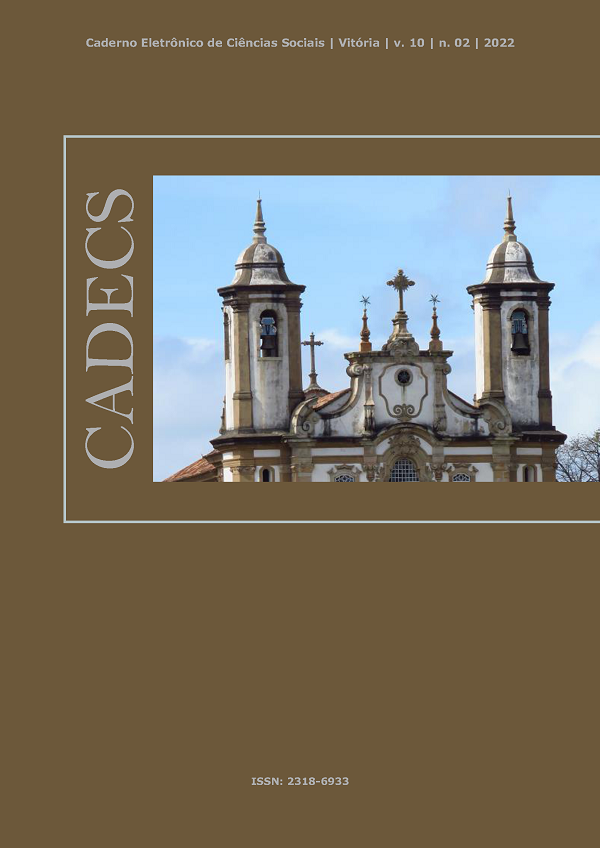
In this work, we reflect on the questions about tradition and modernity in the artistic and cultural perceptions of the bell’s tradition in the city of São João del Rei in the state of Minas Gerais. We bring as material for analysis the visual EP entitled “Sinógeno”, which, when published in March 2021, brought a series of repercussions, among them some controversies, around the possible artistic or sacrilege contained in the work. Here, we will discuss, through this object, themes about the Minas Gerais perception about cosmopolitanism and artistic experimentation, relating the message concepts of José Miguel Wisnik, as well as the in-between of the local and global conceptions. Passing briefly through the historical context of Minas, from the land exploration process, through the influence of Churches and the Catholic religion in the process of building the region, to contemporary sound, visual and performance experiments, this work addresses the idea of movements and narratives. artistic works in São João del Rei and other bell cities. The sociability inherent in the language of the bells, which crosses the place, the soundscape (SCHAFER, 2001) of the ringtones, as well as the imagination of the listeners, bring up reflections on the various artistic practices and knowledge involved in this tradition. We defend that the culture and bells’s tradition and Minas are being negotiated daily by the people who invent and move them through the mediations that operate in their relationships. In this sense, the controversy around the Sinógeno expresses this relational aspect in the production of assemblages and meanings from works of art, whether through the attempt, by some, to accuse it of sacrilege, or through the attempt of others, to affirm and claim the expression of belongings and contributions of African sounds and rhythms in Brazilian territory as bases for nation building. Let us therefore analyze the way in which the Sineira culture manifests itself in São João Del Rei, in its emergence, institutionalization, and resignification.
References
ANDERSON, B. 1989. Nação e consciência nacional. São Paulo: Ática.
BACZO, B. 1985. Imaginação social. Enciclopédia Einaudi. Lisboa: Imprensa Nacional-Casa da Moeda.
BITTENCOURT, A. 2019. Personalidade e destino: Pedro Nava, Mário de Andrade e a socialização do modernismo. Sociologia. Antropologia. v.9 n.1, pp. 235-256.
BOSCHI, C.C. 1986. Os Leigos e o Poder: irmandades leigas e política colonizadora em Minas Gerais. São Paulo: Ática.
BOTELHO, A. 2020. Minas mundo, Hermenêutica de uma Subjetividade Individual. Sociologia e Antropologia, v. 10, n. 2, pp. 707-727.
BOTELHO, A. 2020. O modernismo como movimento cultural: Uma sociologia política da cultura. Lua Nova: Revista de Cultura e Política, n. 111, pp. 175-209.
CARVALHO, F. I. 2010. O autor da morte e da vida: a escrita barroca de João Cabral de Melo Neto. (Dissertação de Mestrado). Universidade Federal do Rio Grande do Norte.
CASTRO, E. V. 2007. Filiação intensiva e aliança demoníaca. Novos estudos CEBRAP.
CERTEAU, M. 1998. A invenção do cotidiano: Artes de fazer. Petrópolis: Editora Vozes.
DIAS, F. C. 2002. Gênese e expressão grupal do modernismo em Minas. In: ÁVILA, Affonso (org.). O modernismo. São Paulo: Perspectiva, pp. 165-177.
FLORES, R. J. C. 2005. Três olhares, uma cidade: em busca de um passado nacional. Atas do I Encontro de História da Arte – IFCH/ NICAMP, v. 3, pp. 275-285.
GALEANO, E. 2010. As veias abertas da América Latina. Porto Alegre: L&PM Editores.
HENRI G., RUAS E. 1950. Ouro Preto: sua história, seus templos e monumentos. Rio de Janeiro: Departamento de Imprensa Nacional.
IPHAN/MinC. 2009. Dossiê de Registro “O Toque dos Sinos em Minas Gerais tendo como referencia São João del-Rei e as cidades de Ouro Preto, Mariana, Catas Altas, Congonhas do Campo, Diamantina, Sabará, Serro e Tiradentes. Brasília: Iphan/MinC,
SCHAFER, R. M. 2001. A afinação do mundo. São Paulo: Editora UNESP.
VIEIRA, Y. H.; CARDOSO FILHO, M. E. 2018. Influência africana na linguagem dos sinos em São João del-Rei. ANAIS DA REUNIÃO ANUAL DA SBPC, 70. Maceió: UFAL.
, p. 1-4. WISNIK, J. M. 2018. A maquinação do mundo: Drummond e a mineração. Rio de Janeiro: Companhia das letras.
Downloads
Published
Issue
Section
License
O Caderno Eletrônico de Ciências Sociais detém os direitos autorais dos artigos nele publicados mediante submissão dos autores .O envio espontâneo de qualquer colaboração implica automaticamente a cessão integral dos direitos autorais ao Cadecs.