Cartographies of Erasure
DOI:
https://doi.org/10.7147/GEO23.14825Keywords:
erasure; cartography; sociusAbstract
The rupture between the thought of nature as physis and human thought leads to
suffering and confusion for man in the fields of subjectivity. An affirmative relationship
with becoming, in accordance with the proposal of Nietzsche's concept of dionysian wisdom, might lead man once again to the path of tragic life - one that produces strength by
asserting pain and difference – thus surpassing the false opposition man/nature. Inspired
by Nietzsche, Deleuze and Guattari propose fighting against the fascism of the socius,
the State, of capitalism and all the dominant discourses of established knowledge and
established power that capture body and its will. An instrument for such struggle is the
production of counterfascist erasures on the encodings of power. The question of how to
produce bodies without organs as a way to escape the organic structure of the socius is made
possible by the power of sensation to erase and rediagram the cartographies of subjectivity.
erasure, cartography, socius
Downloads
References
ARAVENA, M. et al. Investigación educativa I. [S.l.]: Asociación de Facultades Ecuatorianas de Filosofía y Ciencias de la Educación (AFEFCE) Ecuador, Universidad de Arte y Ciencias Sociales (ARCIS) Chile, 2006.
ARBIZU ECHÁVARRI, F. M.; ARIAS FERNÁNDEZ, M. J. Sistema Nacional de Cualificaciones y Formación Profesional (SNCFP). . Madrid: [s.n.], 2002.
ARTÍLES GIL, L. et al. La escuela más alla de sus muros. Santo Domingo (Rep. Dominicana): Fe y Alegría República Dominicana, 2005.
BENERÍA, L. Trabajo productivo/reproductivo, pobreza y políticas de conciliación. Nómadas, n. 24, p. 8–21, 2006.
CALDERON, M. Orientaciones para los grupos focales. . Quito: [s.n.], 2015.
CEDEFOP. Developing lifelong learning. Disponível em: <http://www.cedefop.europa.eu/EN/developing-lifelong-learning/index.aspx>. Acesso em: 14 abr. 2013.
DE SOUZA MARTINS, J. O artesanato intelectual na sociologia. Revista Brasileira de Sociologia, v. 1, n. 2, p. 36, 2013.
EQUIPO TÉCNICO FE Y ALEGRÍA. Plan estratégico de Fe y Alegría Ecuador. 2015 - 2019. . Quito: [s.n.], 2015.
FE Y ALEGRÍA. La formación para el trabajo en América Latina. Contextos nacionales y experiencias de Fe y Alegría. [S.l.]: Federación Internacional de Fe y Alegría. Banco Interamericano de Desarrollo, 2003.
FREIRE, P. El grito manso. 2. ed. [S.l.]: Siglo XXI, 2003.
HOMS, O. La formación profesional en España. Hacia la sociedad del conocimiento. Núm. 25. Colección Estudios Sociales. Barcelona: Fundación ”la Caixa”, 2008. . Disponível em: <http://obrasocial.lacaixa.es/StaticFiles/StaticFiles/3c100a21817b5210VgnVCM200000128cf10aRCRD/es/vol25_es.pdf>. Acesso em: 5 abr. 2013.
INSTITUTO TECNOLÓGICO Y DE ESTUDIOS SUPERIORES DE MONTERREY. El Aprendizaje Basado en Problemas como técnica didáctica. Las estrategias y técnicas didácticas en el rediseño. Monterrey: Dirección de Investigación y Desarrollo Educativo, Vicerrectoría Académica, Instituto Tecnológico y de Estudios Superiores de Monterrey, 2004. .
IRAHOLA, J. Instituto de Aprendizaje Industrial. Una experiencia de Fe y Alegría en Bolivia. Formación para el trabajo. Santo Domingo (Rep. Dominicana): Fe y Alegría Ecuador, AECID, 2009. .
JACINTO, C.; FREY, F. Políticas y estrategias para el mejoramiento de las oportunidades de los jóvenes: estudio en la Ciudad de Buenos Aires. . Buenos Aires: [s.n.], 2004.
MARHUENDA, F. La Formación Profesional. Madrid: Editorial Síntesis, 2012.
MARIÑO, G.; CENDALES, L. Educacion No Formal y Educacion Popular. [S.l.]: Federación Internacional de Fe y Alegríay Fundación Santa María, 2004.
MILLS, J.; BONNER, A.; FRANCIS, K. The development of constructivist Grounded Theory. International Journal of Qualitative Methods, v. 5, p. 25–35, 2006.
MINISTERIO DE EDUCACIÓN. Real Decreto 127/2014, de 28 de febrero, por el que se regulan aspectos específicos de la Formación Profesional Básica de las enseñanzas de formación profesional del sistema educativo. . España: [s.n.]. , 2014
MJELDE, L. Las propiedades magicas de la formación en el taller. Ontario: The Centre for Study of Education and Work, 2011.
MORGAN, D. L. Focus Groups as Qualitative Research. p. 32–46, 1997.
NARVÁEZ, A. C.; CALDERÓN, M. C.; PALOP, V. C. La educación popular ante los nuevos contextos latinoamericanos y el sistema educativo ecuatoriano. Quito: Fe y Alegría Ecuador, Entreculturas, AECID, 2015.
NAVARRO, V. Las causas del enorme desempleo y la baja ocupación en la Unión Europea. Nueva Tribuna, 2014.
NICHOLSON, P.; ET.AL. Políticas y acciones para erradicar el hambre y la desnutrición. . Eradicate Hunger and Malnutrition: [s.n.], 2009. Disponível em: <http://www.eradicatehunger.org/>. Acesso em: 14 set. 2014.
PALOP ESTEBAN, V. Aproximación a las propuestas de desarrollo desde perspectivas holísticas. València: La Nau Solidària. Universitat de València., 2014. v. 17.
PALOP, V.; HERDOIZA, P.; DINIZ, A. Alternativas para el desarrollo territorial desde la Educación-Formación Profesional. Revista do Mestrado Profissional Gestão em Organizações Aprendentes - UFPB, p. 1–19, 2013.
PÉREZ, M. Multinacionales y Territorio: FORD y IBM en la Comunidad Valenciana. Sistemas regionales de innovación: universidad y empresa, 2006.
Portal Todo FP: Acreditación de Competencias Profesionales. Disponível em: <http://www.todofp.es/todofp/formacion/acreditacion-de-competencias.html>. Acesso em: 6 abr. 2013.
RABASSA, Bernardo. Formación dual juvenil, otro despropósito tardío, de España. Diariocrítico.com, 12 ago. 2013. , p. 6–7.
RUIZ. Metodología de la investigación cualitativa. Bilbao: Universidad de Deusto, 1996.
SANDOVAL, M. D. C. Concepto y dimensiones del clima organizacional. Hitos de Ciencias Económico Administrativas, n. 27, p. 83–88, 2004.
SEN, A. El desarrollo como libertad. 1. ed. [S.l.]: Planeta, 2000.
SERRANO, J.; SERRANO, J. La Economía Social y Solidaria en el desarrollo de los territorios, comunidades y personas: La riqueza de la complejidad. foromundialadel.org, [S.d.]. Disponível em: <http://foromundialadel.org/desc/JdD Garcia Serrano Economia Social.pdf>. Acesso em: 29 mar. 2013.
SHIVA, V. The Violence of the Green Revolution: Third World Agriculture, Ecology and Politics. [S.l.]: Zed Books, 1991. v. 3.
STENSTRÖM, M.-L.; LASONEN, J. Strategies for reforming workforce preparation programs in Europe. The Journal of Technology Studies, p. 38–43, 2005.
SUÑOL, I. et al. La formación para el trabajo en América Latina. Caracas: Banco Interamericano de Desarrollo. Fe y Alegría, 2003.
VALLES, M. Metodología y tecnología cualitativas: actualización de un debate, desde la mirada más atenta en la obra de Barney G. Glaser.
EMPIRIA. Revista de Metodología de Ciencias Sociales., n. 9, p. 145–168, 2005.
VYGOTSKY, L. S. Interaction between learning and development. Mind in society. [S.l: s.n.], 1978. p. 79–91.
YOUTHREACH. Education and training for early-school-leavers. Disponível em: <http://www.youthreach.ie/>. Acesso em: 4 abr. 2013.

Downloads
Published
Issue
Section
License
Copyright (c) 2016 Os Autores

This work is licensed under a Creative Commons Attribution 4.0 International License.
Authors who publish in the journal agree with the following terms:
- Authors will keep their copyrights and grant the journal the right to their first publishing, simultaneously licenced under Creative Commons Attribution License which allows sharing their work with authorship recognition and initial release through this journal.
- Authors may sign additional contracts separately diffusing a non-exclusively version of the paper published in this journal (i.g. publishing in institutional repository or as a book chapter), once citing the authorship and initial release through this journal.
- Authors are encouraged to publicize and diffuse their paper online, for example onto institutional repositories or on their personal websites.
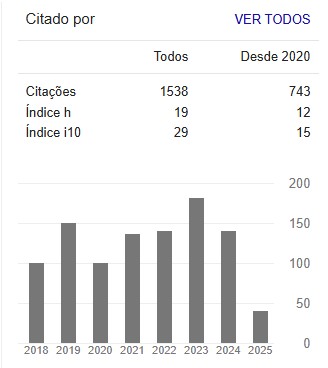
The effect of open access and downloads ('hits') on citation impact: a bibliography of studies