Urban impacts on river functionality: semi-arid rivers of America and Europe
DOI:
https://doi.org/10.47456/geo.v6i43.52215Keywords:
urban rivers; fluvial geomorphology; semi-arid basinsAbstract
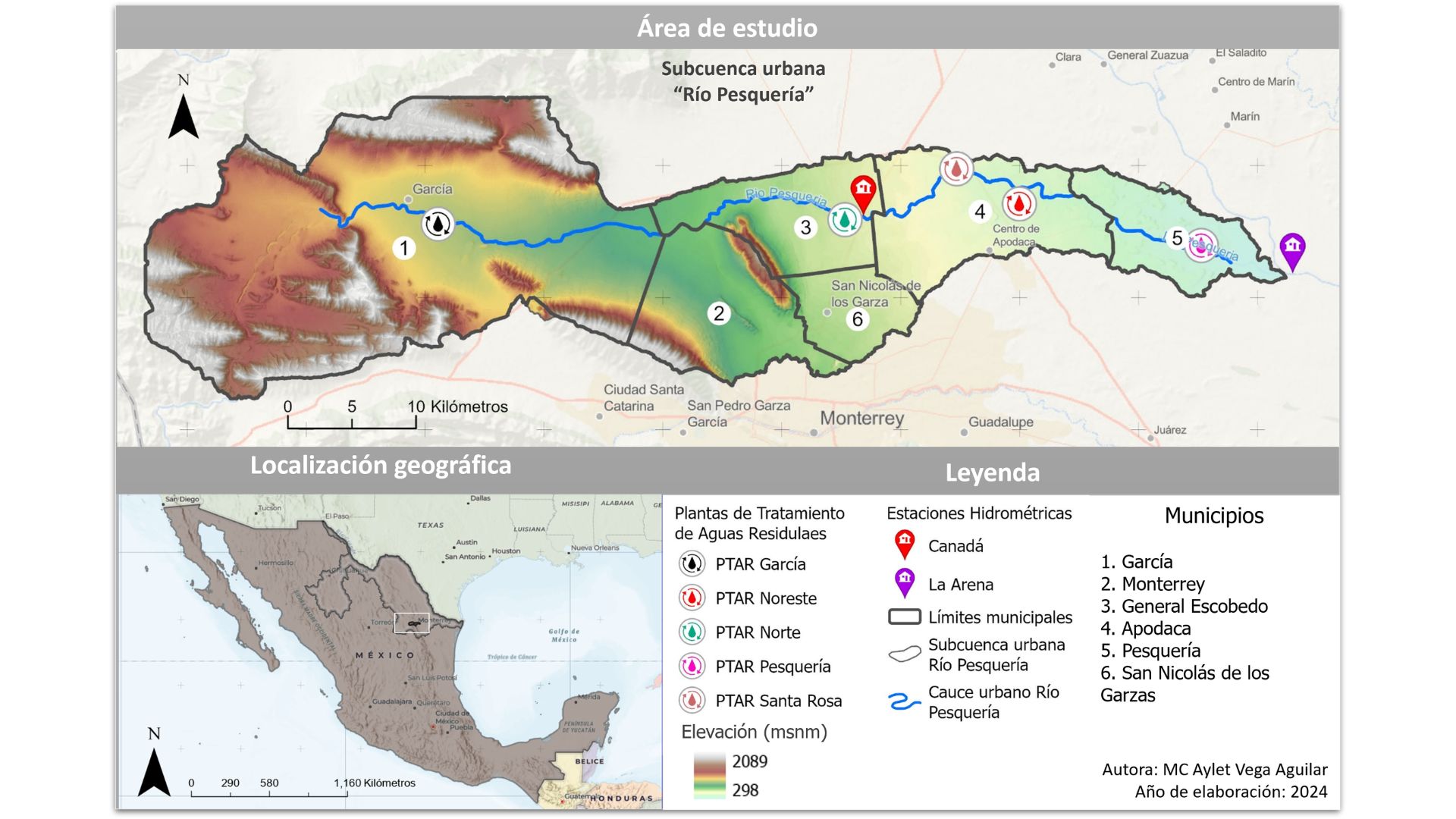
Urban rivers exhibit profound alterations in their hydrological and geomorphological dynamics as a consequence of urban sprawl, floodplain development, and infrastructure construction. This study evaluates the hydrogeomorphological quality of two urban rivers in semi-arid regions of the Americas (Mexico) and Europe (Spain) using the Hydrogeomorphological Index. The methodology integrates spatial analysis, fieldwork, historical hydrological data, and the delineation of functional reaches. The results reveal a marked contrast between urban and peri-urban reaches, with the former showing the lowest hydrogeomorphological quality values, associated with channel fragmentation, altered flow regimes, and degradation of the riparian corridor. Based on the diagnosis, the implications for the management and improvement of urban rivers are discussed, through a set of measures aimed at functional restoration and enhancing socio-environmental resilience.
Downloads
References
Álvez, A.; Espinosa, P.; Castillo, R.; Iglesias, K.; Bañales-Seguel, C. An Urgent Dialogue between Urban Design and Regulatory Framework for Urban Rivers: The Case of the Andalién River in Chile. Water 2022, 14, 3444. https://doi.org/10.3390/w14213444
Castro-López, D., Rodríguez-Lozano, P., Arias-Real, R., Guerra-Cobián, V., Prat, N., 2019. The influence of riparian corridor land use on the Pesqueria River’s macroinvertebrate community (NE Mexico). Water 11(9), 1930. https://doi.org/10.3390/w11091930
Gaxiola-Beltrán, A. L., Narezo-Balzaretti, J., Ramírez-Moreno, M. A., Pérez-Henríquez, B. L., Ramírez-Mendoza, R. A., Krajzewicz, D., & Lozoya-Santos, J. D. J. (2021). Assessing urban accessibility in Monterrey, Mexico: a transferable approach to evaluate access to main destinations at the metropolitan and local levels. Applied sciences, 11(16), 7519.
Hanna, E., Bruno, D., & Comín, F. A. (2023). Evaluating naturalness and functioning of urban green infrastructure. Urban Forestry & Urban Greening, 80, 127825. https://doi.org/10.1016/j.ufug.2022.127825
Lázaro, J. M., & Navarro, J. Á. S. (2011). Análisis de circulación de crecidas mediante el programa SHEE. Aplicación a la cuenca del río Huerva, España. Revista de la sociedad geológica de España, 24(3), 187-196.
Lespez, L., Germaine, M. A., Gob, F., Tales, E., Thommeret, N., De Milleville, L., ... & Archaimbault, V. (2022, July). A new tool to characterize the socio-environmental dimensions of Urban rivers: Urban River Socioenvironmental index (URBS). Landscape and Urban Planning, 261 (2025) 105388. https://doi.org/10.1016/j.landurbplan.2025.105388
Magaña, V., Herrera, E., Ábrego-Góngora, C. J., Ávalos, J. A.,2021. Socioeconomic drought in a mexican semi-arid city: Monterrey Metropolitan Area, a case study. Frontiers in Water, 3, 579564. doi: 10.3389/frwa.2021.579564
Martínez, B. G. (2021). Alteración hidromorfológica y estado ecológico del tramo bajo del río Bembézar. Cuenca del Guadalquivir, España. Estudios geográficos, 82(291), 1. DOI: https://doi.org/10.3989/estgeogr.202182.082
Mora, A., Mahlknecht, J., Rosales-Lagarde, L., & Hernández-Antonio, A. (2017). Assessment of major ions and trace elements in groundwater supplied to the Monterrey metropolitan area, Nuevo León, Mexico. Environmental Monitoring and Assessment, 189(8), 394.
Ollero, A., Ibisate, A., Gonzalo, L. E., Acín, V., Ballarín Ferrer, D., Díaz Bea, E., and Sánchez, M. (2011). The IHG index for hydromorphological quality assessment of rivers and streams: updated version. Limnetica, 30(2), 0255-262.
Ollero, A., Conesa-García, C., & Vidal-Abarca, M. R. (coords.) (2021). Buenas prácticas en gestión y restauración de cursos efímeros mediterráneos: resiliencia y adaptación al cambio climático. Murcia: Universidad de Murcia. https://doi.org/10.6018/editum.2900
Palmer, M. A., Hondula, K. L., & Koch, B. J. (2014). Ecological restoration of streams and rivers: shifting strategies and shifting goals. Annual Review of Ecology, Evolution, and Systematics, 45(1), 247-269. https://doi.org/10.1146/annurev-ecolsys-120213-091935
Pirchi, V. N., Zapperi, P. A., & Volonté, A. (2023). Calidad hidrogeomorfológica en áreas fluviales de expansión urbana. Aplicación del Índice Hidrogeomorfológico (IHG) en un tramo antropizado del arroyo Napostá Grande (Argentina). Investigaciones Geográficas, (80), 129-149. https://doi.org/10.14198/ INGEO.23931
Peña, J. L., Julián, A., Chueca, J., Echeverría, M. T., & Ángeles, G. (2004). Etapas de evolución holocena en el valle del río Huerva: Geomorfología y Geoarqueología. Geografía Física de Aragón. Aspectos generales y temáticos. Zaragoza: Univ. Zaragoza-Institución Fernando el Católico, 289-302.
Rodrigues, J. M., & de Souza, J. O. P. (2025). Parameterization of flow intermittency and river styles in two hydrographic basins in the semiarid region of Paraíba. Revista Brasileira de Geomorfologia, 26(3).
Segura-Beltrán, F., & Ollero, A. (2021). Cambios ambientales en los sistemas fluviales: nuevas metodologías, diversidad de casos e implicaciones para la gestión. Cuadernos de geografía, (107), 7-20. DOI: https://doi.org/10.7203/CGUV.107.23741
Volonté, A., & Gil, V. (2023). Diagnóstico y monitoreo de ambientes fluviales a partir de geoindicadores. Cuenca del Oro (Argentina). Cuadernos geográficos de la Universidad de Granada, 62(1), 130-149. DOI: https://doi.org/10.30827/cuadgeo.v62i1.25343
Yuste, M. P. R., & Ferrández, G. B. (2024). Análisis hidromorfológico de ríos efímeros utilizando teledetección y machine learning: Monográfico Geomorfológia. Geographicalia, (76), 149-162. DOI: 10.26754/ojs_geoph/geoph.20247611401
Published
Issue
Section
License

This work is licensed under a Creative Commons Attribution 4.0 International License.
Authors who publish in the journal agree with the following terms:
- Authors will keep their copyrights and grant the journal the right to their first publishing, simultaneously licenced under Creative Commons Attribution License which allows sharing their work with authorship recognition and initial release through this journal.
- Authors may sign additional contracts separately diffusing a non-exclusively version of the paper published in this journal (i.g. publishing in institutional repository or as a book chapter), once citing the authorship and initial release through this journal.
- Authors are encouraged to publicize and diffuse their paper online, for example onto institutional repositories or on their personal websites.
The effect of open access and downloads ('hits') on citation impact: a bibliography of studies