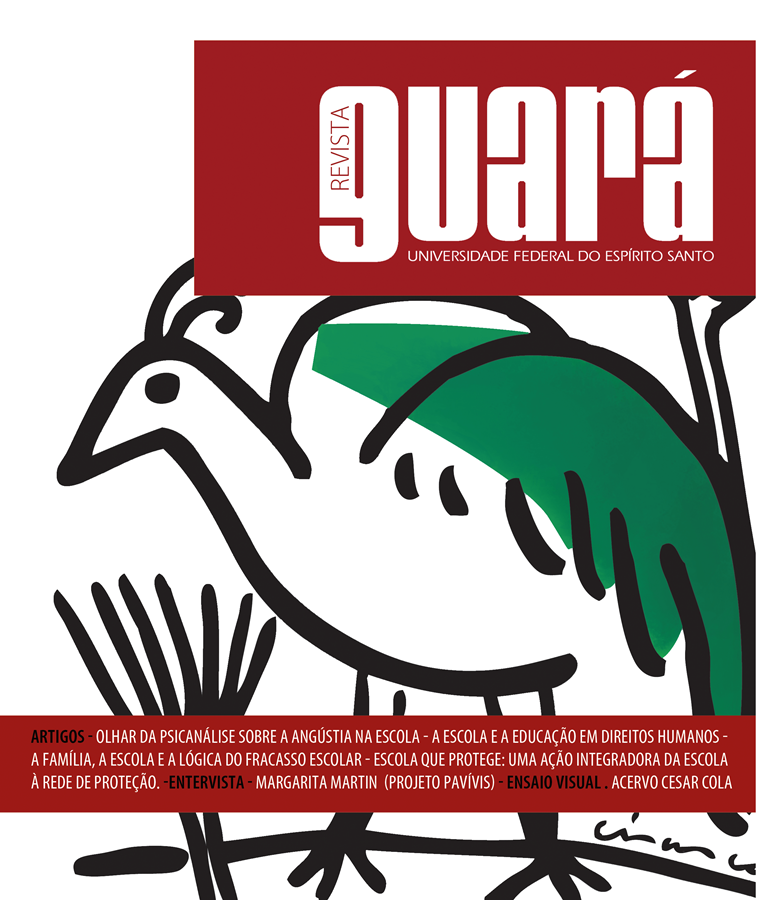
School that protects
An action integrating the school into the protection network
DOI:
https://doi.org/10.30712/guara.v1i1.10089Keywords:
Human rights education, University extension, School that protectsAbstract
The "School That Protects" project is a partnership between the Ministry of Education and the Federal University of Espírito Santo's Extension University. The project aims to provide resources for education professionals and the protection network to work on preventing and addressing various forms of violence against children and adolescents. This article presents the work of the project's partners in the cities where it operates through university extension services, as well as some reflections on human rights education and the project's perspectives.
Downloads
References
Conselho Escolar e Direitos Humanos. – Brasília: Presidência da República, Secretaria Especial dos Direitos Humanos; Ministério da Educação, Secretaria de Educação Básica, 2008. 104 p.: il. – (Programa Nacional de Fortalecimento dos Conselhos Escolares; 11).
PNEDH. Plano Nacional de Educação em Direitos Humanos / Comitê Nacional de Educação em Direitos Humanos. Brasília: Secretaria Especial dos Direitos Humanos, Ministério da Educação, Ministério da Justiça, UNESCO, 2008. 76 p.
SILVEIRA, Rosa Maria Godoy, et al. Educação em Direitos Humanos: Fundamentos teórico-metodológicos. João Pessoa: Editora Universitária, 2007. 513 p.
WAISELFIZ, Julio Jacobo. Mapa da violência 2012: os novos padrões da violência homicida no Brasil: Intituto Sangari, São Paulo, 2012. 243p.
Downloads
Published
Issue
Section
License
Copyright (c) 2015 Revista de Extensão Guará

This work is licensed under a Creative Commons Attribution-NonCommercial-NoDerivatives 4.0 International License.
Revista Guará adopts the Creative Commons Attribution 4.0 International (CC BY 4.0) license, under which authors retain copyright over their submitted and published works.
Authors are responsible for declaring that the submitted manuscript is original, has not been previously published, and is not under simultaneous consideration by another journal. Upon submission, manuscripts undergo a peer review process.
By submitting a manuscript, authors grant Revista Guará the right of first publication, while remaining free to enter into additional non-exclusive distribution agreements for the published version (for example, in institutional repositories, personal websites, or as part of future works), provided that proper credit is given to the authors and to the original publication in the journal.
Revista Guará encourages the broad dissemination of published works, including their availability in institutional repositories and other platforms, as a way to increase the visibility and impact of scientific production.
Under the CC BY 4.0 license, users are allowed to:
- Share — copy and redistribute the material in any medium or format;
- Adapt — remix, transform, and build upon the material for any purpose, including commercial use.
These rights are irrevocable, provided that the following terms are respected:
- Attribution — appropriate credit must be given to the authors, a link to the license must be provided, and any changes made must be indicated. Attribution must be made in a reasonable manner, without suggesting endorsement by the authors or the journal.
The license does not impose additional restrictions. Users may not apply legal terms or technological measures that legally restrict others from exercising the rights granted by the license.