Banda de Congo Piabas/Irundi
Culture e Tradition
DOI:
https://doi.org/10.30712/guara.v3i4.11481Keywords:
Rural community, Banda de congo, Oral history, Immaterial patrimony, AssistanceAbstract
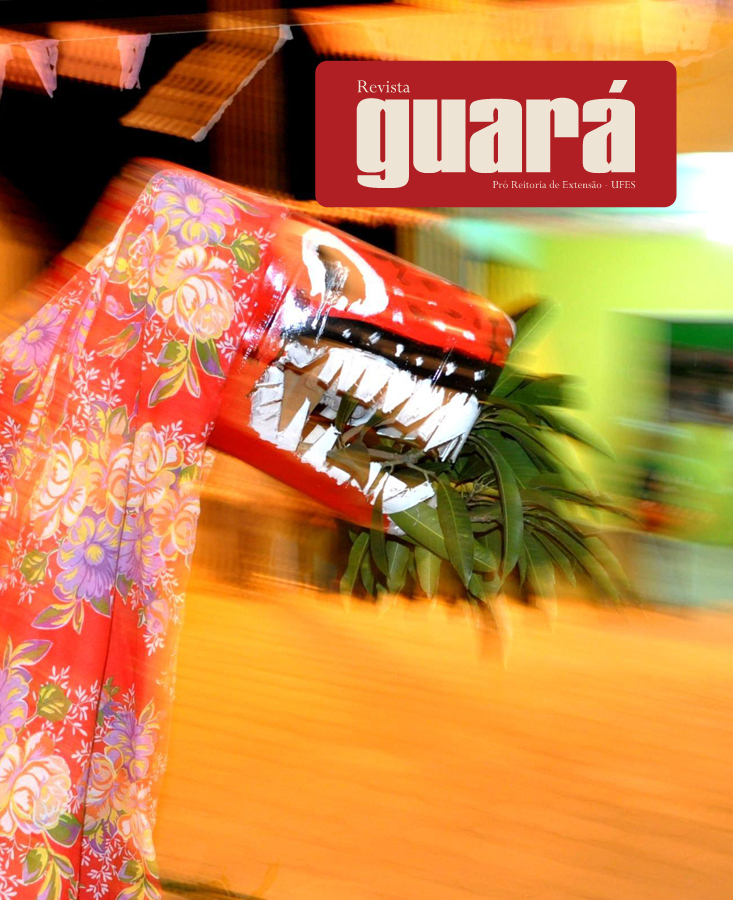
This paper presents a project developed with the community leaders and the members of the “Banda de Congo” in two rural communities, providing aid to the celebrations, assisting the groups in governments cultural prizes, giving workshops, sensitizing and capacitating the leaders in conserve their cultural expressions. The effectiveness of the project happens by meetings, gatherings, interviews and workshops of the memories of Congo, photography and “toadas”, theirs
folk songs. They already achieved three prizes: The “Mestre Armojo do Folclore Capixaba” prize witch 1 awarded a king and a queen of “Banda de Congo”; The “Renato Pacheco” award to acquire adornments, costumes and musical instruments for the adults and childrento perform their presentations in theirs celebrations; both by the Secretary of Culture from the state of Espírito Santo; and, by the Secretary of Citizenship and Cultural Diversity from the federal
Ministry of Culture; The “Cultura Populares - Edição 100 anos de Mazzaropi” prize for the “Banda de Congo”. By the maintenance and development of their culture for the future generations, preserving their immaterial cultural heritage we found the elevation of the “congueiros” self-esteems, creating a dwell environment for the exchange of knowledge and doings, strengthening the community bounds and the solidarity between the dwellers.
Downloads
References
FORPROEX. Fórum de Pró-Reitores de Extensão, 2010.
FREIRE, Paulo. Pedagogia do Oprimido. 15ª edição, Rio de Janeiro: Paz e Terra, 1985.
INSTITUTO DO PATRIMÔNIO HISTÓRICO E ARTÍSTICO NACIONAL (IPHAN). A Trajetória da Salvaguarda do Patrimônio Cultural Imaterial no Brasil: 1936 - 2006. Brasília: Departamento do Patrimônio Imaterial, 2006. Disponível em: http://portal.iphan.gov.br/portal/baixaFcdAnexo.do?id=582. Acesso em 28/04/2015.
LINS, Jacequay. O Congo no Espírito Santo: uma panorâmica musiológica das bandas de congo. Vitória, 2009
NEVES, Guilherme Santos. Coletânea de estudos e registros do folclore capixaba: 1944-1982/Guilherme Santos Neves; seleção, organização e edição de texto: Reinaldo Santos Neves. – Vitória: Centro Cultural de Estudos e Pesquisas do Espírito Santo, 2008.
ORGANIZAÇÃO PARA A EDUCAÇÃO, A CIÊNCIA E A CULTURA DAS NAÇÕES UNIDAS. Disponível em: <http://www.unesco.org/new/pt/brasilia/culture/world-heritage/intangible-heritage/>. Acesso em 28/07/2015.
PIRCHINER, Juliana Casotto. Processos educativos e memórias coletivas na Banda de Congo Piabas/Irundi. 2014, 134 páginas, TCC apresentado ao Centro de Educação da UFES, Vitória, 2014.
ROLDI, Ana Paula Dias Pazzaglini. A educação ambiental nos encontros do Congo com os cotidianos escolares de uma Escola Municipal da Barra do Jucu, Vila Velha/ES. Dissertação. PPGE/CE/UFES, 2014.
SILVA, Oberdan Dias da. O que é extensão universitária? 2007, Disponível em: http://www.ecientificocultural.com/ECC2/artigos/oberdan9.html>. Acesso em 28/04/2015.
Downloads
Published
Issue
Section
License
Copyright (c) 2015 Revista Guará

This work is licensed under a Creative Commons Attribution-NonCommercial-NoDerivatives 4.0 International License.
Revista Guará adopts the Creative Commons Attribution 4.0 International (CC BY 4.0) license, under which authors retain copyright over their submitted and published works.
Authors are responsible for declaring that the submitted manuscript is original, has not been previously published, and is not under simultaneous consideration by another journal. Upon submission, manuscripts undergo a peer review process.
By submitting a manuscript, authors grant Revista Guará the right of first publication, while remaining free to enter into additional non-exclusive distribution agreements for the published version (for example, in institutional repositories, personal websites, or as part of future works), provided that proper credit is given to the authors and to the original publication in the journal.
Revista Guará encourages the broad dissemination of published works, including their availability in institutional repositories and other platforms, as a way to increase the visibility and impact of scientific production.
Under the CC BY 4.0 license, users are allowed to:
- Share — copy and redistribute the material in any medium or format;
- Adapt — remix, transform, and build upon the material for any purpose, including commercial use.
These rights are irrevocable, provided that the following terms are respected:
- Attribution — appropriate credit must be given to the authors, a link to the license must be provided, and any changes made must be indicated. Attribution must be made in a reasonable manner, without suggesting endorsement by the authors or the journal.
The license does not impose additional restrictions. Users may not apply legal terms or technological measures that legally restrict others from exercising the rights granted by the license.