

2.png)






































Aplicación y sistematización del control estadístico de proceso (cep) en una línea de empaque de frutas
- Autores/as
-
-
Diego Jean de Melo
Instituto de Engenharia de Produção e Gestão (IEPG), Universidade Federal de Itajubá (UNIFEI)
Autor/a
-
Laila Alves da Silva
Departamento de Estatística (DEST), Universidade Federal de Minas Gerais (UFMG)
Autor/a
-
Anderson Paulo de Paiva
Instituto de Engenharia de Produção e Gestão (IEPG), Universidade Federal de Itajubá (UNIFEI)
Autor/a
-
Roberto da Costa Quinino
Departamento de Estatística (DEST), Universidade Federal de Minas Gerais (UFMG)
Autor/a
-
- Palabras clave:
- Agricultura, Capacidad de procesamiento, Tabla de control, ficha técnica, Industria 4.0
- Resumen
-
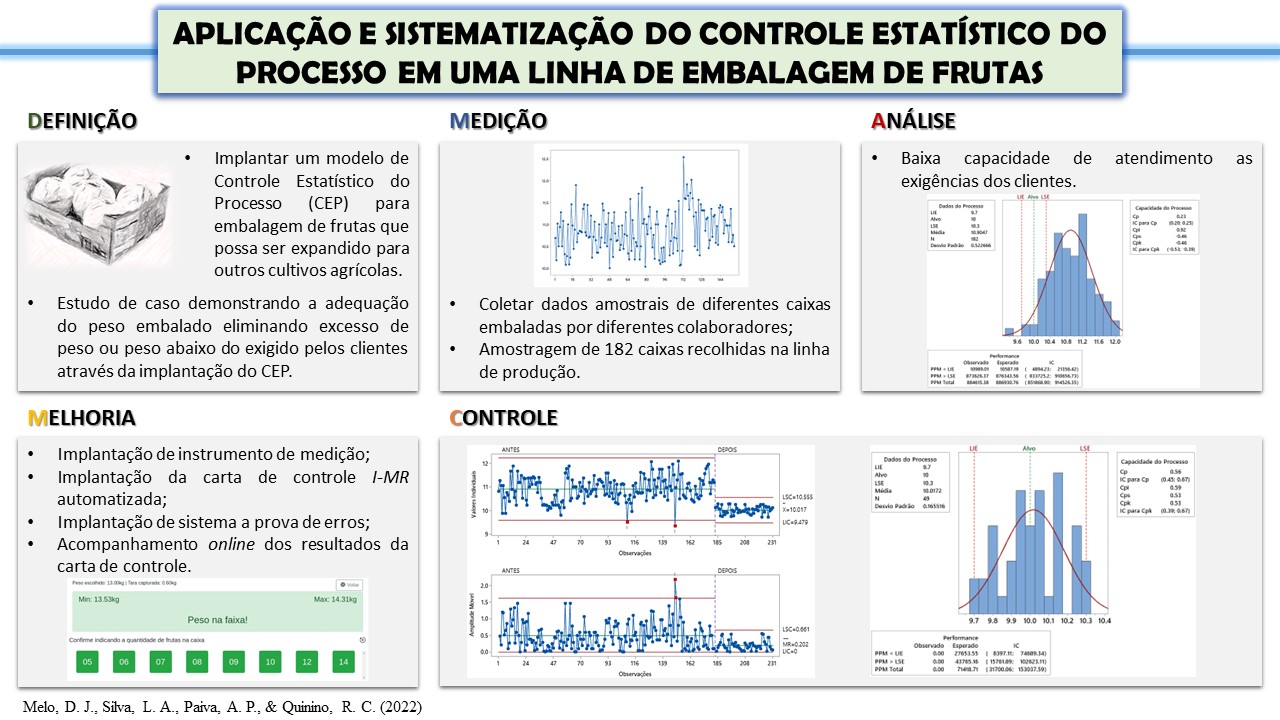
La agricultura es uno de los segmentos más importantes de la economía mundial, responsable de apalancar el PIB de muchos países como China, Brasil, India y Estados Unidos. Con tan gran representatividad, el desarrollo y aplicación de herramientas de mejora en este segmento cobra gran relevancia. En este sentido, este artículo tiene como objetivo presentar la aplicación del Control Estadístico de Procesos (SPC) integrado con el concepto de Industria 4.0 para reducir las pérdidas de proceso en una línea de envasado de una empresa frutícola. De las herramientas que componen el CEP, se integró a un sistema digital y en línea el análisis de capacidad y el cuadro de control I-MR para analizar la adecuación del proceso con las expectativas del cliente. Los resultados de la aplicación del sistema fueron la reducción de la pérdida de paquetes con peso fuera de los estándares de especificación, teniendo una reducción del promedio del peso del paquete en 8.10%, y desviación del promedio del proceso a la meta de solo 0.17% . El proceso también se ha vuelto más robusto, con una reducción de la desviación estándar del 68,33 %. Así, es posible concluir la eficiencia de la aplicación del CEP con un sistema digital para obtener mejores resultados en los procesos agrícolas.
- Biografía del autor/a
- Referencias
-
Abbas, Z., Nazir, H. Z., Akhtar, N., Abid, & M., Riaz, M. (2020). On designing an efficient control chart to monitor fraction nonconforming. Quality and Reliability Engineering International, 36(2), 547–564. https://doi.org/10.1002/qre.2590
Addeh, J., Ebrahimzadeh, A., Azarbad, M., & Ranaee, V. (2014). Statistical process control using optimized neural networks: A case study. ISA Transactions, 53(5), 1489–1499. https://doi.org/10.1016/j.isatra.2013.07.018
American Society for Quality (2000). ANSI/ISO/ASQ 9004-2000. Milwaukee: ASQ Quality Press.
Aslam M., Azam M., Khan N., & Jun C. (2015). A mixed control chart to monitor the process. International Journal of Production Research, 53(15), 4684–4693. https://doi.org/10.1080/00207543.2015.1031354
Casella, G. & Berger, R. L. (1990). Statistical Inference (2ª ed.). Florida: Duxbury Press.
Cheng, C. B. (2005). Fuzzy process control: construction of control charts with fuzzy numbers. Fuzzy sets and Sustems, 154(2), 287-303. https://doi.org/10.1016/j.fss.2005.03.002
Cooksey, R. W. (2020). Illustrating Statistical Procedures: Finding Meaning in Quantitative Data. (3ª ed). Nova Iorque: Springer.
Darestani, S. A., & Nasiri, M. (2016). Statistical process control: Fuzzy X ̅-S control chart and process capability índices in normal data environment. International Journal of Quality & Reliability Management, 33(1), 2-24. https://doi.org/10.1108/IJQRM-08-2013-0130
Deming, W. E. (1986). Out of the Crisis (1ª ed.). Cambridge: Massachusetts Inst Technology.
Faria S., C. E., Jardim, F. S., Camargo, V. C. B., Lizarelli, F. L., & Oprime, P. C. (2020). Unconditional performance of the X ̅ chart: Comparison among five standard deviation estimators. Quality and Reliability Engineering International, 36(5), 1808-1819. https://doi.org/10.1002/qre.2661
Finnerty, P., Provost, L., O’donnell, E., Selk, S., Stephens, K., Kim, J., & Berns, S. (2019). Using Infant Mortality Data to Improve Maternal and Child Health Programs: An Application of Statistical Process Control Techniques for Rare Events. Maternal and Child Health Journal, 23(6), 739–745. https://doi.org/10.1007/s10995-018-02710-3
Fonseca, L. A., Jr., Gomes, L. C. P., Santos, A. G., & Peruchi, R. S. (2019). Análise da percepção da satisfação dos clientes de uma empresa de produtos de máquinas e implementos agrícolas. Brazilian Journal of Production Engineering, 5(3), 1-18. https://doi.org/10.0001/V05N03_01
Haq, A. & Munir, W. (2021). New CUSUM and Shewhart-CUSUM chart for monitoring the process mean. Quality and Reliability Engineering International, 37(8), 3512-3528. https://doi.org/10.1002/qre.2930
Jardim, F. S., Chakraborti, S., & Epprecht, E. K. (2019). X ̅ Chart with Estimated Parameters: The Conditional ARL Distribution and New Insights. Production and Operations Management, 28(6), 1545–1557. https://doi.org/10.1111/poms.12985
Keller, D. S., Paula, T. R., Yu, G., Zhang, H., Al-Mazrou, A., & Kiran, R. P. (2020). Statistical Process Control (SPC) to drive improvement in length of stay after colorectal surgery. The American Journal of Surgery, 219(1), 1006-1011. https://doi.org/10.1016/j.amjsurg.2019.08.029
Kennedy, C. W., Hoffman E. G., & Bond S. D. (1987). Inspection and gaging (6ª ed.). NewYork: Industrial Press Inc.
Khan, M. Z., Khan, M. F., Aslam, M., Akhavan Niaki, S. T., & Mughal, A. R. (2018). A fuzzy EWMA attribute control chart to monitor process mean. Information (Switzerland), 9(12), 1-13. https://doi.org/10.3390/info9120312
Knauer, W. A., Godden, S. M., Dietrich, A., Hawkins, D. M., & James, R. E. (2018). Evaluation of applying statistical process control techniques to daily average feeding behaviors to detect disease in automatically fed group-housed preweaned dairy calves. Journal of Dairy Science, 101(9), 8135-8145. https://doi.org/10.3168/jds.2017-13947
Kottner, J. (2014). The value of Statistical Process Control in quality improvement contexts: Commentary on Unbeck et al. (2013). International Journal of Nursing Studies, 51(1), 346-349. https://doi.org/10.1016/j.ijnurstu.2013.04.011
Kringel, D. H., Dias, A. R. G., Zavareze, E. R., & Gandra, E. A. (2020). Fruit Wastes as Promising Sources of Starch: Extraction, Properties, and Applications. Starch ‐ Stärke, 72(3-4), 1-9. https://doi.org/10.1002/star.201900200
Lee, L. Y., Khoo, M. B. C., Teh, S. Y., & Lee, M. H. (2015). A variable sampling interval synthetic Xbar chart for the process mean. PLoS ONE, 10(5), 1-18. https://doi.org/10.1371/journal.pone.0126331
Lilliefors, H. W. (1967). On the Kolmogorov-Smirnov Test for Normality with Mean and Variance Unknown. Journal of the American Statistical Association, 62, 399-402. https://doi.org/10.2307/2283970
Lim, S. A. H., Antony, J., He, Z., & Arshed, N. (2017). Critical observations on the statistical process control implementation in the UK food industry: A survey. International Journal of Quality & Reliability, 34(5), 684-700. https://doi.org/10.1108/IJQRM-03-2015-0035
Mizaei, N., Niroomand, S., & Zare, R. (2016). Application of statistical process control in service industry. Journal of Modelling in Management, 11(3), 763-782. https://doi.org/10.1108/JM2-06-2014-0046
Montgomery, D. C. (2019). Introduction to Statistical Quality Control (7ª ed.). Nova Jersey: John Wiley & Sons.
Montgomery, D. C. & Runger, G. C. (2020). Applied Statistics and Probability for Engineers (6ª ed.). Nova Jersey: John Wiley & Sons.
Oakland, J. & Oakland, R. (2018). Statistical Process Control (7ª ed.). Nova Iorque: Routledge.
Oliveira, G. D., Santos, J. D., Silva, V. L., & Röder, C. (2018). Aplicação do controle estatístico do processo em uma indústria de autoadesivos. Exacta, 16(2), 135-154. https://doi.org/10.5585/exactaep.v16n2.7340
Peruchi, R. S., Rotela, P., Jr., Brito, T. G., Paiva, A. P., Balestrassi, P. P., & Araújo, L. M. M. (2020). Integrating multivariate statistical analysis into Six Sigma DMAIC projects: A case study on AISI 52100 hardened steel turning. IEEE Access, 8(1), 34246-34255. http://dx.doi.org/10.1109/ACCESS.2020.2973172
Polhemus, N. W. (2017). Process Capability Analysis (1ª ed.). Florida: CRC Press.
Prata, E. R. B. A., Chaves, J. B. P., Gomes, S. G. S., & Passos, F. J. V. (2020). Statistical quality control in the food industry: a risk-based approach. International Journal of Quality & Reliability Management, 38(2), 437-452. https://doi.org/10.1108/IJQRM-08-2019-0272
Raji, I. A., Lee, M. H., Riaz, M., Abujiya, M. R., Abbas, N. A robust multivariate Shewhart chart for contaminated normal environments. Quality and Reliability Engineering International, 37(6), 2665-2684. https://doi.org/10.1002/qre.2882
Riaz M., & Does R. J. M. M. (2009). A process variability control chart. Computational statistics, 24(2), 345–368. https://doi.org/10.1007/s00180-008-0122-z
Ross, J. E. (2017). Total Quality Management: Text, Cases and Readings (3ª ed.). Nova Iorque: Routledge.
Sahay, A. (2017). Process Capability Analysis for Quality and Lean Six Sigma (1ª ed). Nova Iorque: QMS Global LLC.
Shewhart, W. A. (1931). Economic Controlo of Quality of Manufactured Product (1ª ed). Nova Iorque: Van Nostrand.
Shewhart, W. A. (1939). Statistical Method from the Viewpoint of Quality Control (1ª ed). Whashington: Graduate School of the Department of Agriculture.
Soela, D. M., Vitória, E. L., Oliveira, R. F., Crause, D. H., Freitas, I. L. J., & Locatelli, T. (2020). Controle Estatístico de Processo em pulverização usando veículo aéreo não tripulado na cultura do café Conilon. Brazilian Journal of Production Engineering, 6(4), 52-63. https://periodicos.ufes.br/bjpe/article/view/30180/20928
Sower, V. E., Quarles, R., & Broussard, E. (2007). Cost of quality usage and its relationship to quality system maturity. International Journal of Quality & Reliability Management, 24(1), 121–140. https://doi.org/10.1108/02656710710722257
Sutterfield, J. S. & Daramola, T. R. (2016). Using the Tools of Quality to Improve Production Operations at Wilmington Textile. ProQuest, 9(2), 118-133. https://www.proquest.com/scholarly-journals/using-tools-quality-improve-production-operations/docview/2044296482/se-2
Vetter, T. R. & Morrice, D. (2019). Statistical Process Control: No Hots, No Runs, No Errors? Anesthesia and analgesia, 128(2), 374-382. https://doi.org/10.1213/ane.0000000000003977
Wiemken, T. L., Furmanek, S. P., Mattingly, W. A., Wright, M. O., Persaud, A. K., Guinn, B. E., Carrico, R. M., Arnold, F. W., & Ramirez, J. A. (2018). Methods for computational disease surveillance in infection prevention and control: Statistical process control versus Twitter's anomaly and breakout detection algorithms. American Journal of Infection Control, 46(2), 124-132. https://doi.org/10.1016/j.ajic.2017.08.005
Zerbato, C., Furlani, C. E. A., Ormond, A. T. S., Girio, L. A. S., Carneiro, F. M., & Silva, R. P. da (2017) Statistical process control applied to mechanized peanut sowing as a function of soil texture. (Research Article)(Report). PLoS ONE, 12(7), 1-14. https://doi.org/10.1371/journal.pone.0180399
Zhao, F., Chen, L., Xia, T., Ye, Z., & Zheng, Y. (2019). Gas turbine exhaust system health management based on recurrent neural networks. Procedia CIRP, 83, 630–635. https://doi.org/10.1016/j.procir.2019.04.122
Zhou, W., Cheng, C., & Zheng, Z. (2019). Optimal design of an attribute control chart for monitoring the mean of autocorrelated processes. Computers and Industrial Engineering, 137(January), 106081, 2019. http://dx.doi.org/10.1016/j.cie.2019.106081
- Cover Image
-
- Descargas
- Publicado
- 2022-07-06
- Sección
- ENGENHARIA AGRÍCOLA
- Licencia
-
Derechos de autor 2022 Brazilian Journal of Production Engineering

Esta obra está bajo una licencia internacional Creative Commons Atribución 4.0.
Todas las obras publicadas en la Revista Brasileña de Ingeniería de Producción (BJPE) están bajo la licencia Creative Commons Atribución 4.0 Internacional (CC BY 4.0). Esto significa que: Cualquier persona puede copiar, distribuir, exhibir, adaptar, remezclar e incluso utilizar comercialmente el contenido publicado en la revista; Siempre que se reconozca debidamente a los autores y a BJPE como fuente original; No se requiere permiso adicional para la reutilización, siempre que se respeten los términos de la licencia. Esta política cumple con los principios de acceso abierto, promoviendo la amplia difusión del conocimiento científico. 🔗 Haga clic aquí para acceder a la licencia completa.
