

2.png)





































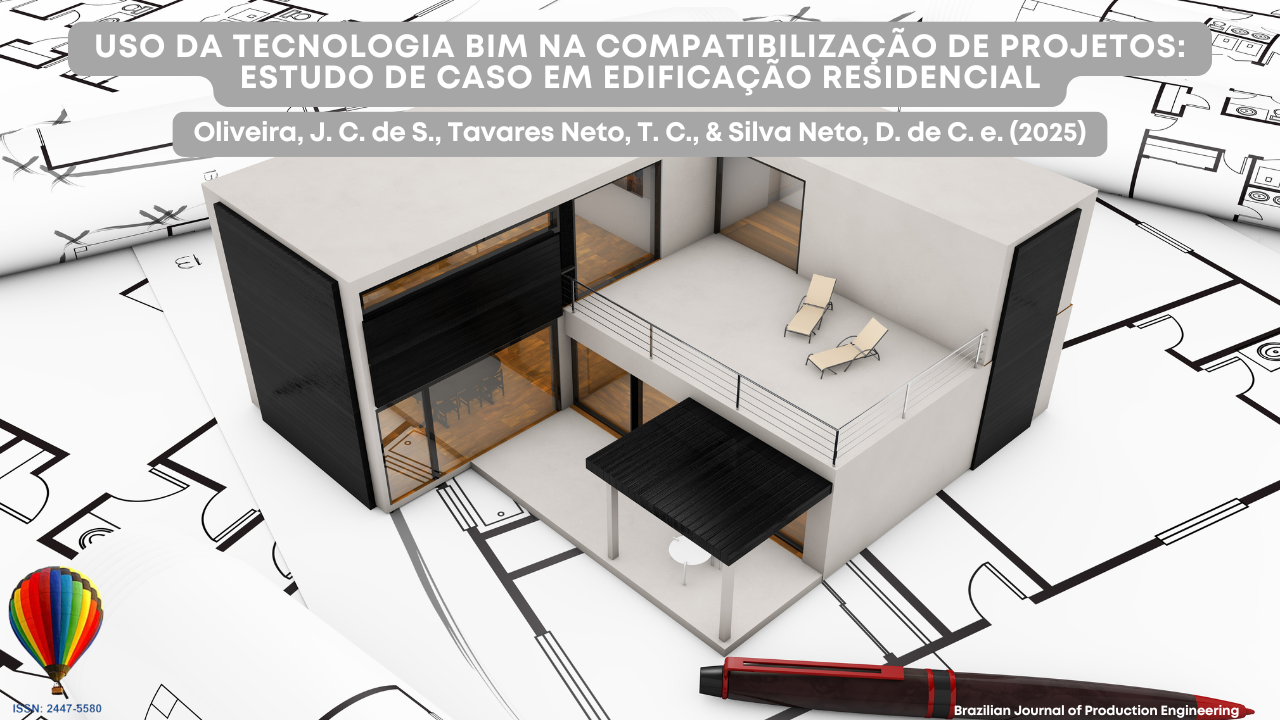
Uso da tecnologia BIM na compatibilização de projetos: estudo de caso em edificação residencial
- Autores
-
-
Jamile Cristine de Souza Oliveira
Universidade Federal do Cariri, Centro de Ciências e Tecnologia
Autor
-
Thayná Cavalcante Tavares
Universidade Federal do Cariri, Centro de Ciências e Tecnologia
Autor
-
Dimas de Castro e Silva Neto
Universidade Federal do Cariri, Centro de Ciências e Tecnologia
Autor
-
- Palavras-chave:
- BIM, Compatibilização de projetos, Interferências
- Resumo
-
A compatibilização de projetos contribui para evitar inconsistências entre disciplinas, mas nem sempre é bem conduzida quando feita com ferramentas bidimensionais. Neste estudo, analisou-se a aplicação da tecnologia BIM (Building Information Modeling) na detecção de interferências entre os projetos arquitetônico, estrutural e hidrossanitário de uma residência unifamiliar. A metodologia incluiu a modelagem dos projetos no software Revit e a análise de conflitos no Navisworks, com uso do recurso Clash Detective. Foram identificadas 72 interferências: 31 entre os elementos arquitetônicos e estruturais, e 41 entre estrutura e instalações hidrossanitárias. Parte dos conflitos foi resolvida com ajustes simples nos modelos, mas alguns, especialmente os relacionados às tubulações, exigiram alterações no traçado e revisão de elementos estruturais. A experiência mostrou que o uso de modelos 3D favorece a antecipação de problemas ainda na fase de projeto, o que pode reduzir retrabalho e facilitar a tomada de decisão técnica. Apesar da análise estar limitada a um único projeto, os resultados obtidos dialogam com estudos anteriores sobre o uso do BIM na construção civil, indicando benefícios práticos para a coordenação de projetos.
- Biografia do Autor
- Referências
-
Associação Brasileira de Normas Técnicas. (2023). NBR 6118:2023 Projeto de estruturas de concreto: procedimento. ABNT.
Aziz, R. M., Nasreldin, T. I., & Hashem, O. M. (2024). The role of BIM as a lean tool in design phase. Journal of Engineering and Applied Science, 71(1), 23. https://doi.org/10.1186/s44147-023-00340-3
Bitaraf, I., Salimpour, A., Elmi, P., & Shirzadi Javid, A. A. (2024). Improved building information modeling based method for prioritizing clash detection in the building construction design phase. Buildings, 14(11), 3611. https://doi.org/10.3390/buildings14113611
Chahrour, R., Hafeez, M. A., Ahmad, A. M., Sulieman, H. I., Dawood, H., Rodriguez-Trejo, S., Kassem, M., Naji, K. K., & Dawood, N. (2021). Cost-benefit analysis of BIM-enabled design clash detection and resolution. Construction Management and Economics, 39(1), 55–72. https://doi.org/10.1080/01446193.2020.1802768
Eldeep, A. (2022). Benefits of integration between lean and BIM in the design and construction phase; Lessons learned. SVU-International Journal of Engineering Sciences and Applications, 3(1), 21–28. https://doi.org/10.21608/svusrc.2022.120081.1029
Harode, A., Thabet, W., & Gao, X. (2024). Developing a machine-learning model to predict clash resolution options. Journal of Computing in Civil Engineering, 38(2), 04024005. https://doi.org/10.1061/JCCEE5.CPENG-5548
Harode, A., Thabet, W., & Leite, F. (2024). Formulation of feature and label space using modified delphi in support of developing a machine-learning algorithm to automate clash resolution. Journal of Construction Engineering and Management, 150(3), 04023173. https://doi.org/10.1061/JCEMD4.COENG-14167
Hartmann, T. (2010). Detecting design conflicts using building information models: A comparative lab experiment. Proceedings of the CIB W78 2010: 27th International Conference on Applications of IT in the AEC Industry (pp. 16–18). Cairo, Egypt: International Council for Research and Innovation in Building and Construction (CIB). Recuperado de https://itc.scix.net/pdfs/w78-2010-57.pdf
Hasannejad, A., Majrouhi Sardroud, J., Shirzadi Javid, A. A., Purrostam, T., & Ramesht, M. H. (2022). An improvement in clash detection process by prioritizing relevance clashes using fuzzy-AHP methods. Building Services Engineering Research and Technology, 43(4), 485–506. https://doi.org/10.1177/01436244221080023
Hasannejad, A., Sardrud, J. M., & Shirzadi Javid, A. A. (2023). BIM-based clash detection improvement automatically. International Journal of Construction Management, 23(14), 2431–2437. https://doi.org/10.1080/15623599.2022.2063014
Hu, Y., & Castro-Lacouture, D. (2019). Clash relevance prediction based on machine learning. Journal of Computing in Civil Engineering, 33(2), 04018060. https://doi.org/10.1061/(ASCE)CP.1943-5487.0000810
Jang, S., & Lee, G. (2018). Impact of organizational factors on delays in BIM-based coordination from a decision-making view: A case study. Journal of Civil Engineering and Management, 24(1), 19–30. https://doi.org/10.3846/jcem.2018.296
Jowett, B., Al Hattab, M., & Kassem, M. (2018). Demystifying collaboration in BIM-based projects under design-build procurement: Clash detection as a use value. In B. Kumar (Ed.), Contemporary strategies and approaches in 3-D information modeling (pp. 158-190). IGI Global Scientific Publishing. https://doi.org/10.4018/978-1-5225-5625-1.ch007
Juszczyk, M., Wieczorek, D., Pacyno, H., & Dzienniak, A. (2023). Clash detection based on IFC/BIM models – Case studies process parameterization. Proceedings of the 6th IPMA SENET Project Management Conference “Digital Transformation and Sustainable Development in Project Management”, 110–126. https://doi.org/10.5592/CO/SENET.2022.8
Kermanshahi, E. K., Tahir, M. B. M., Shukor Lim, N. H. A., Balasbaneh, A. T., & Roshanghalb, S. (2020). Implementation of building information modeling for construction clash detection process in the design stage: A case study of malaysian police headquarter building. IOP Conference Series: Earth and Environmental Science, 476(1), 012009. https://doi.org/10.1088/1755-1315/476/1/012009
Lin, W. Y., & Huang, Y.-H. (2019). Filtering of irrelevant clashes detected by BIM software using a hybrid method of rule-based reasoning and supervised machine learning. Applied Sciences, 9(24), 5324. https://doi.org/10.3390/app9245324
Liu, X., Zhao, J., Yu, Y., & Ji, Y. (2024). BIM-based multi-objective optimization of clash resolution: A NSGA-II approach. Journal of Building Engineering, 89, 109228. https://doi.org/10.1016/j.jobe.2024.109228
Mayer, P., Funtík, T., & Honti, R. (2022). MEP coordination and clash management in BIM and common data environment. Czech Journal of Civil Engineering, 8(2), 54–63. https://doi.org/10.51704/cjce.2022.vol8.iss2.pp54-63
Meem, T. M., & Iordanova, I. (2023). Overcoming obstacles in BIM-based multidisciplinary coordination: A literature overview. In R. Gupta, M. Sun, S. Brzev, M. S. Alam, K. T. W. Ng, J. Li, A. El Damatty, & C. Lim (Org.), Proceedings of the Canadian Society of Civil Engineering Annual Conference 2022 (V. 363, p. 637–654). Springer International Publishing. https://doi.org/10.1007/978-3-031-34593-7_39
Motiejunas, V. (2016). Improving the MEP coordination using BIM technologies: A case study based on observations and interviews (Master’s thesis, Chalmers University of Technology, Gothenburg, Sweden). Chalmers University of Technology. Recuperado de https://publications.lib.chalmers.se/records/fulltext/244829/244829.pdf
Pérez, Y., Ávila, J., & Sánchez, O. (2024). Influence of BIM and Lean on mitigating delay factors in building projects. Results in Engineering, 22, 102236. https://doi.org/10.1016/j.rineng.2024.102236
Seo, Jung-Ho, Lee, Baek-Rae, Kim, JuHyong, & Kim, Jae-Jun. (2012). Collaborative process to facilitate BIM-based clash detection tasks for enhancing constructability. Journal of the Korea Institute of Building Construction, 12(3), 299–314. https://doi.org/10.5345/JKIBC.2012.12.3.299
Wong, J. K. W., Zhou, J. X., & Chan, A. P. C. (2018). Exploring the linkages between the adoption of BIM and design error reduction. International Journal of Sustainable Development and Planning, 13(01), 108–120. https://doi.org/10.2495/SDP-V13-N1-108-120
- Cover Image
-
- Downloads
- Publicado
- 22.09.2025
- Seção
- ENGENHARIA ORGANIZACIONAL
- Licença
-
Direitos autorais (c) 2025 Oliveira, J. C. de S., Tavares Neto, T. C., & Silva Neto, D. de C. e.

Este trabalho está licenciado sob uma licença Creative Commons Attribution 4.0 International License.
Qualquer pessoa pode copiar, distribuir, exibir, adaptar, remixar e até utilizar comercialmente os conteúdos publicados na revista; Desde que sejam atribuídos os devidos créditos aos autores e à BJPE como fonte original; Não é exigida permissão adicional para reutilização, desde que respeitados os termos da licença. Esta política está em conformidade com os princípios do acesso aberto, promovendo a ampla disseminação do conhecimento científico. 🔗 CC BY 4.0
