






























Study of temporal variability on sugarcane production in the municipality of Pedras de Fogo, Paraíba (2003-2024)

Authors

  • Raíres Liliane de Oliveira Cruz Universidade Federal de Campina Grande, Programa de Pós-Graduação em Engenharia Agrícola, Campina Grande-Paraíba Author https://orcid.org/0009-0008-2542-8771
  • Wemerson Leonardo Cruz da Silva Universidade Federal da Paraíba, Programa de Pós-Graduação Em Ciência do Solo, João Pessoa- Paraíba Author
  • Ana Cecília da Rocha Oliveira Universidade Federal da Paraíba - UFPB Author https://orcid.org/0009-0009-9625-6839
  • Renato Isidro Universidade Federal de Campina Grande Author
  • Maria Luana Lima Ferreira Universidade Federal do Vale do São Francisco – UNIVASF Author https://orcid.org/0009-0009-2332-3391
  • Welinagila Grangeiro de Sousa Pesquisadora Bolsista-PCI no Instituto Nacional do Semiárido Author
  • Luiz Henrique Guedes Sousa Universidade Federal da Paraíba - UFPB Author https://orcid.org/0009-0005-3236-3564
  • Maria Eduarda Bezerra Alves Cordeiro Universidade Federal Rural do Semi-Árido - UFERSA Author
  • João Nathan Silva Universidade Federal Rural do Semi-Árido - UFERSA Author
  • Robério de Oliveira Secretaria de Estado da Educação, do Esporte e do Lazer do RN Author https://orcid.org/0000-0002-4590-9934
  • Wanderlecio Rodrigues da Silva Universidade Federal da Paraíba - UFPB Author
  • Jheison Yan Santana da Silva Universidade Federal da Paraíba - UFPB Author https://orcid.org/0009-0002-1441-029X
  • Anne Kétyla Monte Diógenes Universidade Federal da Paraíba (UFPB), Ciências Biológicas Author https://orcid.org/0009-0003-3987-3079
  • Roberto Balbino da Silva Associação de Plantadores de Cana da Paraíba Author https://orcid.org/0000-0003-4105-7858
  • Ana Caroline da Silva Soares Universidade Estadual da Paraíba - UEPB Author https://orcid.org/0009-0007-7642-5020
  • Rhaldney Felipe de Santana Centro de Ciências Agrárias, UFPB Author https://orcid.org/0000-0002-2945-5143
  • Philipe Mendes de Andrade Universidade Federal da Paraíba - UFPB Author
  • Elder da Silva Velez Universidade Federal de Pernambuco - UFPE Author
  • Francisco de Assys Romero da Mota Sousa Universidade Federal de Pernambuco - UFPE Author
  • Helder Francisco Santana Nobrega Faculdade Rebouças, Gestão de Recursos Humanos, Author
  • Pablo Ferreira da Silva Universidade Federal Rural do Semi-Árido - UFERSA Author https://orcid.org/0000-0001-8939-3637
  • Emanuele Lucas Moura Universidade Federal Rural do Semi-Árido - UFERSA Author https://orcid.org/0009-0003-0100-0619
  • Daise Feitoza da Rocha Universidade Federal Rural do Semi-Árido - UFERSA Author https://orcid.org/0000-0001-9998-8191
  • Wesley Silva de Lacerda Universidade Federal do Vale do São Francisco – UNIVASF Author
  • Khyson Gomes Abreu Universidade Federal da Paraíba - UFPB Author https://orcid.org/0000-0002-3439-6598
  • Artur Mineu da Silva Barbosa Universidade Federal do Agreste de Pernambuco (UFAPE) Author https://orcid.org/0009-0009-7633-8925
  • Vitor Mineu Silva Barbosa Universidade Federal do Agreste de Pernambuco - UFAPE Author https://orcid.org/0009-0007-4009-7248
  • José Matheus Gonzaga Santos Universidade Federal do Agreste de Pernambuco - UFAPE Author https://orcid.org/0009-0001-6339-9077
  • Izamara Gesiele Bezerra de Oliveira State University of Paraíba (UEPB) Author https://orcid.org/0000-0002-6066-359X

DOI:

https://doi.org/10.47456/bjpe.v11i4.48838

Keywords:

Agricultural production, Productive dynamics, Saccharum officinarum

Abstract

Sugarcane plays an important role in the agricultural economy of Pedras de Fogo, Paraíba, contributing to the economy in terms of generating jobs and income in the region. However, its production has been affected by challenges such as climate variations and traditional agricultural practices. The objective of this study was to analyze the productive dynamics of sugarcane in the municipality of Pedras de Fogo, PB, between 2004 and 2023, seeking to understand the factors that influence this production chain and offer subsidies for local development actions. The methodology consisted of analysis through a database, evaluating the variables: planted area, harvested area, quantity produced, productivity and production value. The results revealed a significant reduction in the cultivated area, which went from approximately 30.000 hectares (ha), in 2004 to approximately 18.000 ha in 2023, with emphasis on 2019, which presented the lowest production. Despite the reduction in area, a trend towards increased production was observed, reflected in the stability of productivity throughout much of the period. Therefore, to ensure the sustainability of the activity, it is necessary to invest in more efficient agricultural practices, adoption of technologies, adequate irrigation management and strengthening of public policies that support local producers.

Downloads

Download data is not yet available.

Author Biographies

  • Raíres Liliane de Oliveira Cruz, Universidade Federal de Campina Grande, Programa de Pós-Graduação em Engenharia Agrícola, Campina Grande-Paraíba

    Master's student - PPGEA– UFCG (CAPES scholarship recipient), Agroecologist, at the State University of Paraíba (UEPB). Undergraduate student in Agronomy, at the State University of Paraíba (UEPB). Master's student in Agricultural Engineering, at the Federal University of Campina Grande, area of ​​concentration: Irrigation and Drainage. Scientific Initiation scholarship recipient. Participation in the extension project: Socio-environmental education and health practices for the improvement of animal welfare (2019-2020), Participation in the PIBIC project: Application of Levels of Algae-Based Fertilizer on the Production and Quality of Pineapple Fruits (Ananas comosus var. comosus) cv. Pérola (2020-2021). Research Projects in the PIBIC program: Production and quality of curly lettuce (vc. Grand Rapids) grown in different conductivity nutrient solutions and coconut fiber (2021-2022). Research Projects in the PIBIC program: Nutrient solutions and coconut fiber in the production and quality of semi-hydroponic strawberries (Fragaria x Ananassa Duch) (2022-2023).

  • Wemerson Leonardo Cruz da Silva, Universidade Federal da Paraíba, Programa de Pós-Graduação Em Ciência do Solo, João Pessoa- Paraíba

    He holds a Bachelor's degree in Agricultural Sciences from the Federal Institute of Education, Science and Technology of Maranhão (IFMA/Campus Codó) and is currently pursuing a Master's degree in Soil Science at the Federal University of Paraíba (UFPB). He has extensive scientific production, with publications in national and international journals and events, addressing topics such as environmental education, teacher training, agricultural sciences/soil science, and artificial intelligence applied to education. He works as a researcher in the Interdisciplinary Research Group in Education, Health and Environment (GPIESMA/IFMA/CNPQ). He has experience in the areas of environmental education, agricultural sciences and soil science, as well as the use of artificial intelligence in education, mainly working on the topics of soil fertility and plant nutrition, environmental education and family farming, and teacher training.

  • Ana Cecília da Rocha Oliveira, Universidade Federal da Paraíba - UFPB

    She holds a high school diploma from the State University of Paraíba and a technical degree in agriculture (2017). She graduated in agronomy from the State University of Paraíba and is currently pursuing a Master's degree at the Federal University of Paraíba. She also completed supplementary training as an operator of agricultural machinery and implements through Paraibatec.

  • Renato Isidro, Universidade Federal de Campina Grande

    Associate Professor II at UFCG/CDSA, with a degree in Agronomy from the Federal University of Paraíba (1994), a master's degree in Agronomy (Phytotechnics) from the Federal University of Ceará (1996), a doctorate in Biochemistry from the Federal University of Ceará-UFC (2002), and a post-doctorate from the Federal University of Paraíba-UFPB (2020). Currently, he is a professor at the Federal University of Campina Grande, Sumé Campus, in the Center for Sustainable Development of the Semi-arid Region, where he teaches the subjects of Introduction to Agroecology, General Entomology, Agroecological Pest Management, Laboratory for the Production of Agroecological Pesticides, Agroecology Applied to Fruit Tree Cultivation, and Soil Physical Chemistry. She has experience in the field of Biochemistry, with an emphasis on Proteins, mainly working in the following areas: research and development projects in the areas of Agroecological Management for pest control and goat milk quality.

  • Maria Luana Lima Ferreira, Universidade Federal do Vale do São Francisco – UNIVASF

    I am a 9th-semester undergraduate student in Agronomic Engineering at the Federal University of the São Francisco Valley (UNIVASF). A constant learner fascinated by entomology, I currently contribute to the Instagram page "Mundo dos Insetos" (World of Insects), where I make weekly posts about the class Insecta, its biodiversity, and importance. I have experience as a teaching assistant in Agricultural Entomology (General and Applied Entomology), where I worked for two consecutive semesters, developing skills such as leadership, organization, and responsibility in assisting students in the laboratory/field. Furthermore, I had the opportunity to participate as a volunteer in the SUFICA project (Sustainable Fruit Farming in the Caatinga: managing ecosystem service trade-offs as agriculture intensifies), studying sustainable management and biodiversity protection on fruit farms in the Caatinga biome. I have completed a supervised internship at the Sertão Myrmecology Laboratory (CEMAFAUNA-UNIVASF), where I performed laboratory/field activities including identification, handling, collection, monitoring, and surveying of pests and natural enemies, as well as maintenance/conservation of entomological collections.

  • Welinagila Grangeiro de Sousa, Pesquisadora Bolsista-PCI no Instituto Nacional do Semiárido

    Graduated in Biosystems Engineering from the Federal University of Campina Grande (2018), with a gradual training in Engineering as her first area of ​​expertise. Master's degree in Meteorology, with a concentration in Meso and Large Scale Meteorology from the Federal University of Campina Grande (2020). PhD in Meteorology from the Federal University of Campina Grande (2024). Bachelor's degree in Mathematics from the UNIFAEL University Center (2021). Currently, she is a PCI scholarship holder at the National Institute of the Semi-Arid (INSA), working in the Geoprocessing sector of the Science Management and Popularization Center. She has experience in the areas of Climatology, descriptive and multivariate statistical analysis, Geoprocessing and Remote Sensing (QGIS).

  • Luiz Henrique Guedes Sousa, Universidade Federal da Paraíba - UFPB

    Currently pursuing a degree in Agronomy at the Center for Agricultural Sciences of the Federal University of Paraíba. Holds a diploma as an Agricultural Technician, completed entirely alongside high school, from the Federal Institute of Ceará, Iguatu Campus. Has a strong affinity for the area of ​​Animal Science, particularly in the branches of Forage Production, Feed Formulation, and Animal Production. In Agronomy, has a strong affinity for the areas of Soil Science and Phytotechnics, with emphasis on the study of Soil Fertility, Interpretation of Soil Analyses, and Recommendation of Soil Amendments and Fertilization. https://lattes.cnpq.br/9115813624162931

  • Maria Eduarda Bezerra Alves Cordeiro, Universidade Federal Rural do Semi-Árido - UFERSA

    Agronomy student, working on research related to the interaction of abiotic factors (water and saline stress) in plant development and phytology. Additionally, has experience in hydroponic plant cultivation, focusing on plant nutrition.

  • João Nathan Silva, Universidade Federal Rural do Semi-Árido - UFERSA

    Holds a technical-professional degree in Agriculture from the Federal Institute of Education, Science and Technology of Rio Grande do Norte (2020) and completed primary education at Colégio Nossa Senhora da Conceição (2016). Has experience in the field of Agronomy, with an emphasis on plant cultivation under stress conditions and plant physiology.

  • Robério de Oliveira, Secretaria de Estado da Educação, do Esporte e do Lazer do RN

    Agricultural Technician from the Vidal de Negreiros Agricultural College/CAVN. Holds a Bachelor's degree in Biological Sciences, with a Master's and Doctorate in Agronomy from the Federal University of Paraíba/UFPB. He is a reviewer for national and international journals. His research focuses on integrated pest management, with an emphasis on biological control: entomopathogenic fungi, parasitoids, and predators. His main research interests include: fungi in the control of fruit flies; Encarsia hispida in the control of whiteflies; Ceraeochrysa cubana, Pygidicrana v-nigrum, and Euborellia annulipes controlling blackflies, fruit flies, and aphids, respectively.

  • Wanderlecio Rodrigues da Silva, Universidade Federal da Paraíba - UFPB

    Currently pursuing a degree in Biological Sciences at the Federal University of Paraíba (UFPB). Holds a degree in Mining Technician from the Federal Institute of Education, Science and Technology of Paraíba (IFPB), with integrated high school education. Has been a Scientific Initiation scholarship recipient (PIBIC/UFPB) since 2023, currently developing the project "Population dynamics of fruit flies (Diptera: Drosophilidae: Zaprionus) and parasitoids in domestic and commercial orchards" (2024/2025). Intern at the Invertebrate Laboratory (LABIN/CCA/UFPB), focusing on the rearing of pest insects for research in biological control. Volunteered in the Tutorial Education Program PET AgroBio in 2023, participating in research, teaching, and extension activities. Has experience in fieldwork, extension projects, scientific communication (audio and image), and participation in research groups. He has an interest in the areas of Forensic Entomology and Criminalistics.

  • Jheison Yan Santana da Silva, Universidade Federal da Paraíba - UFPB

    Graduating in Agronomy from the Federal University of Paraíba (UFPB), Center for Agricultural Sciences (CCA), Campus II, Areia - PB. Currently, a Computer Technician at the Federal Institute of Education, Science and Technology of Ceará (IFCE), Crato Campus - CE. Volunteer in the Extension Program (PROEX), started in 2023, entitled: Rural Environmental Registry: Assistance to small rural properties of low-income families, located in the municipality of Alagoa Grande, Paraíba. Also a volunteer in PROEX, started in 2023, entitled: Development of a Fruit Growing Manual for family farmers in the microregion of the Paraíba wetlands.

  • Anne Kétyla Monte Diógenes, Universidade Federal da Paraíba (UFPB), Ciências Biológicas

    Holds a Bachelor's degree in Biological Sciences from the Center for Agricultural Sciences of the Federal University of Paraíba (CCA/UFPB). She worked as a Scientific Initiation scholarship recipient (PIBIC-CNPq) between 2022 and 2024, focusing on projects in the field of Entomology. In 2025, she was a scholarship recipient from the Accessibility Committee of CIA-UFPB, acting as a support student, and volunteered as a monitor for the General Microbiology course. During her undergraduate studies, she was part of the Invertebrate Laboratory at CCA/UFPB, developing research activities. Currently, she is a Master's student in Entomology at the Federal Rural University of Pernambuco (UFRPE), working in the Biological Control Laboratory, where she conducts research focused on the study and management of insects of agricultural importance. Her main interest lies in Entomology, with an interdisciplinary approach across various areas of Biological Sciences.

  • Roberto Balbino da Silva, Associação de Plantadores de Cana da Paraíba

    Bachelor's and Licentiate degrees in Biological Sciences (2011) from the Vale do Acaraú State University (UVA). Specialization in Environmental Sciences (2015) from the Integrated Center for Technology and Research of Paraíba (CINTEP PB). Graduated in Agricultural Sciences (2019) from the Federal University of Paraíba (UFPB). Master's degree in Agricultural Sciences - Agroecology (PPGCAG) from the Federal University of Paraíba (UFPB). Doctorate in Agronomy from the Federal University of Paraíba (UFPB). Agribusiness Technician, Senar-PB 2022. Administrative Supervisor in Bioinput Production at the Association of Sugarcane Planters of Paraíba (ASPLAN); responsible for the production of entomopathogenic fungi and the parasitoid Cotesia flavipes, from 2004 to the present day. Volunteer Professor at the Federal University of Paraíba (CCHSA) 2023; Professor at Agroadvance (2024 and 2025), teaching the subjects Sugarcane Pests and Sugarcane Pest Management. Professor at EBPÒS Brazilian School of Postgraduate Studies (2025), teaching Agricultural Entomology and Integrated Pest Management. Guest professor at the Federal Institute of Goiás (Specialization Course in Bioinputs) 2024. ON FARM consultant, for the implementation of Biofactories, fungus production, field assistance on integrated pest management (IPM), as well as guiding producers and the general public on pest management.

  • Ana Caroline da Silva Soares, Universidade Estadual da Paraíba - UEPB

    Undergraduate student in Agronomy at the State University of Paraíba. Experience in scientific initiation projects using vitreous microparticles in cowpea. Part of the Agrobiodiversity of the Semi-Arid research team.

  • Rhaldney Felipe de Santana, Centro de Ciências Agrárias, UFPB

    Holds a degree in Biological Sciences with an emphasis in Environmental Sciences and a Master's degree in Development and Environment from the Federal University of Pernambuco. Currently a PhD candidate in Environmental Engineering at the Federal Rural University of Pernambuco. Experience in research projects on sustainability in the primary sector and sustainable development. Member of the Environmental Management Group in Pernambuco at the Federal Rural University of Pernambuco.

  • Philipe Mendes de Andrade, Universidade Federal da Paraíba - UFPB

    Technician in Agribusiness and Animal Husbandry from the National Rural Learning Service of Paraíba (SENAR-PB). Currently pursuing a degree in Agronomy at Faculdade Rebouças. Works as an Agricultural Technician, with experience in animal production, pig farming, sustainability, innovation, and leadership in agriculture. Participant in the CNA Jovem program, aimed at training young leaders in the Brazilian agricultural sector. Develops projects focused on integrating technology, management, and sustainability in rural production, with an emphasis on strengthening pig farming and the socioeconomic development of the countryside.

  • Elder da Silva Velez, Universidade Federal de Pernambuco - UFPE

    Agricultural Technician - Graduated from the Federal Agrotechnical School of Barreiros - 2005. Currently studying Agronomy at Faculdade Rebouças in Campina Grande/PB (3rd semester). http://lattes.cnpq.br/3736685001265987

  • Francisco de Assys Romero da Mota Sousa, Universidade Federal de Pernambuco - UFPE

    Brief Biography: PhD in Agronomy from the Postgraduate Program in Agronomy at the Federal University of Paraíba. Member of the Post-Harvest Biology and Technology Laboratory at the Federal University of Paraíba, holding a PROBEX/PROEXT scholarship, participating in projects emphasizing technological innovation, as well as the valorization of native fruits from the semi-arid region and the use of biodegradable coatings in the post-harvest conservation of fruits. Currently coordinator of the Agronomy course at Faculdade Rebouças in Campina Grande, PB. https://lattes.cnpq.br/3157999958676291

  • Helder Francisco Santana Nobrega, Faculdade Rebouças, Gestão de Recursos Humanos,

    Helder Francisco Santana Nobrega holds a degree in Human Resources Management. He works as a teaching assistant for the Animal Nutrition course, directly involved in teaching and pedagogical support activities. He is a researcher in the Animal Production Systems Study Group (GESPA), developing studies focused on animal production and performance. He participates in the Forage Crops Study Group (GEFOR), deepening his knowledge in pasture management and ruminant feeding. He has experience in organizing scientific and academic events, participating in planning and execution committees. He also gives lectures in the area of ​​animal production, contributing to the dissemination and popularization of technical and scientific knowledge. http://lattes.cnpq.br/1360858535084950

  • Pablo Ferreira da Silva, Universidade Federal Rural do Semi-Árido - UFERSA

    Graduated in Agronomy from the Federal Rural University of the Semi-Arid Region - UFERSA (2023). Currently a Master's student in the Postgraduate Program in Environment, Technology and Society - PPGATS/UFERSA. Works in the research area of ​​seed technology for agricultural and forestry species, developing work with native Caatinga seeds on the following topics: abiotic stresses in germination, seed vigor, and the use of attenuators in mitigating abiotic stresses. http://lattes.cnpq.br/0701949847375556

  • Emanuele Lucas Moura, Universidade Federal Rural do Semi-Árido - UFERSA

    She holds a Bachelor's degree in Agronomy from the Federal Institute of Ceará - Limoeiro do Norte campus (2022) and a Technical degree in Agriculture from the same institution (2023). She is currently a Master's student in the Phytotechnics Graduate Program at the Federal Rural University of the Semi-Arid Region (UFERSA), working in the research area of ​​seed technology. http://lattes.cnpq.br/1517480008167110

  • Daise Feitoza da Rocha, Universidade Federal Rural do Semi-Árido - UFERSA

    Possui graduação em Engenharia Agronômica pela Universidade do Estado da Bahia (2022). Foi bolsista de iniciação científica - CNPq / PICIN (2018-2021). Tem experiência na área de Agronomia, com ênfase em Agrometeorologia. É mestre em Fitotecnia pela Universidade Federal Rural do Semi-Árido (UFERSA), com pesquisa na subárea de Tecnologia de Sementes, e atualmente é doutoranda no Programa de Pós-Graduação em Fitotecnia da mesma instituição, com pesquisa na subárea de Propagação Vegetativa e Fruticultura. Atua também como bolsista no Programa MAI/DAI (Mestrado e Doutorado Acadêmico para Inovação), desenvolvendo pesquisa aplicada em parceria com o setor produtivo, com foco na utilização de remineralizadores na fruticultura do Semiárido. http://lattes.cnpq.br/2412294663219151

  • Wesley Silva de Lacerda, Universidade Federal do Vale do São Francisco – UNIVASF

    Undergraduate student in Agronomic Engineering at the Federal University of the São Francisco Valley (UNIVASF). Conducts research in Entomology, focusing on the insecticidal action of saponins from native Caatinga plants for pest control. Has taught a workshop on the production of entomological boxes. Interested in insect ecology and sustainable pest management. https://lattes.cnpq.br/5483600415376420

  • Khyson Gomes Abreu, Universidade Federal da Paraíba - UFPB

    Agroecologist from the Center for Sustainable Development of the Semi-Arid Region, Federal University of Campina Grande (UFCG), Sumé Campus (2018), with a specialization in Development and Environment from the Federal Institute of Paraíba (IFPB) (2023). Holds a Master's degree in Agronomy from the Federal University of Paraíba (UFPB) (2021) and a Doctorate in Agronomy from the Federal University of Paraíba (UFPB) (2024), in the area of ​​concentration in Tropical Agriculture, working in the research line in Biotechnology, Improvement and Protection of Cultivated Plants, emphasis on Agricultural Entomology. Has experience in the area of ​​Insect Bioecology, Biological and alternative control of insect pests, Integrated Pest Management and insect rearing in the laboratory. Currently studying Agronomy at the State University of Paraíba and a technical degree in Agribusiness from SENAR-PB. http://lattes.cnpq.br/5479214127683294

  • Artur Mineu da Silva Barbosa, Universidade Federal do Agreste de Pernambuco (UFAPE)

    Undergraduate student in the Bachelor's degree program in Animal Science (2020-) at the Federal University of Agreste of Pernambuco (UFAPE). Currently, a scholarship holder in the Tourism Education Program of the Knowledge Connections, Popular and Quilombola Communities group (PET-CS/FNDE) (2022-), with ongoing research in the area of ​​wild animals and environmental education in rural properties, quilombola and popular communities. Also has ongoing research in the area of ​​nutrition and behavior of wild animals. Participant in the Forage and Biotechnology Center (NFB) (2022-) at UFAPE, with research in the area of ​​forage plants and plant growth-promoting bacteria. Was a BIC FACEPE scholarship holder for 2 years (2022-2024), with research in Road Ecology. Was a scholarship monitor in the subject of Technical Drawing for 1.5 years (2020-2021) at UFAPE. Participated in the Interdisciplinary Experiential Activities Program (PAVI) at UFAPE, in the subject of Plant Physiology for one academic semester (2022). Selected for and participated in the International Exchange Program during high school through the "Ganhe o Mundo" (Win the World) program (2019), traveling to Spain and studying for one semester at the Instituto Valdelagrana school in El Puerto de Santa Maria, in the province of Cadiz. Took courses involving Spanish and basic computer skills. https://lattes.cnpq.br/0610293653322495

  • Vitor Mineu Silva Barbosa, Universidade Federal do Agreste de Pernambuco - UFAPE

    Adjunct Professor at the Federal University of Agreste of Pernambuco (UFAPE - 2020), currently pursuing a Bachelor's degree in Agronomic Engineering at UFAPE, member and scholarship recipient (FNDE) of the Tutorial Education Program "Connections of Knowledge, Popular and Quilombola Communities" (PET-CS) at UFAPE, and research student at the forage and biotechnology laboratory at UFAPE, working with an emphasis on growth-promoting bacteria associated with grasses and molecular extraction, was a member of the Academic Board of the Agronomy course in the 2022.1 and 2023.1 academic semesters at UFAPE. http://lattes.cnpq.br/4065804515047384

  • José Matheus Gonzaga Santos, Universidade Federal do Agreste de Pernambuco - UFAPE

    Currently pursuing a Bachelor's degree in Agronomy at the Federal University of Agreste of Pernambuco (UFAPE 2020), he conducts research at the Forage and Biotechnology Center, focusing on the inoculation of plant growth-promoting bacteria. He is a member and scholarship recipient of the Tutorial Education Program (PET) "Connections of Knowledge: Popular and Quilombola Communities" at UFAPE. He was a member of the Academic Board of the Agronomy course from 2022 to 2023.1 at UFAPE. https://lattes.cnpq.br/5057945177014739

  • Izamara Gesiele Bezerra de Oliveira, State University of Paraíba (UEPB)

    Bachelor in Biological Sciences from the State University of Paraíba (2021), and degree in Biology from the Cruzeiro do Sul University (2023), Master in Agricultural Sciences from the Postgraduate Program in Agricultural Sciences (PPGCA) from the State University of Paraíba (UEPB/ Embrapa), linked to the UEPB Plant Biotechnology Laboratory. She also has a Specialization in Natural Sciences, its Technologies and the World of Work or from the Center for Open and Distance Education/UFPI. During her undergraduate studies, she received a Scientific Initiation scholarship (CAPES/CNPq), with experience in the selection of bacteria that promote plant growth under a mitigating effect on red rice under conditions of water deficiency and performed University Monitoring activities in the disciplines of Plant Morphology and Plant Physiology. During the Master's degree, she gained experience with in silico modeling and protein interaction networks in order to understand the interaction between bacteria and plants, whose dissertation topic was: In silico modeling of the gene and its interaction network in Gluconacetobacter diazotrophicus PAL5. Currently, she works as a teacher in the subjects of Science, Biology and Chemistry in Elementary School - Final Years.

References

Agroclima. (2025). Defensivos agrícolas evitam perdas econômicas causadas pela broca-da-cana-de-açúcar. Recuperado de https://agroclima.climatempo.com.br/noticia/2024/10/24/defensivos-agricolas-evitam-perdas-economicas-causadas-pela-broca-da-cana-de-acucar

Andrade, V. A. de. (2022) Desempenho produtivo de cana-de-açúcar sob uso de bioestimulante no brejo paraibano. Trabalho de Conclusão de Curso (Graduação em Agronomia), Universidade Federal da Paraíba, Areia. Recuperado de https://repositorio.ufpb.br/jspui/handle/123456789/30455

Araújo, D. & Araújo Sobrinho, F. (2020). A cultura agrícola da cana-de-açúcar no Brasil: Contribuição ao estudo dos territórios rurais e suas contradições e conflitos. Geopauta, 4(1), 162. http://doi.org/10.22481/rg.v4i1.6303

Cardoso, T. F., Marcos, D. B., Watanabe, A., Souza, M. F. C., Cavalett, O., Morais, E. R., Nogueira, L. A. H., Leal, M. R. L. V., Cortez, L, & Bonomi, A. (2019). A regional approach to determine economic, environmental e social impacts of different sugarcane production systems in Brazil. Biomass e Bioenergy 120, 9-20. https://doi.org/10.1016/j. biombioe.2018.10.018

Companhia Nacional de Abastecimento – Conab. (2025). Produção de cana-de-açúcar na safra 2024/25 sofre redução devido a condições climáticas adversas. Recuperado de https://www.conab.gov.br/ultimas-noticias/5841-producao-de-cana-de-acucar-na-safra-2024-25-sofre-reducao-devido-a-condicoes-climaticas-adversas

Ali, A., Khan, M., Sharif, R., Mujtaba, M., Gao, S. J. (2020). Sugarcane Omics: An update on the current status of research and crop improvement. Plants, 8(9), 344. https://doi.org/10.3390/plants8090344

Dias, L. C., Pimenta, F. M., Santos, A. B., Costa, M. H., & Ladle, R. J. (2016). Patterns of land use, extensification, and intensification of Brazilian agriculture. Global Change Biology, 22(8), 2887-2903. https://doiorg.ez15.periodicos.capes.gov.br/10.1111/gcb.1331

Dias, M. S., Cartaxo, P. H. A., Silva, F. A., Freitas, A. B. T. M., Santos, R. H. S., Dantas, E. A., Magalhães, J. V. A., Silva, I. J., Araújo, J. R. E. S, & Santos, J. P. O. (2021). Dinâmica produtiva da cultura da cana-de-açúcar em um município da zona da mata alagoana. Scientific Electronic Archives, 14(5), 22-28. http://dx.doi.org/10.36560/14520211276

Embrapa. Empresa Brasileira de Pesquisa Agropecuária. (2025). Açúcar. Recuperado de https://portal-h.sede.embrapa.br/agencia-de-informacao-tecnologica/cultivos/cana/pos-producao/acucar

Feltre, C. & Benzaquen Perosa, B. (2020). Governança no setor sucroalcooleiro: uma análise comparada de São Paulo e do Cerrado Mineiro e Goiano. Economia Ensaios, 35(2), 25-48. http://doi.org/10.14393/REE-v35n2a2020-57244

Galafassi, L. B., Bebber, R. A., & Shikida, P. F. A. (2021). Uma análise da distribuição espacial da produção de cana-de-açúcar no Paraná (1975-2018). Teoria e Evidência Econômica, 26(55), 272-296. http://doi.org/10.5335/rtee.v26i55.12137

Legesse, D., Legesse, H., & Geleta, N. (2016). Effects of blended fertilizer rate and time of application on growth and yield of sugarcane ratoon crop at Arjo-Sugar Factory, Western Ethiopia. Science, Technology and Arts Research Journal, 5(1), 1-8. http://dx.doi.org/10.4314/star.v5i1.00

Leite, M. R., Zanetta, D. M. T., Trevisan, I. B., Burdmann, E. A., & Santos, U. P. (2018). O trabalho no corte de cana-de-açúcar, riscos e efeitos na saúde: revisão da literatura. Revista de Saude Publica, 52, 80. http://doi.org/10.11606/s1518-8787.2018052000138

Mantovani, G. G., Shikida, P. F. A., & Gomes, M. R. (2022). Diferenças salariais e o impacto da segmentação regional: um estudo para os trabalhadores na cultura de cana-de-açúcar no período de 2012 e 2019. Revista de Economia e Sociologia Rural, 60(1), e241167. http://doi.org/10.1590/1806-9479.2021.241167

Marin, F. R., Lopes-Assad, M. L., Assad, E. D., Vian, C. E., & Santos, M. C. 2008. Sugarcane crop efficiency in two growing seasons in São Paulo State, Brazil. Pesquisa Agropecuária Brasileira, 43 (11), 1449-55.

Naidu, P. N., Khan, M. G. M., & Jokhan, A. D. (2017). Assessment of sugarcane varieties for their stability and yield potential in Fiji. The South Pacific Journal of Natural and Applied Sciences, 35(2), 20-32. https://doi.org/10.1071/SP17003

Neto, R. F. da S. Peres, W. L. R., & Rocha, A. Q. da. (2023). Curva de Maturação em Três Cultivares de Cana-de-Açúcar da Safra 2023 no Município ne João Pinheiro, MG. Contemporary Journal, 3(11), 22448- 22477. https://doi.org/10.56083/RCV3N11-125

Perin, V., Sentelhas, P. C., Dias, H. B., & Santos, E. A. (2019). Sugarcane irrigation potential in Northwestern São Paulo, Brazil, by integrating Agrometeorological and GIS tools. Agricultural Water Management, 220, 50-58. https://doiorg.ez15.periodicos.capes.gov.br/10.1016/j.agwat.2 019.04.012

Bordonal, R. O., Carvalho, J. L. N., Lal, R., Figueiredo, E. B., Oliveira, B. G., & La Scala, N. (2018). Sustainability of sugarcane production in Brazil. A review. Agronomy for Sustainable Development, 38(2), 1-23. https://doiorg.ez15.periodicos.capes.gov.br/10.1007/s13593-018-0490-x

Pessoa, G. G. F. A., et al. (2021). Dinâmica temporal da produção de cana-de-açúcar em um município do Brejo Paraibano, Brasil (1995-2019). Scientific Electronic Archives, 14(11), 18-24. http://dx.doi.org/10.36560/141120211451

Petrini, M. A., Rocha, J. V., & Brown, J. C. (2017). Mismatches between mill-cultivated sugarcane and smallholding farming in Brazil: environmental and socioeconomic impacts. Journal of Rural Studies, 50, 218-227. http://doi.org/10.1016/j.jrurstud.2017.01.009

R Core Team. (2025). R: A language and environment for statistical computing. R Foundation for Statistical Computing, Vienna, Austria. 2023; Recuperado de https://www.R-project.org/

Silva, D. L. G., Batisti, D. L. S., Giacomelli Ferreira, M. J., Merlini, F. B., Camargo, R. B., & Barros, B. C. B. (2021). Sugarcane: economic, social, environmental, by-products and sustainability. Research, Society and Development, 10(7), e44410714163. http://dx.doi.org/10.33448/rsd-v10i7.14163

SIDRA. Sistema IBGE de Recuperação Automática. Produção Agrícola Municipal. (2025). Recuperado de https://sidra.ibge.gov.br/pesquisa/pam/tabelas

Silva, D. L. G., et al. (2021). Cana-de-açúcar: Aspectos econômicos, sociais, ambientais, subprodutos e sustentabilidade. Research, Society and Development, 10(7), e44410714163-e44410714163. https://doi.org/10.33448/rsd-v10i7.14163

Silalertruksa, T. & Gheewala, S. H. (2018). Landwater-energy nexus of sugarcane production in

Thailand. Journal of Cleaner Production, 182, 521-528.https://doiorg.ez15.periodicos.capes.gov.br/10.1016/j.jclepro.2018.02.085

Verma, A. et al. (2021). A sugarcane yield forecasting model based on weather parameters. Sugar Tech, 23(1), 158-166. https://doi.org/10.1007/s12355-020-00900-4

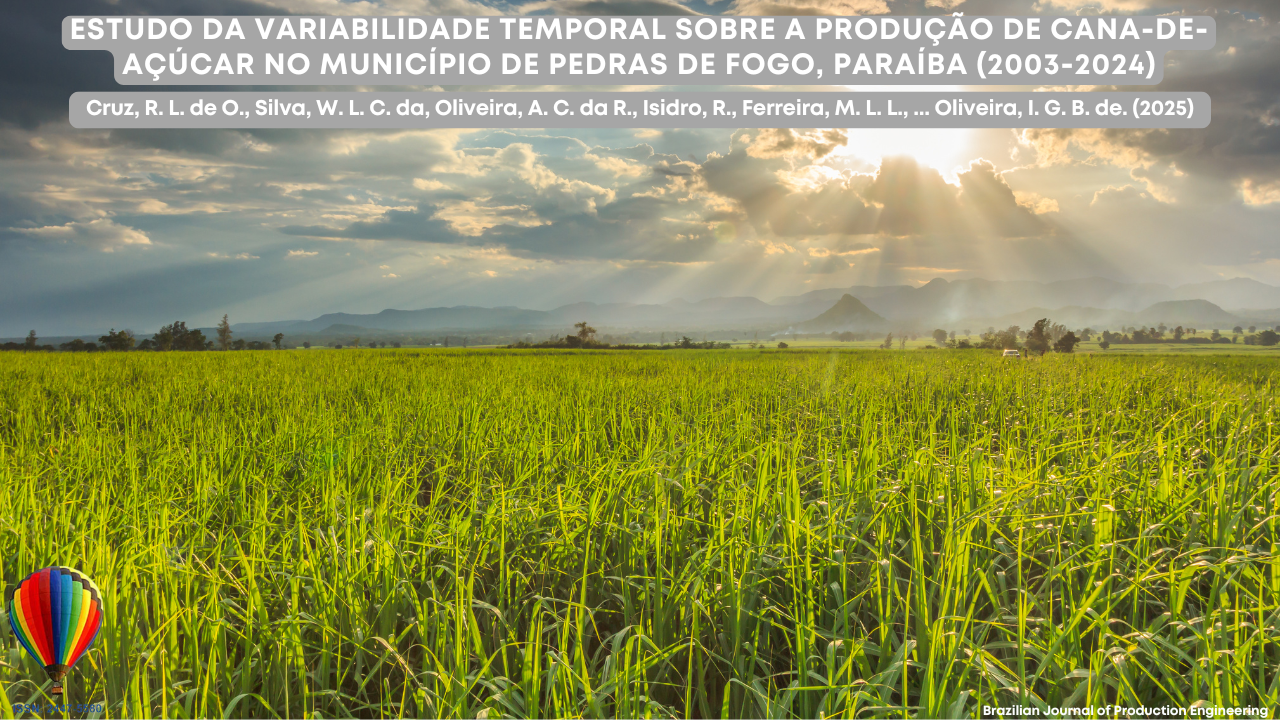
"Image showing a green sugarcane field at sunset, with sunlight rays breaking through clouds on the horizon. At the top, the title of a scientific article from the Brazilian Journal of Production Engineering appears, focusing on the temporal variability of sugarcane production in Pedras de Fogo, Paraíba (2003–2024). In the lower left corner, a colorful hot air balloon represents the journal’s logo."

Published

2025-11-04

How to Cite

Cruz, R. L. de O. ., Silva, W. L. C. da, Oliveira, A. C. da R., Isidro, R., Ferreira, M. L. L., Sousa, W. G. de, Sousa, L. H. G., Cordeiro, M. E. B. A., Silva, J. N. ., Oliveira, R. de, Silva, W. R. da, Silva, J. Y. S. da, Diógenes, A. K. M., Silva, R. B. da, Soares, A. C. da S., Santana, R. F. de ., Andrade, P. M. de, Velez, E. da S., Sousa, F. de A. R. da M., … Oliveira, I. G. B. de. (2025). Study of temporal variability on sugarcane production in the municipality of Pedras de Fogo, Paraíba (2003-2024). Brazilian Journal of Production Engineering, 11(4), 144-153. https://doi.org/10.47456/bjpe.v11i4.48838

Similar Articles

1-10 of 591

You may also start an advanced similarity search for this article.