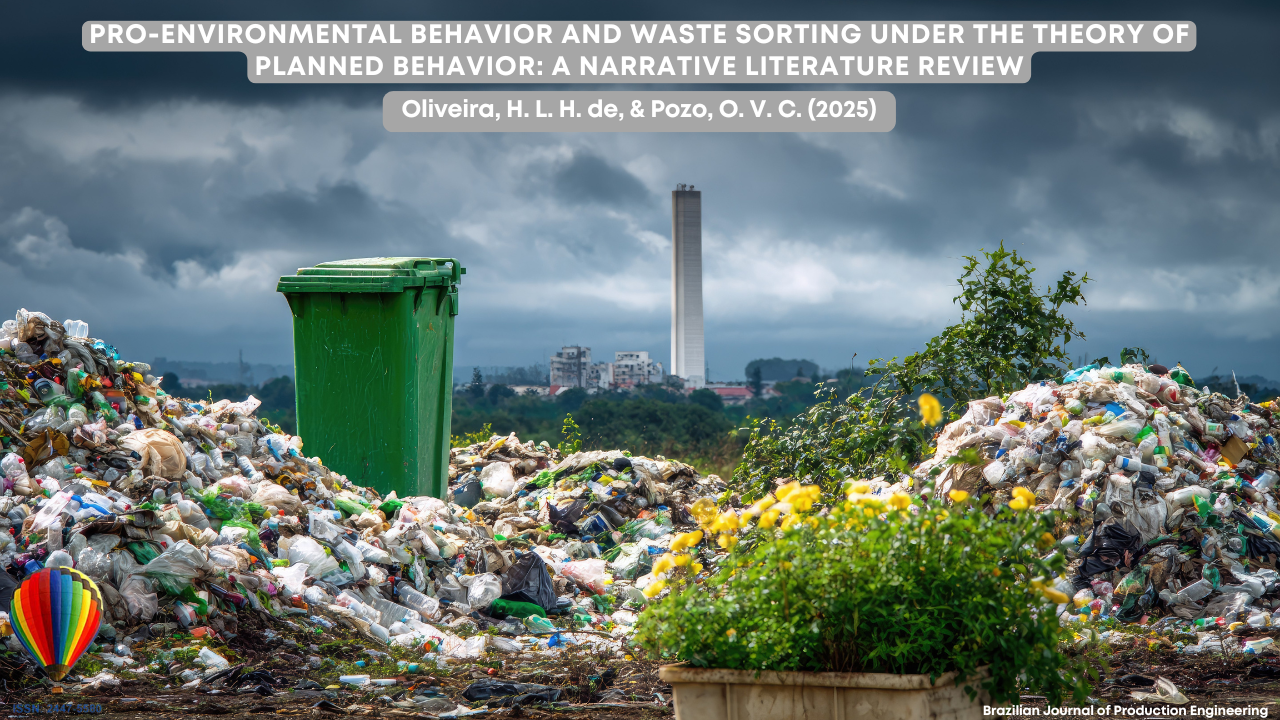
Pro-environmental behavior and waste sorting under the theory of planned behavior: a narrative literature review
DOI:
https://doi.org/10.47456/bjpe.v11i4.49941Keywords:
pro-environmental behavior, waste sorting, theory of planned behavior, sustainability, literature reviewAbstract
The climate emergency and the rising generation of municipal solid waste have placed pro-environmental behavior at the center of global agendas. This article aims to critically review recent literature on the determinants of pro-environmental behavior related to waste sorting, based on the Theory of Planned Behavior (TPB). A narrative literature review was conducted by analyzing 32 empirical articles published between 2020 and 2025, retrieved from Web of Science and Scopus databases. The findings reveal that psychosocial factors (attitudes, subjective norms, perceived control), emotional variables (guilt, pride), and identity aspects (ecological identity) significantly influence waste separation intentions and behavior. Structural factors such as infrastructure, convenience, and institutional support were also found to be key drivers. It is concluded that waste sorting is a multidimensional phenomenon, and effective public policies must integrate environmental education, incentives, accessible technologies, and targeted communication strategies. The study recommends future research to prioritize real behavior, longitudinal designs, and broader geographic contexts.
Downloads
References
Adu-Gyamfi, G., Asamoah, A. N., Nketiah, E., Obuobi, B., Adjei, M., Cudjoe, D., & Zhu, B. (2023). Reducing waste management challenges: Empirical assessment of waste sorting intention among corporate employees in Ghana. Journal of Retailing and Consumer Services, 72, 103261. https://doi.org/10.1016/j.jretconser.2023.103261
Aikowe, L. D., & Mazancová, J. (2021). Plastic waste sorting intentions among university students. Sustainability, 13(14), 7526. https://doi.org/10.3390/su13147526
Ajzen, I. (1991). The theory of planned behavior. Organizational Behavior and Human Decision Processes, 50(2), 179-211.
Bamberg, S., & Möser, G. (2007). Twenty years after Hines, Hungerford, and Tomera: a new meta-analysis of psycho-social determinants of pro-environmental behaviour. Journal of Environmental Psychology, 27(1), 14–25. https://doi.org/10.1016/j.jenvp.2006.12.002
Bardus, M., & Massoud, M. A. (2022). Predicting the intention to sort waste at home in rural communities in Lebanon: an application of the theory of planned behavior. International Journal of Environmental Research and Public Health, 19(15), 9383. https://doi.org/10.3390/ijerph19159383
Calvin, K., Dasgupta, D., Krinner, G., Mukherji, A., Thorne, P. W., Trisos, C., Romero, J., Aldunce, P., Barrett, K., Blanco, G., Cheung, W. W. L., Connors, S., Denton, F., Diongue-Niang, A., Dodman, D., Garschagen, M., Geden, O., Hayward, B., Jones, C., … Péan, C. (2023). IPCC, 2023: Climate Change 2023: Synthesis Report. Contribution of Working Groups I, II and III to the Sixth Assessment Report of the Intergovernmental Panel on Climate Change [Core Writing Team, H. Lee and J. Romero (eds.)]. IPCC, Geneva, Switzerland. (First). Intergovernmental Panel on Climate Change (IPCC). https://doi.org/10.59327/IPCC/AR6-9789291691647
Chen, F., Wang, F., & Hou, J. (2020). Individual preference framework or group preference framework? which will regulate the impact path of product facilities on residents’ waste-sorting behavior better. International Journal of Environmental Research and Public Health, 17(7), 2324. https://doi.org/10.3390/ijerph17072324
Chen, L., & Gao, M. (2021). Novel information interaction rule for municipal household waste classification behavior based on an evolving scale-free network. Resources, Conservation and Recycling, 168, 105445. https://doi.org/10.1016/j.resconrec.2021.105445
Cudjoe, D., Nketiah, E., Obuobi, B., Adjei, M., Zhu, B., & Adu-Gyamfi, G. (2022). Predicting waste sorting intention of residents of Jiangsu Province, China. Journal of Cleaner Production, 366, 132838. https://doi.org/10.1016/j.jclepro.2022.132838
Cudjoe, D., Yuan, Q., & Han, M. S. (2020). An assessment of the influence of awareness of benefits and perceived difficulties on waste sorting intention in Beijing. Journal of Cleaner Production, 272, 123084. https://doi.org/10.1016/j.jclepro.2020.123084
Dilixiati, D., Suzuki, S., Yoshida, H., & Takahashi, F. (2023). A case study of unwillingness toward PET bottle recycling behaviors. A new contingent valuation approach which requests only simple comparison of perceptive stimuli. Resources, Conservation and Recycling, 189, 106746. https://doi.org/10.1016/j.resconrec.2022.106746
Geng, X., Li, H., Liu, X., Liu, H., & Huang, M. (2023). The effect of the evaluation of trash can removal policy under the “compulsory times” of waste-sorting in Longhua District in China. Sustainability, 15(12), 9763. https://doi.org/10.3390/su15129763
Hao, M., Zhang, D., & Morse, S. (2020). Waste separation behavior of college students under a mandatory policy in China: a case study of Zhengzhou City. International Journal of Environmental Research and Public Health, 17(21), 8190. https://doi.org/10.3390/ijerph17218190
Kan, J., Zhu, N., & Zhao, Y. (2025). Behavioral response analysis of rural residents’ living waste classification: evidence from Jiangsu, China. Sustainability, 17(8), 3529. https://doi.org/10.3390/su17083529
Karuniasa, M., & Wahyono, S. (2024). Behavioral intention of domestic organic waste segregation in urban communities (case study: Depok City, Indonesia). Journal of Natural Resources and Environmental Management. http://dx.doi.org/10.29244/jpsl.14.1.92
Kuang, Y., & Lin, B. (2021). Public participation and city sustainability: evidence from urban garbage classification in China. Sustainable Cities and Society, 67, 102741. https://doi.org/10.1016/j.scs.2021.102741
Labib, O. A., Abd Manaf, L. B., Bin Sharaai, A. H., Zaid, S. S. B. M., & Khalil, M. S. (2023). The influence of socio-psychological factors on residents’ willingness to practice sustainable waste handling in Dammam City, Saudi Arabia. Sustainability, 15(18), 13654. https://doi.org/10.3390/su151813654
Labib, O., Manaf, L., Sharaai, A. H., & Zaid, S. S. M. (2021). Moderating effects on residents’ willingness in waste sorting to improve waste handling in Dammam City, Saudi Arabia. Recycling, 6(2), 24. https://doi.org/10.3390/recycling6020024
Li, W., & Wang, J. (2021). Household waste management in Shanghai and its implications for the second-tier cities in China. Journal of Cleaner Production, 321, 128980. https://doi.org/10.1016/j.jclepro.2021.128980
Li, Y., Bhutto, M. Y., Sun, C., & Mahdi, S. M. (2023). Do information publicity and moral norms trigger waste-sorting intention among households? A sequential mediation analysis. Frontiers in Psychology, 14, 1193411. https://doi.org/10.3389/fpsyg.2023.1193411
Liu, Q., Xu, Q., Shen, X., Chen, B., & Esfahani, S. S. (2022). The Mechanism of household waste sorting behavior. a study of Jiaxing, China. International Journal of Environmental Research and Public Health, 19(4), 2447. https://doi.org/10.3390/ijerph19042447
Ly, B., & Ly, R. (2022). Waste sorting practices of cambodians during covid-19. International Journal of Sustainable Engineering, 15(1), 98-106. https://doi.org/10.1080/19397038.2022.2065704
Moeini, B., Barati, M., Khazaei, M., Tapak, L., & Hashemian, M. (2024). In-depth analysis to develop a social marketing model to promote women’s participation in waste segregation behaviour: a qualitative study. Heliyon, 10(7), e28690. https://doi.org/10.1016/j.heliyon.2024.e28690
Negash, Y. T., Sarmiento, L. S. C., Tseng, M.-L., Lim, M. K., & Ali, M. H. (2021). Engagement factors for household waste sorting in Ecuador: improving perceived convenience and environmental attitudes enhances waste sorting capacity. Resources, Conservation and Recycling, 175, 105893. https://doi.org/10.1016/j.resconrec.2021.105893
ONU. (2015a). Paris Agreement. https://unfccc.int/files/essential_background/convention/application/pdf/english_paris_agreement.pdf
ONU. (2015b). Transforming Our World: The 2030 Agenda For Sustainable Development. https://sdgs.un.org/sites/default/files/publications/21252030%20Agenda%20for%20Sustainable%20Development%20web.pdf
Pongpunpurt, P., Muensitthiroj, P., Pinitjitsamut, P., Chuenchun, P., Painmanakul, P., Chawaloesphonsiya, N., & Poyai, T. (2022). Studying waste separation behaviors and environmental impacts toward sustainable solid waste management: a case study of Bang Chalong Housing, Samut Prakan, Thailand. Sustainability, 14(9), 5040. https://doi.org/10.3390/su14095040
Schoeman, D. C., & Rampedi, I. T. (2022). Drivers of household recycling behavior in the city of Johannesburg, South Africa. International Journal of Environmental Research and Public Health, 19(10), 6229. https://doi.org/10.3390/ijerph19106229
Setiawan, B., Afiff, A. Z., & Heruwasto, I. (2021). The role of norms in predicting waste sorting behavior. Journal of Social Marketing, 11(3), 224-239. https://doi.org/10.1108/JSOCM-05-2020-0088
Shen, J., Zheng, D., Zhang, X., & Qu, M. (2020). Investigating rural domestic waste sorting intentions based on an integrative framework of planned behavior theory and normative activation models: evidence from Guanzhong Basin, China. International Journal of Environmental Research and Public Health, 17(13), 4887. https://doi.org/10.3390/ijerph17134887
Shi, J., Xu, K., Si, H., Song, L., & Duan, K. (2021). Investigating intention and behaviour towards sorting household waste in Chinese rural and urban-rural integration areas. Journal of Cleaner Production, 298, 126827. https://doi.org/10.1016/j.jclepro.2021.126827
Tian, J., Gong, Y., Li, Y., Chen, X., Zhang, L., & Sun, Y. (2022). Can policy implementation increase public waste sorting behavior? The comparison between regions with and without waste sorting policy implementation in China. Journal of Cleaner Production, 363, 132401. https://doi.org/10.1016/j.jclepro.2022.132401
UNEP (Org.). (2024). Beyond an age of waste: Turning rubbish into a resource. UNEP.
Wan, M., & Wan, L. (2020). Exploring the pathways to participation in household waste sorting in different national contexts: a fuzzy set QCA Approach. Ieee Access, 8, 179373-179388. https://doi.org/10.1109/ACCESS.2020.3027978
Wang, C., Chu, Z., & Gu, W. (2021). Participate or not: impact of information intervention on residents’ willingness of sorting municipal solid waste. Journal of Cleaner Production, 318, 128591. https://doi.org/10.1016/j.jclepro.2021.128591
Wang, S., Wang, J., Yang, S., Li, J., & Zhou, K. (2020). From intention to behavior: comprehending residents’ waste sorting intention and behavior formation process. Waste Management, 113, 41-50. https://doi.org/10.1016/j.wasman.2020.05.031
Zhang, L.-P., & Zhu, Z.-P. (2020). Can smart waste bins solve the dilemma of household solid waste sorting in China? A case study of Fuzhou City. Polish Journal of Environmental Studies, 29(5), 3943-3954. https://doi.org/10.15244/pjoes/115868
Zheng, J., Ma, G., Wei, J., Wei, W., He, Y., Jiao, Y., & Han, X. (2020). Evolutionary process of household waste separation behavior based on social networks. Resources Conservation and Recycling, 161, 105009. https://doi.org/10.1016/j.resconrec.2020.105009
Downloads
Published
Issue
Section
License
Copyright (c) 2025 Oliveira, H. L. H. de, & Pozo, O. V. C.

This work is licensed under a Creative Commons Attribution 4.0 International License.

All works published in the Brazilian Journal of Production Engineering (BJPE) are licensed under Creative Commons Attribution 4.0 International (CC BY 4.0).
This means that:
Anyone can copy, distribute, display, adapt, remix, and even commercially use the content published in the journal;
Provided that due credit is given to the authors and to BJPE as the original source;
No additional permission is required for reuse, as long as the license terms are respected.
This policy complies with the principles of open access, promoting the broad dissemination of scientific knowledge.


2.png)