

2.png)








































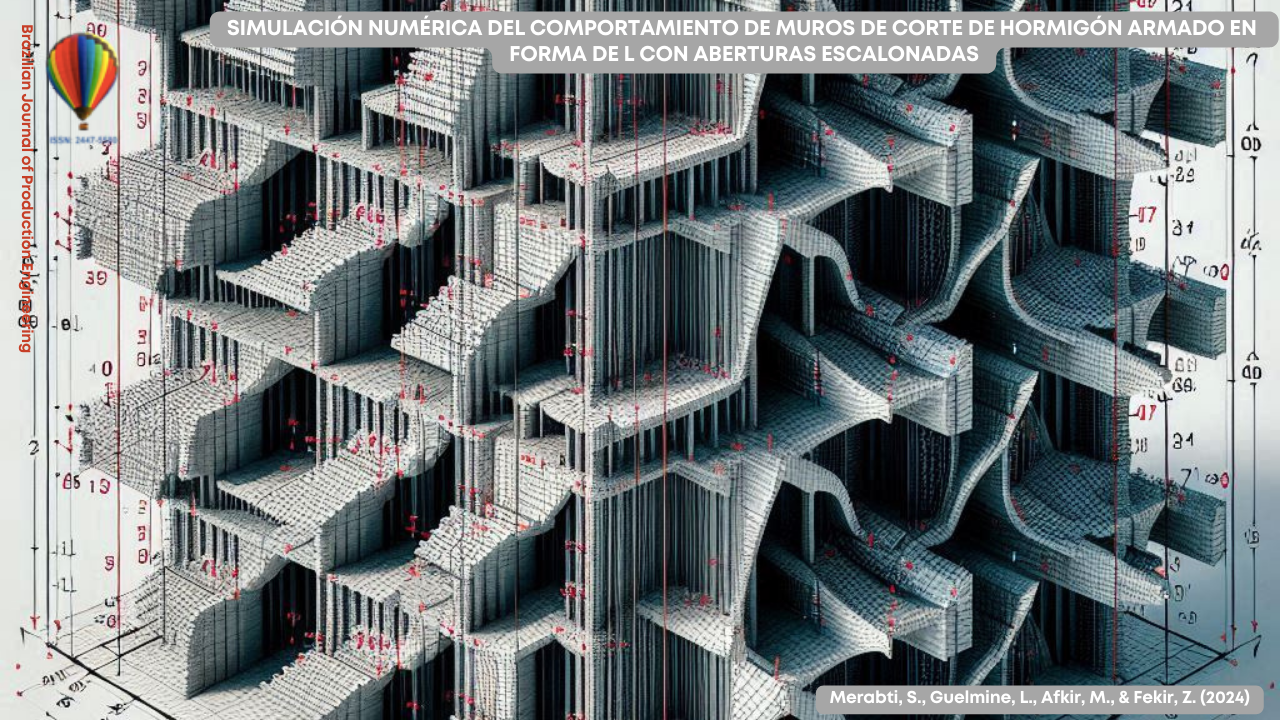
Simulación numérica del comportamiento de muros de corte de hormigón armado en forma de l con aberturas escalonadas
- Autores/as
-
-
Salem Merabti
University of Khemis Miliana
Autor/a
-
Autor/a
-
Mohamed Afkir
University of Khemis-Miliana
Autor/a
-
Zineddine Fekir
University of Khemis-Miliana
Autor/a
-
- Palabras clave:
- Muros cortantes, Hormigón Armado, Aberturas desplazadas, Simulación Numérica, Tensiones, Fuerzas cortantes, Desplazamientos del piso superior
- Resumen
-
Las paredes de cortante de hormigón armado en forma de L son muy valoradas en la arquitectura moderna por su capacidad para resistir cargas laterales. Sin embargo, la incorporación de aberturas, necesarias por razones funcionales, puede comprometer su integridad estructural. Nuestro estudio investiga los efectos de las aberturas desalineadas en las tensiones de compresión, tracción y cortante en estas paredes, con el objetivo de proporcionar recomendaciones de diseño. También analizamos las fuerzas de cortante y los desplazamientos en la parte superior de edificios con diversas configuraciones de apertura mediante simulaciones numéricas realizadas en estructuras de diez pisos. Los resultados indican que las tensiones de cortante aumentan cuando las aberturas están descentradas. Sin embargo, independientemente de su posición, la proporción óptima de aberturas se encuentra en el 30% de la superficie de la pared de cortante.
- Biografía del autor/a
- Referencias
-
Algerian Paraseismic Regulations, RPA 99/Version 2003. (2003). National Center for applied research in paraseismic engineering, Edition CGS, Algeria.
Balkaya, C. & Kalkan, E. (2024). Three-Dimensional Effects on openings of laterally loaded pierced shear walls. J Stru Eng-ASCE. 130(10). 1506-1514.
Benbellil, B., Kebdani, S., Kettab, R. M., & Benbouras, M. A. (2019). Comparative modelling of seismic performance of L-shaped reinforced concrete shear walls. Urbanism. Arhitectură. Construcţii. Vol. 10.
Galal, K. & El-Sokkarry, H. (2008). Recent Advancements in Retrofit of Rc Shear Walls. Proceedings of the 14th World Conference on Earthquake Engineering. Beijing, China, pp. 12-17.
Guo, W., Huang, J., Chen, S., & Ren, Y-X. (2023). Experimental study on the stability of L - Shaped hybrid quay wall in sand. Ocean. Engineering, 280. https://doi.org/10.1016/j.oceaneng.2023.114851.
Hosseinia, S. A., Kheyroddina, A., & Mastalib, M. (2019). An experimental investigation into the impacts of eccentric openings on the in-plane behavior of squat RC shear walls. Engineering Structures, 197. 109410. https://doi.org/10.1016/j.engstruct.2019.109410.
Liu, C., Luan., K, Wang., L, Wang, H., & Qin, J. (2024). Study on the oblique seismic behavior of reinforced concrete L-shaped columns strengthened with carbon fiber reinforced polymer slabs. Structures. 60, 105842. https://doi.org/10.1016/j.istruc.2023.105842.
Merabti S. (2022). Effect of concrete class, maximum aggregate size and specimen size on the compressive strength of cores and cast specimens. Advances in materials science, 22(4), 74. https://doi: 10.2478/adms-2022-0016.
Merabti S & Guelmine L. (2024). Influence of Concrete Compressive Strength on L-Shaped Shear Wall Performance in Buildings within High-Seismicity Zones. The Journal of Engineering and Exact Sciences, 10(4). https://doi: 10.18540/jcecvl10iss4pp18712.
Merabti S, Bezari S, & Aymen A. (2023). Investigation into the Impact of L-Shaped RC Shear Wall Placement with Openings on the Behavior of Medium-Rise Buildings. The Journal of Engineering and Exact Sciences. 9(9). https://doi:10.18540/jcecvl9iss9pp16816-01e.
Merabti S. & Bezari S. (2023). Study of Stress Distribution in L-Shaped Walls with Openings under Intense Seismic Conditions on Various Soil Types. The Journal of Engineering and Exact Sciences. 9(8). https://doi:10.18540/jcecvl9iss8pp16604-01e
Montazeri E., Panahshahi N., & Cross B. (2018). Nonlinear Finite Element Analysis of Reinforced Concrete Shear Walls with Staggered Openings under Seismic Loads. Conference: Structures Congress, ASCE, 2018. https://doi:10.1061/9780784481325.030.
Mosoarca, M. (2014). Failure Analysis of RC Shear Walls with Staggered Openings under Seismic Loads. Eng Fail Anal, 41. pp. 48-64.
https://doi.org/10.1016/j.engfailanal.2013.07.037.
Najm, H.M., Ibrahim, A.M., Sabri, M. M., Hassan, A., Morkhade, S., Mashaan, N. S., Eldirderi, M. M. A., & Khedher, K. M. (2022). Modelling of Cyclic Load Behaviour of Smart Composite Steel-Concrete Shear Wall Using Finite Element Analysis. Buildings. Vol. 12(6), 850, https://doi.org/10.3390/buildings12060850.
Pandey S., Murari Dr. K., Pathak A., & Kumar C. (2017). A Review on Shear wall in High Rise Building. International Journal of Engineering Inventions. 6(12). 19-21.
Rong, C., Qu, Y., Shah, A. A., & He, H. (2023). Seismic Performance of Energy Dissipation Low Reinforced Concrete Shear Wall with Shear Lead Dampers. Case Studies in Construction Materials. 19, e02276. https://doi.org/10.1016/j.cscm.2023.e02276.
Saeed, A., Najm, H. M., Hassan, A., Qaidi, S., Sabri Sabri, M. M., Nuha, S. M. A. (2022). Comprehensive Study on the Effect of Regular and Staggered Openings on the Seismic Performance of Shear Walls. Buildings. 12. 1293. https://doi.org/10.3390/buildings12091293.
Sharma, R.; Jignesh A. (2015). Effects of opening in shear walls of 30- storey building. Journal of materials and engineering structures. Vol. 2.pp. 44–55
Varma, V. N. & Kumar, U. P. (2021). Seismic response on multi-storied building having shear walls with and without openings. Materials Today: Proceedings. 37(2), 801-805. https://doi.org/10.1016/j.matpr.2020.05.827.
Wang, B., Wu, M-Z., Shi, Q-X., & Cai, W-Z. (2022). Effects of biaxial loading path on seismic behavior of T-shaped RC walls. Engineering Structures, 273, 115080. https://doi.org/10.1016/j.engstruct.2022.115080.
Wang, Y., Wang, Z., Zhou, Y., Yang, Z., & Zhang, Y. (2022). Test and Bearing Capacity Calculation of a New Energy-Dissipated Precast Shear Wall. Buildings, 12(11). https://doi.org/10.3390/buildings12111990.
Zhou, Y., Zhu, X., Wu, H., Gu, A., & Wenbo, T. (2023). Seismic design and engineering practice of a 10-story self-centering precast concrete wall structure. Structural Design of Tall and Special Buildings. https://doi.org/10.1002/tal.2040
- Cover Image
-
- Descargas
- Publicado
- 2024-08-02
- Sección
- INGENIERÍA DE OPERACIONES Y PROCESOS DE PRODUCCIÓN
- Licencia
-
Derechos de autor 2024 Brazilian Journal of Production Engineering

Esta obra está bajo una licencia internacional Creative Commons Atribución 4.0.
Todas las obras publicadas en la Revista Brasileña de Ingeniería de Producción (BJPE) están bajo la licencia Creative Commons Atribución 4.0 Internacional (CC BY 4.0). Esto significa que: Cualquier persona puede copiar, distribuir, exhibir, adaptar, remezclar e incluso utilizar comercialmente el contenido publicado en la revista; Siempre que se reconozca debidamente a los autores y a BJPE como fuente original; No se requiere permiso adicional para la reutilización, siempre que se respeten los términos de la licencia. Esta política cumple con los principios de acceso abierto, promoviendo la amplia difusión del conocimiento científico. 🔗 Haga clic aquí para acceder a la licencia completa.
