

2.png)


































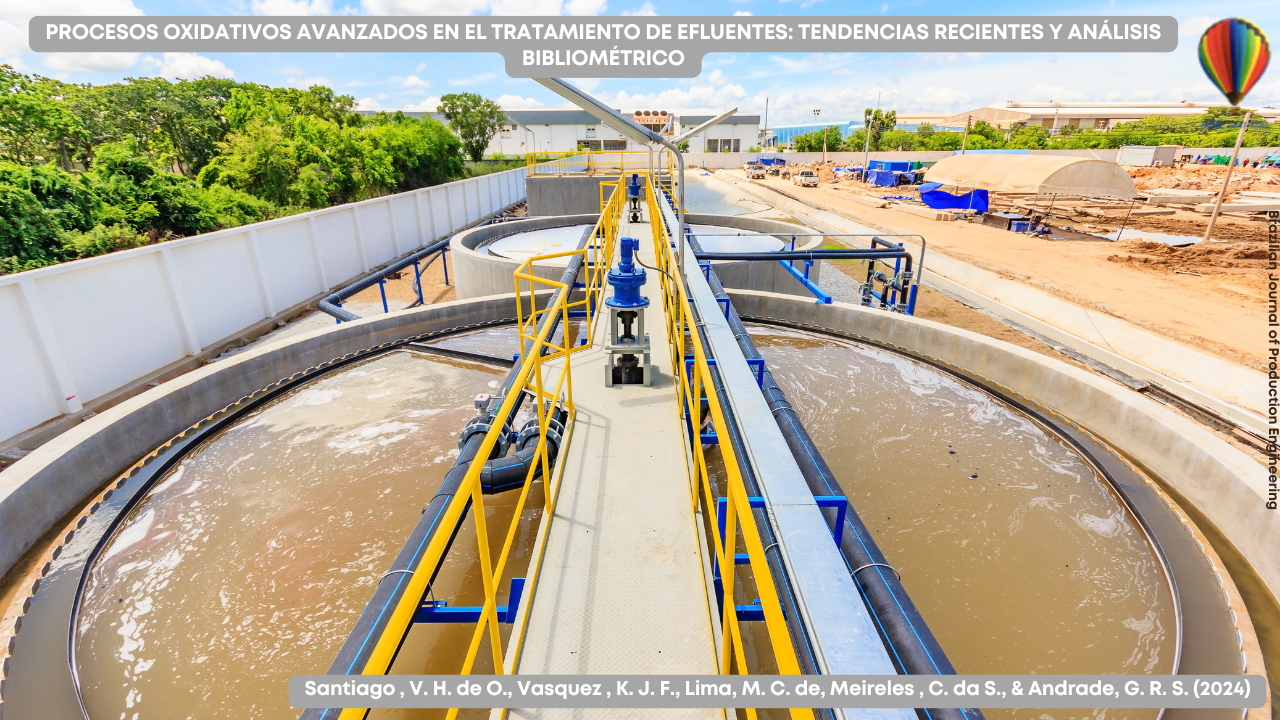
Procesos oxidativos avanzados en el tratamiento de efluentes: tendencias recientes y análisis bibliométrico
- Autores/as
-
-
Autor/a
-
Autor/a
-
Marcio Cypriano de Lima
SEDU - Secretaria da Educação do Espírito Santo
Autor/a
-
Autor/a
-
George Ricardo Santana Andrade
Universidade Federal do Espírito Santo, UFES, Brasil
Autor/a
-
- Palabras clave:
- Tratamiento de efluentes, Proceso Foto-Fenton, Fotocatálisis
- Resumen
-
La eliminación inadecuada de efluentes industriales es una de las principales causas de la liberación de sustancias tóxicas, químicamente complejas y no biodegradables a los cuerpos de agua. Por ello, los Procesos Oxidativos Avanzados (POAs), tecnologías encargadas de oxidar contaminantes mediante la generación de radicales oxigenados, han ganado protagonismo en el tratamiento de aguas residuales al ser métodos considerados prometedores, eficaces e innovadores. En este trabajo se realizó un análisis bibliométrico sobre la base de datos “Web of Science” con el objetivo de verificar la relevancia y avances del tema en cuestión. Inicialmente la estrategia de búsqueda fue utilizar la palabra clave “procesos de oxidación avanzados” y luego se agregó la palabra “tratamiento de agua”. China fue el país con mayor número de publicaciones antes y después de la inserción del segundo semestre y el área de investigación en Ingeniería fue el área más relevante. Posteriormente se agregaron a la búsqueda varios POA por separado junto con las dos palabras mencionadas anteriormente, con el objetivo de determinar las técnicas más relevantes, donde se analizaron las 3 técnicas que presentaron resultados más expresivos, a saber, Foto-Fenton, H2O2/UV. y fotocatálisis heterogénea. Finalmente, se creó una matriz FODA que contiene puntos positivos y negativos presentes en un grupo de artículos seleccionados.
- Biografía del autor/a
- Referencias
-
Adeoye, J. B., Tan, Y. H., Lau, S. Y., Tan, Y. Y., Chiong, T., Mubarak, N. M., & Khalid, M. (2024). Advanced oxidation and biological integrated processes for pharmaceutical wastewater treatment: A review. Journal of Environmental Management, 353, 120170. https://doi.org/10.1016/j.jenvman.2024.120170
Andrade, G. R. S., Nascimento, C. C., Silva Júnior, E. C., Mendes, D. T. S. L. & Gimenez, I. F. (2017). ZnO/Au nanocatalysts for enhanced decolorization of an azo dye under solar, UV-A and dark conditions. Journal of Alloys and Compounds, 710, 557-566. https://doi.org/10.1016/j.jallcom.2017.03.295
Babu Ponnusami, A., Sinha, S., Ashokan, H., V Paul, M., Hariharan, S. P., Arun, J., Gopinath, K. P., Hoang Le, Q. & Pugazhendhi, A. (2023). Advanced oxidation process (AOP) combined biological process for wastewater treatment: A review on advancements, feasibility and practicability of combined techniques. Environmental Research, 237, 116944. https://doi.org/10.1016/j.envres.2023.116944
Bar-Niv, N., Azaizeh, H., Kuc, M. E., Azerrad, S., Haj-Zaroubi, M., Menashe, O., & Kurzbaum, E. (2022). Advanced oxidation process UV-H2O2 combined with biological treatment for the removal and detoxification of phenol. Journal of Water Process Engineering, 48, 102923. https://doi.org/10.1016/j.jwpe.2022.102923
Bokare, A. D. & Choi, W. (2014). Review of iron-free Fenton-like systems for activating H2O2 in advanced oxidation processes. Journal of Hazardous Materials, 275, 121-135. https://doi.org/10.1016/j.jhazmat.2014.04.054
Brillas, E. & Martínez-Huitle, C. A. (2015). Decontamination of wastewaters containing synthetic organic dyes by electrochemical methods. An updated review. Applied Catalysis B: Environmental, 166-167, 603-643. https://doi.org/10.1016/j.apcatb.2014.11.016
Cambié, D., Bottecchia, C., Straathof, N. J. W., Hessel, V., & Noël, T. (2016). Applications of Continuous-Flow Photochemistry in Organic Synthesis, Material Science, and Water Treatment. Chemical Reviews, 116(17), 10276-10341. https://doi.org/10.1021/acs.chemrev.5b00707
CDP. (2022). Global Water Report 2022. Carbon Disclosure Project. Recuperado de https://www.cdp.net/en/research/global-reports/global-water-report-2022
Esfandian, H., Mirzaei, S., Chari, A. S., Ghadi, R. A., & Moqadam, I. H. (2024). Photocatalytic degradation of chlorpyrifos pesticide in aqueous solution using Cu-doped TiO2/GO photocatalysis vicinity of UV and visible light. Materials Science and Engineering: B, 305, 117385. https://doi.org/10.1016/j.mseb.2024.117385
Ghanbari, F. & Moradi, M. (2017). Application of peroxymonosulfate and its activation methods for degradation of environmental organic pollutants: Review. Chemical Engineering Journal, 310, 41-62. https://doi.org/10.1016/j.cej.2016.10.064
Guz, R., Tiburtius, E. R. L., & Pessôa, C. A. (2023). Association of adsorption and heterogeneous photocatalysis in the degradation of Tartrazine yellow dye with CuNb2O6 synthesized and immobilized on chitosan membranes. Inorganic Chemistry Communications, 152, 110645. https://doi.org/10.1016/j.inoche.2023.110645
Hama Aziz, K. H. & Mustafa, F. S. (2024). Advanced oxidation processes for the decontamination of heavy metal complexes in aquatic systems: A review. Case Studies in Chemical and Environmental Engineering, 9, 100567. https://doi.org/10.1016/j.cscee.2023.100567
Harris, R. & Rother, M. (2002). Creating Continuous Flow: An Action Guide for Managers, Engineers & Production Associates. Lean Enterprise Institute.
Hu, Z., Guan, D., Sun, Z., Zhang, Z., Shan, Y., Wu, Y., Gong, C., & Ren, X. (2023). Osmotic cleaning of typical inorganic and organic foulants on reverse osmosis membrane for textile printing and dyeing wastewater treatment. Chemosphere, 336, 139162. https://doi.org/10.1016/j.chemosphere.2023.139162
Humayun, S., Hayyan, M., & Alias, Y. (2025). A review on reactive oxygen species-induced mechanism pathways of pharmaceutical waste degradation: Acetaminophen as a drug waste model. Journal of Environmental Sciences, 147, 688-713. https://doi.org/10.1016/j.jes.2023.11.021
Jiang, H., Chen, H., Duan, Z., Huang, Z., & Wei, K. (2023). Research progress and trends of biochar in the field of wastewater treatment by electrochemical advanced oxidation processes (EAOPs): A bibliometric analysis. Journal of Hazardous Materials Advances, 10, 100305. https://doi.org/10.1016/j.hazadv.2023.100305
Krishnan, R. Y., Manikandan, S., Subbaiya, R., Biruntha, M., Govarthanan, M., & Karmegam, N. (2021). Removal of emerging micropollutants originating from pharmaceuticals and personal care products (PPCPs) in water and wastewater by advanced oxidation processes: A review. Environmental Technology & Innovation, 23, 101757. https://doi.org/10.1016/j.eti.2021.101757
Lee, W., Marcotullio, S., Yeom, H., Son, H., Kim, T.-H., & Lee, Y. (2022). Reaction kinetics and degradation efficiency of halogenated methylparabens during ozonation and UV/H2O2 treatment of drinking water and wastewater effluent. Journal of Hazardous Materials, 427, 127878. https://doi.org/10.1016/j.jhazmat.2021.127878
Mohammed, S., Prathish, K. P., Jeeva, A., & Shukla, S. (2024). Integrated Fenton-like and ozonation based advanced oxidation processes for treatment of real-time textile effluent containing azo reactive dyes. Chemosphere, 349, 140766. https://doi.org/10.1016/j.chemosphere.2023.140766
Moreira, F. C., Boaventura, R. A. R., Brillas, E., & Vilar, V. J. P. (2017). Electrochemical advanced oxidation processes: A review on their application to synthetic and real wastewaters. Applied Catalysis B: Environmental, 202, 217-261. https://doi.org/10.1016/j.apcatb.2016.08.037
Olatunde, O. C., Kuvarega, A. T., & Onwudiwe, D. C. (2020). Photo enhanced degradation of contaminants of emerging concern in waste water. Emerging Contaminants, 6, 283-302. https://doi.org/10.1016/j.emcon.2020.07.006
Oliveira, R. A., Castro, M. A. M., Porto, D. L., Aragão, C. F. S., Souza, R. P., Silva, U. C., Bomio, M. R. D., & Motta, F. V. (2024). Immobilization of Bi2MoO6/ZnO heterojunctions on glass substrate: Design of drug and dye mixture degradation by solar-driven photocatalysis. Journal of Photochemistry and Photobiology A: Chemistry, 452, 115619. https://doi.org/10.1016/j.jphotochem.2024.115619
Oturan, M. A. & Aaron, J.-J. (2014). Advanced Oxidation Processes in Water/Wastewater Treatment: Principles and Applications. A Review. Critical Reviews in Environmental Science and Technology, 44(23), 2577-2641. https://doi.org/10.1080/10643389.2013.829765
Padovan, R. N., de Carvalho, L. S., de Souza Bergo, P. L., Xavier, C., Leitão, A., dos Santos Neto, Á. J., Lanças, F. M., & Azevedo, E. B. (2021). Degradation of hormones in tap water by heterogeneous solar TiO2-photocatalysis: Optimization, degradation products identification, and estrogenic activity removal. Journal of Environmental Chemical Engineering, 9(6), 106442. https://doi.org/10.1016/j.jece.2021.106442
Patel, M., Kumar, R., Kishor, K., Mlsna, T., Pittman, C. U. Jr., & Mohan, D. (2019). Pharmaceuticals of Emerging Concern in Aquatic Systems: Chemistry, Occurrence, Effects, and Removal Methods. Chemical Reviews, 119(6), 3510-3673. https://doi.org/10.1021/acs.chemrev.8b00299
Posser, Y. M. (2016). Degradação da cafeína através dos processos oxidativos avançados fenton e foto- fenton.
Preethi, Shanmugavel, S. P., Kumar, G., N, Y. K., M, G., & J, R. B. (2024). Recent progress in mineralization of emerging contaminants by advanced oxidation process: A review. Environmental Pollution, 341, 122842. https://doi.org/10.1016/j.envpol.2023.122842
Rigotto, L., Aquino, S. F., Rigotto, J., Santos, G., Silva, L. M. L., & Santiago, A. F. (2023). Dynamics of dissolved organic matter (DOM) in waste stabilization ponds: Insights into co-treatment of sanitary sewage and landfill leachate. Journal of Water Process Engineering, 55, 104236. https://doi.org/10.1016/j.jwpe.2023.104236
Sandoval, M. A., Vidal, J., Calzadilla, W., & Salazar, R. (2022). Solar (electrochemical) advanced oxidation processes as efficient treatments for degradation of pesticides. Current Opinion in Electrochemistry, 36, 101125. https://doi.org/10.1016/j.coelec.2022.101125
Saravanan, A., Deivayanai, V. C., Kumar, P. S., Rangasamy, G., Hemavathy, R. V., Harshana, T., Gayathri, N., & Alagumalai, K. (2022). A detailed review on advanced oxidation process in treatment of wastewater: Mechanism, challenges and future outlook. Chemosphere, 308, 136524. https://doi.org/10.1016/j.chemosphere.2022.136524
Sirés, I., Brillas, E., Oturan, M. A., Rodrigo, M. A., & Panizza, M. (2014). Electrochemical advanced oxidation processes: Today and tomorrow. A review. Environmental Science and Pollution Research, 21(14), 8336-8367. https://doi.org/10.1007/s11356-014-2783-1
Soares, P. B., Carneiro, T. C. J., Calmon, J. L., & Castro, L. O. da C. de O. (2016). Análise bibliométrica da produção científica brasileira sobre Tecnologia de Construção e Edificações na base de dados Web of Science. Ambiente Construído, 16, 175–185. https://doi.org/10.1590/s1678-86212016000100067
UNESCO. (2023). The United Nations World Water Development Report 2023: Partnerships and cooperation for water—UNESCO Digital Library. https://unesdoc.unesco.org/ark:/48223/pf0000384655
Van Eck, N. J. & Waltman, L. (2023). Manual for VOSviewer version 1 .6.20. Recuperado de https://www.vosviewer.com/documentation/Manual_VOSviewer_1.6.20.pdf
Vinayagam, V., Palani, K. N., Ganesh, S., Rajesh, S., Akula, V. V., Avoodaiappan, R., Kushwaha, O. S., & Pugazhendhi, A. (2024). Recent developments on advanced oxidation processes for degradation of pollutants from wastewater with focus on antibiotics and organic dyes. Environmental Research, 240, 117500. https://doi.org/10.1016/j.envres.2023.117500
Wang, C., Shi, P., Wang, Z., Guo, R., You, J., & Zhang, H. (2023). Efficient wastewater disinfection through FeOOH-mediated photo-Fenton reaction: A review. Journal of Environmental Chemical Engineering, 11(6), 111269. https://doi.org/10.1016/j.jece.2023.111269
Wang, C.-C., Li, J.-R., Lv, X.-L., Zhang, Y.-Q., & Guo, G. (2014). Photocatalytic organic pollutants degradation in metal–organic frameworks. Energy & Environmental Science, 7(9), 2831-2867. https://doi.org/10.1039/C4EE01299B
Yang, Y., Ok, Y. S., Kim, K.-H., Kwon, E. E., & Tsang, Y. F. (2017). Occurrences and removal of pharmaceuticals and personal care products (PPCPs) in drinking water and water/sewage treatment plants: A review. Science of The Total Environment, 596-597, 303-320. https://doi.org/10.1016/j.scitotenv.2017.04.102
- Cover Image
-
- Descargas
- Publicado
- 2024-12-12
- Sección
- INGENIERÍA AMBIENTAL Y SOSTENIBILIDAD
- Licencia
-
Derechos de autor 2024 Victor Hugo de Oliveira Santiago, Katherine Jisselle Flores Vasquez, Marcio Cypriano de Lima, Carla da Silva Meireles, George Ricardo Santana Andrade (Autor)

Esta obra está bajo una licencia internacional Creative Commons Atribución 4.0.
Todas las obras publicadas en la Revista Brasileña de Ingeniería de Producción (BJPE) están bajo la licencia Creative Commons Atribución 4.0 Internacional (CC BY 4.0). Esto significa que: Cualquier persona puede copiar, distribuir, exhibir, adaptar, remezclar e incluso utilizar comercialmente el contenido publicado en la revista; Siempre que se reconozca debidamente a los autores y a BJPE como fuente original; No se requiere permiso adicional para la reutilización, siempre que se respeten los términos de la licencia. Esta política cumple con los principios de acceso abierto, promoviendo la amplia difusión del conocimiento científico. 🔗 Haga clic aquí para acceder a la licencia completa.
