

2.png)































Sostenibilidad y manufactura esbelta: revisión sistemática de la literatura y modelo conceptual
- Palabras clave:
- Manufactura esbelta, Sostenibilidad, Revisión Sistemática de la Literatura, Mejora continua
- Resumen
-
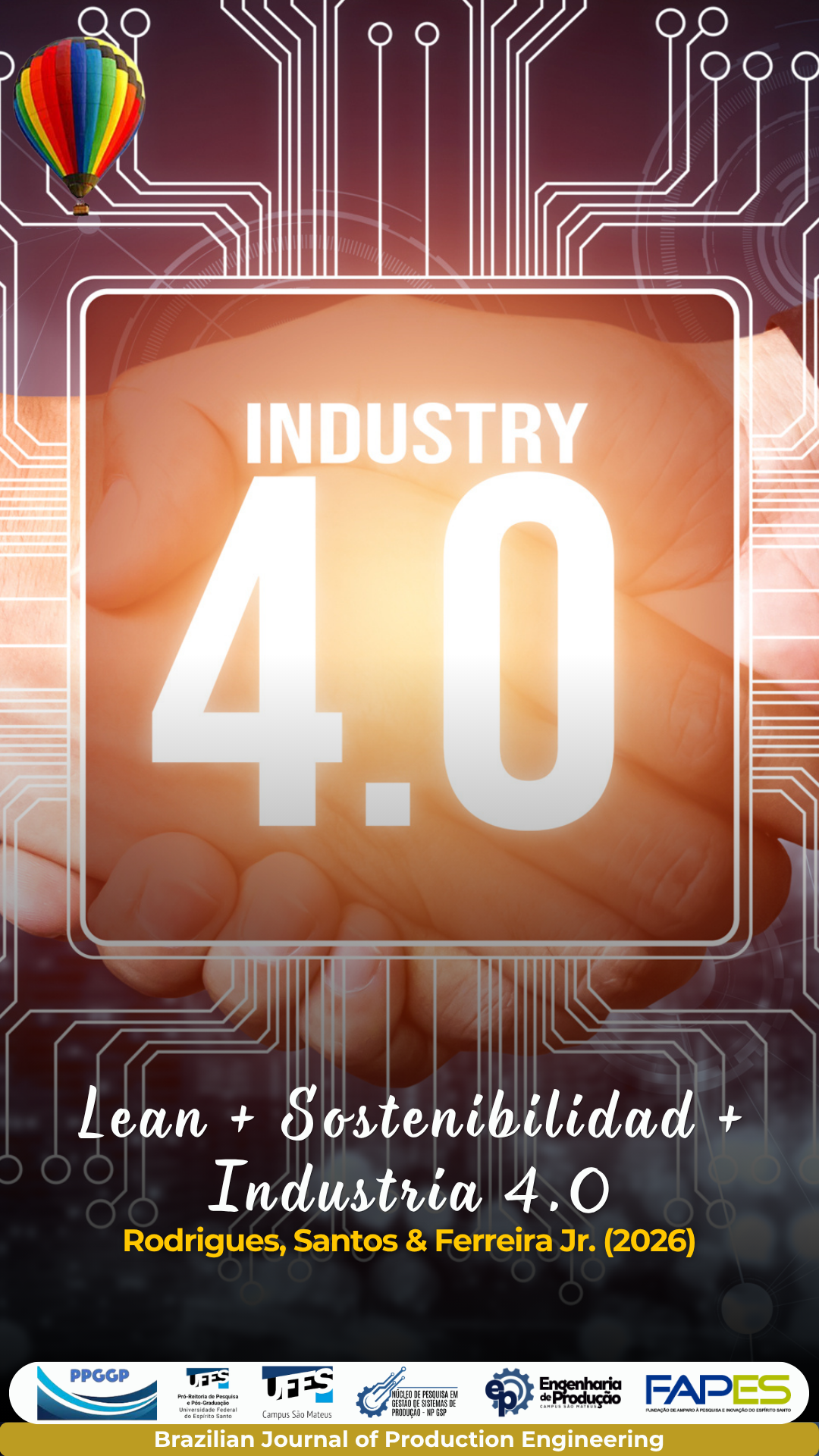
La creciente búsqueda de competitividad, eficiencia operativa y responsabilidad socioambiental ha llevado a las organizaciones a integrar prácticas de manufactura esbelta y sostenibilidad. En este contexto, la manufactura esbelta se destaca por la eliminación de desperdicios, la mejora continua y el aumento de la productividad. El presente estudio tiene como objetivo construir un modelo conceptual que explicite los principales constructos de la manufactura esbelta y la sostenibilidad, explorando sus relaciones. Para ello, se realizó un mapeo científico de la literatura mediante bibliometría descriptiva y análisis de redes sociales, permitiendo identificar temas, tendencias y productores de conocimiento en el campo. Posteriormente, a través de una revisión sistemática de la literatura, se presenta el desarrollo del modelo conceptual propuesto. Los resultados evidenciaron tres clusters temáticos principales: mapeo de procesos, manufactura esbelta e Industria 4.0. La interrelación entre los elementos de estos clusters puede potenciar prácticas sostenibles y apoyar la mejora continua en las organizaciones industriales. Así, el mapeo de procesos contribuye a la identificación de desperdicios y oportunidades de mejora: la manufactura esbelta promueve la eficiencia operativa y la reducción de costos; y la Industria 4.0 amplía la integración tecnológica y la sostenibilidad de las operaciones.
- Biografía del autor/a
- Referencias
-
Abdulmalek, F. A. & Rajgopal, J. (2007). Analyzing the benefits of lean manufacturing and value stream mapping via simulation: a process sector case study. International Journal of Production Economics, 107(1), 223-36. https://doi.org/10.1016/j.ijpe.2006.09.009
Abidin, M. H. Z., Leman, Z., Mohd Yusof, Z. A., & Ismail, M. Y. (2022). Scrutinizing the impact of essential lean methods on sustainable performance in Malaysian manufacturing firms. Jurnal Teknologi (Sciences & Engineering), 84(5), 11-25. https://doi.org/10.11113/jurnalteknologi.v84.18413
Aria, M. & Cuccurullo, C. (2017). Bibliometrix: An R-tool for comprehensive science mapping analysis. Journal of Informetrics, 11(4), 959-75. https://doi.org/10.1016/j.joi.2017.08.007
Bianco, D., Godinho Filho, M., Negrão, L. L. L., Ganga, G. M. D., Tortorella, G. L., da Silva, J. M. N., Costa, L. B. M., & Barata, M. P. C. (2024). Companies’ responsiveness in facing supply chain breakdowns: the role of lean manufacturing. IEEE Transactions on Engineering Management, 71, 6712-24. https://doi.org/10.1109/TEM.2023.3286352
Brito, J. G. L., et al. (2023). Analysis of the application of sustainability practices in companies in Pernambuco. Anais do XXXI Simpósio de Engenharia de Produção.
Brito, M. C. R., et al. (2023). Application of Sustainability Model 4.0: A study in manufacturing companies. Anais do XXX Simpósio de Engenharia de Produção, Bauru, SP, Brasil.
Cherrafi, A., et al. (2016). Lean, green and Six Sigma: A systematic review. Journal of Cleaner Production, 136, 118-32. https://doi.org/10.1016/j.jclepro.2016.03.015
Cherrafi, A., et al. (2016). The integration of lean manufacturing, Six Sigma and sustainability: a literature review and future research directions for developing a specific model. Journal of Cleaner Production, 139, 828-46. https://doi.org/ 10.1016/j.jclepro.2016.08.101/
Díaz-Reza, J. R., García-Alcaraz, J. L., Sánchez-Ramírez, C., & Realyvásquez Vargas, A. (2024a). Assessing the impact of lean manufacturing on the social sustainability through structural equation modeling and system dynamics. Jordan Journal of Mechanical and Industrial Engineering, 18(1), 113-30. https://doi.org/10.59038/jjmie/180109/
Díaz-Reza, J. R., Mousavi, S. H., Sánchez-Ramírez, C., & García-Alcaraz, J. L. (2024b). Achieving social sustainability through lean manufacturing practices: insights from structural equation model and system dynamics. Journal of Cleaner Production, 448, 141453. https://doi.org/10.1016/j.jclepro.2024.141453/
Drucker, P. F. & Maciariello, J. A. (2004). The Daily Drucker: 366 days of insight and motivation for getting the right things done. HarperBusiness.
Elkington, J. (2006). Governance for sustainability. Corporate Governance: An International Review, 14(6), 522-9. https://doi.org/10.1111/j.1467-8683.2006.00527.x
Faulkner, W. & Badurdeen, F. (2014). Sustainable Value Stream Mapping (Sus-VSM): methodology to visualize and assess manufacturing sustainability performance. Journal of Cleaner Production, 85, 8-18. https://doi.org/10.1016/j.jclepro.2014.05.042
Faulkner, W. & Badurdeen, F. (2020). The use of a sustainable value stream mapping tool to improve manufacturing processes. Proceedings of the 24th CIRP Conference on Manufacturing Systems.
Ferrer, J. A. G., Obilcnik, H., Paschoalinoto, N. W., & Bruno, D. O. T. (2022). Lean manufacturing sostenible - metodología de aplicación del mapeo de flujo de valor sostenible (Sus-VSM). Revista Brasileira de Mecatrônica, 4(3), 1-18.
Ferrer, J. A. G., et al. (2022). Sustainable lean manufacturing: Methodology for applying sustainable value stream mapping (SUS-VSM). Revista Brasileira de Mecatrônica, 4(3), 1-18.
Figueroa, A. D., et al. (2024). The mediating role of lean management in the relationship between sustainable manufacturing and firm performance. Journal of Cleaner Production, 441, 140640.
Fukuda, K., et al. (2018). The Japanese economic miracle: The role of manufacturing. In International Encyclopedia of the Social & Behavioral Sciences (2nd ed.). Elsevier.
Fukuda, S. de O., et al. (2018). The importance of innovation and the export-oriented model in the Japanese development project: an analysis based on the Toyota case.
Gaikwad, V. S. & Sunnapwar, V. K. (2021). A hybrid lean-green-six sigma model for sustainable performance improvement. International Journal of Six Sigma and Competitive Advantage, 13(3), 250-75. https://doi.org/10.1504/IJSSCA.2021.120612
García-Alcaraz, J. L., Flor-Montalvo, F. J., Avelar-Sosa, L., Sánchez-Ramírez, C., & Jiménez-Macías, E. (2019). Human resource abilities and skills in TQM for sustainable enterprises. Sustainability, 11(22), 6488. https://doi.org/10.3390/su11226488
Helleno, A. L., Moraes, A. J. I., & Simon, A. T. (2017). Integrating sustainability indicators and Lean Manufacturing to assess manufacturing processes: application case studies in Brazilian industry. Journal of Cleaner Production, 153, 405-16. https://doi.org/10.1016/j.jclepro.2016.12.072
Henao, R., Sarache, W., & Gómez, I. (2019). Lean manufacturing and sustainable performance: Trends and future challenges. Journal of Cleaner Production, 208, 99-116. https://doi.org/10.1016/j.jclepro.2018.10.116
Inman, R. A. & Green, K. W. (2018). Lean and green combine to impact environmental and operational performance. International Journal of Production Research, 56(14), 4802-18. https://doi.org/10.1080/00207543.2018.1447705
Kale, P., et al. (2022). A structural equation modeling approach to lean manufacturing and occupational health and safety management system integration. Journal of Cleaner Production, 333, 129888. https://doi.org/10.1016/j.jclepro.2021.129888
Liker, J. K. (2021). The Toyota Way: 14 management principles from the world's greatest manufacturer (2nd ed.). McGraw-Hill Education.
López-Robles, J.-R., Guallar, J., Gamboa-Rosales, N.-K., Otegi-Olaso, J.-R., & Cobo, M. J. (2019). Mapa de la estructura intelectual de El profesional de la información de 2014 a 2018. Hipertext.net, 19, 115-25.https://doi.org/10.31009/hipertext.net.2019.i19.09
Lopes-Robles, R., et al. (2019). Bibliometric and network analysis of research on sustainability and lean manufacturing. Journal of Cleaner Production, 238, 118047. https://doi.org/10.1016/j.jclepro.2019.117847
Marquez-Figueroa, F., et al. (2023). People management practices and social sustainability in manufacturing firms. Sustainability, 15(21), 15422. https://doi.org/10.3390/su152115422
Nagaraj, T. S. & Jeyapaul, R. (2021). An empirical investigation on association between human factors, ergonomics and lean manufacturing. Production Planning & Control, 32(16), 1337-51. https://doi.org/10.1080/09537287.2020.1810815/
Oliveira, D. C. S., et al. (2023). A bibliometric review of lean manufacturing and sustainability in the context of Industry 4.0. Sustainability, 15(12), 9587. https://doi.org/10.3390/su15129587
Panigrahi, S., Al Ghafri, K. K., Al Alyani, W. R., Ali Khan, M. W., Al Madhagy, T., & Khan, A. (2023). Lean manufacturing practices for operational and business performance: a PLS-SEM modeling analysis. International Journal of Engineering Business Management, 15, 18479790221147864. https://doi.org/10.1177/18479790221147864/
Reichhart, A. & Holweg, M. (2007). Lean distribution: concepts, contributions, conflicts. International Journal of Production Research, 45(16), 3699-722. https://doi.org/10.1080/00207540701449939
Santos, P. H. A. & Lizarelli, F. L. (2023). Práticas da gestão da cadeia de suprimentos sustentável: revisão terciária da literatura. In Anais do XLIII Encontro Nacional de Engenharia de Produção, Fortaleza, CE, Brasil, 1-14.
Savitz, A. W. & Weber, K. (2014). The triple bottom line: How today's best-run companies are achieving economic, social and environmental success, and how you can too. Jossey-Bass.
Singh, C. & Singh, D. (2024). How does green lean practices effect environmental performance? Evidence from manufacturing industries in India. Measuring Business Excellence, 28(1), 151-73. https://doi.org/10.1108/MBE-04-2023-0067/
Shashi, Centobelli, P., Cerchione, R., & Singh, R. (2019). The impact of leanness and innovativeness on environmental and financial performance: Insights from Indian SMEs. International Journal of Production Economics, 212, 111-24. https://doi.org/10.1016/j.ijpe.2019.02.011/
Slaper, T. F., & Hall, T. J. (2011). The triple bottom line: what is it and how does it work? Indiana Business Review, 86(1), 4-8.
Taddeo, R., Simboli, A., Di Vincenzo, F., & Ioppolo, G. (2019). A bibliometric and network analysis of Lean and Clean(er) production research (1990-2017). Science of the Total Environment, 653, 765-75. https://doi.org/10.1016/j.scitotenv.2018.10.412
Womack, J. P. & Jones, D. T. (2003). Lean thinking: Banish waste and create wealth in your corporation (2nd ed.). Free Press.
Womack, J. P. & Jones, D. T. (2005). Lean solutions: How companies and customers can create value and wealth together. Free Press.
Yang, M. G., Hong, P., & Modi, S. B. (2011). Impact of lean manufacturing and environmental management on business performance: An empirical study of manufacturing firms. International Journal of Production Economics, 129, 251-61. https://doi.org/10.1016/j.ijpe.2010.10.017
Yoshino, R. T. (2008). Proposal for the integration of tools in production in medium-sized companies (Tese de doutorado). University of São Paulo, São Carlos, SP, Brasil.
Zupic, I. & Čater, T. (2015). Bibliometric methods in management and organization. Organizational Research Methods, 18(3), 429-72. https://doi.org/10.1177/1094428114562629
- Cover Image
-
- Descargas
- Archivos adicionales
- Publicado
- 2026-09-16
- Sección
- INGENIERÍA DE CALIDAD
- Licencia
-
Derechos de autor 2026 Rodrigues, R. B., Santos, P. H. A., & Ferreira Junior, J. da S.

Esta obra está bajo una licencia internacional Creative Commons Atribución 4.0.
Todas las obras publicadas en la Revista Brasileña de Ingeniería de Producción (BJPE) están bajo la licencia Creative Commons Atribución 4.0 Internacional (CC BY 4.0). Esto significa que: Cualquier persona puede copiar, distribuir, exhibir, adaptar, remezclar e incluso utilizar comercialmente el contenido publicado en la revista; Siempre que se reconozca debidamente a los autores y a BJPE como fuente original; No se requiere permiso adicional para la reutilización, siempre que se respeten los términos de la licencia. Esta política cumple con los principios de acceso abierto, promoviendo la amplia difusión del conocimiento científico. 🔗 Haga clic aquí para acceder a la licencia completa.
