

2.png)





































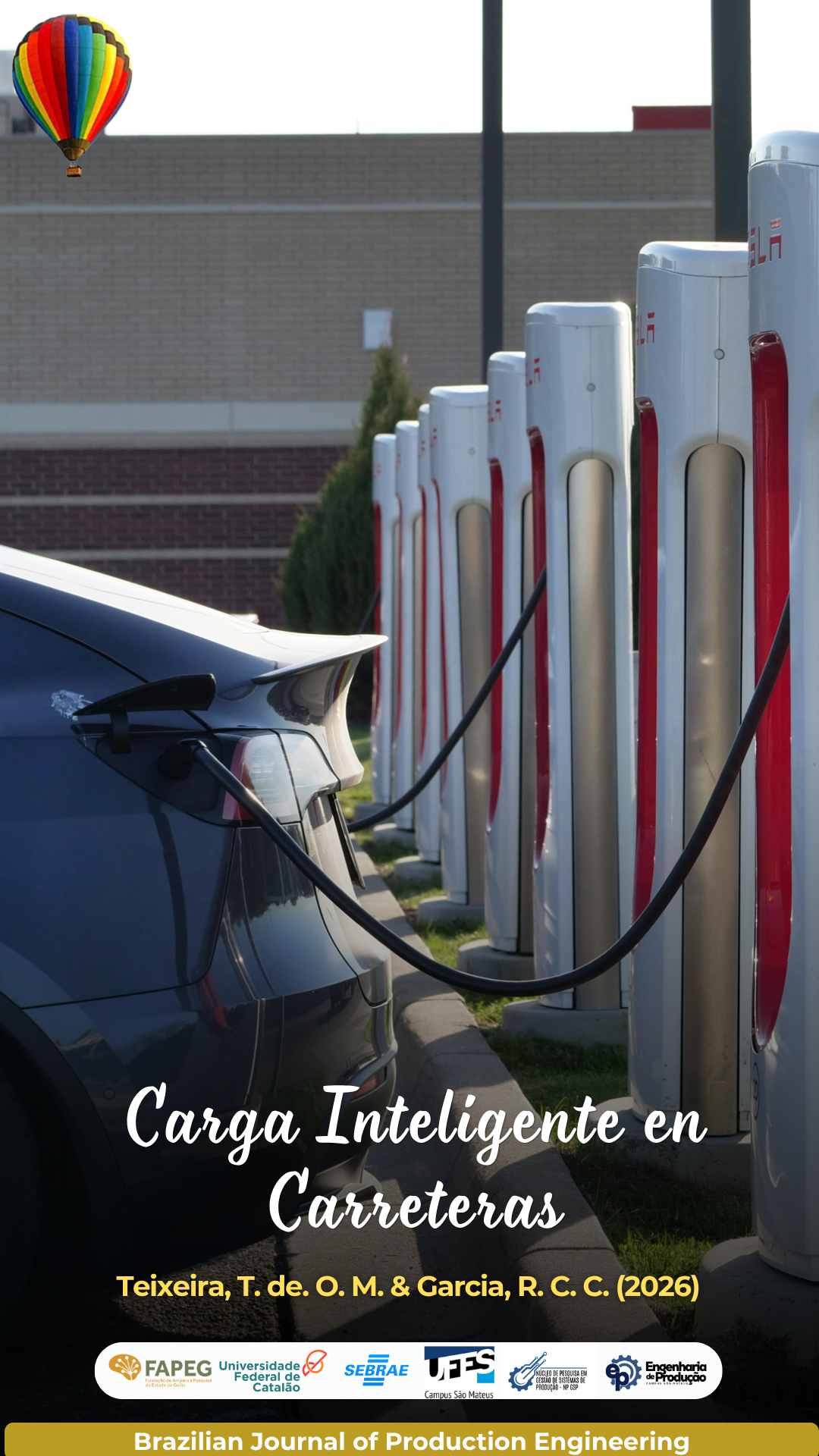
Optimización de la instalación de cargadores para vehículos eléctricos en carreteras no urbanas: un estudio de caso de BR-386, Motiva Viasul, Brasil
- Autores/as
-
-
Autor/a
-
Autor/a
-
- Palabras clave:
- Carga de vehículos eléctricos, optimización, algoritmo genético, sistema de información geográfica, ansiedad por la autonomía
- Resumen
-
Este estudio tiene como objetivo encontrar los puntos óptimos para la instalación de cargadores para vehículos eléctricos (EVs) en la carretera no urbana BR-386, perteneciente a la concesión MOTIVA ViaSul. Para ello, se aplica un modelo de algoritmo genético (GA) combinado con un sistema de información geográfica (GIS). El trabajo se implementó en tres etapas. La primera consistió en la adquisición y limpieza de la base de datos, ya que los datos se obtuvieron de diversas fuentes. La segunda etapa fue la implementación del modelo de GA. Esta fase utilizó los datos aplicados, incluyendo el flujo de tráfico (tanto en 2025 como en una estimación para 2030), la infraestructura de energía eléctrica y las especificaciones de los EVs. La tercera etapa fue la aplicación de diferentes escenarios para obtener la solución óptima del modelo. El modelo identificó dos ubicaciones óptimas para la asignación de cargadores de EVs, además del número ideal de cargadores, el tamaño promedio de la cola y el porcentaje de utilización de los cargadores, según el escenario: el de 2025 o el de 2030.
- Biografía del autor/a
- Referencias
-
Barbosa, W., et al. (2022). Electric vehicles: Bibliometric analysis of the current state of the art and perspectives. Energies, 15(2), 395.
Ghorbani, N., et al. (2018). Optimizing a hybrid wind–PV–battery system using GA-PSO and MOPSO for reducing cost and increasing reliability. Energy, 154, 581–591.
Gnann, T., et al. (2018). Fast charging infrastructure for electric vehicles: Today's situation and future needs. Transportation Research Part D: Transport and Environment, 62, 314–329.
Hassanat, A., et al. (2019). Choosing mutation and crossover ratios for genetic algorithms: A review with a new dynamic approach. Information, 10(12), 390.
Hemavathi, S., & Shinisha, A. (2022). A study on trends and developments in electric vehicle charging technologies. Journal of Energy Storage, 52, Article 105013.
Huang, Y., et al. (2018). Eco-driving technology for sustainable road transport: A review. Renewable and Sustainable Energy Reviews, 93, 596–609.
Hussain, A., et al. (2022). Genetic algorithm with a new round-robin based tournament selection: Statistical properties analysis. PLOS ONE, 17(9), Article e0274456.
Ibrahim, M. A., Mahmood, A. K., & Sultan, N. S. (2019). Optimal PID controller of a brushless DC motor using genetic algorithm. International Journal of Power Electronics and Drive Systems, 10(2), 822–830.
Karnauskas, K. B., Miller, S. L., & Schapiro, A. C. (2020). Fossil fuel combustion is driving indoor CO₂ toward levels harmful to human cognition. GeoHealth, 4(5).
Katoch, S., Chauhan, S. S., & Kumar, V. (2020). A review on genetic algorithm: Past, present, and future. Multimedia Tools and Applications, 80(5), 8091–8126.
Kazemi, H., & Akinci, H. (2018). A land use suitability model for rainfed farming by multi-criteria decision-making analysis (MCDA) and geographic information system (GIS). Ecological Engineering, 116, 1–6.
Kostopoulos, E. D., Spyropoulos, G. C., & Kaldellis, J. K. (2020). Real-world study for the optimal charging of electric vehicles. Energy Reports, 6, 418–426.
Lima, M. A., et al. (2020). Renewable energy in reducing greenhouse gas emissions: Reaching the goals of the Paris Agreement in Brazil. Environmental Development, 33, Article 100504.
Michalewicz, Z. (1996). Genetic algorithms + data structures = Evolution programs (3rd ed.). Springer.
Muratori, M., Kontou, E., & Eichman, J. (2019). Electricity rates for electric vehicle direct current fast charging in the United States. Renewable and Sustainable Energy Reviews, 113, Article 109235.
Neubauer, J., & Wood, E. (2014). The impact of range anxiety and home, workplace, and public charging infrastructure on simulated battery electric vehicle lifetime utility. Journal of Power Sources, 257, 12–20.
Noel, L., et al. (2019). Fear and loathing of electric vehicles: The reactionary rhetoric of range anxiety. Energy Research & Social Science, 48, 96–107.
Papazoglou, G., & Biskas, P. (2023). Review and comparison of genetic algorithm and particle swarm optimization in the optimal power flow problem. Energies, 16(3), 1152.
Pevec, D., et al. (2019). Electric vehicle range anxiety: An obstacle for the personal transportation (R)evolution? In 2019 4th International Conference on Smart and Sustainable Technologies (SpliTech) (pp. xx–xx). IEEE.
Ruan, J., & Song, Q. (2019). A novel dual-motor two-speed direct drive battery electric vehicle drivetrain. IEEE Access, 7, 54330–54342.
Singh, V., Singh, V., & Vaibhav, S. (2020). A review and simple meta-analysis of factors influencing adoption of electric vehicles. Transportation Research Part D: Transport and Environment, 86, Article 102436.
Xu, M., Yang, H., & Wang, S. (2020). Mitigate the range anxiety: Siting battery charging stations for electric vehicle drivers. Transportation Research Part C: Emerging Technologies, 114, 164–188.
Zhou, G., Zhu, Z., & Luo, S. (2022). Location optimization of electric vehicle charging stations: Based on cost model and genetic algorithm. Energy, 247, Article 123437.
- Cover Image
-
- Descargas
- Publicado
- 2026-07-20
- Sección
- Innovación, sostenibilidad y emprendimiento: caminos para transformar la ingeniería de producción.
- Licencia
-
Derechos de autor 2026 Teixeira, T. de. O. M. & Garcia, R. C. C.

Esta obra está bajo una licencia internacional Creative Commons Atribución 4.0.
Todas las obras publicadas en la Revista Brasileña de Ingeniería de Producción (BJPE) están bajo la licencia Creative Commons Atribución 4.0 Internacional (CC BY 4.0). Esto significa que: Cualquier persona puede copiar, distribuir, exhibir, adaptar, remezclar e incluso utilizar comercialmente el contenido publicado en la revista; Siempre que se reconozca debidamente a los autores y a BJPE como fuente original; No se requiere permiso adicional para la reutilización, siempre que se respeten los términos de la licencia. Esta política cumple con los principios de acceso abierto, promoviendo la amplia difusión del conocimiento científico. 🔗 Haga clic aquí para acceder a la licencia completa.
