

2.png)
































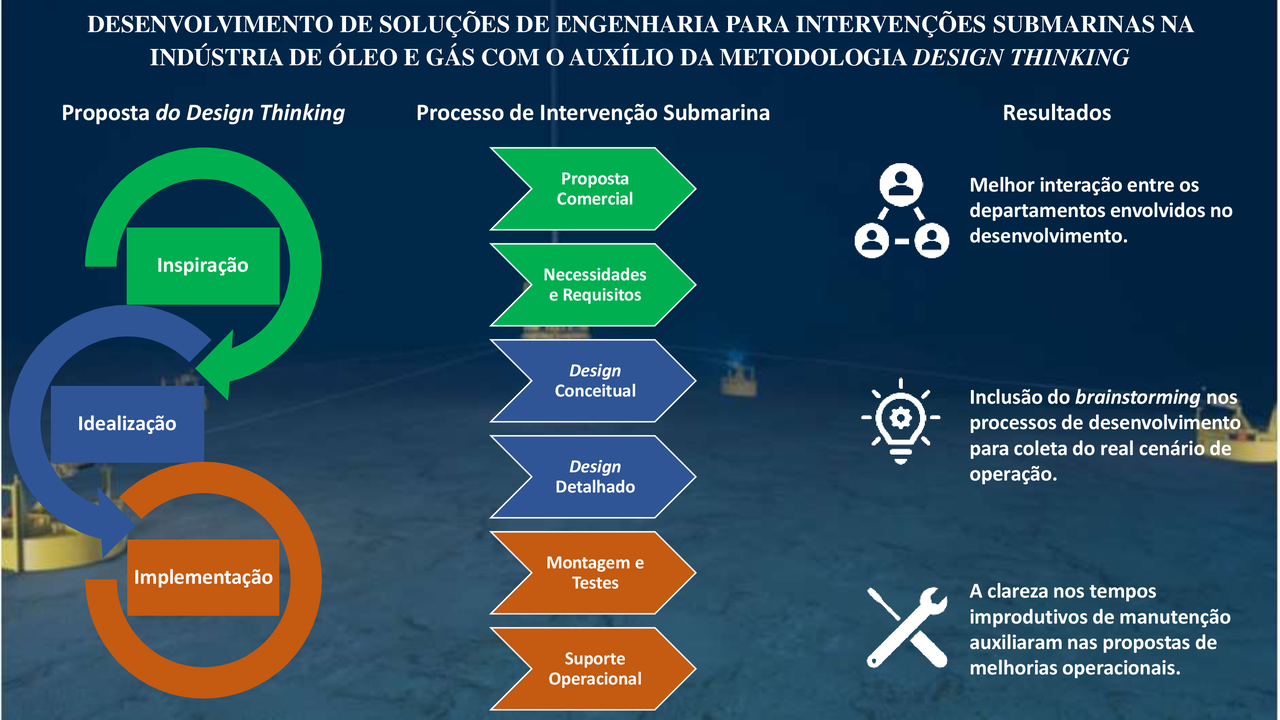
Desenvolvimento de soluções de engenharia para intervenções submarinas na indústria de óleo e gás com o auxílio da metodologia design thinking
- Autores
-
-
Pedro Gall Fernandes
Universidade Federal Fluminense, Instituto de Ciência e Tecnologia – ICT
Autor
-
Ricardo Luiz Fernandes Bella
Universidade Federal Fluminense, Instituto de Ciência e Tecnologia – ICT
Autor
-
- Palavras-chave:
- Desenvolvimento de produto, design thinking, indústria de óleo e gás, inovação, intervenções submarinas
- Resumo
-
A variação do preço do barril de petróleo no mercado global aumenta a competitividade das empresas da indústria de óleo e gás nas atividades de exploração e produção, sendo a melhoria no atendimento ao cliente fundamental para a sobrevivência das empresas prestadoras de serviços. Neste contexto, a aplicação da metodologia design thinking possui uma função essencial no desenvolvimento de soluções para intervenções submarinas nesta indústria, visto que o atendimento ao prazo de entrega e as necessidades do cliente são fundamentais para que não haja interrupção na produção de petróleo. O objetivo deste estudo é analisar como o design thinking, associado aos métodos de desenvolvimento de produto design for manufacturing (DFM) e design for assembly (DFA), pode ser inserido nos processos de engenharia de sistemas de uma empresa multinacional do segmento de óleo e gás para potencializar os resultados durante a execução dos projetos de desenvolvimento. O design thinking é inserido no método de pesquisa soft design science research para construção de uma solução que reduza os impactos nos desafios encontrados. Os resultados obtidos, tais como a interação entre os departamentos de engenharia, projetos, operações e compras, auxiliam no gerenciamento das atividades de desenvolvimento de produto, visando o atendimento às necessidades operacionais, de prazo e custo do usuário final.
- Biografia do Autor
- Referências
-
Al Hamed, O. & Nair, G. K. (2016). Systems dynamics for extra-ordinary results. Society of Petroleum Engineers - Abu Dhabi International Petroleum Exhibition and Conference 2016. https://doi.org/10.2118/183365-ms
Baskerville, R., Pries-Heje, J., & Venable, J. (2009). Soft design science methodology. Proceedings of the 4th International Conference on Design Science Research in Information Systems and Technology. https://doi.org/10.1145/1555619.1555631
Boisvenue-Fox, M. & Meyer, K. (2019). Not what you expected: Implementing design thinking as a leadership practice. Advances in Library Administration and Organization, https://doi.org/10.1108/S0732-067120190000040009
Bonini, L. A. & Sbragia, R. (2011). O Modelo de Design Thinking como Indutor da Inovação nas Empresas: Um Estudo Empírico. Revista de Gestão e Projetos, 2(1), 03–25. https://doi.org/10.5585/gep.v2i1.36
Brown, T & Wyatt, J. (2010). Design thinking for social innovation. Standford Social Innovation Review, 65–70. https://doi.org/10.2307/j.ctt1t8917t.13
Brown, Tim. (2008). Design Thinking. Harvard Business Review. https://doi.org/10.1145/3347709.3347775
Brown, Tim. (2009). Change by desing: How design thinking transform organizations and inspires innovation. Nova York, NY: HarperCollins e-books.
Caluri, L., Jianu, M., Cerioli, P., & Silvestri, G. B. (2019). Open innovation as enabling paradigm to empower digital transformation in oil & gas organizations. Society of Petroleum Engineers - Abu Dhabi International Petroleum Exhibition and Conference 2019, ADIP 2019. https://doi.org/10.2118/197904-ms
Camacho, M. (2016). David Kelley: From Design to Design Thinking at Stanford and IDEO. She Ji ,The Journal of Design, Economics, and Innovation, 2(1), 88–101. https://doi.org/10.1016/j.sheji.2016.01.009
Cankurtaran, P. & Beverland, M. B. (2020). Using design thinking to respond to crises: B2B lessons from the 2020 COVID-19 pandemic. Industrial Marketing Management, 88(June), 255–260. https://doi.org/10.1016/j.indmarman.2020.05.030
Carr, S. D., Halliday, A., King, A. C., Liedtka, J., & Lockwood, T. (2010). The Influence of Design Thinking in Business: Some Preliminary Observations. Design Management Review, 21(3), 58–63. https://doi.org/10.1111/j.1948-7169.2010.00080.x
Corrales-Estrada, M. (2019). Design thinkers’ profiles and design thinking solutions. Academia Revista Latinoamericana de Administracion, 33(1), 9–24. https://doi.org/10.1108/ARLA-01-2018-0028
Doorley, S., Holcomb, S., Klebahn, P., Segovia, K., & Utley, J. (2018). Design Thinking Bootleg. Design Thinking Bootleg. https://dschool.stanford.edu/resources/design-thinking-bootleg
Evensen, O., Womack, D., & Spencer, L. (2020). Essential tactics to foster innovation in oil and gas. Research Insights IBM. https://www.ibm.com/downloads/cas/VOJ540GZ
Geissdoerfer, M., Bocken, N. M. P., & Hultink, E. J. (2016). Design thinking to enhance the sustainable business modelling process – A workshop based on a value mapping process. Journal of Cleaner Production, 135, 1218–1232. https://doi.org/10.1016/j.jclepro.2016.07.020
Gobble, M. M. (2014). Design thinking. Research Technology Management, 59–61.
Goldberg, D. E. (2015). The Six Minds of a Whole New Engineer. Journal of Petroleum Technology, 67(03), 22–24. https://doi.org/10.2118/0315-0022-jpt
Holubchak, K. (2020). The application of design thinking methodology in architectural education in Ukraine: Case Study. 19–29. https://doi.org/10.21307/ACEE-2020-027
IDEO. (2015). Design Thinking for Better Libraries. Information Outlook, 15, 10–11. https://designthinking.ideo.com/resources/design-thinking-for-libraries
International Standard ISO / IEC / IEEE 15288:2015 - Systems and software engineering -System life cycle process. https://standards.ieee.org/ieee/15289/5789/
Johansson-Skoldberg, U., Woodilla, J., & Çetinkaya, M. (2013). Design Thinking: Past, Present and Possible Futures. John Wiley & Sons Ltd, 22(2), 176–190. https://doi.org/10.4324/9781315748825-13
Kelley, D. & Kelley, T. (2013). Creative confidence - Unleashing the creative potential within us all. Nova York, NY: Crown Business.
Kelley, T. & Littman, J. (2005). The ten faces of innovation. Nova York, NY: Doubleday.
Kelly, T. & Littman, J. (2001). The art of innovation, lessons in creativity from IDEO. Nova York, NY: Broadway Business.
Kitchenham, B. & Charters, S. (2007). Guidelines for performing systematic literature reviews in Software Engineering. Technical Report No. EBSE -2007-01. https://doi.org/10.1145/1134285.1134500
Kritsadativud, P., Sivapiromrat, P., Limprasert, T., Srihirunrusmee, S., Whangkitjamorn, J., Navasumrit, P., Roatkanjanaporn, T., Sapmanee, K., Palviriyachote, S., Thongpian, D., Kaewmuang, W., Promsen, P., Kittisupalauk, S., Kittisureethorn, N., Tan, S., & Swarnanto, L. D. (2017). Prolonging gas production until the end of concession by optimizing existing resources: A case study from greater bongkot south field development strategy. Society of Petroleum Engineers - SPE Abu Dhabi International Petroleum Exhibition and Conference 2017. https://doi.org/10.2118/188178-ms
Kumar, V. (2013). Vijay Kumar, 101 Design Methods: A Structured Approach for Driving Innovation in Your Organization. Hoboken, NJ: John Wiley & Sons Inc.
Kummitha, R. K. R. (2018). Institutionalising design thinking in social entrepreneurship: A contextual analysis into social and organizational processes. Social Enterprise Journal, 14(1), 92–107. https://doi.org/10.1108/SEJ-12-2016-0059
Leavy, B. (2011). Roger Martin explores three big ideas: Customer capitalism, integrative thinking and design thinking. Strategy and Leadership, 39(4), 19–26. https://doi.org/10.1108/10878571111147369
Liedtka, J. (2014). Innovative ways companies are using design thinking. Strategy and Leadership, 42(2), 40–45. https://doi.org/10.1108/SL-01-2014-0004
Liedtka, J., King, A., & Bennett, K. (2013). Solving problems with design thinking: 10 stories of what works. Nova York, NY: Columbia Business School
Liedtka, J. & Ogilvie, T. (2011). Designing for Growth. Nova York, NY: Columbia University Press.
Lógó, E., Orbulov, V. "Case study for product development innovation based on design thinking approach, demonstrated by smart furniture project", Periodica Polytechnica Civil Engineering, v. 65, n. 2, p. 397–408, 2021. https://doi.org/10.3311/PPci.17321
Martin, R. (2007). How Successful Leaders. Harvard Business Review. https://hbr.org/2007/06/how-successful-leaders-think
Martin, R. (2009). The design of business: Why design thinking is the next competitive advantage. Cambridge, MA: Harvard Business Press.
Martin, R. & Euchner, J. (2012). Design thinking. Research Technology Management, 55(3), 10–14. https://doi.org/10.5437/08956308X5503003
Mikkelsen, J. B., & Lange, I. S. G. (2017). Place in transition: Exploring the potentials of relocating disused oil rigs and transforming them into public places. Journal of Landscape Architecture, 12(2), 74–84. https://doi.org/10.1080/18626033.2017.1361095
Nahkle, C. (2018). New technological frontiers in the oil and gas industry. Newsweek, 1–37. https://d.newsweek.com/en/file/459598/newsweek-vantage-oil-gas.pdf
Neal, P. R., Ho, M., Fimbres-Weihs, G., Hussain, F., & Cinar, Y. (2010). Demonstrating CO2 sequestration as part of a first year engineering course. Proceedings - SPE Annual Technical Conference and Exhibition, 2, 1220–1233. https://doi.org/10.2118/133740-ms
Riel, J., & Martin, R. (2017). An integrative methodology for creatively exploring decision choices. Strategy and Leadership, 45(5), 3–9. https://doi.org/10.1108/SL-07-2017-0063
Simon, H. A. (1996). The Sciences of the Artificial. Cambridge, MA.: The MIT Press.
Susman, G. I. & Evered, R. D. (1978). An Assessment of the Scientific Merits of Action Research. Administrative Science Quarterly, 23(4), 582. https://doi.org/10.2307/2392581
Tomkoria, A. (2016). Design thinking helps realize the full potential of the digital revolution. Offshore, 76(8). https://www.offshore-mag.com/business-briefs/company-news/article/16755007/design-thinking-helps-realize-the-full-potential-of-the-digital-revolution
Ulrich, K. T., Eppinger, S. D., & Yang, M. (7ª ed.) (2020). Product design and development. Nova York, NY: McGraw-Hill Education.
Walden, D. D., Roedler, G. J., Forsberg, K. J., et al. (2015). Systems Engineering Handbook - A Guide for System Life Cycle Processes and Activities. (4ª ed.). Hoboken, New Jersey: John Wiley & Sons.
Xu, J., Ye, M., Lu, W., Bao, Z., & Webster, C. (2021). A four-quadrant conceptual framework for analyzing extended producer responsibility in offshore prefabrication construction. Journal of Cleaner Production, 282, 124540. https://doi.org/10.1016/j.jclepro.2020.124540
- Cover Image
-
- Publicado
- 07.07.2022
- Seção
- ENGENHARIA DO PRODUTO
- Licença
-
Direitos autorais (c) 2022 Pedro Gall Fernandes, Ricardo Luiz Fernandes Bella (Autor)

Este trabalho está licenciado sob uma licença Creative Commons Attribution 4.0 International License.
Qualquer pessoa pode copiar, distribuir, exibir, adaptar, remixar e até utilizar comercialmente os conteúdos publicados na revista; Desde que sejam atribuídos os devidos créditos aos autores e à BJPE como fonte original; Não é exigida permissão adicional para reutilização, desde que respeitados os termos da licença. Esta política está em conformidade com os princípios do acesso aberto, promovendo a ampla disseminação do conhecimento científico. 🔗 CC BY 4.0
