

2.png)



































A study of HYDROPOL2D and SWAT+GWFLOW models to improve flood forecasting: a case study in Brazil
- Autores
-
-
Autor
-
- Palavras-chave:
- knowledge management, bio-dynamic model, Culture, hydrodynamic model, organizational intelligence
- Resumo
-
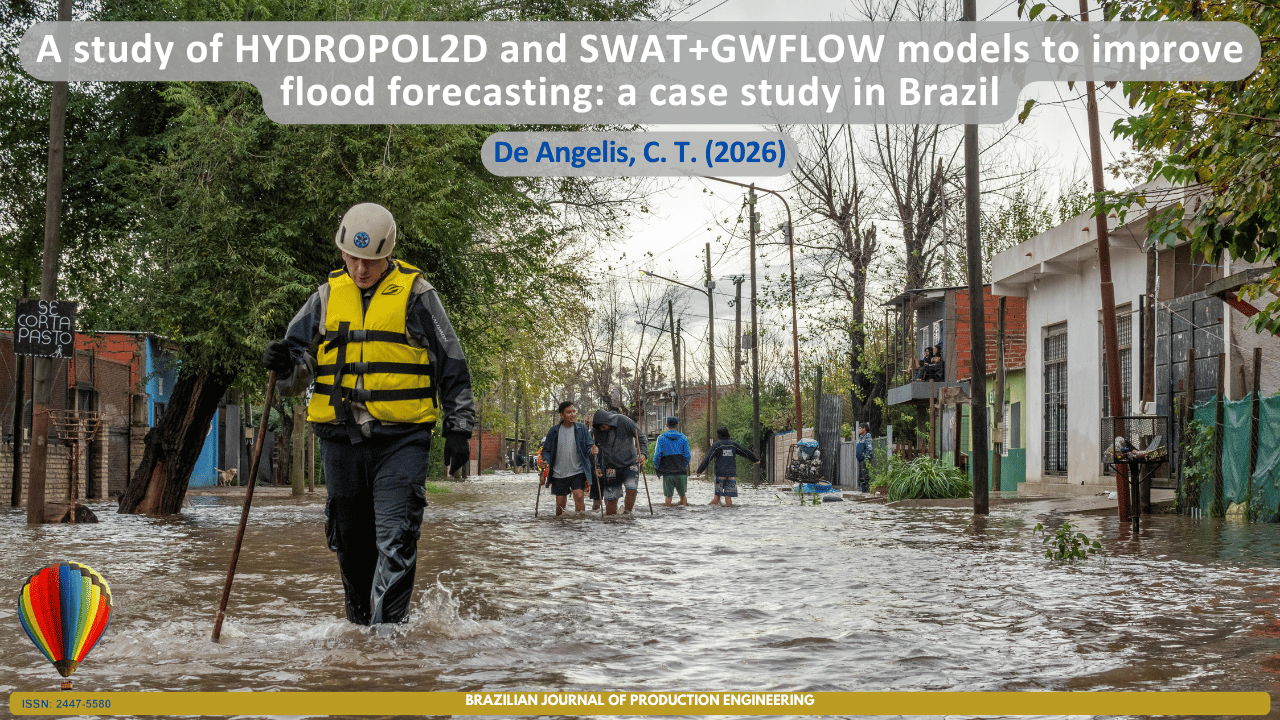
Limited studies have assessed the effects of land management practices on hydrologic processes and agronomic responses in fully integrated stream-aquifer systems, considering the whole picture: hydrology - agroforestry systems - humans - biodiversity. As climate change intensifies and urban vegetation is increasingly altered, urban basins are experiencing more frequent and severe flood events. Hydrodynamic models are vital for understanding and managing these events, but they often rely on hydrometric station data that can be both scarce and inaccurate, especially during extreme weather. This research focuses on how combining structural strategies with non-structural approaches can improve flood resilience and emergency response planning. The central research question asks: How does culture influence flood management systems (including hydrodynamic modeling) and drainage-related challenges like waterlogging? A key outcome of the study is the identification of a Knowledge Management and Social Participation framework as a useful tool for creating an effective flood management plan using the HydroPol2D model. However, the limitations of HydroPol2D, particularly its lack of consideration for agricultural impacts on hydrology, lead to the recommendation of using the SWAT+ model alongside the GWFlow groundwater module to provide a more integrated and robust hydrological evaluation.
- Biografia do Autor
- Referências
-
Araújo. L. (2024). Emergência climática traz necessidade de mudança em parâmetros de risco de desastres. Jornal do Comércio. Retrieved from https://www.jornaldocomercio.com/cadernos/empresas-e-negocios/2024/05/1155968-emergencia-climatica-traz-necessidade-de-mudanca-em-parametros-de-risco-de-desastres.html
Arsenault, R., Breton-Dufour, M., Poulin, A., Dallaire, G., & Romero-Lopez, R. (2019). Streamflow prediction in ungauged basins: analysis of regionalization methods in a hydrologically heterogeneous region of Mexico. Hydrological Sciences Journal, 64(11), 1297-1311. https://doi.org/10.1080/02626667.2019.1639716
Bao, Z., Zhang, J., Liu, J., Fu, G., Wang, G., He, R., Yan, X., Jin, J., & Liu, H. (2012). Comparison of regionalization approaches based on regression and similarity for predictions in ungauged catchments under multiple hydro-climatic conditions. Journal of Hydrology, 466-467, 37-46. https://doi.org/10.1016/j.jhydrol.2012.07.048
Brunner, G. W. (2016). HEC-RAS river analysis system, 2D modeling users' manual. U.S. Army Corps of Engineer, Institute for Water Resource, Hydrologic Engineering Center.
Choo, C. W. (1996). The knowing organization: How organizations use information to construct meaning, create knowledge and make decisions. International Journal of Information Management, 16(5), 329-340. https://doi.org/10.1016/0268-4012(96)00020-5
Davenport, T. H., & Prusak, L. (2000). Working Knowledge, 2nd ed., Harvard Business School Press, Boston, MA.
Cutter, S. (1996). Social vulnerability to environmental hazards. Progress in Human Geography, 20(4), 529-539. https://doi.org/10.1177/030913259602000407
De Angelis, C. T. (2024). Um modelo e plano de emergência padronizado para as inundações. Jornal do Comércio. Retrieved from https://www.jornaldocomercio.com/opiniao/2024/07/1165074-um-modelo-e-plano-de-emergencia-padronizado-para-as-inundacoes.html
De Angelis, C. T. (2023). Um plano de educação ambiental baseado na educação infantil, participação social: um estudo de caso na Aldeia Terere em Sidrolândia. Revista Ambientale. Revista da Universidade Estadual de Alagoas/UNEAL. Retrieved from https://periodicosuneal.emnuvens.com.br/ambientale/article/view/535
De Angelis, C. T. & Gomes Jr., M. N. (2024). Uma sugestão de modelo hidrodinâmico para prever e gerir inundações. Jornal do Comércio. Retrieved from https://www.jornaldocomercio.com/opiniao/2024/07/1160994-uma-sugestao-de-modelo-hidrodinamico-para-prever-e-gerir-inundacoes.html
Do Lago, C., Brasil, J., Nóbrega, M., Mendiondo, E., & Giacomoni, M. (2024). Improving pluvial flood mapping resolution of large coarse models with deep learning. Hydrological Sciences Journal, 69(5), 607-621. https://doi.org/10.1080/02626667.2024.2329268
Fassoni-Andrade, A. C., Paiva, R. C., Rudorff, C. M., Barbosa, C. C., & Leão, E. M. (2020). High-resolution mapping of floodplain topography from space: a case study in the Amazon. Remote Sensing of Environment, 251, 112065. https://doi.org/10.1016/j.rse.2020.112065
Fassoni-Andrade, A. C., Durand, F., Azevedo A., Bertin, X., Santos, L. G., Khan, J. U., Testut, L., Moreira, D. M. (2023). Seasonal to interannual variability of the tide in the Amazon estuary. Continental Shelf Research, 255, 104945. https://doi.org/10.1016/j.csr.2023.104945
Getirana, A., Boone, A., Yamazaki, D., Decharme, B., Papa, F., & Mognard, N. (2012). The hydrological modeling and analysis platform (HyMAP): evaluation in the Amazon basin. Journal of Hydrometeorology, 13(6), 1641-1665. https://doi.org/10.1175/JHM-D-12-021.1
Gomes Jr., M. N., Giacomoni, M. H., Richmond, F. A., & Mendiondo, E. M. (2024). Global optimization-based calibration algorithm for a 2D distributed hydrologic-hydrodynamic and water quality model. Environmental Modelling & Software, 179, 106128. https://doi.org/10.1016/j.envsoft.2024.106128
Gomes Jr., M. N., Lago, C. A., Rápalo, L. M., Oliveira, P. T., Giacomoni, M. H., & Mendiondo, E. M. (2023). HydroPol2D - Distributed hydrodynamic and water quality model: challenges and opportunities in poorly gauged catchments. Journal of Hydrology, 625, Part A. 129982. https://doi.org/10.1016/j.jhydrol.2023.129982
Guidolin, M., Chen, A. S., Ghimire, B., Keedwell, E. C., Djordjevic, S., & Savic, D. A. (2016). A weighted cellular automata 2D inundation model for rapid flood analysis. Environmental Modelling & Software, 84, 378-394. https://doi.org/10.1016/j.envsoft.2016.07.008
Hu, D., Chen, Z., Li, Z., & Zhu, Y. (2024). An implicit 1D-2D deeply coupled hydrodynamic model for shallow water flows, Journal of Hydrology, 631, 130833. https://doi.org/10.1016/j.jhydrol.2024.130833
Jillo, A. Y., Demissie, S. S., Viglione, A., Asfaw, D. H., & Sivapalan, M. (2017). Characterization of regional variability of seasonal water balance within Omo-Ghibe River Basin, Ethiopia. Hydrological Sciences Journal, 62(8), 1200-1215. https://doi.org/10.1080/02626667.2017.1313419
Kroeber, A. L. (1949). The Concept of culture in science. The Journal of General Education, Penn State University Press, 3(3), 182-196. Retrieved from http://www.csun.edu/~rdavids/301fall08/301readings/Kroeber_Concept_of_Culture_in_Science.pdf
Li, G., Zhu, H., Jian, H., Zha, W. J., Wang, J., Shu, Z., Yao, S., & Han, H. (2023). A combined hydrodynamic model and deep learning method to predict water level in ungauged rivers, Journal of Hydrology, 625, Part A, 130025. https://doi.org/10.1016/j.jhydrol.2023.130025
Long, Y., Chen, W., Jiang, C., Huang, Z., Yan, S., & Wen, X. (2023). Improving streamflow simulation in Dongting Lake Basin by coupling hydrological and hydrodynamic models and considering water yields in data-scarce areas, Journal of Hydrology: Regional Studies, 47, 101420. https://doi.org/10.1016/j.ejrh.2023.101420
Silva, M. A. M. da., & Araújo, U. F. (2019). Aprendizagem-serviço e fóruns comunitários: articulações para a construção da cidadania na educação ambiental. Revista de Educação Ambiental. 24(1), 257-273. https://doi.org/10.14295/ambeduc.v24i1.8157
Nonnemacher, L., & Fan, F. (2023). Análise da viabilidade econômica da previsão de cheias no Rio Grande do Sul. Revista de Gestão de Água da América Latina, 20(e8), 1-15. https://doi.org/10.21168/rega.v20e8
Paiva, R., Collischonn, W., Miranda, P., Petry, I., Dornelles, F., Goldenfum, J., Fan, F., Ruhoff, A., & Fagundes, H. (2024). Critérios hidrológicos para adaptação à mudança climática: chuvas e cheias extremas na Região Sul do Brasil. Relatório IPH-UFRGS. 2024. Retrieved from https://www.ufrgs.br/iph/wp-content/uploads/2024/05/CriteriosAdaptacaoMudancaClimaticaChuvasCheiasExtremasSul.pdf
Rennó, C. D., & Soares, J. V. (2022). Modelos hidrológicos para gestão ambiental. Cursos INPE. Retrieved from http://www.dpi.inpe.br/geopro/modelagem/relatorio_modelos_hidrologicos.pdf
Rosman, P. C. C. (2001). Um sistema computacional de hidrodinâmica ambiental. Capítulo 1 (pp 1-161) In Métodos numéricos em recursos hídricos, 5. Editora ABRH e Fundação COPPETEC. Retrieved from https://www.sisbahia.coppe.ufrj.br/
Rothberg, H. N., & Erickson, G. S. (2004). From knowledge to intelligence: creating competitive advantage in the next economy. Retrieved from https://api.semanticscholar.org/CorpusID:168565029
Schein, E. H. (2010). Organizational culture and leadership. 4th. Edition. San Francisco: Jossey-Bass Publishers. Retrieved from https://ia800805.us.archive.org/9/items/EdgarHScheinOrganizationalCultureAndLeadership/Edgar_H_Schein_Organizational_culture_and_leadership.pdf
Stokes Oceanografia. (2023). Estudos sobre modelos hidrodinâmicos. Retrieved from http://stokesoceanografia.com.br/2020/08/07/modelos-hidrodinamicos1/
Yang, L., Zeng, S., Xia, J., Wang, Y., Huang, R., & Chen, M. (2022). Effects of the Three Gorges Dam on the downstream streamflow based on a large-scale hydrological and hydrodynamics coupled model. Journal of Hydrology: Regional Studies, 40, 101039. https://doi.org/10.1016/j.ejrh.2022.101039
- Cover Image
-
- Arquivos adicionais
- Publicado
- 04.06.2026
- Seção
- ENGENHARIA AMBIENTAL E SUSTENTABILIDADE
- Licença
-
Direitos autorais (c) 2026 De Angelis. C. T.

Este trabalho está licenciado sob uma licença Creative Commons Attribution 4.0 International License.
Qualquer pessoa pode copiar, distribuir, exibir, adaptar, remixar e até utilizar comercialmente os conteúdos publicados na revista; Desde que sejam atribuídos os devidos créditos aos autores e à BJPE como fonte original; Não é exigida permissão adicional para reutilização, desde que respeitados os termos da licença. Esta política está em conformidade com os princípios do acesso aberto, promovendo a ampla disseminação do conhecimento científico. 🔗 CC BY 4.0
