

2.png)






























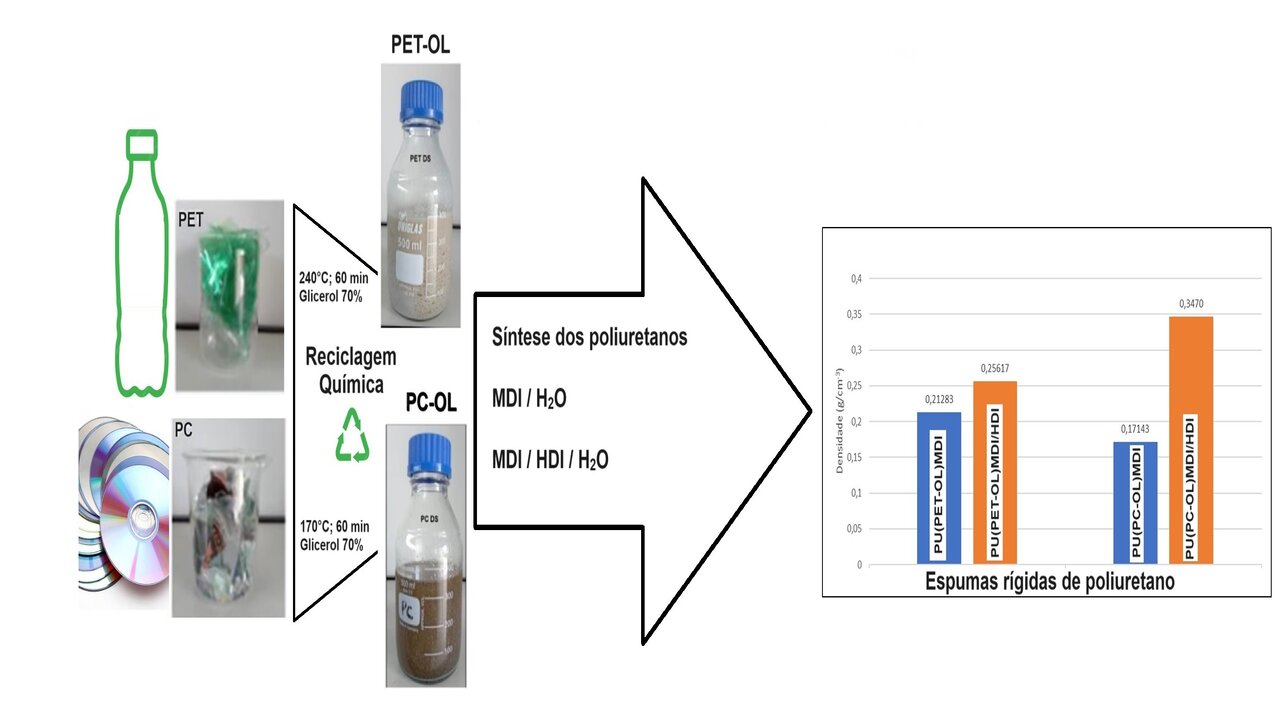
Avaliação da densidade de espumas de poliuretanos de PET e PC com mistura de diisocianatos
- Autores
-
-
Autor
-
Luiz H. Bigles
EEEFM Wallace Castelo Dutra – ES
Autor
-
Luiz H. de Lima
EEEFM Wallace Castelo Dutra – ES
Autor
-
Paulo da Silva
EEEFM Wallace Castelo Dutra – ES
Autor
-
Samuel L. Silvero
EEEFM Wallace Castelo Dutra – ES
Autor
-
David Manuel Costa Passinhas
Universidade Federal do Espírito Santo, CEUNES - Centro Universitário Norte do Espírito Santo.
Autor
-
Breno Nonato Melo
Universidade Federal do Espírito Santo, CEUNES - Centro Universitário Norte do Espírito Santo.
Autor
-
- Palavras-chave:
- Poliuretano, Densidade, HDI/MDI
- Resumo
-
As propriedades mecânicas dos poliuretanos (PU) são dependentes da densidade destes materiais. A mistura de diisocianatos na formulação dos PU’s é uma das estratégias quando se tem razão estequiométrica poliol e diisocianato menor do que um. Os polióis poliésteres obtidos pelo processo de despolimerização parcial do politereftalato de etileno (PET) e do policarbonato (PC) pelo processo de glicerólise formam PU’s com os diisocianato 4,4’-difenilmetano diisocianato (MDI) e com o 1,6- hexametileno diisocianato (HDI). De modo comparativo foram sintetizados PU’s apenas com MDI e também com uma mistura de 10% de HDI e 90% de MDI, para cada tipo de poliol. Observou-se que o PU obtido com a mistura teve sua densidade aumentada em 16% para o PU a partir de PET despolimeriado (PET-OL) e de 50% para o PU obtido a partir do PC despolimerizado (PC-OL). Observou-se a redução da absorção de água para ambos os poliuretanos obtidos com a mistura de diisocianatos.
- Biografia do Autor
- Referências
-
Oertel, G. (1994). Polyurethane Handbook - Chemistry – Raw Material – Processing – Applications – Properties. 2a ed. New York: Hanser Publishers, 1994.
Mordor Intelligence (2023) Tamanho do mercado poliuretano e análise de participação-tendências de crescimento e previsões 2023-2028. Recuperado de https://www.mordorintelligence.com/pt/industry-reports/polyurethane-market
Szycher, M. S. (2013). Handbook of Polyurethanes. 2a Ed. Boca Raton, Florida USA, 1112.
Melo, B. N., Araujo, D. P. R., Araujo, L. V., Pasa, V. M. D., Araujo, R. C. S., Paterno, L. G., & Mol, A. R. (2019). PET-ol uma nova classe de polióis na síntese de poliuretanos. In: 15º Congresso Brasileiro de Polímeros, 2019, Bento Gonçalves. Anais do 15º Congresso Brasileiro de Polímeros/Associação Brasileira de Polímeros. São Carlos: aptor software.
- Cover Image
-
- Downloads
- Arquivos adicionais
- Publicado
- 15.12.2023
- Seção
- Edição Especial "Semana de Química do Norte do Espírito Santo
- Licença
-
Direitos autorais (c) 2023 Kamilly S. Souza, Luiz H. Bigles, Luiz H. de Lima, Paulo da Silva, Samuel L. Silvero , David Manuel Costa Passinhas, Breno Nonato Melo (Autor)

Este trabalho está licenciado sob uma licença Creative Commons Attribution 4.0 International License.
Qualquer pessoa pode copiar, distribuir, exibir, adaptar, remixar e até utilizar comercialmente os conteúdos publicados na revista; Desde que sejam atribuídos os devidos créditos aos autores e à BJPE como fonte original; Não é exigida permissão adicional para reutilização, desde que respeitados os termos da licença. Esta política está em conformidade com os princípios do acesso aberto, promovendo a ampla disseminação do conhecimento científico. 🔗 CC BY 4.0
