

2.png)





































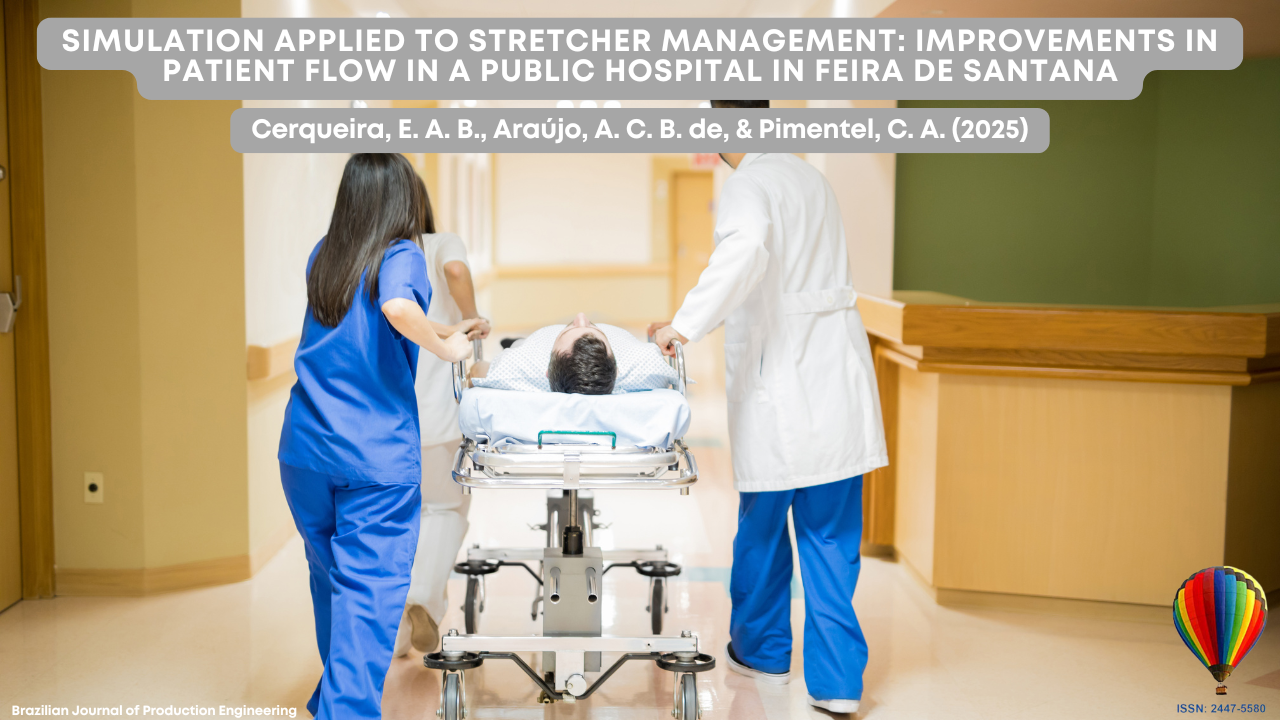
Simulation applied to stretcher management: improvements in patient flow in a public hospital in Feira de Santana
- Keywords:
- Hospital Simulation, Hospital Management, Health 4.0
- Abstract
-
The study explores the use of Industry 4.0 technologies in healthcare, focusing on simulation to optimize stretcher-bearer workflows, a relatively underexplored area. Efficient workflows are crucial for the safe transport of patients, directly impacting care quality and hospital resource management. The objective was to use simulation to improve stretcher-bearer workflows in a public hospital in Feira de Santana specializing in maternal and childcare, reducing wait times and optimizing movements. This descriptive research modeled current and future scenarios using FlexSim 24.0.4 software, with data collected from June to October 2024 during the busiest shifts. In the current scenario, a single stretcher-bearer covered 4.10 km per shift, whereas, in the future scenario with two stretcher-bearers, distances decreased to 2.67 km and 2.58 km, respectively. Travel times were reduced, and time available for patient care increased, enhancing operational efficiency. Simulation proved to be an effective tool for logistics optimization, improving care quality and working conditions. These findings highlight the methodology's potential for application in other hospital areas.
- Author Biographies
- References
-
Abreu, C. E. M., Emiliano, J. P., Andrade, R. O., & Marcelino, L. R. (2017). Indústria 4.0: Como as empresas estão utilizando a simulação para se preparar para o futuro. Revista de Ciências Exatas e Tecnologia, 12(12), 49-53. https://doi.org/10.17921/1890-1793.2017v12n12p49-53
Adaev, R. B. & Vetrova, O. A. (2023). Application of visualization tools for optimization problems of the transport model. Scientific Visualization, 15(2), 22-37. https://doi.org/10.26583/sv.15.2.03
Ahmad, J., Khan, M. E., Abid, S. A., Arif, S., & Tariq, M. (2020). A simulation-based study for managing hospital resources by reducing patient waiting time. IEEE Access, 8, 193523-193531. https://doi.org/10.1109/ACCESS.2020.3032760
Banks, J. (Ed.). (1998). Handbook of simulation: principles, methodology, advances, applications, and practice. John Wiley & Sons. https://doi.org/10.1002/9780470172445.ch6
Buer, S.-V., Semini, M., Strandhagen, J. O., & Sgarbossa, F. (2021). The complementary effect of lean manufacturing and digitalisation on operational performance. International Journal of Production Research, 59(7), 1976-1992. https://doi.org/10.1080/00207543.2020.1790684
Bunder, J. & Barros, G. G. (2019). O estudo de caso e a pesquisa-ação: compreensão teórica e evidências empíricas. Simpósio brasileiro de qualidade de projeto do ambiente construído, 6(1), 1561-1565. https://doi.org/10.14393/sbqp19140
Chao, M. M. & Wen, C. L. (2021). Residenciais 5.0 com saúde conectada: humanização com automação por inteligência artificial para promoção de bem-estar em saúde. World Congress of Architects. Recuperado de https://acsa-arch.org/ACSA.Intl.2021.125.pdf
Ciasullo, M. V., Polese, F., Troisi, O., & Carrubbo, L. (2022). Putting Health 4.0 at the service of Society 5.0: Exploratory insights from a pilot study. Socio-Economic Planning Sciences, 80, 101163. https://doi.org/10.1016/j.seps.2021.101163
Dossou, P.-E., Pereira, R., Salama, C., & Chang Jr., J. (2020). How to use lean manufacturing for improving a healthcare logistics performance. Procedia Manufacturing, 51, 1657-1664. https://doi.org/10.1016/j.promfg.2020.10.231
Flexsim. (2024). Flexsim Healthcare. Recuperado de https://www.flexsim.com/pt/healthcare/flexsim-hc/
Garcia, P. (2021). Simulação clínica: formação e inovação na promoção da qualidade e segurança do doente. Gazeta Médica, 8(4), 247-249.
Javaid, M., Haleem, A., Singh, R. P., & Gupta, S. (2024). Leveraging lean 4.0 technologies in healthcare: An exploration of its applications. Advances in Biomarker Sciences and Technology, 6, 138-151. https://doi.org/10.1016/j.abst.2024.08.001
Krishnamoorthy, S., Dua, A., Gupta, C., Jaiswal, S., Balakrishnan, S., Abraham, A., Chang, V., & Gandomi, A. H. (2023). Role of emerging technologies in future IoT-driven Healthcare 4.0 technologies: A survey, current challenges and future directions. Journal of Ambient Intelligence and Humanized Computing, 14(1), 361-407. https://doi.org/10.1007/s12652-021-03302-w
Lopes, E. C. S., Araújo, A. C., & Pimentel, C. A. (2024). Simulação aplicada à melhoria de fluxo em um hospital público. Brazilian Journal of Production Engineering, 10(3), 435-448. https://doi.org/10.47456/bjpe.v10i3.45221
Mazzocato, P., Savage, C., Brommels, M., Aronsson, H., & Thor, J. (2010). Lean thinking in healthcare: A realist review of the literature. Quality & Safety in Health Care, 19(5), 376-382. https://doi.org/10.1136/qshc.2009.037986
Nascimento Neto, C. D., Silva, S. F. B., Silva, D. G. K. C., Silva, A. L., & Silva, M. A. (2020). Inteligência artificial e novas tecnologias em saúde: desafios e perspectivas. Brazilian Journal of Development, 6(2), 9431-9445. https://doi.org/10.34117/bjdv6n2-306
Oliveira, D. M., Alves, J. P. S., Pontes, S. B. C., & Pimentel, C. A. (2024). Simulação para melhorar fluxo de exames em um laboratório hospitalar. Brazilian Journal of Production Engineering, 10(2), 452-465. https://doi.org/10.47456/bjpe.v10i2.44642
Randon, G., & Cecconello, I. (2019). Simulação como tecnologia habilitadora da Indústria 4.0: Uma revisão da literatura. Scientia cum Industria, 7(2), 117-125. https://doi.org/10.18226/23185279.v7iss2p117
Santana, E. R., Piacezzi, L. H. V., Lopes, M. C. B. T., Batista, R. E. A., Vancini-Campanharo, C. R., & Góis, A. F. T. (2021). Construção e validação de cenário de simulação de transporte intra-hospitalar. Einstein (São Paulo), 19, 1-9. https://doi.org/10.31744/einstein_journal/2021AO5868
Santos, V. S. dos. (2023). Otimização da operação de abastecimento de linhas de produção em processos industriais através da integração de técnicas de aprendizado por reforço e simulação: um estudo com o Proximal Policy Optimization (PPO) no ambiente FlexSim [Dissertação de mestrado]. Universidade Estadual de Campinas. Recuperado de https://repositorio.unicamp.br/acervo/detalhe/1371987
Silva, M. F., Mano, A. P., Oliveira, E., & Brum, E. (2020). Contribuições da Indústria 4.0 no Lean Healthcare. Anais do Encontro Nacional de Engenharia de Produção, Foz do Iguaçu, PR, Brasil. https://doi.org/10.14488/ENEGEP2020_TN_STO_342_1751_39590
Sun, T., Correa, J. C., Pisano, F., Finkelstein, S. N., Rose, A. F., & Wright, J. (2022). The digital twin in medicine: a key to the future of healthcare? Frontiers in Medicine, 9, 907066. https://doi.org/10.3389/fmed.2022.907066
Tlapa, D., Franco-Alucano, I., Limon-Romero, J., Baez-Lopez, Y., & Tortorella, G. (2022). Lean, Six Sigma, and simulation: Evidence from healthcare interventions. Sustainability, 14(24), 16849. https://doi.org/10.3390/su142416849
Tlapa, D., Tortorella, G., Fogliatto, F., Kumar, M., Mac Cawley, A., Vassolo, R., Enberg, L., & Baez-Lopez, Y. (2022). Effects of lean interventions supported by digital technologies on healthcare services: A systematic review. International Journal of Environmental Research and Public Health, 19(15), 9018. https://doi.org/10.3390/ijerph19159018
Tlapa, D., Zepeda-Lugo, C., Tortorella, G. L., Baez-Lopez, Y. A., Limon-Romero, J., Alvarado-Iniesta, A., & Rodriguez-Borbon, M. I. (2020). Effects of lean healthcare on patient flow: A systematic review. Value in Health, 23(2), 260-273. https://doi.org/10.1016/j.jval.2019.11.002
Tortorella, G. L., Fogliatto, F. S., Espôsto, K. F., Mac Cawley, A., Vassolo, R., Tlapa, D., & Narayanamurthy, G. (2020). Measuring the effect of healthcare 4.0 implementation on hospitals' performance. Production Planning & Control, 33(4), 386-401. https://doi.org/10.1080/09537287.2020.1824283
Werner, S. M., Marzall, L. F., Valle, A. C., Garcia, M. A., & Schaefer, J. L. (2019). Análise da implementação de sistemas inteligentes para a gestão da alta hospitalar. Gestão e Desenvolvimento, 16(1), 129-151. https://doi.org/10.25112/rgd.v16i1.1708
- Cover Image
-
- Downloads
- Published
- 2025-09-05
- Section
- TECHNOLOGY AND INNOVATION IN HEALTH
- License
-
Copyright (c) 2025 Cerqueira, E. A. B., Araújo, A. C. B. de, & Pimentel, C. A.

This work is licensed under a Creative Commons Attribution 4.0 International License.
All works published in the Brazilian Journal of Production Engineering (BJPE) are licensed under Creative Commons Attribution 4.0 International (CC BY 4.0). This means that: Anyone can copy, distribute, display, adapt, remix, and even commercially use the content published in the journal; Provided that due credit is given to the authors and to BJPE as the original source; No additional permission is required for reuse, as long as the license terms are respected. This policy complies with the principles of open access, promoting the broad dissemination of scientific knowledge. 🔗 Click here to access the full license
