

2.png)




































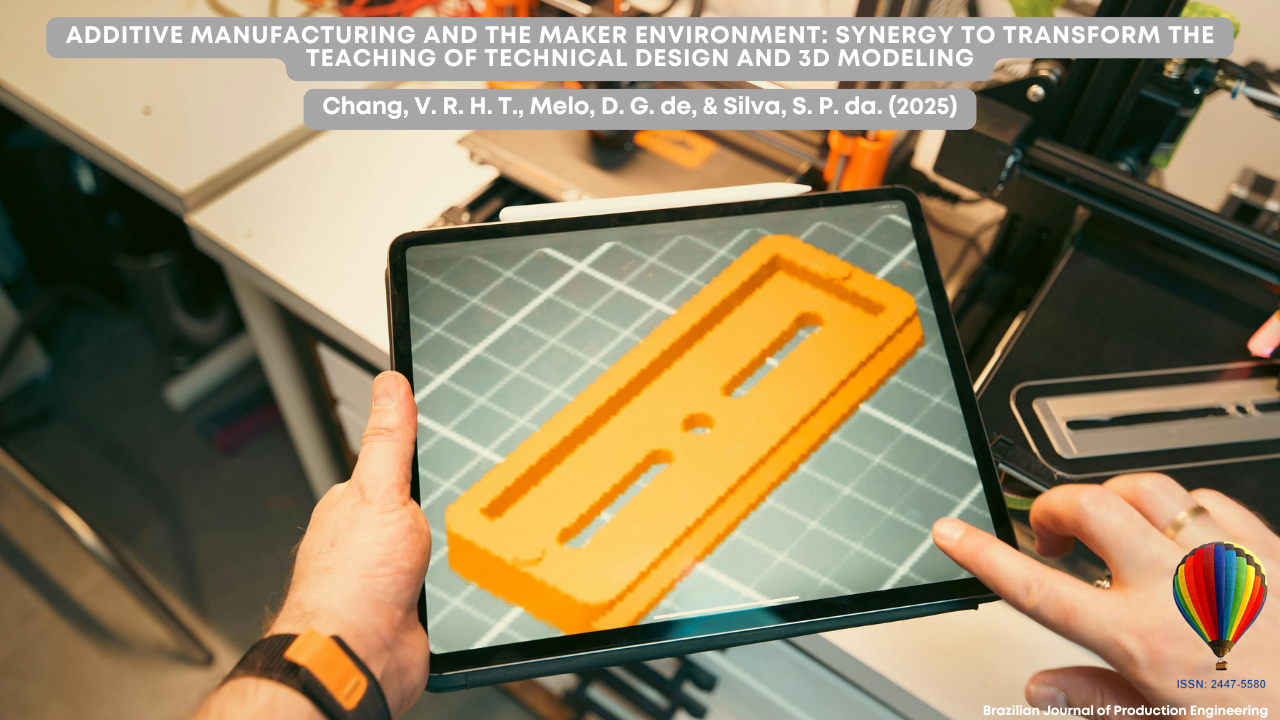
Additive manufacturing and the maker environment: synergy to transform the teaching of technical design and 3d modeling
- Authors
-
-
Victor Rasquinho Ho Te Chang
Instituto Federal de Educação, Ciência e Tecnologia de Minas Gerais Campus Congonhas
Author
-
Dominycke Guasti de Melo
Instituto Federal de Educação, Ciência e Tecnologia de Minas Gerais Campus Congonhas
Author
-
Sinval Pedroso da Silva
Instituto Federal de Educação, Ciência e Tecnologia de Minas Gerais Campus Congonhas
Author
-
- Keywords:
- Active learning, Educational 3D printing;, Digital technologies in education
- Abstract
-
The difficulty in visualizing three-dimensional objects is a common challenge in the teaching and learning process of technical drawing and 3D modeling. Thus, this work proposed the use of additive manufacturing as a strategy to overcome this difficulty and contribute to better preparing students to solve real problems in the study area. The methodology integrated CAD software with 3D printing, combining theory and practice through rapid prototyping of mechanical parts and assemblies. To evaluate the effectiveness of the adopted technique, a pre-test was applied at the beginning of the semester and a post-test at the end, with the eight students enrolled in the 3D Mechanical Modeling discipline, representing the entire class exposed to the methodology. The results showed an average increase of 46.8% in the grades obtained in the post-test compared to the pre-test. The findings suggest that the technique may have contributed to more meaningful learning, with greater understanding of concepts and better student engagement.
- Author Biographies
- References
-
Bertoline, G. R., Wiebe, E. N., Miller, C. L., & Nasman, L. O. (2010). Fundamentals of graphics communication (6. ed.). McGraw-Hill.
Catapan, M. (2014). Apostila de desenho mecânico 1. Recuperado de https://exatas.ufpr.br/degraf_marcio/wp-content/uploads/sites/13/2014/09/Apostila-Desenho-Mecanico-I-Parte.pdf
Carrara, A., Nousias, S., & Borrmann, A. (2024). VectorGraphNET: Graph attention networks for accurate segmentation of complex technical drawings. arXiv. Recuperado de https://arxiv.org/abs/2401.01336
Creality (2024). Creality Print calibration tutorial - Creality Wiki. Recuperado de https://wiki.creality.com/en/Software/creality-print/CalibrationTutorial
Drozda, F. C., et al. (2024). Estudo do efeito da combinação de preenchimento na absorção de energia de impacto de peças fabricadas em PLA utilizando fabricação por filamento fundidos. Brazilian Journal of Production Engineering, 10(3), 285-295. https://doi.org/10.47456/bjpe.v10i3.44945
Elo. (n.d.). Desenho técnico mecânico. Recuperado de https://elojr.com.br/sistemas-mecanicos/desenho-tecnico-mecanico/
Feriotti, M. A., et al. (n.d.). Os impactos da impressão 3D na fabricação de moldes para injeção de termoplásticos. In Anais do IV Simpósio Acadêmico de Engenharia de Produção (SAEPRO) da EEL-USP, 1-15.
Fernandes, J. F. M. (2016). Estudo da Influência de parâmetros de impressão 3D nas propriedades mecânicas do PLA [Dissertação de mestrado, Instituto Superior Técnico da Universidade de Lisboa].
Francesconi, T. (2010) Desenho técnico teórico. Recuperado de https://cliqueapostilas.com/Content/apostilas/fb729f6f52accc40fa475d25d7dd96f7.pdf
French, T. (1978). Desenho técnico (19th ed.). Editora Globo.
Giesecke, F. E., et al. (2023). Techincal drawing with engineering graphics. (16th ed.). Pearson.
Gil, A. C. (2019). Métodos e Técnicas de Pesquisa Social. (7th ed.). Atlas. Recuperado de https://evirtual.upra.ao/examples/biblioteca/content/files/antonio%20carlos%20gil%20-%20metodos%20e%20tecnicas%20de%20pesquisa%20social-atlas%20(2019).pdf
ISO/ASTM. (2021). ISO/ASTM 52900:2021 - Additive manufacturing - General principles - Fundamentals and vocabulary.
Karevska, S., et al. (2019). 3D printing: hype or game changer?
Ludwig, R. et al. (2017). Mechanisms of autoantibody-induced pathology. Frontiers in Immunology. https://doi.org/10.3389/fimmu.2017.00603
Magennis, S. & Ferrel, A. (2005). Teaching and learning activities: expanding the repertoire to support student learning. Emerging issues in the practice of university learning and teaching, 1, 45-54.
Martín Erro, A. & Nuere Menéndez-Pidal, S. (2024). How visual literacy is developed through Engineering Graphics subjects. Journal of Visual Literacy, 43(1), https://doi.org/10.1080/1051144X.2024.2315835
Martin Prosperity Institute (MPI). 2014. Startup city: The urban shift in venture capital and high technology. Recuperado de https://creativeclass.com/category/martin-prosperity-institute/
Mendes, M. L. N. & Silva, P. (2022). CAD e manufatura aditiva como ferramentas de iniciação científica e apoio didático para a área de engenharia. Revista Mundi Engenharia, Tecnologia e Gestão, 7(5), 445-1-445-21.
MiceliI, M. & Ferreira, P. (2009). Desenho técnico básico. (2nd ed.). livro técnico.
Miranda, H. C. (2012). Processos de fabricação. Universidade Federal do Ceará. Recuperado de https://kaiohdutra.wordpress.com/wp-content/uploads/2012/10/apostilateciii.pdf
OALOO (2021). O que é impressão 3D? Para que serve a impressão 3D? [Guia Definitivo 2021}. Recuperado de https://www.oaloo.com.br/impressao-3d-vantagens-desvantagens/
Provenza, F. (2010). Desenhista de máquinas.
Research and Markets. (2024) Aerospace additive manufacturing global market report 2024.
Riedner, D. D. T. & Pischetola, M. (2021). A inovação das práticas pedagógicas com uso de tecnologias digitais no ensino superior: um estudo no âmbito da formação inicial de professores. ETD - Educação Temática Digital, 23(1), 64-81.
Serdar, S. & de Vries, R. H. (2015). Enhancing spatial visualization skills in engineering drawing course. In Proceedings of the 122nd ASEE Annual Conference & Exposition (pp. 26.663.1–26.663.12). Seattle, WA: American Society for Engineering Education.
Souza (2020). 2020: Um ano marcado por desafios e aprendizados. Instituto Souza. Recuperado de https://institutosouza.com.br/fasouza/noticias/2020-um-ano-marcado-por-desafios-e-aprendizados
Vicente, C. M. S., et al. (2023). Large-format additive manufacturing of polymer extrusion-based deposition systems: review and applications. Progress in Additive Manufacturing, 8(6), 1257-1280.
Volpato, N. (2017). Manufatura aditiva: tecnologias e aplicações da impressão 3D. (1st ed.). Edgard Blucher Ltda.
- Cover Image
-
- Downloads
- Published
- 2025-07-23
- Section
- ENGINEERING EDUCATION
- License
-
Copyright (c) 2025 Chang, V. R. H. T., Melo, D. G. de, & Silva, S. P. da

This work is licensed under a Creative Commons Attribution 4.0 International License.
All works published in the Brazilian Journal of Production Engineering (BJPE) are licensed under Creative Commons Attribution 4.0 International (CC BY 4.0). This means that: Anyone can copy, distribute, display, adapt, remix, and even commercially use the content published in the journal; Provided that due credit is given to the authors and to BJPE as the original source; No additional permission is required for reuse, as long as the license terms are respected. This policy complies with the principles of open access, promoting the broad dissemination of scientific knowledge. 🔗 Click here to access the full license
