

2.png)



































Rota de produção de biocombustível a partir de casca de macadâmia: efeito de parâmetros sobre o índice de mistura em leitos fluidizados
- Authors
-
-
Bárbara Mendonça
Universidade Federal do Espírito Santo (UFES), Brasil
Author
-
Diunay Mantegazini
Universidade Federal do Espírito Santo (UFES), Brasil
Author
-
Yuri Nariyoshi
Universidade Federal do Espírito Santo (UFES), Brasil
Author
-
Author
-
- Keywords:
- Biomass, Fluid dynamic, Energy, Segregation, Sustainability
- Abstract
-
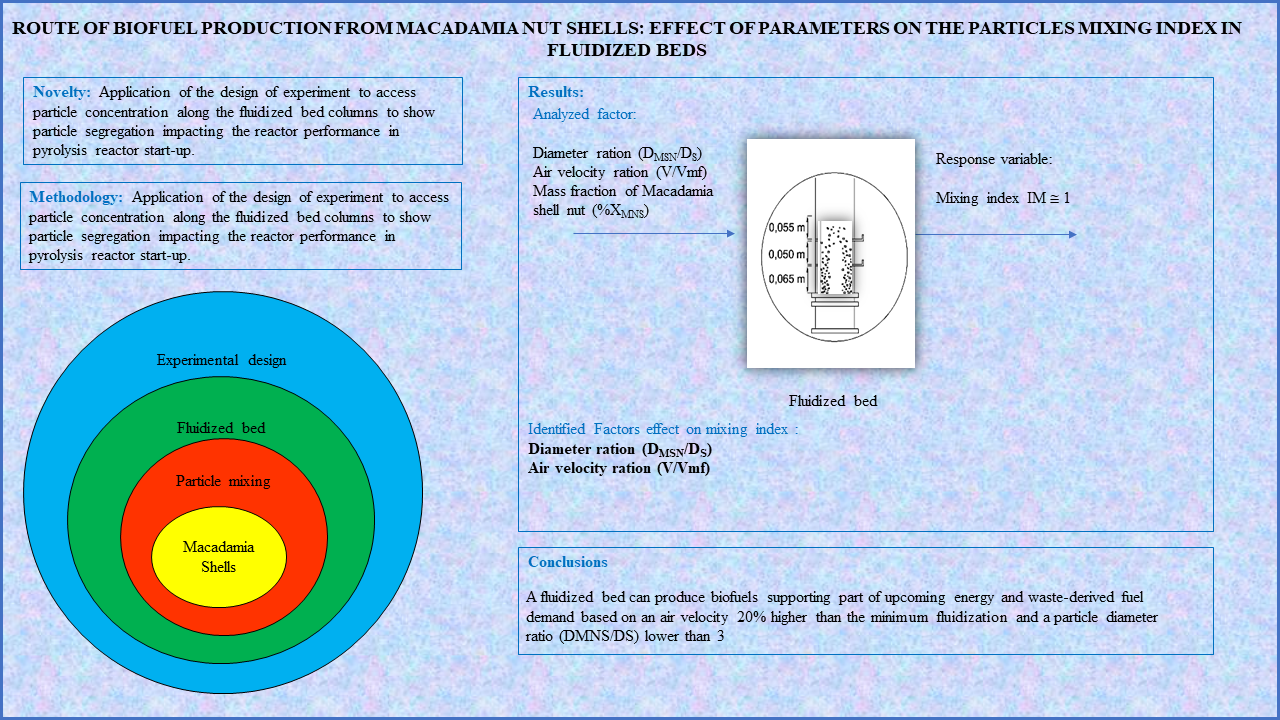
A pirólise da casca da macadâmia (MNS) em leito fluidizado tem grande potencial para produção de bio-óleo. O efetivo contato gás-sólido permite alcançar altas taxas de transferência de calor e temperatura uniforme no leito. Entretanto, misturas binárias podem levar à segregação de partículas, reduzindo as taxas de transferência de calor e massa no reator. Portanto, nesta pesquisa, o planejamento de experimentos foi aplicado para avaliar o efeito dos parâmetros (velocidade de injeção do ar, V/VMF; razão do diâmetro das partículas, DMNS/DS, e fração mássica de MNS, XMNS) sobre o índice de mistura (Im) em leito fluidizado composto por MNS e areia. A análise estatística revelou que apenas DMNS/DS e V/VMF tiveram efeito sobre índice de mistura (Im), considerando um intervalo de confiança de 95%. Desta forma, para velocidade do ar 20% acima da mínima fluidização e misturas com DMNS/DS < 3, os leitos fluidizados apresentaram concentrações de partículas uniforme ao longo da coluna. Os resultados indicam que o leito fluidizado pode ser empregado na produção de biocombustível a partir da casca de macadâmia.
- Author Biographies
- References
-
Artetxe, M., Lopez, G., Amutio, M., Elordi, G., Olazar, M., & Bilbao, J. (2010). Operating Conditions for the Pyrolysis of Poly-(ethylene terephthalate) in a Conical Spouted-Bed Reactor. Industrial & Engineering Chemistry Research, 49(5), 2064–2069. https://doi.org/10.1021/ie900557c
Bacelos, M. S., & Freire, J. T. (2006). Stability of spouting regimes in conical spouted beds with inert particle mixtures. Industrial and Engineering Chemistry Research, 45(2). https://doi.org/10.1021/ie050633s
Barcelos, K. M., Almeida, P. S., Araujo, M. S., Xavier, T. P., Santos, K. G., Bacelos, M. S., & Lira, T. S. (2020). Particle segregation in spouted bed pyrolysis reactor: Sand-coconut shell and sand-cocoa shell mixtures. Biomass and Bioenergy, 138, 105592. https://doi.org/10.1016/j.biombioe.2020.105592
Daleffe, R. V., & Freire, J. T. (2004). Analysis of the fluid-dynamic behavior of fluidized and vibrofluidized bed containing glycerol. Brazilian Journal of Chemical Engineering, 21(1), 35–46. https://doi.org/10.1590/S0104-66322004000100005
Freitas, T. M., Arrieche, L. S., Ribeiro, D. C., Gidaspow, D., & Bacelos, M. S. (2017). CFD analysis of fluidized beds using wastes from post-consumer carton packaging. Chemical Engineering and Processing: Process Intensification, 111, 89–100. https://doi.org/10.1016/j.cep.2016.12.002
Gong, Y., & Pegg, R. B. (2015). Tree nut oils: Properties and processing for use in food. Specialty Oils and Fats in Food and Nutrition: Properties, Processing and Applications, 65–86. https://doi.org/10.1016/B978-1-78242-376-8.00003-X
Hasan, M. M., Rasul, M. G., Jahirul, M. I., & Khan, M. M. K. (2022). Modeling and process simulation of waste macadamia nutshell pyrolysis using Aspen Plus software. Energy Reports, 8, 429–437. https://doi.org/10.1016/J.EGYR.2022.10.323
Hidaka, N., Onitani, M., Matsumoto, T., & Shigeharu, M. (1995). Inverted segregation of binary particles in gas-liquid-solid fluidized bed. Powder Technology, 84, 157–163.
Iannello, S., Bond, Z., Sebastiani, A., Errigo, M., & Materazzi, M. (2023). Axial segregation behaviour of a reacting biomass particle in fluidized bed reactors: experimental results and model validation. Fuel, 338, 127234. https://doi.org/10.1016/J.FUEL.2022.127234
Ji, X., Bie, R., Chen, P., & Gu, W. (2016). Reed Black Liquor Combustion in Fluidized Bed for Direct Causticization with Limestone as Bed Material. Energy and Fuels, 30(7), 5791–5798. https://doi.org/10.1021/ACS.ENERGYFUELS.6B00847
José, M. J. S., Olazar, M., Peñas, F. J., & Bilbao, J. (1994a). Segregation in Conical Spouted Beds with Binary and Ternary Mixtures of Equidensity Spherical Particles. 1838–1844. https://doi.org/10.1021/ie00031a025
José, M. J. S., Olazar, M., Peñas, F. J., & Bilbao, J. (1994b). Segregation in Conical Spouted Beds with Binary and Ternary Mixtures of Equidensity Spherical Particles. 1838–1844. https://doi.org/10.1021/ie00031a025
Lee, J., Kim, S., You, S., & Park, Y. K. (2023). Bioenergy generation from thermochemical conversion of lignocellulosic biomass-based integrated renewable energy systems. Renewable and Sustainable Energy Reviews, 178, 113240. https://doi.org/10.1016/J.RSER.2023.113240
Lopez, G., Artetxe, M., Amutio, M., Bilbao, J., & Olazar, M. (2017). Thermochemical routes for the valorization of waste polyolefinic plastics to produce fuels and chemicals. A review. In Renewable and Sustainable Energy Reviews, 73, 346–368. Elsevier Ltd. https://doi.org/10.1016/j.rser.2017.01.142
López, G., Olazar, M., Aguado, R., & Bilbao, J. (2010). Continuous pyrolysis of waste tyres in a conical spouted bed reactor. Fuel, 89(8), 1946-1952. https://doi.org/10.1016/J.FUEL.2010.03.029
Mantegazini, D. Z., Neves, F. L., Xavier, T. P., & Bacelos, M. S. (2021). Review on advanced technologies for aluminum recovery from carton packages waste using pyrolysis. Brazilian Journal of Production Engineering-BJPE, 7(1), 117–129. https://doi.org/10.47456/bjpe.v7i1.34583
Marques, I. I. D. R., & Bacelos, M. S. (2013). Analysis of conical spouted bed fluid dynamics using carton mixtures. Chemical Engineering and Processing: Process Intensification, 70, 37–47. https://doi.org/10.1016/j.cep.2013.05.009
Martinez Castilla, G., Larsson, A., Lundberg, L., Johnsson, F., & Pallarès, D. (2020). A novel experimental method for determining lateral mixing of solids in fluidized beds – Quantification of the splash-zone contribution. Powder Technology, 370, 96–103. https://doi.org/10.1016/J.POWTEC.2020.05.036
Massaro Sousa, L., & Ferreira, M. C. (2020). On the performance of a spouted bed type device for feeding spent coffee grounds to a circulating fluidized bed reactor. Chemical Engineering Research and Design, 160, 31–38. https://doi.org/10.1016/J.CHERD.2020.05.002
Melo, J. L. Z., Bacelos, M. S., Pereira, F. A. R., Lira, T. S., & Gidaspow, D. (2016). CFD modeling of conical spouted beds for processing LDPE/Al composite. Chemical Engineering and Processing: Process Intensification, 108, 93–108. https://doi.org/10.1016/j.cep.2016.07.011
Norouzi, H. R., Mostoufi, N., & Sotudeh-Gharebagh, R. (2012). Effect of fines on segregation of binary mixtures in gas-solid fluidized beds. Powder Technology, 225, 7–20. https://doi.org/10.1016/j.powtec.2012.03.025
Nunes, C. A., Freitas, M. P., Pinheiro, A. C. M., & Bastos, S. C. (2012). Chemoface: a novel free user-friendly interface for chemometrics. Journal of the Brazilian Chemical Society, 23(11), 2003–2010. https://doi.org/10.1590/S0103-50532012005000073
Parikh, J., Channiwala, S. A., & Ghosal, G. K. (2005). A correlation for calculating HHV from proximate analysis of solid fuels. Fuel, 84(5), 487–494. https://doi.org/10.1016/J.FUEL.2004.10.010
Saidi, M., Basirat Tabrizi, H., Chaichi, S., & Dehghani, M. (2014). Pulsating flow effect on the segregation of binary particles in a gas-solid fluidized bed. Powder Technology, 264, 570–576. https://doi.org/10.1016/j.powtec.2014.06.003
Samoraj, M., Izydorczyk, G., Krawiec, P., Moustakas, K., & Chojnacka, K. (2022). Biomass-based micronutrient fertilizers and biofortification of raspberries fruits. Environmental Research, 215, 114304. https://doi.org/10.1016/J.ENVRES.2022.114304
Selvatici, A. C., Mantegazini, D. Z., & Bacelos, M. S. (2021). Produção de combustível a partir de resíduos de embalagens tetra pak em leito fluidizado: identificação de fatores que afetam a mistura de partículas de areia e compósito PEBD/AL. Brazilian Journal of Production Engineering, 7(5), 133–144. https://doi.org/10.47456/BJPE.V7I5.36926
Soria-Verdugo, A., Cano-Pleite, E., Passalacqua, A., & Fox, R. O. (2023a). Effect of particle shape on biomass pyrolysis in a bubbling fluidized bed. Fuel, 339, 127365. https://doi.org/10.1016/J.FUEL.2022.127365
Soria-Verdugo, A., Cano-Pleite, E., Passalacqua, A., & Fox, R. O. (2023b). Effect of particle shape on biomass pyrolysis in a bubbling fluidized bed. Fuel, 339. https://doi.org/10.1016/j.fuel.2022.127365
Soria-Verdugo, A., Rubio-Rubio, M., Goos, E., & Riedel, U. (2020). On the characteristic heating and pyrolysis time of thermally small biomass particles in a bubbling fluidized bed reactor. Renewable Energy, 160, 312–322. https://doi.org/10.1016/j.renene.2020.07.008
Strezov, V., Patterson, M., Zymla, V., Fisher, K., Evans, T. J., & Nelson, P. F. (2007). Fundamental aspects of biomass carbonisation. Journal of Analytical and Applied Pyrolysis, 79(1–2), 91–100. https://doi.org/10.1016/J.JAAP.2006.10.014
Tchoffor, P. A., Davidsson, K. O., & Thunman, H. (2015). Production of Activated Carbon within the Dual Fluidized Bed Gasification Process. Industrial and Engineering Chemistry Research, 54(15), 3761–3766. https://doi.org/10.1021/IE504291C
Tran, Q. K., Han, S., Ly, H. V., Kim, S. S., & Kim, J. (2020). Hydrodeoxygenation of a bio-oil model compound derived from woody biomass using spray-pyrolysis-derived spherical γ-Al2O3-SiO2 catalysts. Journal of Industrial and Engineering Chemistry, 92, 243–251. https://doi.org/10.1016/J.JIEC.2020.09.012
Wang, S., Hu, C., Luo, K., Yu, J., & Fan, J. (2022). Multi-scale numerical simulation of fluidized beds: Model applicability assessment. Particuology. https://doi.org/10.1016/J.PARTIC.2022.11.011
Wang, S., & Shen, Y. (2021). Particle-scale study of heat and mass transfer in a bubbling fluidised bed. Chemical Engineering Science, 240, 116655. https://doi.org/10.1016/J.CES.2021.116655
Xavier, T. P., Libardi, B. P., Lira, T. S., & Barrozo, M. A. S. (2016). Fluid dynamic analysis for pyrolysis of macadamia shell in a conical spouted bed. Powder Technology, 299, 210–216. https://doi.org/10.1016/J.POWTEC.2016.05.034
Yang, C., Kwon, H., Bang, B., Jeong, S., & Lee, U. (2022). Role of biomass as low-carbon energy source in the era of net zero emissions. Fuel, 328, 125206. https://doi.org/10.1016/J.FUEL.2022.125206
Zhou, M., Wang, S., Luo, K., & Fan, J. (2022). Three-dimensional modeling study of the oxy-fuel co-firing of coal and biomass in a bubbling fluidized bed. Energy, 247, 123496. https://doi.org/10.1016/J.ENERGY.2022.123496
- Cover Image
-
- Downloads
- Published
- 2023-03-28
- Section
- ENERGY
- License
-
Copyright (c) 2023 Brazilian Journal of Production Engineering

This work is licensed under a Creative Commons Attribution 4.0 International License.
All works published in the Brazilian Journal of Production Engineering (BJPE) are licensed under Creative Commons Attribution 4.0 International (CC BY 4.0). This means that: Anyone can copy, distribute, display, adapt, remix, and even commercially use the content published in the journal; Provided that due credit is given to the authors and to BJPE as the original source; No additional permission is required for reuse, as long as the license terms are respected. This policy complies with the principles of open access, promoting the broad dissemination of scientific knowledge. 🔗 Click here to access the full license
