

2.png)
































Perception classification of federal public servants regarding acts of corruption using machine learning algorithms
- Authors
-
-
Vinicius Matheus Pimentel Ariza
Universidade Tecnológica Federal do Paraná - UTFPR
Author
-
Bruno Samways dos Santos
Universidade Tecnológica Federal do Paraná - UTFPR
Author
-
- Keywords:
- Data Mining, Corruption, 5W2H, Federal Public Service
- Abstract
-
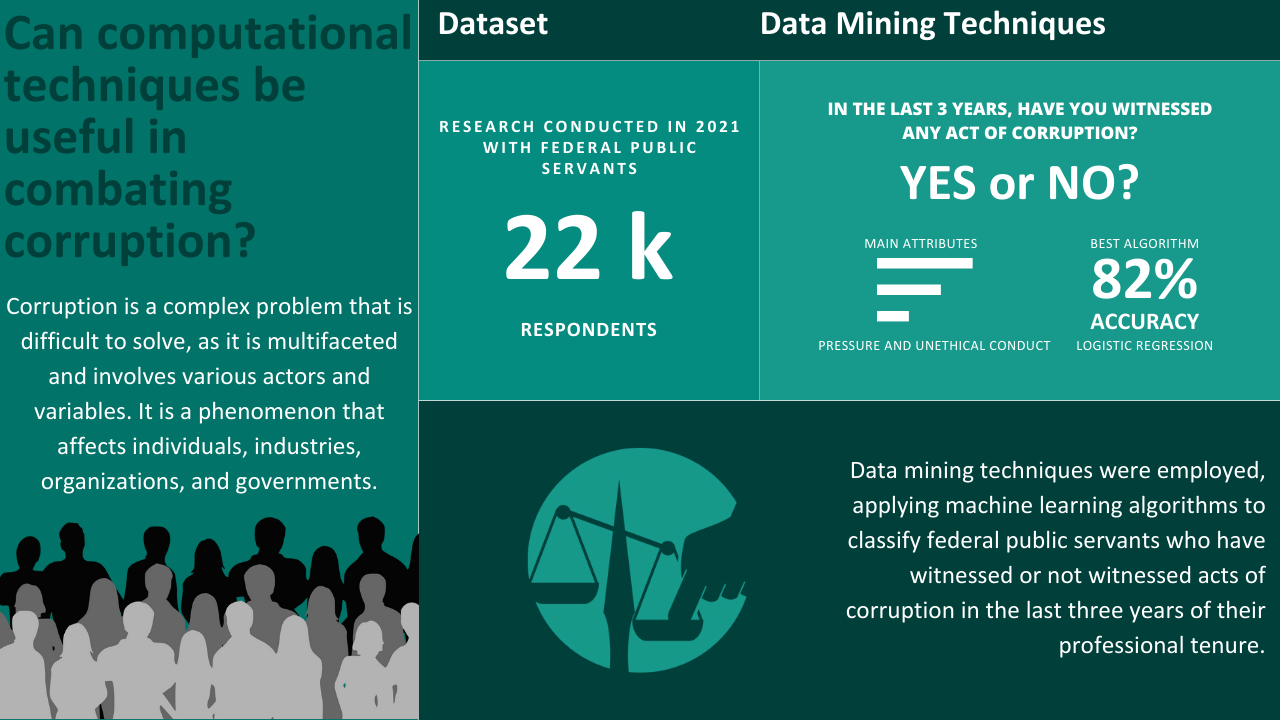
Computational techniques have proven useful in the fight against corruption in the public sector, enabling the early detection of suspicious activities. The aim of this study was to compare machine learning algorithms in the context of observing acts of corruption in the Public Service. In this regard, data extracted from a survey conducted by the World Bank in 2021 on the topic of Ethics and Corruption in the Public Service were analyzed, involving approximately 22.000 respondents. The development of models aimed at promoting transparency and integrity in the Brazilian public service is proposed. The results demonstrated the feasibility of using machine learning techniques, with Logistic Regression proving to be the best option for the studied scenario, with an accuracy of 82%. The developed model and generated analysis can be used to assist in the identification of suspicious corruption activities in the public sector, contributing to early detection and prevention of illegal practices. The results also highlight the importance of developing public policies to promote ethics and integrity in public service, as well as the role of advanced technologies in improving governance and society's trust in public institutions.
- References
-
Adam, I. & Fazekas, M. (2021). Are emerging technologies helping win the fight against corruption? A review of the state of evidence. Information Economics and Policy, 57. https://doi.org/10.1016/j.infoecopol.2021.100950
Aggarwal, C. C. (2015). Data mining: the textbook (Vol. 1). New York: springer.
Breiman, L. (2001). Random forests. Machine learning, 45. https://doi.org/10.1023/A:1010933404324
Ashforth, B. E., Gioia, D. A., Robinson, S. L., & Trevino, L. K. (2008). Re-viewing organizational corruption. Academy of Management review, 33(3). https://doi.org/10.5465/amr.2008.32465714
Castro, L. N. D., & Ferrari, D. G. (2016). Introdução à mineração de dados: conceitos básicos, algoritmos e aplicações. São Paulo: Saraiva, 5.
Chen, S. H. & Liao, C. C. (2011). Are foreign banks more profitable than domestic banks? Home-and host-country effects of banking market structure, governance, and supervision. Journal of Banking & Finance, 35(4). https://doi.org/10.1016/j.jbusres.2022.03.032
Fawcett, T. (2006). An introduction to ROC analysis. Pattern recognition letters, 27(8). https://doi.org/10.1016/j.patrec.2005.10.010
Fernandes, A. A. T., Figueiredo Filho, D. B., Rocha, E. C. D., & Nascimento, W. D. S. (2021). Leia este artigo se você quiser aprender regressão logística. Revista de Sociologia e Política, 28. https://doi.org/10.1590/1678-987320287406en
Gonzalez, L. D. A. (2018). Regressão logística e suas aplicações. Recuperado de https://monografias.ufma.br/jspui/bitstream/123456789/3572/1/LEANDRO-GONZALEZ.pdf
de Blasio, G., D'Ignazio, A., & Letta, M. (2022). Gotham city. Predicting ‘corrupted’ municipalities with machine learning. Technological Forecasting and Social Change, 184. https://doi.org/10.1016/j.techfore.2022.122016
Domashova, J. & Politova, A. (2021). The Corruption Perception Index: analysis of dependence on socio-economic indicators. Procedia Computer Science, 190. https://doi.org/10.1016/j.procs.2021.06.024
Fayyad, U., Piatetsky-Shapiro, G., & Smyth, P. (1996). From data mining to knowledge discovery in databases. AI magazine, 17(3). https://doi.org/10.1609/aimag.v17i3.1230
Gamarra, C., Guerrero, J. M., & Montero, E. (2016). A knowledge discovery in databases approach for industrial microgrid planning. Renewable and Sustainable Energy Reviews, 60. https://doi.org/10.1016/j.rser.2016.01.091
Gehrke, G., Borba, J. A., & Ferreira, D. D. M. (2017). A repercussão da corrupção brasileira na mídia: uma análise comparada das revistas Der Spiegel, L ‘Obs, The Economist, Time e Veja. Revista de Administração Pública, 5. http://dx.doi.org/10.1590/0034-7612158681
Géron, A. (2019). Mãos à Obra: Aprendizado de Máquina com Scikit-Learn & TensorFlow. Alta Books.
Goutte, S., Péran, T., & Porcher, T. (2022). Corruption, economy and governance in Central Africa: An analysis of public and regional drivers of corruption. Finance Research Letters, 44. https://dx.doi.org/10.2139/ssrn.3808716
Jackson, D. & Köbis, N. (2018). Anti-corruption through a social norms lens. U4 Issue, 7. Recuperado de https://www.u4.no/publications/anti-corruption-through-a-social-norms-lens#conclusion-a-social-norms-approach-to-anti-corruption
James, G., Witten, D., Hastie, T., Tibshirani, R., & Taylor, J. (2023). An Introduction to Statistical Learning with Applications in Python. Springer.
Jancsics, D. (2019). Corruption as resource transfer: An interdisciplinary synthesis. Public Administration Review, 79(4). https://doi.org/10.1111/puar.13024
Jeong, D., Shenoy, A., & Zimmermann, L. V. (2023). De Jure versus De Facto transparency: Corruption in local public office in India. Journal of Public Economics, 221. https://doi.org/10.1016/j.jpubeco.2023.104855
Li, J., Chen, W. H., Xu, Q., Shah, N., Kohler, J. C., & Mackey, T. K. (2020). Detection of self-reported experiences with corruption on twitter using unsupervised machine learning. Social Sciences & Humanities Open, 2(1). https://doi.org/10.1016/j.ssaho.2020.100060
Lima, M. S. M. & Delen, D. (2020). Predicting and explaining corruption across countries: A machine learning approach. Government Information Quarterly, 37(1). https://doi.org/10.1016/j.giq.2019.101407
Lino, A. F., Azevedo, R. R., de., Aquino, A. C. B., de., & Steccolini, I. (2022). Fighting or supporting corruption? The role of public sector audit organizations in Brazil. Critical Perspectives on Accounting, 83. https://doi.org/10.1016/j.cpa.2021.102384
Macedo, S. V. & Valadares, J. L. (2021). Corrupção: reflexões epistemológicas e contribuições para o campo de públicas. Organizações & Sociedade, 28. https://doi.org/10.1590/1984-92302021v28n9607PT
Mitchell, T. M. (1997). Machine learning. (Vol. 1). New York: McGraw-hill.
Pan, Z., Wang, Y., & Pan, Y. (2020). A new locally adaptive k-nearest neighbor algorithm based on discrimination class. Knowledge-Based Systems, 204.
https://doi.org/10.1016/j.knosys.2020.106185
Raschka, S. (2015). Python machine learning. Packt publishing ltd.
Speiser, J. L., Miller, M. E., Tooze, J., & Ip, E. (2019). A comparison of random forest variable selection methods for classification prediction modeling. Expert systems with applications, 134. https://doi.org/10.1016/j.eswa.2019.05.028
Transparência Internacional. (2022). Índice de Percepção da Corrupção 2022. Recuperado de https://www.transparency.org/en/cpi/2022/index/brasil
- Cover Image
-
- Downloads
- Published
- 2023-11-09
- Section
- OPERATIONAL RESEARCH
- License
-
Copyright (c) 2023 Brazilian Journal of Production Engineering

This work is licensed under a Creative Commons Attribution 4.0 International License.
All works published in the Brazilian Journal of Production Engineering (BJPE) are licensed under Creative Commons Attribution 4.0 International (CC BY 4.0). This means that: Anyone can copy, distribute, display, adapt, remix, and even commercially use the content published in the journal; Provided that due credit is given to the authors and to BJPE as the original source; No additional permission is required for reuse, as long as the license terms are respected. This policy complies with the principles of open access, promoting the broad dissemination of scientific knowledge. 🔗 Click here to access the full license
