

2.png)



































Hybrid nanocomposites based on CeO2, AgNANO and cellulose: preparation, characterization and antimicrobial study
- Authors
-
-
Gustavo Teixeira Machado
Universidade Federal do Espírito Santo, CEUNES - Centro Universitário Norte do Espírito Santo.
Author
-
Carla da Silva Meireles
Universidade Federal do Espírito Santo, CEUNES - Centro Universitário Norte do Espírito Santo.
Author
-
George Ricardo Santana Andrade
Universidade Federal do Espírito Santo, CEUNES - Centro Universitário Norte do Espírito Santo.
Author
-
- Keywords:
- Nanomaterials, Antibacterial activity, Skin dressings
- Abstract
-
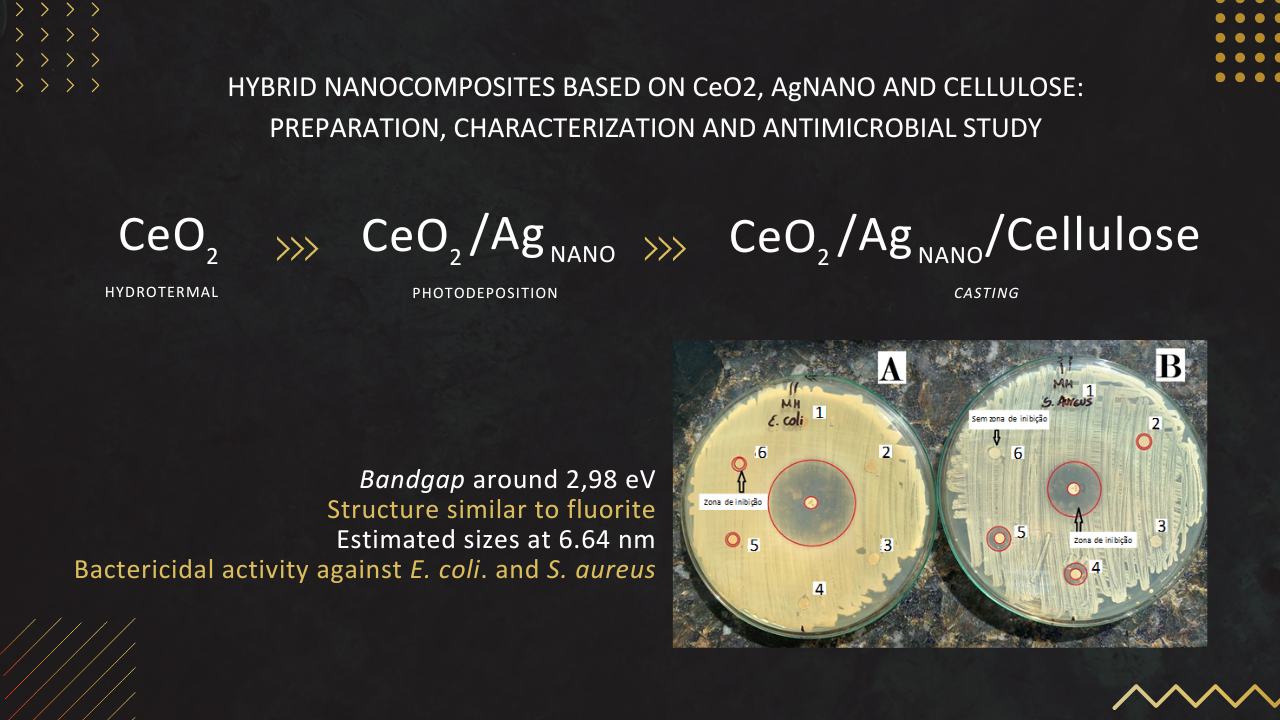
Wound healing is the focus of numerous studies in the literature, since the exposure of wounds or lesions to the skin makes the body susceptible to biological attacks, such as bacteria and fungi, directly affecting the quality of life and health systems in different spheres. In this context, the search for innovative strategies for the treatment of skin wounds has been intensified, with a main focus on the use of biomaterials. The use of cellulose as a polymeric matrix, incorporating cerium oxide (CeO2) and silver nanoparticles (AgNANO), offers the biodressing healing properties, such as antioxidant and antibacterial activity, respectively. Studies conducted using techniques such as UV-vis and XRD revealed that the bandgap energy of CeO2 nanoparticles is approximately 2.98 eV, with a fluorite-type crystallite geometry of cubic symmetry and an average diameter of 6.64 nm. The lignin amount was 3.1%. Discs prepared from pure cellulose and membranes impregnated with CeO2/AgNANO NPs demonstrated antimicrobial activity against bacteria such as S. aureus and E. coli.
- Author Biographies
- References
-
Andrade, G. R. S., Nascimento, C. C., Lima, Z. M., Teixeira-Neto, E., Costa, L. P., & Gimenez, I. F. (2017). Star-shaped ZnO/Ag hybrid nanostructures for enhanced photocatalysis and antibacterial activity. Applied Surface Science, 399, 573-582. https://doi.org/10.1016/j.apsusc.2016.11.202
Bauer, A. W., Kirby, W. M., Sherris, J. C., & Turck, M. (1966). Antibiotic susceptibility testing by a standardized single disk method. American Journal of Clinical Pathology, 45(4), 493-496.
EMBRAPA. (2011). Procedimento para análise lignocelulósica. - Portal Embrapa. Recuperado de https://www.embrapa.br/busca-de-publicacoes/-/publicacao/900898/procedimento-para-analise-lignocelulosica
Fudala, A. S., Salih, W. M., & Alkazaz, F. F. (2022). Synthesis different sizes of cerium oxide CeO2 nanoparticles by using different concentrations of precursor via sol–gel method. Materials Today: Proceedings, 49, 2786-2792. https://doi.org/10.1016/j.matpr.2021.09.452
Grizzo, A., dos Santos, D. M., da Costa, V. P. V., Lopes, R. G., Inada, N. M., Correa, D. S., & Campana-Filho, S. P. (2023). Multifunctional bilayer membranes composed of poly(lactic acid), beta-chitin whiskers and silver nanoparticles for wound dressing applications. International Journal of Biological Macromolecules, 251, 126314. https://doi.org/10.1016/j.ijbiomac.2023.126314
Lei, W., Zhang, T., Gu, L., Liu, P., Rodriguez, J. A., Liu, G., & Liu, M. (2015). Surface-Structure Sensitivity of CeO2 Nanocrystals in Photocatalysis and Enhancing the Reactivity with Nanogold. ACS Catalysis, 5(7), 4385–4393. https://doi.org/10.1021/acscatal.5b00620
Ma, L., Jiang, W., Xun, X., Liu, M., Han, X., Xie, J., Wang, M., Zhang, Q., Peng, Z., & Ao, H. (2023). Homogeneous silver nanoparticle loaded polydopamine/polyethyleneimine-coated bacterial cellulose nanofibers for wound dressing. International Journal of Biological Macromolecules, 246, 125658. https://doi.org/10.1016/j.ijbiomac.2023.125658
Murugadoss, G., Kumar, D. D., Kumar, M. R., Venkatesh, N., & Sakthivel, P. (2021). Silver decorated CeO2 nanoparticles for rapid photocatalytic degradation of textile rose bengal dye. Scientific Reports, 11(1), 1080. https://doi.org/10.1038/s41598-020-79993-6
Naskar, A., & Kim, K. (2020). Recent Advances in Nanomaterial-Based Wound-Healing Therapeutics. Pharmaceutics, 12(6), Artigo 6. https://doi.org/10.3390/pharmaceutics12060499
Nath, M. P., Biswas, S., Nath, P., & Choudhury, B. (2022). Synergy of Adsorption and Plasmonic Photocatalysis in the Au–CeO2 Nanosystem: Experimental Validation and Plasmonic Modeling. Langmuir, 38(24), 7628-7638. https://doi.org/10.1021/acs.langmuir.2c01056
Yang, C., Zhu, Y., Tian, Z., Zhang, C., Han, X., Jiang, S., Liu, K., & Duan, G. (2024). Preparation of nanocellulose and its applications in wound dressing: A review. International Journal of Biological Macromolecules, 254, 127997. https://doi.org/10.1016/j.ijbiomac.2023.127997
Yang, Z., Ren, X., & Liu, Y. (2021). N-halamine modified ceria nanoparticles: Antibacterial response and accelerated wound healing application via a 3D printed scaffold. Composites Part B: Engineering, 227, 109390. https://doi.org/10.1016/j.compositesb.2021.109390
Zarei, N., & Hassanzadeh-Tabrizi, S. A. (2023). Alginate/hyaluronic acid-based systems as a new generation of wound dressings: A review. International Journal of Biological Macromolecules, 253, 127249. https://doi.org/10.1016/j.ijbiomac.2023.127249
- Cover Image
-
- Downloads
- Additional Files
- Published
- 2023-12-15
- Section
- Edição Especial "Semana de Química do Norte do Espírito Santo
- License
-
Copyright (c) 2023 Brazilian Journal of Production Engineering

This work is licensed under a Creative Commons Attribution 4.0 International License.
All works published in the Brazilian Journal of Production Engineering (BJPE) are licensed under Creative Commons Attribution 4.0 International (CC BY 4.0). This means that: Anyone can copy, distribute, display, adapt, remix, and even commercially use the content published in the journal; Provided that due credit is given to the authors and to BJPE as the original source; No additional permission is required for reuse, as long as the license terms are respected. This policy complies with the principles of open access, promoting the broad dissemination of scientific knowledge. 🔗 Click here to access the full license
