

2.png)

































Use of water from air conditioning using arduino and photovoltaic panels for automatic irrigation of vegetables
- Authors
-
-
Adriano Freitas de Jesus
Instituto Federal de Educação Ciência e Tecnologia da Bahia (IFBA)
Author
-
Marcus Vinícius Martins Marco
Instituto Federal de Educação Ciência e Tecnologia da Bahia (IFBA)
Author
-
Pedro Lopes Rios
Instituto Federal de Educação Ciência e Tecnologia da Bahia (IFBA)
Author
-
Albert Meneses Gonçalves Luz
Instituto Federal de Educação Ciência e Tecnologia da Bahia (IFBA)
Author
-
Luan Diego de Lima Pereira
Instituto Federal de Educação Ciência e Tecnologia da Bahia (IFBA)
Author
-
- Keywords:
- Arduino, sustainability, renewable energy, automatic irrigation
- Abstract
-
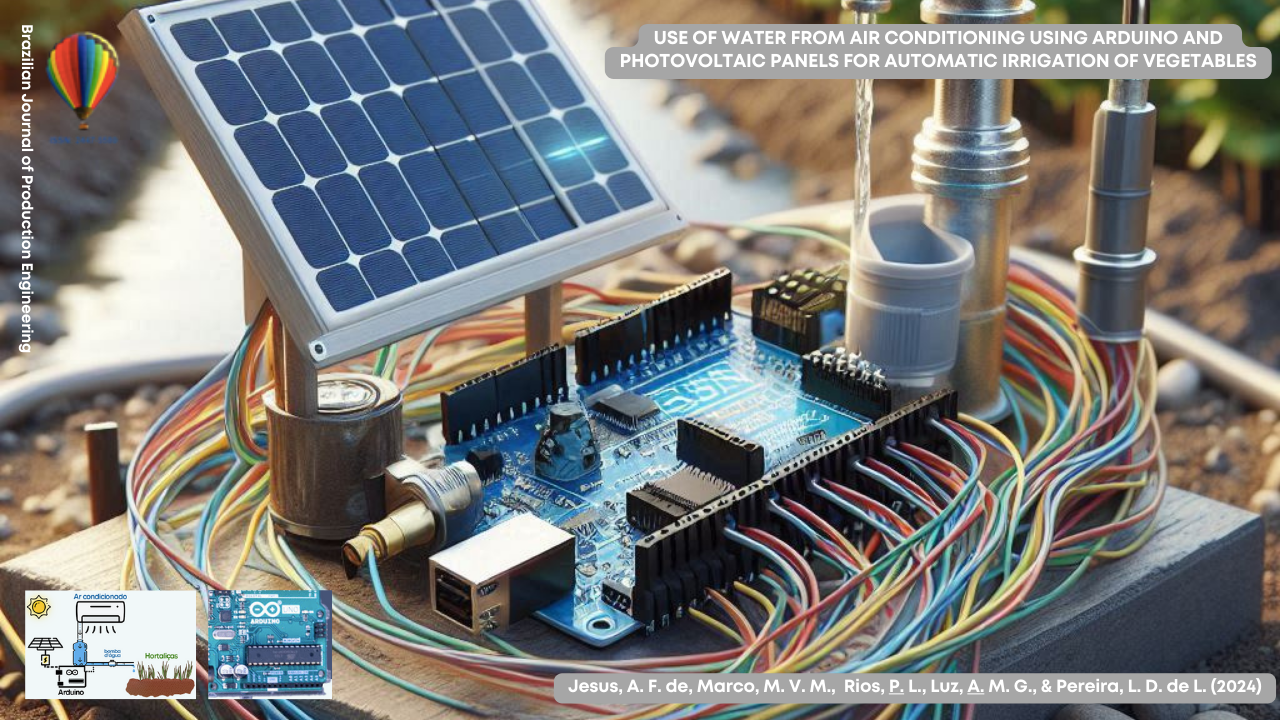
This paper explores the implementation of the irrigation system using water from air conditioning systems at the Instituto Federal da Bahia (IFBA), Campus Feira de Santana, analyzing the technical feasibility and environmental benefits of this initiative. The system operates with water from the air conditioning drain, stored in a plastic bottle. Using Arduino, water pump and humidity sensors, automated irrigation control is carried out. The system not only brings efficiency in the management of water resources and renewable energy, but also stands out as a sustainable model for educational institutions, promoting the reuse of air conditioning water and inspiring ecologically responsible practices.
- Author Biographies
- References
-
Almeida, J. A., Valença, S., & Silva, I. C. (2022). Aproveitamento de água condensada por aparelhos de ar-condicionado no IFPE/Campus Belo Jardim. Revista Gestão & Sustentabilidade Ambiental, 11(4), 376-393. https://doi.org/10.59306/rgsa.v11e42022376-393
Biscaro, G. A. (2014). Sistemas de irrigação localizada. Portal de Livros Abertos da Editora da UFGD. Recuperado de https://omp.ufgd.edu.br/omp/index.php/livrosabertos/catalog/book/50
Ermes, Á., Maciel, J., & Sahdo, K. (2020). Proposta de implantação de sistema de reuso de água proveniente de condicionadores de ar em uma instituição de ensino do Amazonas. Brazilian Journal of Animal and Environmental Research. 3. 1713-1728. https://doi.org/10.34188/bjaerv3n3-087
Inada, P., Oliveira, D., & Mota, T. (2012). Reutilização da água dos aparelhos de ar condicionado em uma escola de ensino médio no município de Umuarama-PR. IIV EPCC. Maringá, Pr.
Intergovernmental Panel on Climate Change. (2023) Climate Change 2023: Synthesis Report. Contribution of Working Groups I, II and III to the Sixth Assessment Report of the Intergovernmental Panel on Climate Change [Core Writing Team, H. Lee and J. Romero (eds.)]. IPCC, Geneva, Switzerland, pp. 35-115. https://doi.org/10.59327/IPCC/AR6-9789291691647
Lima, S. M, Valentini, C. M. A., Zague, R., A, M., Souza, F. S. C. de., & Albano, P. F. M. (2020) Engenharia no Século XXI – Volume 17: Estudos sobre a água do ar condicionado. Cap. 5, 43-49pp. Belo Horizonte: Poisson. Recuperado de https://poisson.com.br/2018/produto/engenharia-no-seculo-xxi-volume-17/
Marouelli, W. A., Silva, W. L. de C. e., & Silva, H. R. da. (2008). Irrigação por aspersão em hortaliças: qualidade da água, aspectos do sistema e método prático de manejo. Brasília, DF: Embrapa Informação Tecnológica. Recuperado de https://www.embrapa.br/busca-de-publicacoes/-/publicacao/762590/irrigacao-por-aspersao-em-hortalicas-qualidade-da-agua-aspectos-do-sistema-e-metodo-pratico-de-manejo
McRoberts, M. (2011). Arduino básico. 1a ed. São Paulo: Novatec Editora. Recuperado de https://edisciplinas.usp.br/pluginfile.php/4287597/mod_resource/content/2/Arduíno%20Básico%20-%20Michael%20McRoberts.pdf
Merheby, T. H. E. (2021) prospects for participatory water condensate harvesting from air-conditioning home units for use in public gardens: a case study in Tripoli, Lebanon (Dissertação de mestrado). American University of Beirut, Beirut, Lebanon. Recuperado de https://scholarworks.aub.edu.lb/handle/10938/22431
- Cover Image
-
- Downloads
- Published
- 2024-05-15
- Section
- ENVIRONMENTAL ENGINEERING AND SUSTAINABILITY
- License
-
Copyright (c) 2024 Brazilian Journal of Production Engineering

This work is licensed under a Creative Commons Attribution 4.0 International License.
All works published in the Brazilian Journal of Production Engineering (BJPE) are licensed under Creative Commons Attribution 4.0 International (CC BY 4.0). This means that: Anyone can copy, distribute, display, adapt, remix, and even commercially use the content published in the journal; Provided that due credit is given to the authors and to BJPE as the original source; No additional permission is required for reuse, as long as the license terms are respected. This policy complies with the principles of open access, promoting the broad dissemination of scientific knowledge. 🔗 Click here to access the full license
