

2.png)


































Application of the DMAIC cycle for cost reduction in a disposable diaper manufacturing industry
- Authors
-
-
Pedro Eduardo Cassanti de Carvalho
Universidade Federal do Triângulo Mineiro - UFTM
Author
-
Douglas Miranda
Universidade Federal do Triângulo Mineiro - UFTM
Author
-
- Keywords:
- six sigma, DMAIC Cycle, process improvement, cost reduction
- Abstract
-
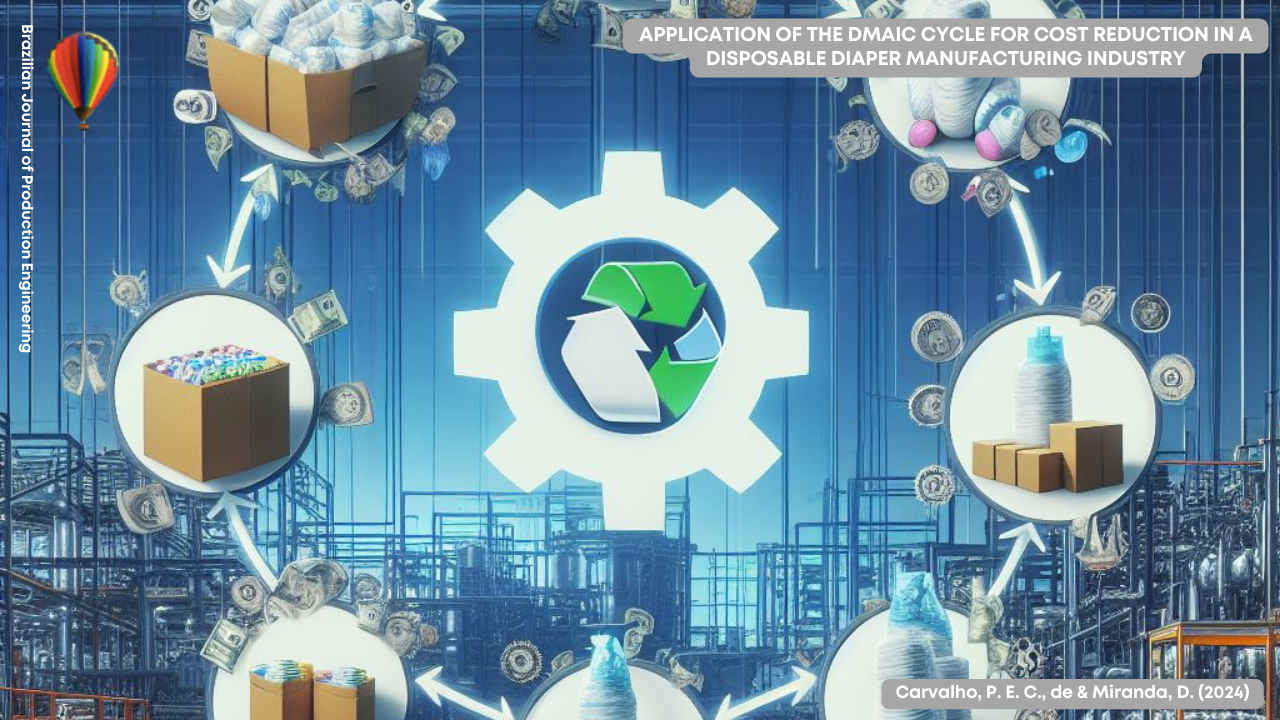
The present work is a case study that applies DMAIC in a disposable diaper manufacturing industry with the aim of identifying waste and proposing solutions. The work was divided into five stages (Define, Measure, Analyze, Improve and Control) and initially identifies excessive consumption of two components of children's diapers. It then carries out an investigation and analysis of the production process to discover the causes of this problem, creates an action plan, carries out improvement actions and validates the effectiveness of the actions in order to reduce the environmental and financial impacts of the problem. The results show an estimated annual savings of approximately R$570,000.00, achieved without the need for investment. Finally, it creates control methods to ensure the benefits of the improvements implemented.
- Author Biographies
- References
-
Appolinário, F. (2004). Dicionário de Metodologia Científica. um guia para a produção do conhecimento científico. São Paulo: Atlas, 2004.
Beckert, S. F. & Paim, W. S. (2017). Critical analysis of the acceptance criteria used in measurement systems evaluation. International Journal of Metrology and Quality Engineering, 8, 23.
Bunce, M., Wang, L., & Bidanda, B. (2008). Leveraging Six Sigma with industrial engineering tools in crateless retort production. International Journal of Production Research.
Carvalho, L. S. R., Menezes, A. H. N., Duarte, F. R., & Souza, T. E. S. (2019). Metodologia científica: teoria e aplicação na educação a distância.
César, F. I. G. (2011). Ferramentas Básicas da Qualidade. Editora Biblioteca24horas.
Chen, Y., Liu, J., & Li, C. (2016). Lean Six Sigma Implementation in Electronics Manufacturing: A Case Study of XYZ Company. Procedia CIRP, 56, 57-62.
George, M. L. (2002). Lean Sigma: Combining Six Sigma Quality with Lean Speed. McGraw-Hill.
Gil, A. C. (2002). Como elaborar projetos de pesquisa (4th ed.). Atlas.
Glushkovsky, A. (2006). Stability Index of Stochastic Processes: The Statistical Process Control Approach.
Gonsalves, E. P. (2003). Iniciação à pesquisa científica. Alínea.
Gupta, V., Jain, R., Meena, M. L., & Dangayach, G. S. (2018). Six-sigma application in tire-manufacturing company: a case study. Journal of Industrial Engineering International, 14, 511-520.
Henny, H., Andriana, I., Latifah, A. N., & Haryanto, H. (2019, November). The Application Lean Six Sigma Method Approach to Minimize Waste. In IOP Conference Series: Materials Science and Engineering, 662(2), 022089. IOP Publishing.
(n.d.). Independence and Stability. Dunamath. Recuperado de https://dunamath.com/autocorrelation_stability.aspx
Indrawati, S. & Ridwansyah, M. (2015). Manufacturing continuous improvement using lean six sigma: An iron ores industry case application. Procedia Manufacturing, 4, 528-534.
Ishikawa, K. (1997). Controle de Qualidade Total. Elsevier.
Javaid, M., Haleem, A., Singh, R. P., & Suman, R. (2021). Significance of Quality 4.0 towards comprehensive enhancement in manufacturing sector. Sensors International, 2, 100109.
Lee, S., Kim, S., & Park, J. (2017). Application of Lean Six Sigma to Reduce Defects of Automotive Products. Procedia Engineering, 174, 827-834.
Mandahawi, N. & Obeidat, S. M. (2012). Six Sigma implementation to minimise weight variation for Baby Lido Diaper manufacturing company. International Journal of Six Sigma and Competitive Advantage, 7(2-4), 243-255.
McGraw-Hill Education.Mandahawi, N., & Obeidat, S. M. (2012). Six Sigma implementation to minimise weight variation for Baby Lido Diaper manufacturing company. International Journal of Six Sigma and Competitive Advantage, 7(2-4), 243-255.
Martinelli, F. B. (2009). Gestão da Qualidade Total. Fundação Biblioteca Nacional.
Montgomery, D. C. & Runger, G. C. (2021). Estatística Aplicada e Probabilidade para Engenheiros. 7ª edição. Grupo GEN.
Oakland, J. S. (2003). Total Quality Management text with cases (3rd ed.). Routledge.
Pande, P. S., Neuman, R. P., & Cavanagh, R. (2001). Estratégia Seis Sigma: Como a GE, a Motorola e outras empresas estão aguçando seu desempenho. Rio de Janeiro.
Patyal, V. S., & Maddulety, K. (2015). Interrelationship between total quality management and six sigma: A review. Global Business Review, 16(6), 1025-1060.
Pongboonchai-Empl, T., Antony, J., Garza-Reyes, J. A., Komkowski, T., & Tortorella, G. L. (2023). Integration of Industry 4.0 technologies into Lean Six Sigma DMAIC: A systematic review. Production Planning & Control, 1-26.
Pyzdek, T. & Keller, P. A. (2018). The Six Sigma Handbook: A Complete Guide for Green Belts, Black Belts, and Managers at All Levels (5th ed.). McGraw-Hill Education.
Rechulski, D. K. & Carvalho, M. M. (2003). Programas de qualidade seis sigma: características distintivas do modelo DMAIC e DFSS. Produção em Iniciação Científica da Escola Politécnica da USP.
Rotondaro, R. G. (2002). Seis Sigma: Estratégia Gerencial para a Melhoria de Processos, Produtos e Serviços. Editora Atlas S.A.
Smith, J. R., Jones, L. M., & Patel, K. (2019). Improving Efficiency in Food Manufacturing: A Lean Six Sigma Approach. International Journal of Lean Six Sigma, 10(5), 740-758.
Vergara, S. C. (2006). Projetos e relatórios de pesquisa em Administração. Atlas.
Tenera, A. & Pinto, L. C. (2014). A Lean Six Sigma (LSS) project management improvement model. IPMA World Congress.
TSHTurkey. Baby Diaper Raw Material. Recuperado de https://www.tshturkey.com/en/baby-diaper-raw-material.html
Widodo, A. & Soediantono, D. (2022). Benefits of the six-sigma method (dmaic) and implementation suggestion in the defense industry: A literature review. International Journal of Social and Management Studies, 3(3), 1-12.
Werkema, C. (2012). Criando a Cultura Lean Seis Sigma (3rd ed.). Elsevier.
- Cover Image
-
- Downloads
- Published
- 2024-06-10
- Section
- QUALITY ENGINEERING
- License
-
Copyright (c) 2024 Brazilian Journal of Production Engineering

This work is licensed under a Creative Commons Attribution 4.0 International License.
All works published in the Brazilian Journal of Production Engineering (BJPE) are licensed under Creative Commons Attribution 4.0 International (CC BY 4.0). This means that: Anyone can copy, distribute, display, adapt, remix, and even commercially use the content published in the journal; Provided that due credit is given to the authors and to BJPE as the original source; No additional permission is required for reuse, as long as the license terms are respected. This policy complies with the principles of open access, promoting the broad dissemination of scientific knowledge. 🔗 Click here to access the full license
