

2.png)




































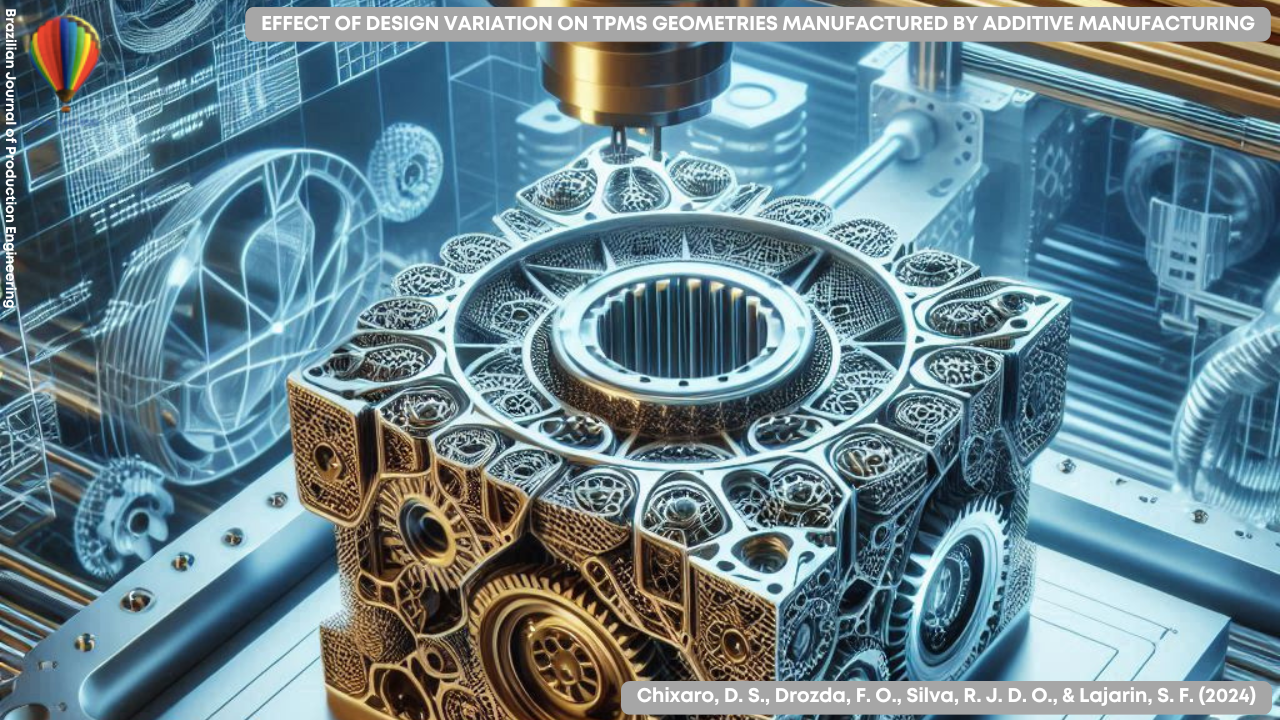
Effect of design variation on tpms geometries manufactured by additive manufacturing
- Authors
-
-
Author
-
Fabiano Oscar Drozda
Universidade Federal do Paraná, Programa de Pós-graduação em Engenharia de Produção (PPGEP-UFPR)
Author
-
RicardoRicardo Júnior De Oliveira Silva
Universidade Federal do Paraná, Programa de Pós-graduação em Engenharia de Produção (PPGEP-UFPR)
Author
-
Author
-
- Keywords:
- Additive Manufacturing, Digital Light Processing, Triply Periodic Minimal Surfaces, TPMS, DLP
- Abstract
-
Additive Manufacturing has become a useful process for producing highly customizable and complex products. DLP technology is employed across fields such as medicine, dentistry, footwear, and safety equipment due to its high resolution in detailing produced parts. Triply Periodic Minimal Surface (TPMS) structures have been studied since the 19th century as curved proposals devoid of sharp corners, thereby hindering crack propagation under mechanical stress. Due to their complexity, their manufacture was previously impossible before the advent of additive manufacturing technologies. Analyzing studies on TPMS structures reveals a lack of defined design parameters and their influence on compression mechanical tests, as well as comparisons between structures. This study aimed to evaluate the most studied TPMS structures gyroid, diamond, and Schwarz P and their design parameters such as cell size and wall thickness, to analyze their behaviors under compression tests. Results indicated that cell size did not show statistical significance, whereas geometry and wall thickness exhibited a strong relationship with calculated elasticity modulus values.
- Author Biographies
- References
-
Altiparmak, S. C., Yardley, V. A., Shi, Z., & Lin, J. (2022). Extrusion-based additive manufacturing technologies: State of the art and future perspectives. Journal of Manufacturing Processes, 83, 607-636. https://doi.org/10.1016/j.jmapro.2022.09.032
Feng, J., Fu, J., Yao, X., & He, Y. (2022). Triply periodic minimal surface (TPMS) porous structures: from multi-scale design, precise additive manufacturing to multidisciplinary applications. International Journal of Extreme Manufacturing, 4(2), 022001. https://doi.org/10.1088/2631-7990/ac5be6
Haney, C. W., & Siller, H. R. (2023). Anthropo-fidelic behavior of elastic-plastic lattice structures. Polymer Testing, 120, 107970. https://doi.org/10.1016/j.polymertesting.2023.107970
Hwang, B.-K., Kim, S.-K., Kim, J.-H., Kim, J.-D., & Lee, J.-M. (2020). Dynamic compressive behavior of rigid polyurethane foam with various densities under different temperatures. International Journal of Mechanical Sciences, 180, 105657. https://doi.org/10.1016/j.ijmecsci.2020.105657
Maskery, I., Sturm, L., Aremu, A. O., Panesar, A., Williams, C. B., Tuck, C. J., Wildman, R. D., Ashcroft, I. A., & Hague, R. J. M. (2018). Insights into the mechanical properties of several triply periodic minimal surface lattice structures made by polymer additive manufacturing. Polymer, 152, 62–71. https://doi.org/10.1016/j.polymer.2017.11.049
Pereira, T., Jesus, A. V. de Valverde, G., Roland, R., & Oliveira Rodrigues, L. K. de. (2021). Análise da influência do padrão de preenchimento e da altura de camada de deposição nas propriedades mecânicas de peças fabricadas em PLA a partir de impressão 3D. DESAFIOS - Revista Interdisciplinar da Universidade Federal do Tocantins, 8(1), 95–103. https://doi.org/10.20873/uftv8-9605
Rahimidehgolan, F., & Altenhof, W. (2023). Compressive behavior and deformation mechanisms of rigid polymeric foams: A review. Composites Part B: Engineering, 253, 110513. https://doi.org/10.1016/j.compositesb.2023.110513Rodríguez-Panes, A., Claver, J., & Camacho, A. (2018). The Influence of Manufacturing Parameters on the Mechanical Behaviour of PLA and ABS Pieces Manufactured by FDM: A Comparative Analysis. Materials, 11(8), 1333. https://doi.org/10.3390/ma11081333
SAVA, R., APOSTOL, D. A., & CONSTANTINESCU, D. M. (2023). Evaluation of the mechanical behavior of 3D printed cellular metamaterials with special geometries. Proceedings of the Romanian Academy, Series A: Mathematics, Physics, Technical Sciences, Information Science, 24(1), 61–70. https://doi.org/10.59277/PRA-SER.A.24.1.08
Shen, M., Qin, W., Xing, B., Zhao, W., Gao, S., Sun, Y., Jiao, T., & Zhao, Z. (2021). Mechanical properties of 3D printed ceramic cellular materials with triply periodic minimal surface architectures. Journal of the European Ceramic Society, 41(2), 1481–1489. https://doi.org/10.1016/j.jeurceramsoc.2020.09.06
Shi, K., Yang, W., Mei, H., Yan, Y., Xu, L., Cheng, L., & Zhang, L. (2023). Characterization and enhancement of quasi-static and shear mechanical properties of 3D printed lightweight SiOC lattices: Effects of structural design and parameters. Journal of the European Ceramic Society, 43(14), 5882–5893. https://doi.org/10.1016/j.jeurceramsoc.2023.06.06
Volpato, N. (2017). Manufatura Aditiva: Tecnologias e Aplicações da Impressão 3D (1o ed). Blucher.
Yu, S., Sun, J., & Bai, J. (2019). Investigation of functionally graded TPMS structures fabricated by additive manufacturing. Materials & Design, 182, 108021. https://doi.org/10.1016/j.matdes.2019.108021
- Cover Image
-
- Downloads
- Published
- 2024-09-12
- Section
- PRODUCT ENGINEERING
- License
-
Copyright (c) 2024 Brazilian Journal of Production Engineering

This work is licensed under a Creative Commons Attribution 4.0 International License.
All works published in the Brazilian Journal of Production Engineering (BJPE) are licensed under Creative Commons Attribution 4.0 International (CC BY 4.0). This means that: Anyone can copy, distribute, display, adapt, remix, and even commercially use the content published in the journal; Provided that due credit is given to the authors and to BJPE as the original source; No additional permission is required for reuse, as long as the license terms are respected. This policy complies with the principles of open access, promoting the broad dissemination of scientific knowledge. 🔗 Click here to access the full license
