

2.png)


































Long-term demand forecasting applied to a retail company using Prophet
- Authors
-
-
Author
-
Yuri de Almeida Malheiros Barbosa
Author
-
Author
-
Author
-
- Keywords:
- Supply Chain Management, Demand Forecast, Time Series, Prophet
- Abstract
-
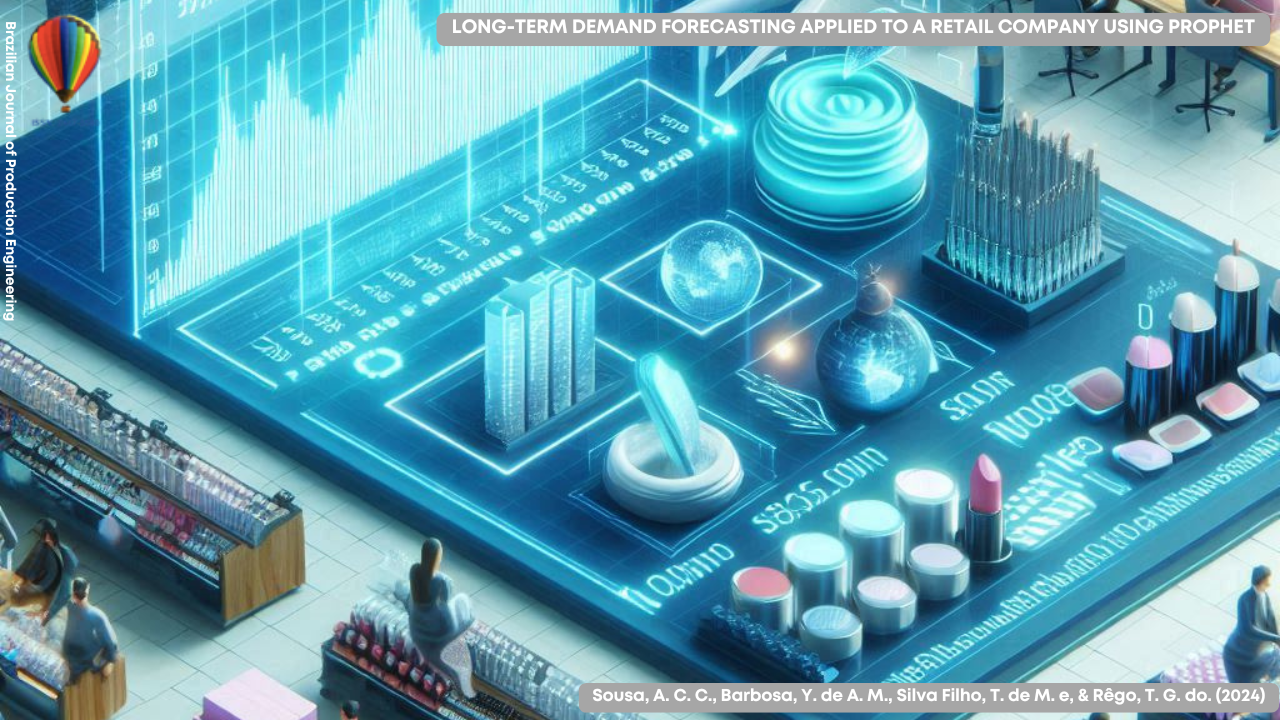
The spread of data-driven decision making has been driven by the abundance of information and the increase in computer processing capacity. To support this decision-making process, it is feasible to extract knowledge and make forecasts using Data Science. Within Supply Chain Management, a common challenge is to forecast demand using historical data. Forecasting a company's sales volume is complex. Overestimating demand leads to wasted stock, while underestimating causes stock-outs. In this case study, long-term demand forecasting (30 weeks) will be carried out for two different sales channels of a company in the industry and retail segment of the Cosmetic, Fragrance and Toiletry market. The Prophet algorithm was used. After implementing the methodology, the results showed that week 30 had a WAPE of 4% and 5% for the Store and Direct Sales channels, respectively. When analyzing the error in the thirtieth week for the three most marketed product categories, the highest error recorded was 9.36%. This result suggests that the methodology employed achieved satisfactory performance.
- Author Biographies
- References
-
Andrade, L. & Cunha, C. B. (2022). Disaggregated retail forecasting: A gradient boosting approach.
Baržic, M., Munitic, N.F., Bronic, F., Jelic, L., & Lešic, V. (2022). Forecasting Sales in Retail with XGBoost and Iterated Multi-step Ahead Method. In 2022 International Conference on Smart Systems and Technologies (SST) (pp. 153-158).
Bergmeir, C. & Benítez, J. (2012). On the use of cross-validation for time series predictor evaluation. Information Sciences, 191, 192-213.
Hasan, M., Kabir, M., Shuvro, R., & Das, P. (2022). A Comparative Study on Forecasting of Retail Sales. arXiv preprint arXiv:2203.06848.
Kelleher, J. & Tierney, B. (2018). Data Science. MIT Press.
Lopes, G. (2022). The wisdom of crowds in forecasting at high-frequency for multiple time horizons: A case study of the Brazilian retail sales. Brazilian Review of Finance, 20(2), 77-115.
Provost, F. & Fawcett, T. (2013). Data Science for Business. O'Reilly.
Saltz, J. & Stanton, J. (2017). An Introduction to Data Science. SAGE Publications.
Schoenherr, T. & Speier-Pero, C. (2015). Data science, predictive analytics, and big data in supply chain management: Current state and future potential. Journal of Business Logistics, 36(1), 120-132.
Seyedan, M. & Mafakheri, F. (2020). Predictive big data analytics for supply chain demand forecasting: methods, applications, and research opportunities. Journal of Big Data, 7(1), 1-22.
Sousa, A., Rego, T., Barbosa, Y., Menezes, T. (2023). Comparing Gradient Boosting Algorithms to Forecast Sales in Retail. In: Anais do XX Encontro Nacional de Inteligência Artificial e Computacional (pp. 596-609).
Wu, H., Xu, J., Wang, J., & Long, M. (2021). Autoformer: Decomposition transformers with auto-correlation for long-term series forecasting. Advances in Neural Information Processing Systems, 34, 22419-22430.
Zhou, T., Zhu, J., Wang, X., Ma, Z., Wen, Q., Sun, L., & Jin, R. (2022). TreeDRNet: A Robust Deep Model for Long Term Time Series Forecasting. arXiv preprint arXiv:2206.12106
- Cover Image
-
- Downloads
- Published
- 2024-08-24
- Section
- OPERATIONAL RESEARCH
- License
-
Copyright (c) 2024 Brazilian Journal of Production Engineering

This work is licensed under a Creative Commons Attribution 4.0 International License.
All works published in the Brazilian Journal of Production Engineering (BJPE) are licensed under Creative Commons Attribution 4.0 International (CC BY 4.0). This means that: Anyone can copy, distribute, display, adapt, remix, and even commercially use the content published in the journal; Provided that due credit is given to the authors and to BJPE as the original source; No additional permission is required for reuse, as long as the license terms are respected. This policy complies with the principles of open access, promoting the broad dissemination of scientific knowledge. 🔗 Click here to access the full license
