

2.png)




































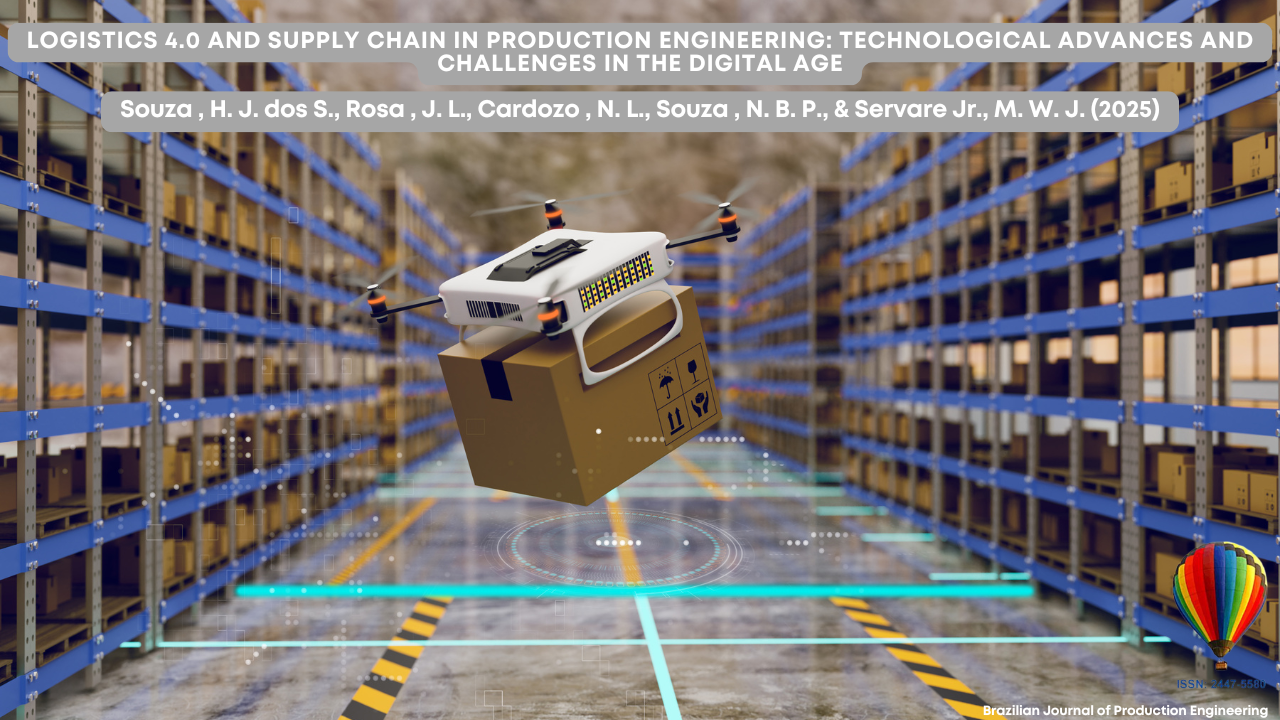
Logistics 4.0 and supply chain in production engineering: technological advances and challenges in the digital age
- Authors
-
-
Hertiquitefanio J. dos Santos Souza
Universidade Federal do Espírito Santo (UFES)
Author
-
Jordan Lavanholle Rosa
Universidade Federal do Espírito Santo (UFES)
Author
-
Noamy Lima Cardozo
Universidade Federal do Espírito Santo (UFES)
Author
-
Noele Bissoli Perini Souza
Universidade Federal do Espírito Santo (UFES)
Author
-
Marcos Wagner Jesus Servare Junior
Universidade Federal do Espírito Santo (UFES)
Author
-
- Keywords:
- Logistics 4.0, Supply Chain 4.0, Industry 4.0, Smart Supply Chain
- Abstract
-
This article analyzes the technological advances and challenges inherent to Logistics 4.0 and Supply Chain 4.0 in the context of Production Engineering. There is a growing adoption of emerging technologies, such as the Internet of Things (IoT), Artificial Intelligence (AI), Big Data, and Blockchain, which favor connectivity, automation, and real-time data analysis. The ProKnow-C methodology was used to support the research, enabling the careful selection and analysis of relevant scientific publications produced between 2010 and 2024. The results demonstrate significant benefits, such as increased operational efficiency, traceability, and strategic planning capabilities, and present examples of applications in companies that have already implemented these technologies. However, challenges such as high implementation costs, the complexity of technological integration, and the need for professional qualifications still constitute barriers to large-scale adoption. The conclusion is that, to ensure effective digital transformation, organizations must develop adaptive strategies, combining innovation with overcoming identified challenges. This process is essential for making operations more agile, competitive, and aligned with the demands of the contemporary market.
- Author Biographies
- References
-
Costa, P. H. D., & Gomes, R. L. R. (2021). Procurement 4.0: como a aplicação de novas tecnologias e robotização transformará a área de suprimentos das empresas. Revista Caribeña de Ciencias Sociales, 10(7), 25-37.
Martins, F. C., Simon, A. T., Campos, R. S., & Campos, F. C. (2018). Desafios da Supply Chain 4.0. In Anais do XXXVIII Encontro Nacional de Engenharia de Produção (pp. 1-12). Maceió, AL, Brasil.
Ribeiro, J. S. A. N., Ziviani, F., França, R. S., Corrêa, F., & Ferreira, E. P. (2022). Gestão da informação e do conhecimento na cadeia de suprimentos 4.0. Revista Eletrônica de Estratégia & Negócios, 15(2), 117-138. https://doi.org/10.59306/reen.v15e22022117-138
Sanitá, A. L. A. C., Solon, A. S., & Franco, D. (2023). Aplicações das tecnologias da Indústria 4.0: impactos na gestão da cadeia de suprimentos. In Anais do XLIII Encontro Nacional de Engenharia de Produção (pp. 1-10). Fortaleza, CE, Brasil.
Santana, H. L., Assumpção, M. R. P., & de Oliveira, M. C. (2019). Uma perspectiva colaborativa da cadeia de suprimentos para apoiar a Indústria 4.0. Revista Produção Online, 19(2), 694-721. https://doi.org/10.14488/1676-1901.v19i2.3460
Santos, H. T. M., Carvalho, V. S., Ueoka, N. A., Negrão, L. L. L., & Blaz, C. L. C. (2023). Avaliação da relação da Indústria 4.0 nas práticas SCM com foco no desempenho: uma revisão da literatura. In Anais do XLIII Encontro Nacional de Engenharia de Produção (pp. 1-10). Fortaleza, CE, Brasil.
- Cover Image
-
- Downloads
- Published
- 2025-08-08
- Section
- LOGISTICS
- License
-
Copyright (c) 2025 Souza, H. J. dos S., Rosa, J. L., Cardozo , N. L., Souza, N. B. P., & Servare Junior, M. W. J.

This work is licensed under a Creative Commons Attribution 4.0 International License.
All works published in the Brazilian Journal of Production Engineering (BJPE) are licensed under Creative Commons Attribution 4.0 International (CC BY 4.0). This means that: Anyone can copy, distribute, display, adapt, remix, and even commercially use the content published in the journal; Provided that due credit is given to the authors and to BJPE as the original source; No additional permission is required for reuse, as long as the license terms are respected. This policy complies with the principles of open access, promoting the broad dissemination of scientific knowledge. 🔗 Click here to access the full license
