

2.png)


































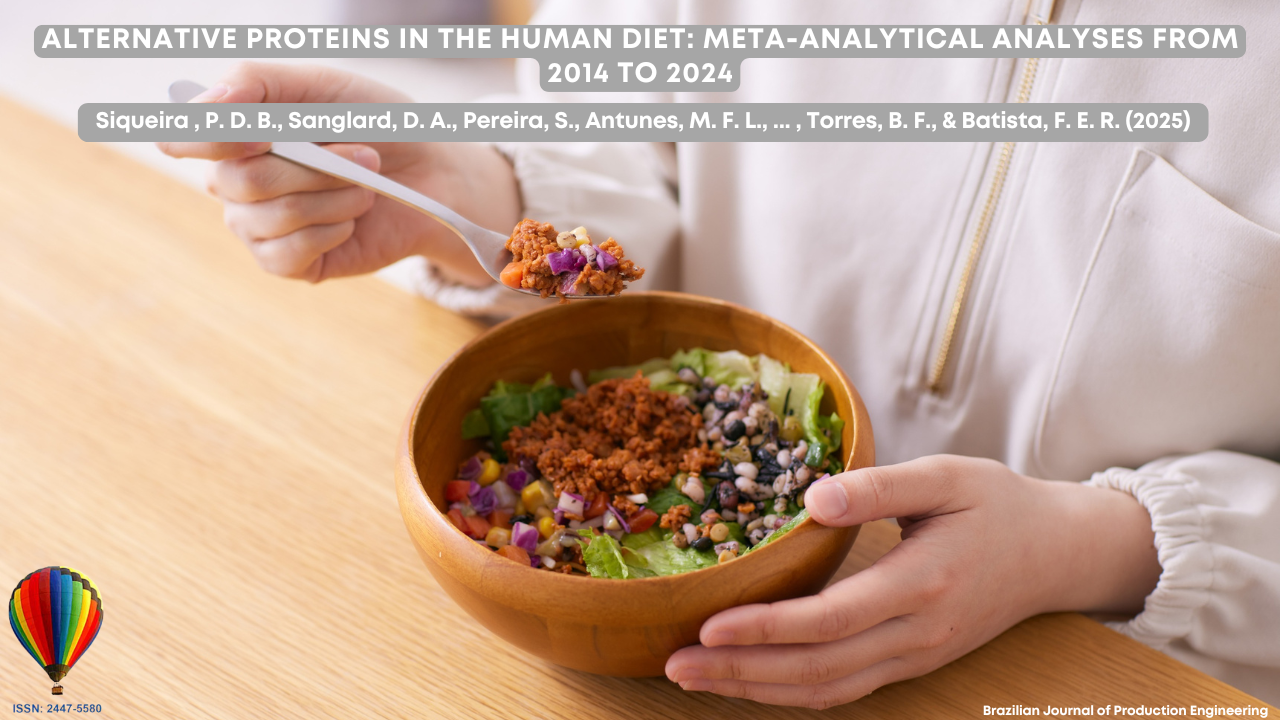
Alternative proteins in the human diet: Meta-Analytical analyses from 2014 to 2024
- Authors
-
-
Author
-
Author
-
Author
-
Author
-
Leonardo Máximo Silva
Universidade Federal de Minas Gerais (UFMG)
Author
-
Author
-
Author
-
Author
-
Author
-
- Keywords:
- Cultural barriers, Food sustainability, Nutritional efficiency, Circular economy, Agro-industrial innovations
- Abstract
-
This work details the evolution of the use of alternative proteins in human diets, based on a meta-analytical review from 2014 to 2024, highlighting technological advances, cultural challenges, and environmental impacts. Plant-based proteins lead in accessibility, reflecting cultural familiarity, affordability, and sustainability. Microalgae and fungi have also progressed, offering healthy nutritional benefits despite higher costs. Insects have been gaining ground, especially in Asia and Africa, but face resistance in the West. Agro-industrial residues are emerging as a sustainable option, standing out in the context of the circular economy. Globally, microalgae lead in nutritional benefits, while plants and seafood stand out for health and accessibility. Environmental impacts vary plants and insects have low emission levels, while microalgae and seafood face challenges due to high production costs. Nutritional efficiency is highest in plants and microalgae, while insects and agro-industrial residues show potential in specific niches. The alternative protein market is growing, driven by an increase in companies and patents, particularly in Asia and Europe. Despite regional disparities, the trends reflect a shift toward more sustainable and alternative diets. To consolidate these sources, public policies, technological innovations, and food education strategies are essential. Thus, alternative proteins can increasingly become viable in addressing global food security and sustainability challenges.
- Author Biographies
- References
-
Abergel, E. (2024). Making and Eating Meat in/for/Against the Anthropocene. In Dead Meat (pp. 125-164). Palgrave Macmillan, Singapore. https://doi.org/10.1007/978-981-97-9049-4_5
Akinmeye, F., Chriki, S., Liu, C., Zhao, J., & Ghnimi, S. (2024). What factors influence consumer attitudes towards alternative proteins? Food and Humanity, 3, 100349.https://doi.org/10.1016/j.foohum.2024.100349
Amara, A. A., & El-Baky, N. A. (2023). Fungi as a source of edible proteins and animal feed. Journal of Fungi, 9(1), 73. https://doi.org/10.3390/jof9010073
Amorim, M. L., Soares, J., Coimbra, J. S. D. R., Leite, M. D. O., Albino, L. F. T., & Martins, M. A. (2021). Microalgae proteins: Production, separation, isolation, quantification, and application in food and feed. Critical Reviews in Food Science and Nutrition, 61(12), 1976-2002. https://doi.org/10.1080/10408398.2020.1768046
Antoniak, M. A., Szymkowiak, A., & Pepliński, B. (2022). The source of protein or its value? Consumer perception regarding the importance of meat (-like) product attributes. Applied Sciences, 12(9), 4128. https://doi.org/10.3390/app12094128
Aschemann-Witzel, J., Gantriis, R. F., Fraga, P., & Perez-Cueto, F. J. (2021). Plant-based food and protein trend from a business perspective: Markets, consumers, and the challenges and opportunities in the future. Critical reviews in food science and nutrition, 61(18), 3119-3128. https://doi.org/10.1080/10408398.2020.1793730
Atif, S. (2023). Mapping circular economy principles and servitisation approach in business model canvas: an integrated literature review. Future Business Journal, 9(1), 33. https://doi.org/10.1186/s43093-023-00211-6
Bajić, B., Vučurović, D., Vasić, Đ., Jevtić-Mučibabić, R., & Dodić, S. (2022). Biotechnological production of sustainable microbial proteins from agro-industrial residues and by-products. Foods, 12(1), 107. https://doi.org/10.3390/foods12010107
Barzee, T. J., Cao, L., Pan, Z., & Zhang, R. (2021). Fungi for future foods. Journal of Future Foods, 1(1), 25-37. https://doi.org/10.1016/j.jfutfo.2021.09.002
Bedsaul-Fryer, J. R., Monroy-Gomez, J., van Zutphen-Küffer, K. G., & Kraemer, K. (2023). An introduction to traditional and novel alternative proteins for low-and middle-income countries. Current Developments in Nutrition, 8(Suppl 1), 102014. https://doi.org/10.1016/j.cdnut.2023.102014
Belhadj Slimen, I., Yerou, H., Ben Larbi, M., M’Hamdi, N., & Najar, T. (2023). Insects as an alternative protein source for poultry nutrition: a review. Frontiers in Veterinary Science, 10, 1200031. https://doi.org/10.3389/fvets.2023.1200031
Berners-Lee, M., Kennelly, C., Watson, R., & Hewitt, C. N. (2018). Current global food production is sufficient to meet human nutritional needs in 2050 provided there is radical societal adaptation. Elem Sci Anth, 6, 52. https://doi.org/10.1525/elementa.310
Bohnes, F. A., & Laurent, A. (2021). Environmental impacts of existing and future aquaculture production: comparison of technologies and feed options in Singapore. Aquaculture, 532, 736001. https://doi.org/10.1016/j.aquaculture.2020.736001
Chong, P. H., Tan, J. H., & Troop, J. (2022). Microalgae as a Source of Sustainability. In Microalgae for Environmental Biotechnology (pp. 1-66). CRC Press. https://doi.org/10.1201/9781003202196-1
Cruz, C. D. (2016). Programa Genes-Ampliado e integrado aos aplicativos R, Matlab e Selegen. Acta Scientiarum. Agronomy, 38, 547-552. https://doi.org/10.4025/actasciagron.v38i3.32629
Dhaliwal, S. S., Sharma, V., Shukla, A. K., Verma, V., Kaur, M., Shivay, Y. S., ... & Hossain, A. (2022). Biofortification—A frontier novel approach to enrich micronutrients in field crops to encounter the nutritional security. Molecules, 27(4), 1340. https://doi.org/10.3390/molecules27041340
Derbyshire, E. J., & Delange, J. (2021). Fungal protein–what is it and what is the health evidence? A systematic review focusing on mycoprotein. Frontiers in Sustainable Food Systems, 5, 581682. https://doi.org/10.3389/fsufs.2021.581682
Detzel, A., Krüger, M., Busch, M., Blanco‐Gutiérrez, I., Varela, C., Manners, R., ... & Zannini, E. (2022). Life cycle assessment of animal‐based foods and plant‐based protein‐rich alternatives: an environmental perspective. Journal of the Science of Food and Agriculture, 102(12), 5098-5110. https://doi.org/10.1002/jsfa.11417z
Diaz, C. J., Douglas, K. J., Kang, K., Kolarik, A. L., Malinovski, R., Torres-Tiji, Y., ... & Mayfield, S. P. (2023). Developing algae as a sustainable food source. Frontiers in Nutrition, 9, 1029841. https://doi.org/10.3389/fnut.2022.1029841
Dossa, K. F., & Miassi, Y. E. (2024). Plant Proteins Availability in Europe and Asia: A Causality Analysis of Climate, Demographics, and Economic Factors. Rural and Regional Development, 2(1), 10002. https://doi.org/10.54646/rrd.10002
Feld, K. (2023). The Role of Climate Movement Organizations and Consciousness Raising in a Plant-Based Food System Transition (Master's thesis, Northern Arizona University).
Finnigan, T., Mach, K., & Edlin, A. (2024). Mycoprotein: a healthy new protein with a low environmental impact. In Sustainable protein sources (pp. 539-566). Academic Press. https://doi.org/10.1016/b978-0-323-91652-3.00011-3
Freitas, L. C., Barbosa, J. R., da Costa, A. L. C., Bezerra, F. W. F., Pinto, R. H. H., & de Carvalho Junior, R. N. (2021). From waste to sustainable industry: How can agro-industrial wastes help in the development of new products? Resources, Conservation and Recycling, 169, 105466. https://doi.org/10.1016/j.resconrec.2021.105466
Gil, M., Rudy, M., Duma-Kocan, P., Stanisławczyk, R., Krajewska, A., Dziki, D., & Hassoon, W. H. (2024). Sustainability of Alternatives to Animal Protein Sources, a Comprehensive Review. Sustainability, 16(17), 7701. https://doi.org/10.3390/su16177701
Grossmann, L., & Weiss, J. (2021). Alternative protein sources as technofunctional food ingredients. Annual Review of Food Science and Technology, 12(1), 93-117. https://doi.org/10.1146/annurev-food-062520-093642
Guyony, V., Fayolle, F., & Jury, V. (2023). High moisture extrusion of vegetable proteins for making fibrous meat analogs: A review. Food Reviews International, 39(7), 4262-4287. https://doi.org/10.1080/87559129.2021.2023816
Hadidi, M., Aghababaei, F., Gonzalez-Serrano, D. J., Goksen, G., Trif, M., McClements, D. J., & Moreno, A. (2024). Plant-based proteins from agro-industrial waste and by-products: Towards a more circular economy. International Journal of Biological Macromolecules, 129576. https://doi.org/10.1016/j.ijbiomac.2024.129576
Helliwell, R., Bjørnerud, E., & Nerby, T. (2024). Cultured meat and responsible research when the future is an illusion for financial speculation. In EurSafe2024 Proceedings (pp. 93-98). Wageningen Academic. https://doi.org/10.3920/978-90-8686-947-3_14
Henchion, M., Moloney, A. P., Hyland, J., Zimmermann, J., & McCarthy, S. (2021). Trends for meat, milk and egg consumption for the next decades and the role played by livestock systems in the global production of proteins. Animal, 15, 100287. https://doi.org/10.1016/j.animal.2021.100287
Issifu, I., Deffor, E. W., Deyshappriya, N. P. R., Dahmouni, I., & Sumaila, U. R. (2022). Drivers of seafood consumption at different geographical scales. Journal of Sustainability Research, 4(3). https://doi.org/10.20900/jsr20220017
Jain, I., Kaur, R., Kumar, A., Paul, M., & Singh, N. (2024). Emerging protein sources and novel extraction techniques: a systematic review on sustainable approaches. International Journal of Food Science & Technology, 59(10), 6797-6820. https://doi.org/10.1111/ijfs.17466
Kennedy, E. J. (2024). Sustainable Labor Rights. Berkeley J. Emp. & Lab. L., 45, 55. https://doi.org/10.15779/Z38K649R0F
Khoshnevisan, B., He, L., Xu, M., Valverde-Pérez, B., Sillman, J., Mitraka, G. C., ... & Angelidaki, I. (2022). From renewable energy to sustainable protein sources: Advancement, challenges, and future roadmaps. Renewable and Sustainable Energy Reviews, 157, 112041. https://doi.org/10.1016/j.rser.2021.112041
Kim, D., Caputo, V., & Kilders, V. (2023). Consumer preferences and demand for conventional seafood and seafood alternatives: Do ingredient information and processing stage matter? Food Quality and Preference, 108, 104872. https://doi.org/10.1016/j.foodqual.2023.104872
Koukoulithras Sr, I., Stamouli, A., Kolokotsios, S., Plexousakis Sr, M., & Mavrogiannopoulou, C. (2021). The effectiveness of non-pharmaceutical interventions upon pregnancy-related low back pain: a systematic review and meta-analysis. Cureus, 13(1). https://doi.org/10.7759/cureus.13011
Kröger, T., Dupont, J., Büsing, L., & Fiebelkorn, F. (2022). Acceptance of insect-based food products in western societies: a systematic review. Frontiers in nutrition, 8, 759885. https://doi.org/10.3389/fnut.2021.759885
Kurek, M. A., Onopiuk, A., Pogorzelska-Nowicka, E., Szpicer, A., Zalewska, M., & Półtorak, A. (2022). Novel protein sources for applications in meat-alternative products—Insight and challenges. Foods, 11(7), 957. https://doi.org/10.3390/foods11070957
Kumar, P., Mehta, N., Abubakar, A. A., Verma, A. K., Kaka, U., Sharma, N., ... & Lorenzo, J. M. (2023). Potential alternatives of animal proteins for sustainability in the food sector. Food Reviews International, 39(8), 5703-5728. https://doi.org/10.1080/87559129.2022.2094403
Lähteenmäki-Uutela, A., Rahikainen, M., Lonkila, A., & Yang, B. (2021). Alternative proteins and EU food law. Food Control, 130, 108336. https://doi.org/10.1016/j.foodcont.2021.108336
Lima, M., Costa, R., Rodrigues, I., Lameiras, J., & Botelho, G. (2022). A narrative review of alternative protein sources: highlights on meat, fish, egg and dairy analogues. Foods, 11(14), 2053. https://doi.org/10.3390/foods11142053
Liang, Y., & Lee, D. (2022). Recent progress of cultivated meat in Asia. Food Materials Research, 2(1), 1-8. https://doi.org/10.48130/FMR-2022-0012
Lucakova, S., Branyikova, I., & Hayes, M. (2022). Microalgal proteins and bioactives for food, feed, and other applications. Applied Sciences, 12(9), 4402. https://doi.org/10.3390/app12094402
Małecki, J., Muszyński, S., & Sołowiej, B. G. (2021). Proteins in food systems-bionanomaterials, conventional and unconventional sources, functional properties, and development opportunities. Polymers, 13(15), 2506. https://doi.org/10.3390/polym13152506
Malila, Y., Owolabi, I. O., Chotanaphuti, T., Sakdibhornssup, N., Elliott, C. T., Visessanguan, W., ... & Petchkongkaew, A. (2024). Current challenges of alternative proteins as future foods. npj Science of Food, 8(1), 53. https://doi.org/10.1038/s41538-024-00291-w
Moura, M. A. F. E., Martins, B. D. A., Oliveira, G. P. D., & Takahashi, J. A. (2023). Alternative protein sources of plant, algal, fungal and insect origins for dietary diversification in search of nutrition and health. Critical Reviews in Food Science and Nutrition, 63(31), 10691-10708. https://doi.org/10.3920/JIFF2022.0176
Mylan, J., Andrews, J., & Maye, D. (2023). The big business of sustainable food production and consumption: Exploring the transition to alternative proteins. Proceedings of the National Academy of Sciences, 120(47), e2207782120. https://doi.org/10.1073/pnas.2207782120
Nguyen, J., Ferraro, C., Sands, S., & Luxton, S. (2022). Alternative protein consumption: A systematic review and future research directions. International Journal of Consumer Studies, 46(5), 1691-1717. https://doi.org/10.1111/ijcs.12818
Nirmal, N., Anyimadu, C. F., Khanashyam, A. C., Bekhit, A. E. D. A., & Dhar, B. K. (2024). Alternative Protein Sources: Addressing Global Food Security and Environmental Sustainability. Sustainable Development. https://doi.org/10.1002/sd.2572
Ogutu, F. O., Okiko, G., Wanjala, G., Luvitaa, S., Obong'o, B. O., Vriesekoop, F., & Munialo, C. D. (2024). Unlocking the potential of plant‐based foods in sub‐Saharan Africa: a review of the opportunities and challenges. International Journal of Food Science & Technology, 59(8), 5326-5342. https://doi.org/10.1111/ijfs.17327
Onwezen, M. C., Bouwman, E. P., Reinders, M. J., & Dagevos, H. (2021). A systematic review on consumer acceptance of alternative proteins: Pulses, algae, insects, plant-based meat alternatives, and cultured meat. Appetite, 159, 105058. https://doi.org/10.1016/j.appet.2020.105058
Otero, P., Carpena, M., Fraga‐Corral, M., Garcia‐Oliveira, P., Soria‐Lopez, A., Barba, F. J., ... & Prieto, M. A. (2021). Aquaculture and agriculture‐by products as sustainable sources of omega‐3 fatty acids in the food industry. EFood, 2(5), 209-233. https://doi.org/10.53365/efood.k/144603
Rolands, M. R., Hackl, L. S., Bochud, M., & Lê, K. A. (2024). Protein adequacy, plant protein proportion and main plant protein sources consumed across vegan, vegetarian, pesco-vegetarian and semi-vegetarian diets: A systematic review. The Journal of Nutrition. https://doi.org/10.1016/j.jn.2024.03.001
Salter, A. M., & Lopez-Viso, C. (2021). Role of novel protein sources in sustainably meeting future global requirements. Proceedings of the Nutrition Society, 80(2), 186-194. https://doi.org/10.1017/S0029665121000513di
Schulp, C. J., Ulug, C., Stratton, A. E., Williams, T. G., & Verburg, P. H. (2024). Linking production, processing, and consumption of plant-based protein alternatives in Europe. Global Environmental Change, 89, 102940. https://doi.org/10.1016/j.gloenvcha.2024.102940
Segatto, M. L., Stahl, A. M., Zanotti, K., & Zuin, V. G. (2022). Green and sustainable extraction of proteins from agro-industrial waste: An overview and a closer look to Latin America. Current Opinion in Green and Sustainable Chemistry, 37, 100661. https://doi.org/10.1016/j.cogsc.2022.100661
Shaghaghian, S., McClements, D. J., Khalesi, M., Garcia-Vaquero, M., & Mirzapour-Kouhdasht, A. (2022). Digestibility and bioavailability of plant-based proteins intended for use in meat analogues: A review. Trends in Food Science & Technology, 129, 646-656. https://doi.org/10.1016/j.tifs.2022.11.016
Siddiqui, S. A., Alvi, T., Sameen, A., Khan, S., Blinov, A. V., Nagdalian, A. A., ... & Onwezen, M. (2022). Consumer acceptance of alternative proteins: A systematic review of current alternative protein sources and interventions adapted to increase their acceptability. Sustainability, 14(22), 15370. https://doi.org/10.3390/su142215370
Silva, L. M., Sanglard, D. A., Nogueira, A. da S., Dourado, L. R., Silva, L. S. da, & Lessa, M. F. G. (2024). Agronomic and bromatological characteristics of genotypes of Carthamus tinctorius l. Potential for the cerrado region. Brazilian Journal of Production Engineering, 10(2), 340–348. https://doi.org/10.47456/bjpe.v10I².44380
Sobczak, P., Grochowicz, J., Łusiak, P., & Żukiewicz-Sobczak, W. (2023). Development of alternative protein sources in terms of a sustainable system. Sustainability, 15(16), 12111. https://doi.org/10.3390/su151612111
Tavares, P. P. L. G., dos Santos Lima, M., Pessôa, L. C., de Andrade Bulos, R. B., de Oliveira, T. T. B., da Silva Cruz, L. F., ... & de Souza, C. O. (2022). Innovation in alternative food sources: A review of a technological state-of-the-art of insects in food products. Foods, 11(23), 3792. https://doi.org/10.3390/foods11233792
Ulhas, R. S., Ravindran, R., Malaviya, A., Priyadarshini, A., Tiwari, B. K., & Rajauria, G. (2023). A review of alternative proteins for vegan diets: sources, physico-chemical properties, nutritional equivalency, and consumer acceptance. Food Research International, 113479. https://doi.org/10.1016/j.foodres.2023.113479
Van Dijk, M., Morley, T., Rau, M. L., & Saghai, Y. (2021). A meta-analysis of projected global food demand and population at risk of hunger for the period 2010–2050. Nature Food, 2(7), 494-501. https://doi.org/10.1038/s43016-021-00322-9
van Meijl, H., Shutes, L., Valin, H., Stehfest, E., van Dijk, M., Kuiper, M., ... & Havlik, P. (2020). Modelling alternative futures of global food security: Insights from FOODSECURE. Global Food Security, 25, 100358. https://doi.org/10.1016/j.gfs.2020.100358
Veldkamp, T., Meijer, N., Alleweldt, F., Deruytter, D., Van Campenhout, L., Gasco, L., ... & Van der Fels-Klerx, H. J. (2022). Overcoming technical and market barriers to enable sustainable large-scale production and consumption of insect proteins in Europe: A SUSINCHAIN perspective. Insects, 13(3), 281. https://doi.org/10.3390/insects13030281
Villaró, S., Viñas, I., & Lafarga, T. (2021). Consumer acceptance and attitudes toward microalgae and microalgal-derived products as food. In Cultured microalgae for the food industry (pp. 367-385). Academic Press. https://doi.org/10.1016/B978-0-12-821080-2.00016-6
Xu, Y., Tong, X., Lu, Y., Lu, Y., Wang, X., Han, J., ... & Sun, Q. (2024). Microalgal proteins: Unveiling sustainable alternatives to address the protein challenge. International Journal of Biological Macromolecules, 133747. https://doi.org/10.1016/j.ijbiomac.2024.133747
Wali, A. (2021). Microbial fermentation and quality preservation of agro-industrial wet by-products. Thesis Doctor of Philosophy in Agriculture. Graduate School of Environmental and Life Science, Okayama University. http://doi.org/10.18926/62174
Walter, N., Cohen, J., Holbert, R. L., & Morag, Y. (2020). Fact-checking: A meta-analysis of what works and for whom. Political communication, 37(3), 350-375. https://doi.org/10.1080/10584609.2020.1723752
Wang, Y., Tuccillo, F., Niklander, K., Livi, G., Siitonen, A., Pöri, P., ... & Katina, K. (2024). Masking off-flavors of faba bean protein concentrate and extrudate: The role of in situ and in vitro produced dextran. Food Hydrocolloids, 150, 109692. https://doi.org/10.1016/j.foodhyd.2024.109692
Williamson, E., Ross, I. L., Wall, B. T., & Hankamer, B. (2024). Microalgae: Potential novel protein for sustainable human nutrition. Trends in Plant Science, 29(3), 370-382. https://doi.org/10.1016/j.tplants.2023.10.004
Wu, J. Y., Tso, R., Teo, H. S., & Haldar, S. (2023). The utility of algae as sources of high value nutritional ingredients, particularly for alternative/complementary proteins to improve human health. Frontiers in nutrition, 10, 1277343. https://doi.org/10.3389/fnut.2023.1277343
Zahari, I., Östbring, K., Purhagen, J. K., & Rayner, M. (2022). Plant-based meat analogues from alternative protein: a systematic literature review. Foods, 11(18), 2870. https://doi.org/10.3390/foods11182870
- Cover Image
-
- Downloads
- Published
- 2025-11-25
- Section
- AGRICULTURAL ENGINEERING
- License
-
Copyright (c) 2025 Siqueira, P. D. B., Sanglard, D. A., Pereira, S., Antunes, M. F. L., Silva, L. M., Nogueira, A. da S., Silveira, A. C. A., Torres, B. F., & Batista, F. E. R.

This work is licensed under a Creative Commons Attribution 4.0 International License.
All works published in the Brazilian Journal of Production Engineering (BJPE) are licensed under Creative Commons Attribution 4.0 International (CC BY 4.0). This means that: Anyone can copy, distribute, display, adapt, remix, and even commercially use the content published in the journal; Provided that due credit is given to the authors and to BJPE as the original source; No additional permission is required for reuse, as long as the license terms are respected. This policy complies with the principles of open access, promoting the broad dissemination of scientific knowledge. 🔗 Click here to access the full license
