

2.png)




































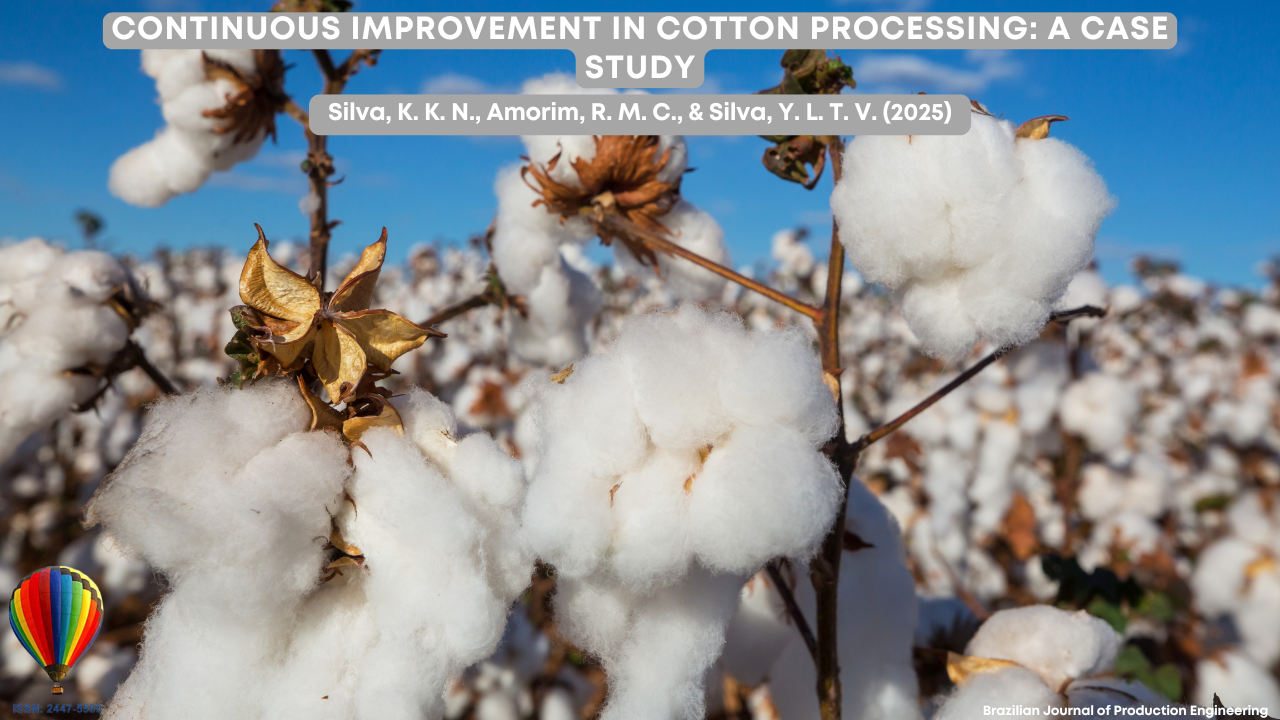
Continuous improvement in cotton processing: a case study
- Authors
-
-
Author
-
Keren Karolyne Nóbrega Silva
Universidade Federal da Paraíba (UFPB)
Author
-
Author
-
- Keywords:
- Agribusiness, Quality Management, Statistical Quality Control, Cotton
- Abstract
-
This study aims to analyze the production process of a cotton processing company, applying quality tools and statistical methods as a basis for continuous process improvement. The research is characterized as applied and experimental, with a quantitative approach, conducted in a real industrial environment. Critical process variables were evaluated, such as temperature, cotton humidity at different stages, feed rate, and equipment rotations, comparing scenarios with incorrect and correct parameters. The data were subjected to statistical analysis and instrumental verification in the laboratory, making it possible to identify the main causes of variation in operational performance. The results showed high variability in bale weight, with 77.6% non-conformity in relation to the specified limits, with 41% below and 36.6% above the standard weight. The main causes identified are related to operational failures, environmental variations, and lack of standardization between shifts. The application of quality tools allowed the identification and prioritization of the causes with the greatest impact, directing corrective actions aimed at standardizing humidification and pressing, improving communication between operators, and preventive maintenance of equipment. The study highlights the scientific relevance of integrating quality management and industrial statistics as support instruments for decision-making and continuous process improvement in agribusiness.
- Author Biographies
- References
-
Bononi, D. F., & Polli, H. Q. (2020). Aplicabilidade da ferramenta FMEA na mitigação de falhas de processos produtivos da agroindústria 4.0. Revista Interface Tecnológica, 17(2), 513-522.
Campos, V. F. (2004). Controle da qualidade total (no estilo japonês). Nova Lima, MG: INDG Tecnologia e Serviços Ltda.
Centro de Estudos Avançados em Economia Aplicada (CEPEA). (2020). PIB cadeias do agronegócio – 2017. Piracicaba.
Confederação da Agricultura e Pecuária do Brasil (CNA). (2022, 13 de janeiro). Panorama do Agro. Disponível em: https://www.cnabrasil.org.br/cna/panorama-do-agro.
Confederação da Agricultura e Pecuária do Brasil (CNA). (2023, 11 de janeiro). Alta dos custos pressiona PIB do agronegócio no primeiro semestre recuo de 2,48%. Disponível em: https://cnabrasil.org.br/publicacoes/alta-dos-custos-pressiona-pib-do-agronegocio-no-primeiro-semestre-recuo-de-2-48.
Costa, M. S. D., & Marjotta-Maistro, M. C. (2017). Indicadores de qualidade da infraestrutura logística brasileira: um estudo para o agronegócio. Revista Brasileira de Iniciação Científica, 4(9).
Empresa Brasileira de Pesquisa Agropecuária (EMBRAPA). (2023, 13 de janeiro). Agroindústria. Disponível em: https://www.embrapa.br/grandes-contribuicoes-para-a-agricultura-brasileira/agroindustria#:~:text=A%20agroind%C3%BAstria%20tem%20participa%C3%A7%C3%A3o%20de,com%20a%20economia%20de%20mercado.
Engel, B. S., & Fernandes, D. M. M. (2015). Agroindústrias familiares no Rio Grande do Sul: características principais. V SEBE – Seminário de Ensino Pesquisa e Extensão. Disponível em: https://periodicos.uffs.edu.br/index.php/SEPE-UFFS/article/viewFile/2738/1623.
John, B., & Singhal, S. (2019). An application of integrated EPC–SPC methodology for simultaneously monitoring multiple output characteristics. International Journal of Quality & Reliability Management, 36(5), 669-685.
Linins, O., Boiko, I., Leitans, A., & Lungevics, J. (2020). Assessment of surface parameters of machine parts. In 19th International Scientific Conference Engineering for Rural Development, ERD 2020.
Lobo, R. N. (2010). Gestão da qualidade: as sete ferramentas da qualidade, análise e solução de problemas, JIT, KAISEN, HOUSEKEEPING, KANBAN, FEMEA, REENGENHARIA (1ª ed.). São Paulo: Érica.
Pacaíova, H. (2015). Analysis and identification of nonconforming products by 5w2h method. Center for Quality. Disponível em: http://www.cqm.rs/2015/CD1/PDF/PAPERS/FOCUS_1/006.PDF.
Santana, V. M. de, & Sellitto, M. A. (2020). O processo de encurtamento de uma cadeia produtiva de arroz: motivadores e implicações. Revista Produção Online, 20(1), 95–118.
Santos, E. B. C. (2020). Resíduo da agroindústria de girassol e algodão em substituição à silagem de milho na dieta de ovinos (Tese de doutorado, Universidade Federal de Mato Grosso).
Silva, F. E., & Loos, M. J. (2020). Padronização da utilização de embalagem por meio das ferramentas da qualidade. Produto & Produção, 21(3), 53-75.
Silveira, C. B. (2013). Histograma.
Soares, T. C., & Jacometti, M. (2016). Estratégias que agregam valor nos segmentos do agronegócio no Brasil: um estudo descritivo. Revista Eletrônica de Estratégia & Negócios, 8(3), 92. https://doi.org/10.19177/reen.v8e3201592-120.
- Cover Image
-
- Downloads
- Published
- 2025-11-12
- Section
- QUALITY ENGINEERING
- License
-
Copyright (c) 2025 Silva, K. K. N., Amorim, R. M. C., & Silva, Y. L. T. V.

This work is licensed under a Creative Commons Attribution 4.0 International License.
All works published in the Brazilian Journal of Production Engineering (BJPE) are licensed under Creative Commons Attribution 4.0 International (CC BY 4.0). This means that: Anyone can copy, distribute, display, adapt, remix, and even commercially use the content published in the journal; Provided that due credit is given to the authors and to BJPE as the original source; No additional permission is required for reuse, as long as the license terms are respected. This policy complies with the principles of open access, promoting the broad dissemination of scientific knowledge. 🔗 Click here to access the full license
