

2.png)






































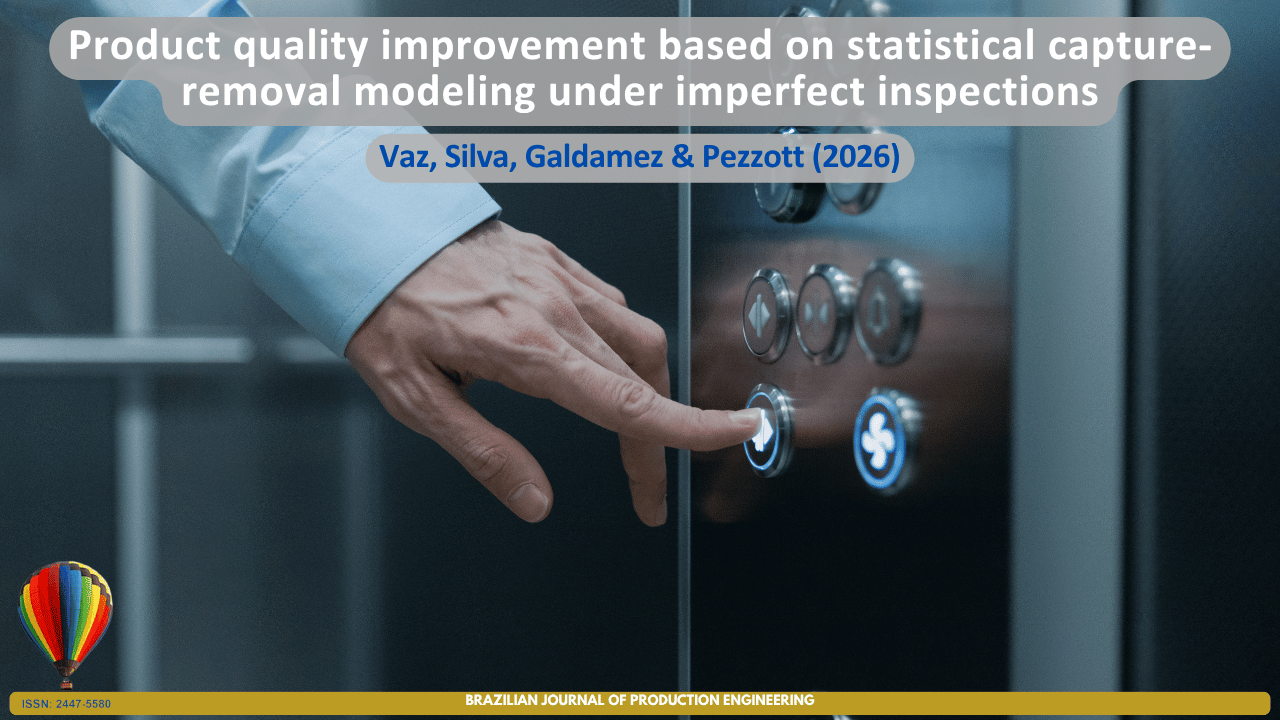
Product quality improvement based on statistical capture-removal modeling under imperfect inspections
- Authors
-
-
Author
-
Author
-
Author
-
Author
-
- Keywords:
- Quality Control, Imperfect Inspections, Capture–Removal Model
- Abstract
-
This article proposes an approach for evaluating and improving product quality in production processes subject to imperfect inspections. The objective is to estimate the number of nonconforming items after inspections and to support decision-making in quality control planning. The methodology is based on a statistical capture–removal model, which estimates the proportion of defective items and the efficiency of inspections in detecting nonconformities. In addition, it allows estimating the expected number of nonconforming items before inspections and determining the minimum number of stages required to achieve acceptable defect levels. The model was applied in a factory of elevator components, using data from 2,447 inspected boxes over a 13-week period. The results indicate that approximately 3.7% of the approved boxes still present nonconformities, highlighting limitations of the current control system. Furthermore, predictions of the number of nonconforming items before inspections were close to the estimates obtained after inspections, indicating the consistency and applicability of the proposed model. Overall, the proposed methodology proved to be an effective tool for quality planning and control, contributing to decision-making in production environments.
- Author Biographies
- References
-
Berrade, M. D., Scarf, P. A., Cavalcante, C. A. V., & Dwight, R. A. (2013). Imperfect inspection and replacement of a system with a defective state: a cost and reliability analysis. Reliability Engineering & System Safety, 120, 80-87. https://doi.org/10.1016/j.ress.2013.02.024
Byrd, R. H., Lu, P., Nocedal, J., & Zhu, C. (1995). A limited memory algorithm for bound constrained optimization. SIAM Journal on scientific computing, 16(5), 1190-1208 https://doi.org/10.1137/0916069
Bonett, D. G. & Woodward, J. A. (1994). Sequential defect removal sampling. Management Science, 40(7), 898-902. https://doi.org/10.1287/mnsc.40.7.898
Casella, G., & Berger, R. (2024). Statistical inference. Chapman and Hall/CRC. https://doi.org/10.1201/9781003456285
Chun, Y. H. (2005). Serial inspection plan in the presence of inspection errors: maximum likelihood and maximum entropy approaches. Quality Engineering, 17(4), 627-632. https://doi.org/10.1080/08982110500225463
Chun, Y. H. (2008). Bayesian analysis of the sequential inspection plan via the Gibbs sampler. Operations Research, 56(1), 235-246. https://doi.org/10.1287/opre.1070.0501
Chun, Y. H. (2015). Improved method of estimating the product quality after multiple inspections. International Journal of Production Research, 54(19), 5686-5696. https://doi.org/10.1080/00207543.2015.1128128
Chun, Y. H. (2016). Designing repetitive screening procedures with imperfect inspections: an empirical Bayes approach. European Journal of Operational Research, 253(3), 639-647. https://doi.org/10.1016/j.ejor.2016.03.003
Chun, Y. H. (2019). Imperfect inspection with directional information: a general failure probability model. Journal of Quality Technology, 51(3), 300-313. https://doi.org/10.1080/00224065.2019.1569953
Chun, Y. H. (2023). Economic design of multiple inspection plans via the expectation-maximization algorithm. Journal of the Operational Research Society, 74(3), 762-776. https://doi.org/10.1080/01605682.2022.2053306
Duffuaa, S. O. & Khan, M. (2005). Impact of inspection errors on the performance measures of a general repeat inspection plan. International Journal of Production Research, 43(23), 4945-4967. https://doi.org/10.1080/00207540412331325413
Gadrich, T. & Katriel, G. (2021). Estimating the rate of defects under imperfect sampling inspection-a new approach. Probability in the Engineering and Informational Sciences, 35(2), 242-257. https://doi.org/10.1017/S0269964819000391
Kang, Z., Catal, C., & Tekinerdogan, B. (2022). Product failure detection for production lines using a data-driven model. Expert Systems with Applications, 202, 117398. https://doi.org/10.1016/j.eswa.2022.117398.
Maisano, D. A., Ferrara, L., & Franceschini, F. (2025). Characteristic curves for multiple‐inspector sampling plans with inspection errors. Quality and Reliability Engineering International. https://doi.org/10.1002/qre.70058
Myung, I. J. (2003). Tutorial on maximum likelihood estimation. Journal of mathematical Psychology, 47(1), 90-100. https://doi.org/10.1016/S0022-2496(02)00028-7
Nunes, P., Santos, J., & Rocha, E. (2023). Challenges in predictive Maintenance-A review. CIRP Journal of Manufacturing Science and Technology, 40, 53-67. https://doi.org/10.1016/j.cirpj.2022.11.004
Pakkala, D., Kääriäinen, J., & Mätäsniemi, T. (2024). Improving efficiency and quality of operational industrial production assets information management in customer-vendor interaction. Journal of Industrial Information Integration, 41, 100644 https://doi.org/10.1016/j.jii.2024.100644
Powell, D., Magnanini, M. C., Colledani, M., & Myklebust, O. (2022). Advancing zero defect manufacturing: A state-of-the-art perspective and future research directions. Computers in Industry, 136, 103596. https://doi.org/10.1016/j.compind.2021.103596
R Core Team. (2021). R: a language and environment for statistical computing. R foundation for statistical computing, Vienna, Austria.
Sabry, A. H. & Amirulddin, U. A. B. U. (2024). A review on fault detection and diagnosis of industrial robots and multi-axis machines. Results in Engineering, 23, 102397. https://doi.org/10.1016/j.rineng.2024.102397
Shahmoradi, Z. & Ünlüyurt, T. (2018). Failure detection for series systems when tests are unreliable. Computers & Industrial Engineering, 118, 309-318. https://doi.org/10.1016/j.cie.2018.02.033
Wang, J., Ma, X., Yang, L., Qiu, Q., Shang, L., & Wang, J. (2024). A hybrid inspection-replacement policy for multi-stage degradation considering imperfect inspection with variable probabilities. Reliability Engineering & System Safety, 241, 109629. https://doi.org/10.1016/j.ress.2023.109629
Wei, W., Li, H., & Leus, R. (2017). Test sequencing for sequential system diagnosis with precedence constraints and imperfect tests. Decision Support Systems, 103, 104-116. https://doi.org/10.1016/j.dss.2017.09.009
White, G. C. (1982). Capture-recapture and removal methods for sampling closed populations. Los Alamos National Laboratory. Recuperado de https://doi.org/10.2307/2347719
Yang, M. H. & Cho, J. H. (2013). Minimisation of inspection and rework cost in a BLU factory considering imperfect inspection. International Journal of Production Research, 52(2), 384-396. https://doi.org/10.1080/00207543.2013.828171
- Cover Image
-
- Downloads
- Additional Files
- Published
- 2026-06-15
- Section
- QUALITY ENGINEERING
- License
-
Copyright (c) 2026 Vaz, N. A. F. R., Silva, V. R. da, Galdamez, E. V. C., & Pezzott, G. L. M.

This work is licensed under a Creative Commons Attribution 4.0 International License.
All works published in the Brazilian Journal of Production Engineering (BJPE) are licensed under Creative Commons Attribution 4.0 International (CC BY 4.0). This means that: Anyone can copy, distribute, display, adapt, remix, and even commercially use the content published in the journal; Provided that due credit is given to the authors and to BJPE as the original source; No additional permission is required for reuse, as long as the license terms are respected. This policy complies with the principles of open access, promoting the broad dissemination of scientific knowledge. 🔗 Click here to access the full license
