

2.png)


































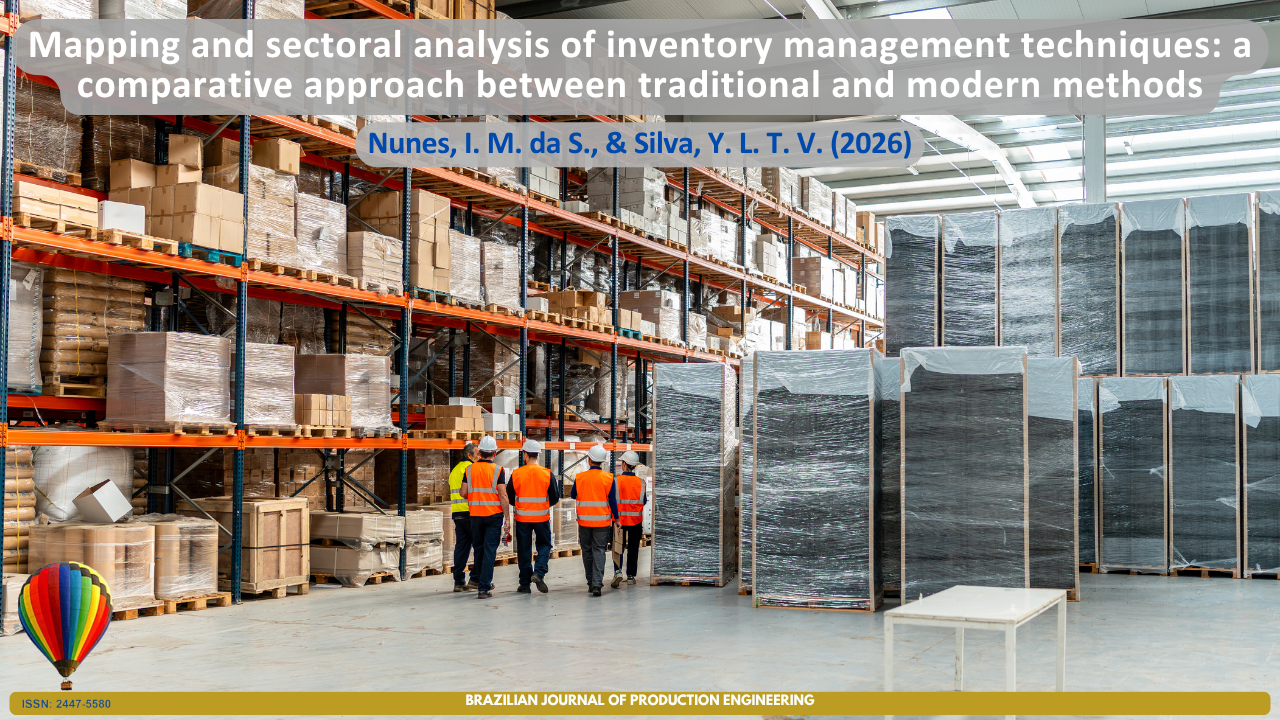
Mapping and sectoral analysis of inventory management techniques: a comparative approach between traditional and modern methods
- Keywords:
- Inventory technique mapping, inventory management, Materials management
- Abstract
-
Efficient inventory management is essential to organizational performance, motivating the search for methods that improve control and reduce operating costs. In this context, this study presents the mapping and comparative analysis of 12 inventory techniques (six traditional and six modern), providing a clear overview of the approaches and their applications across different sectors. The results indicate that traditional techniques remain widely used in retail, distribution, and manufacturing due to their simplicity and ease of integration into existing processes, whereas modern techniques, driven by technological advances, have spread mainly in logistics, technology, and more digitized industries because of their potential to increase accuracy and responsiveness. The comparison between the groups highlights relevant differences in complexity, required technological support, and suitability for distinct production contexts. It is concluded that the evolution of these techniques is continuous and essential to operational efficiency, offering support for companies to choose the approach best suited to each sector’s needs.
- Author Biographies
- References
-
Ahmadi, E., Mosadegh, H., Maihami, R., Ghalehkhondabi, I., Sun, M., & Süer, G. A. (2022). Intelligent inventory management approaches for perishable pharmaceutical products in a healthcare supply chain. Computers & Operations Research, 147, 105968. https://doi.org/10.1016/j.cor.2022.105968
Ahmed, K. R., Hossain, A., Asif, M. A. B., Mohammad, M., Rahaman, M., & Dewan, M. A. (2025). Optimizing production and inventory management for defective items in manufacturing systems. 3rd International Conference on Intelligent Systems, Advanced Computing and Communication (ISACC): IEEE. https://doi.org/10.1109/ISACC65211.2025.10969370
Becerra, P., Mula, J., & Sanchis, R. (2022). Sustainable inventory management in supply chains: trends and further research. Sustainability, 14(5), 2613. https://doi.org/10.3390/su14052613
Demizu, T., Fukazawa, Y., & Morita, H. (2023). Inventory management of new products in retailers using model-based deep reinforcement learning. Expert Systems with Applications, 229, 120256. https://doi.org/10.1016/j.eswa.2023.120256
Kaynov, I., Van Knippenberg, M., Menkovski, V., Van Breemen, A., & Van Jaarsveld, W. (2024). Deep reinforcement learning for one-warehouse multi-retailer inventory management. International Journal of Production Economics, 267, 109088. https://doi.org/10.1016/j.ijpe.2023.109088
Li, M. & Mizuno, S. (2022). Dynamic pricing and inventory management of a dual-channel supply chain under different power structures. European Journal of Operational Research, 303(1), 273-285. https://doi.org/10.1016/j.ejor.2022.02.049
Madamidola, O. A., et al. (2024). A review of existing inventory management systems. International Journal of Research in Engineering and Science (IJRES), 12(9), 40-50. Recuperado de https://www.ijres.org/papers/Volume-12/Issue-9/12094050.pdf
Mashayekhy, Y., Babaei, A., Yuan, X. M., & Xue, A. (2022). Impact of Internet of Things (IoT) on inventory management: a literature survey. Logistics, 6(2), 33. https://www.mdpi.com/2305-6290/6/2/33
Mfizi, E., Niragire, F., Bizimana, T., & Mukanyangezi, M. F. (2023). Analysis of pharmaceutical inventory management based on ABC-VEN analysis in Rwanda: a case study of Nyamagabe District. Journal of Pharmaceutical Policy and Practice, 16(1), 30. https://doi.org/10.1186/s40545-023-00540-5
Muckstadt, J. A. & Sapra, A. (2010). Principles of inventory management: when you are down to four, order more. Berlin: Springer Science & Business Media. https://doi.org/10.1007/978-0-387-68948-7
Munyaka, J. B. & Yadavalli, V. S. S. (2022). Inventory management concepts and implementations: a systematic review. South African Journal of Industrial Engineering, 33(2), 15-36. https://doi.org/10.7166/33-2-2527
Nozari, H., Ghahremani-Nahr, J., & Szmelter-Jarosz, A. (2023). A multi-stage stochastic inventory management model for transport companies including several different transport modes. International Journal of Management Science and Engineering Management, 18(2), 134-144. https://doi.org/10.1080/17509653.2022.2042747
Sahu, M. K. (2021). Advanced AI techniques for optimizing inventory management and demand forecasting in retail supply chains. Journal of Bioinformatics and Artificial Intelligence, 1(1), 190-224.
Shah, S. & Thegar, Y. (2021). Exploratory study of inventory management techniques on organizational performance. International Journal of Economics and Management Systems, 6. Recuperado de https://www.iaras.org/iaras/filedownloads/ijems/2021/007-0027(2021).pdf
Waters, D. (2003). Inventory control and management. 2nd ed. ISBN 0-470-85876-1. England: John Wiley & Sons. 407p. Recuperado de https://afifnurichwan.wordpress.com/wp-content/uploads/2015/06/inventory-control-and-management-second-edition.pdf
Yang, L., Liu, K., Zhang, J., & Zelbst, P. J. (2024). Inventory management with actual palletized transportation costs and lost sales. Transportation Research Part E: Logistics and Transportation Review, 184, 103462. https://doi.org/10.1016/j.tre.2024.103462
- Cover Image
-
- Downloads
- Additional Files
- Published
- 2026-06-27
- Section
- LOGISTICS
- License
-
Copyright (c) 2026 Nunes, I. M. da S., & Silva, Y. L. T. V.

This work is licensed under a Creative Commons Attribution 4.0 International License.
All works published in the Brazilian Journal of Production Engineering (BJPE) are licensed under Creative Commons Attribution 4.0 International (CC BY 4.0). This means that: Anyone can copy, distribute, display, adapt, remix, and even commercially use the content published in the journal; Provided that due credit is given to the authors and to BJPE as the original source; No additional permission is required for reuse, as long as the license terms are respected. This policy complies with the principles of open access, promoting the broad dissemination of scientific knowledge. 🔗 Click here to access the full license
