





































Use of thermography to analyze the thermal diffusivity of a concrete blocks produced with electric arc furnace steel slag
- Authors
-
-
Author
-
- Keywords:
- Steel Slag, Thermal Diffusivity, Infrared Thermography
- Abstract
-
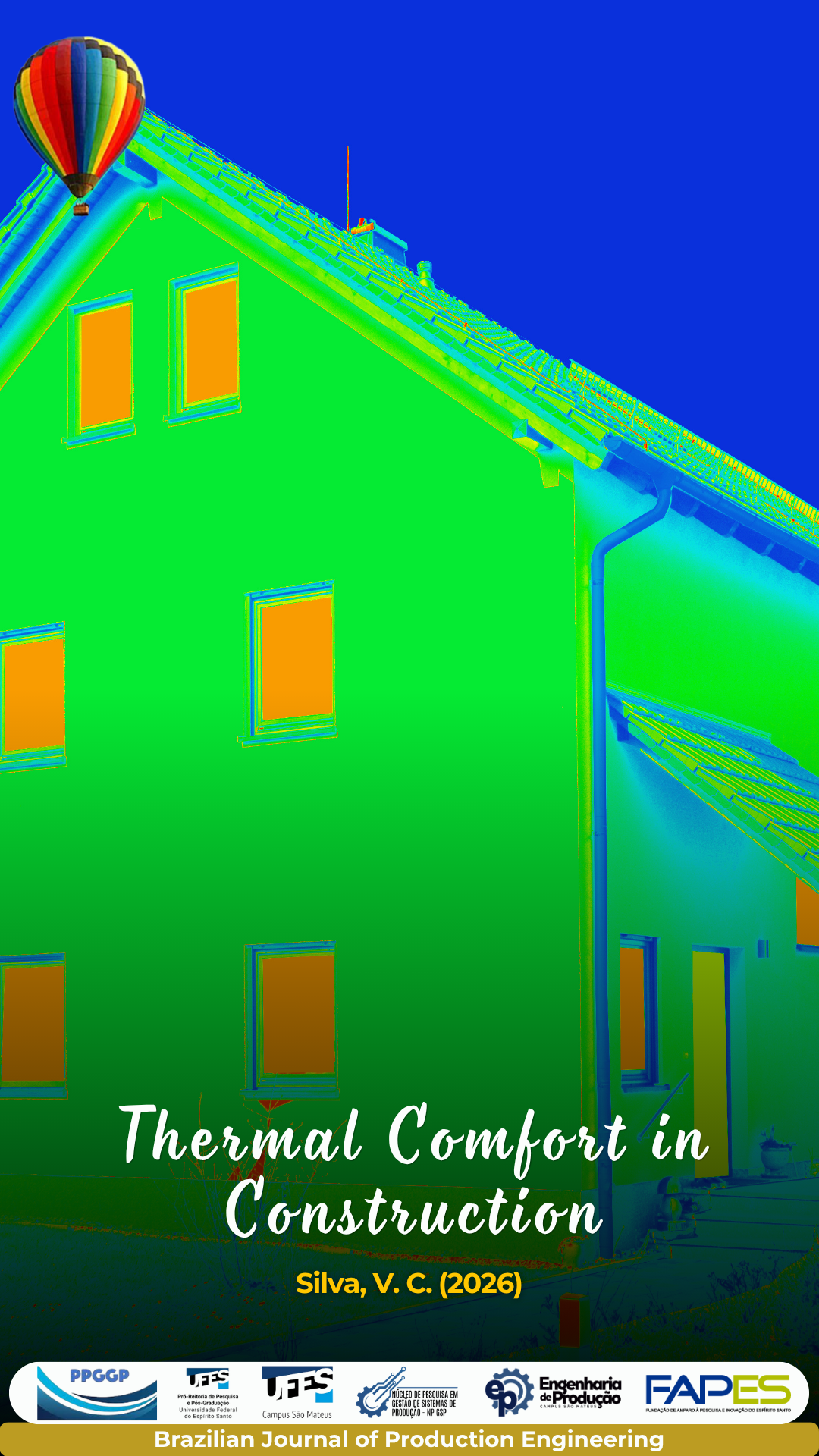
Regarding the increasing thermal sensation in the environments caused by global warming, ways to improve the thermal comfort of buildings have been extensively studied. Due to the need for constructions with higher thermal performance and energy efficiency, the use of materials with lower thermal diffusivity is essential to obtain more comfortable environments. Aiming at the use of a more sustainable material in civil construction, this work seeks to analyze the thermal behavior of a concrete block with the addition of electric steel slag using thermographic camera and compare with others conventional blocks. In order to reach the proposed objective, the experimental methodology used is based on the evaluation of the thermal diffusivity of the concrete block with electric steel slag submitted to a heat source both positioned inside a casing with insulation material. The method considers one-dimensional transient heat conduction and uses an infrared camera to determine the temperatures of the outer face of the block. The results indicate that the concrete block with electric steel slag presents a higher value of thermal diffusivity compared to conventional concrete blocks. In addition, this study proves the efficiency of thermography in civil construction as a non-destructive test of rapid measurement of phenomena involving heat transfer.
- Author Biography
- References
-
Associação Brasileira de Normas Técnicas. ABNT. (2012). NBR 15572: ensaios não destrutivos - Termografia - Guia para inspeção de equipamentos elétricos e mecânicos. Rio de Janeiro: ABNT. https://www.normas.com.br
Baïri, A., García de María, J. M., & Laraqi, N. (2007). Thermal diffusivity measurements of building materials based on 2D models. Computational materials science, 38(4), 838-46. 10.1016/j.commatsci.2006.06.002
Barbosa, P. G. (2014). Uma contribuição para o design do conforto: avaliação da difusividade térmica de blocos cerâmicos e de concreto utilizando a termografia infravermelha. Dissertação de mestrado, Universidade do Estado de Minas Gerais, Belo Horizonte. https://anapaulanasta.com
Barreira, E., Almeida, R. M. S. F., & Delgado, J. M. P. Q. (2016). Infrared thermography for assessing moisture rlated phenomena in building components. Construction and Building Materials. 110, 251-69. 10.1016/j.conbuildmat.2016.02.026.
Bergman, T. L., Lavine, A. S., Incropera, F. P., & Dewitt, D. P. (2011). Fundamentals of heat and mass transfer. 7ed. John Wiley & Sons, Inc. https://madar-ju.com
Chrzanowski, K. (2010). Testing thermal imagers - practical guide. P.P.H Remigraf, 11. Ratuszowa Str., 03-430. Warsaw, Poland. http://inframet.su
Chrzanowski, K. (2001). Non-contact thermometry - measurement errors. Research & Development Treatises, 7, Polish Chapter of SPIE, Warsaw. https://inframet.com
Chrzanowski, K., Fischer J., & Matyszkiel R. (2000). Testing and evaluation of thermal cameras for absolute temperature measurement. Journal of Optical Engineering. 39(9), 2535-44. 10.1117/1.1287832
Chrzanowski, K. & Park, S. N. (2001). Evaluation of thermal cameras for non-destructive thermal testing applications. Infrared Physics & Technology, 42, 101-5. 10.1016/S1350-4495(00)00062-1
Chirdon, W. M., Aquino, W, & Hover, K. C. (2007). A method for measuring transient thermal diffusivity in hydrating Portland cement mortars using an oscillating boundary temperature. Cement And Concrete Research, 37(5), 680-90. 10.1016/j.cemconres.2007.01.010
Deng, J., et al. (2018). Thermal diffusivity of coal and its predictive model in nitrogen and air atmospheres. Applied Thermal Engineering. 130, 1233-45. 10.1016/j.applthermaleng.2017.11.102
Deng, L., et al. (2026). Thermoelectric energy-harvesting concrete modules for multifunctional building elements. Cement and Concrete Composites. 171, 106648. 10.1016/j.cemconcomp.2026.106648
Diotti, A., et al. (2021). Sustainable recycling of electric arc furnace steel slag as aggregate in concrete: effects on the environmental and technical performance. Sustainability. 13(2), 521. 10.3390/su13020521
Flir Systems. (2012). The User’s manual FLIR Exx series: a ResourceGuide for using Infrared in the research and development industry, United Kingdom: Instrumart. https://www.instrumart.com
Flores, L. S. & Lesino, G. (2004). Medicion de la difusividad térmica de materiales de construcción. Revista de la Construcción, Pontificia Universidad Católica de Chile. 1(3), 24-31. https://buscador.bibliotecas.uc.cl
Franco, L. C. (2015). Concretos e argamassas sustentáveis aplicados à habitação de interesse social. Dissertação de mestrado, Universidade Federal de Ouro Preto. https://educapes.capes.gov.br
García-López, C. & Álvarez-Tey, G. (2022). Evaluation of the uncertainty of surface temperature measurements in photovoltaic modules in outdoor operation. Sensors, 22(15), 5685. 10.3390/s22155685
González, C. E. M. (2003). Seleccion de materiales em la concepcion arquitectonica bioclimática. Instituto de Investigaciones de la Facultad de Arquitectura y Diseño (IFAD). Universidad Del Zulia, Maracaibo/Venezuela. https://www.academia.edu
Gonzalez, R. C. & Woods, R. C. (2010). Processamento Digital de Imagens. 3ªed. São Paulo: Pearson Prentice Hall. https://www.bvirtual.com.br
Grys, S., Vokorokos, L., & Borowik, L. (2014). Size determination of subsurface defect by active thermography - Simulation research. Infrared Physics & Technology, 62, 147-53. 10.1016/j.infrared.2013.11.011
Grossi, P. A., Camarano, D. das M., Ferreira, R. A. N., & Andrade, R. M. de. (2007). Metodologia para a estimativa da incerteza de medição da difusividade térmica pelo método do Flash Laser. In: 8º Congresso Iberoamericano de Engenharia Mecânica. Cusco. https://www.abcm.org.br
Irwin, A. & Grigor, J. (2014). An alternate method for performing MRTD measurements. Infrared Imaging Systems: design, analysis, modeling, and testing. XXV, Ed. Holst, G. C. & Krapels, K. A. Proc. of SPIE. 9071, 1-7. https://sbir.com/wp-content
Jin, L., et al. (2015). Multi-scale analytical theory of the diffusivity of concrete subjected to mechanical stress. Construction and Building Materials. 95, 171-85. 10.1016/j.conbuildmat.2015.07.123
Kagata, K., et al. (2025). Investigation of thermal diffusivity measurement technique based on photoacoustic signal response under the influence of three-dimesional heat transfer. Applied Thermal Engineering, 258, 124519. 10.1016/j.applthermaleng.2024.124519
Li, Z., et al. (2023). Recent advances and challenges in the inverse identification of thermal diffusivity of natural ice in China. Water. 15(6), 1041. 10.3390/w15061041
Ma, A., et al. (2021). Measuring thermophysical properties of building insulation materials using transient plane heat source method. Energy and Buildings, 240, 110891. 10.1016/J.ENBUILD.2021.110891
Migunthanna, J., et al. (2026). Developing eco-friendly foam concrete with waste clay bricks and recycled polypropylene fibre. Next Sustainability, 7, 100263. 10.1016/j.nxsust.2026.100263
Minkina, W. & Dudzik, S. (2009). Infrared thermography errors and uncertainties. 1ª ed., Wiley. https://api.pageplace.de
Mombelli, D., et al. (2019). The influence of slag tapping method on the efficiency of stabilization treatment of electric arc furnace carbon steel slag (EAF-C). Minerals. 9(11), 706. 10.3390/min9110706
Monosi, S., Ruello, M. L., & Sani, D. (2016). Electric arc furnace slag as natural aggregate replacement in concrete production. Cement and concrete composites. 66, 66-72. 10.1016/j.cemconcomp.2015.10.004
Motz, H., Ehrenberg, A., & Mudersbach, D. (2013). Dry solidification with heat recovery of ferrous slag. 3rd International Slag Valorisation Symposium, Leuven, Belgium. https://journals.sagepub.com
Noh, H. G., et al. (2017). Effective thermal conductivity and diffusivity of containment wall for nuclear power plant OPR1000. Nuclear Engineering and Technology. 49(3), 459-65. 10.1016/j.net.2016.10.010
Owczarek, M., et al. (2021). Measurement method of thermal diffusivity of the building wall for summer and winter seasons in Poland. Energies, 14(13), 3836. 10.3390/en14133836
Pratticò, D., et al. (2025). Hybrid FEM-AI approach for thermographic monitoring of biomedical electronic devices. Computers. 14(9), 344. 10.3390/computers14090344
Taylor, R. E. & Cape, J. A. (1964). Finite pulse time effects in the flasd diffusivity technique. J. Appl. Phys. Lett. 5(10), 212-3. 10.1063/1.1723593
Rizzo. E. M. S. (2005). Introdução aos processos siderúrgicos. São Paulo: Associação Brasileira de Metalurgia e materiais. 150p. https://pt.scribd.com
Santamaría, A., et al. (2017). Performing self-compacting concrete with electric arc-furnace slag as aggregates. International Conference on Advances in Sustainable Construction Materials & Civil Engineering Systems (ASCMCES-17). 120, 03003. 10.1051/matecconf/201712003003
Sellami, A., et al. (2022). Study of toughness and thermal properties of bio-composite reinforced with diss fibers for use as an insulating material. Energy and Buildings, 276(20), 112527. 10.1016/j.enbuild.2022.112527
Shin, K., et al. (2002). Thermo-physical properties and transient heat transfer of concrete at elevated temperatures. Nuclear engineering and design. 212(1-3), 233-41. 10.1016/S0029-5493(01)00487-3
Silva, V. C. (2014). Estudo da viabilidade da utilização da escória de aciaria como matéria prima alternativa em novos produtos. In: 11º Congresso Brasileiro de Pesquisa e Desenvolvimento em Design, Gramado. São Paulo: Editora Edgard Blücher. p. 2114. https://www.proceedings.blucher.com.br
Sun, F., et al. (2025). Over temperature in thermal barrier coating system induced by local spallation of ceramic layer. Applied Thermal Engineering. 269(1-2), 126121. 10.1016/j.applthermaleng.2025.126121
Teo, P. T., et al. (2020). Assessment of electric arc furnace (EAF) steel slag waste’s recycling options into value added green products: a review. Metals. 10(10), 1347. 10.3390/met10101347
Ting, J. C. J., et al. (2025). Revolutionizing concrete: performance enhancement and elemental insights with Electric Arc Furnace (EAF) slag replacement. Materials. 18(7), 1528. 10.3390/ma18071528
Tran, Q. H., et al. (2017). Effects of ambient temperature and relative humidity on subsurface defect detection in concrete structures by active thermal imaging. Sensors. 17(8), 1718. 10.3390/s17081718
Venegas, P., et al. (2018). Projected thermal diffusivity analysis for thermographic nondestructive inspections. International Journal of Thermal Sciences. 124, 251-62. 10.1016/j.ijthermalsci.2017.10.010
Xu, F., et al. (2020). Experimental investigation on the effect of sulfate attack on chloride diffusivity of cracked concrete subjected to composite solution. Construction and Building Materials. 237, 117643. 10.1016/j.conbuildmat.2019.117643
Zahrani, F., et al. (2026). Sustainable cement mortar-esparto composites: experimental thermal and mechanical characterization, building energy simulation, and life cycle assessment. Journal of Building Engineering. 128, 116725. 10.1016/j.jobe.2026.116725
Wang, C., et al. (2025). Optimized design of contact interfaces for enhanced heat dissipation in flip-chip package. Applied thermal engineering. 259, 124936. 10.1016/j.applthermaleng.2024.124936
White, G., et al. (2022). Novel methods for measuring the thermal diffusivity and the thermal conductivity of a lithium-ion battery. Applied Thermal Engineering. 212, 118573. 10.1016/j.applthermaleng.2022.118573
You, X., et al. (2026). Utilizing desert sand and industrial by-products for developing cement-free highly thermal conductive, low-cost materials for data center buildings. Construction and Building Materials. 534, 146849. 10.1016/j.conbuildmat.2026.146849
- Cover Image
-
- Downloads
- Additional Files
- Published
- 2026-11-06
- Section
- Civil Engineering, Design and Architecture
- License
-
Copyright (c) 2026 Vanessa Cristine Silva (Autor)

This work is licensed under a Creative Commons Attribution 4.0 International License.
All works published in the Brazilian Journal of Production Engineering (BJPE) are licensed under Creative Commons Attribution 4.0 International (CC BY 4.0). This means that: Anyone can copy, distribute, display, adapt, remix, and even commercially use the content published in the journal; Provided that due credit is given to the authors and to BJPE as the original source; No additional permission is required for reuse, as long as the license terms are respected. This policy complies with the principles of open access, promoting the broad dissemination of scientific knowledge. 🔗 Click here to access the full license
