

2.png)



































Models for predicting environmental impacts with artificial intelligence: a bibliometric review
- Authors
-
-
Author
-
Author
-
Author
-
- Abstract
-
This study examines the evolution of international scientific production on environmental impact prediction models based on AI algorithms, with an emphasis on Machine Learning-ML techniques applied to the context of climate change. The objective was to map trends, identify gaps, and assess the consolidation of this field, considering its potential for integration with sustainability metrics. The research used bibliometric methods based on 631 articles indexed in the WoS between 1945-2023, analyzed with the Bibliometrix in R software. The results indicate exponential growth in publications since 2016, accompanied by the predominance of China, the USA, and India in both volume and scientific influence. The application of Bradford’s and Lotka’s Laws revealed a concentration of production in a few journals and high authorial fragmentation. The thematic analysis showed that ML, climate change, and prediction models are the driving themes of the field, although still focused on isolated environmental variables. It was found that there is an absence of integrated models articulating environmental forecasts, socioeconomic impacts, and governance dimensions, as well as a lack of systematic connections between AI techniques and ESG indicators. It is concluded that this integration constitutes a promising frontier for future research and for the formulation of sustainability strategies.
- Author Biographies
- References
-
Adisa, O. M., Masinde, M., Botai, J. O., & Botai, C. M. (2020). Bibliometric analysis of methods and tools for monitoring and forecasting droughts in Africa. Sustainability, 12(16), 6516. https://doi.org/10.3390/su12166516
Al-Abassi, A., Karimipour, H., Haddadpajouh, H., Dehghantanha, A., & Parizi, R. M. (2020). Industrial big data analytics: challenges and opportunities. In Handbook of Big Data Privacy (37-61). Springer. https://doi.org/10.1007/978-3-030-38557-6_3
Anderegg, W. R. L., Prall, J. W., Harold, J., & Schneider, S. H. (2010). Expert credibility on climate change. Proceedings of the National Academy of Sciences, 107(27), 12107-09. https://doi.org/10.1073/pnas.1003187107
Aria, M. & Cucurullo, C. (2017). Bibliometrix: an R tool for comprehensive science mapping analysis. Journal of Informetrics, 11(4), 959-975. https://doi.org/10.1016/j.joi.2017.08.007
Banihashemi, S., Ding, G., & Wang, J. (2017). Developing a hybrid model of prediction and classification algorithms for building energy consumption. Energy Procedia, 110, 371-376. https://doi.org/10.1016/j.egypro.2017.03.155
Belayneh, A., Adamowski, J., & Khalil, B. (2015). Short-term SPI drought forecasting in the Awash River Basin, Ethiopia, using wavelet transforms and machine learning methods. Sustainable Water Resources Management, 2, 87-101. https://doi.org/10.1007/s40899-015-0010-2
Bornmann, L. (2016). Bibliometrics in climate change research: A perspective from bibliometric indicators. PLoS ONE, 11(7), e0157650. https://doi.org/10.1371/journal.pone.0157650
Brookes, B. C. (1969). Bradford’s law and the bibliography of science. Nature, 224, 953-6. https://doi.org/10.1038/224953a0
Buarque, S. C. (2003). Metodologia e técnicas de construção de cenários globais e regionais. IPEA.
Cobo, M. J., López-Herrera, A. G., Herrera-Viedma, E., & Herrera, F. (2011). An approach for detecting, quantifying, and visualizing the evolution of a research field: a practical application to the fuzzy sets theory field. Journal of Informetrics, 5(1), 146-66. https://doi.org/10.1016/j.joi.2010.10.002
Ferreira, A. L., Marton, F., & Perez, G. (2022). Cybersecurity in services: a bibliometric study. Journal of Professional Master’s Degrees, 11(2). https://doi.org/10.51359/2317-0115.2022.256796
Gleckler, P. J., Taylor, K. E., & Doutriaux, C. (2008). Performance metrics for climate models. Journal of Geophysical Research: Atmospheres, 113, D06104. https://doi.org/10.1029/2007JD008972
Gosling, N. W. & Arnell, N. (2016). A global assessment of the impact of climate change on water scarcity. Climatic Change, 134, 371-85. https://doi.org/10.1007/s10584-013-0853-x
Greco, D. (2017). Modelos preditivos: o que são e para que servem. Análise de Dados. https://marketingpordados.com/2017/05/10/
Grieneisen, M. L. & Zhang, M. (2011). The current status of climate change research. Nature Climate Change, 1(2), 72-3. https://doi.org/10.1038/nclimate1093
Guresen, E., Kayakutlu, G., & Daim, T. U. (2011). Using artificial neural network models in stock market index prediction. Expert Systems with Applications, 38, 10389-97. https://doi.org/10.1016/j.eswa.2011.02.068
Haunschild, R., Bornmann, L., & Marx, W. (2016). Climate change research in view of bibliometrics. PLoS ONE, 11(7), e0157649. https://doi.org/10.1371/journal.pone.0157649
Hughes, L. (2003). Climate change and Australia: trends, projections and impacts. Austral Ecology, 28, 423-43. https://doi.org/10.1046/j.1442-9993.2003.01300.x
Hussin, F., Rahim, S. A. N. M., Hatta, N. S. M., Aroua, M. K., & Mazari, S. A. (2023). A systematic review of machine learning approaches in carbon capture applications. Journal of CO₂ Utilization, 71. https://doi.org/10.1016/j.jcou.2023.102474
IPCC. (2014). Climate change 2014: synthesis report. Summary for Policymakers. Intergovernmental Panel on climate change. https://www.ipcc.ch/pdf/assessment-report/ar5/syr/AR5_SYR_FINAL_SPM.pdf
Laniak, G. F. et al. (2013). Integrated environmental modeling: A vision and roadmap for the future. Environmental Modelling & Software, 39, 3-23. https://doi.org/10.1016/j.envsoft.2012.09.006
Li, J. F., Wang, M. H., & Ho, Y. S. (2011). Trends in global climate change research. Global and Planetary Change, 77(1-2), 13-20. https://doi.org/10.1016/j.gloplacha.2011.02.005
Li, W. & Zhao, Y. (2015). Bibliometric analysis of global environmental assessment research. Environmental Impact Assessment Review, 50, 158-66. https://doi.org/10.1016/j.eiar.2014.09.012
Liu, Y., Esan, O. C., Pan, Z., & An, L. (2021). Machine learning for advanced energy materials. Energy and AI, 3. https://doi.org/10.1016/j.egyai.2021.100049
Miyano, T. & Girosi, F. (1994). Forecasting global temperature variations by neural networks (Technical Report). MIT, Artificial Intelligence Laboratory.
Müller, V. C. & Bostrom, N. (2016). Future progress in artificial intelligence: A survey of expert opinion. In V. C. Müller (Ed.), Fundamental issues of artificial intelligence (553-71). Springer. https://doi.org/10.1007/978-3-319-26485-1_33
Okubo, Y. (1997). Bibliometric indicators and analysis of research systems: Methods and examples. OECD.
Penland, C. & Matrosova, L. (1998). Prediction of tropical Atlantic sea surface using linear inverse modeling. Journal of Climate, 11, 483-96. https://doi.org/10.1175/1520-0442(1998)011‹0483:POTASS›2.0.CO;2
Roesch, I. & Günther, T. (2018). Visualization of neural network predictions for weather forecasting. Computer Graphics Forum, 38, 209-20. https://doi.org/10.1111/cgf.13403
Rodrigues, C. & Godoy, A. F. G. (2016). Bibliometric studies on the scientific production of information and communication technologies in libraries. InCID: Revista de Ciência da Informação e Documentação, 7(1), 167-80. https://doi.org/10.11606/issn.2178-2075.v7i1p167-180
Sembay, M., Luiz Pinto, A., de Macedo, D. J., & Moreiro-González, J. A. (2020). Aplicación de la Ley de Bradford a la investigación sobre open government. Anales de Documentación, 23(1). https://doi.org/10.6018/analesdoc.326771
Smith, D. M., Cusack, S., Colman, A. W., Folland, C. K., Harris, G. R., & Murphy, J. M. (2007). Improved prediction of surface temperature for the next decade from a global climate model. Science, 317, 796-99.
Su, H. & Lee, P. (2010). Mapping knowledge structure by keyword co-occurrence. Scientometrics, 85(1), 65-79. https://doi.org/10.1007/s11192-010-0252-8
Tanure, T. M. P., et al. (2020). The impacts of climate change on agricultural production, land use and economy of the Legal Amazon region between 2030 and 2049. Economia Aplicada, 21, 73-90. https://doi.org/10.11606/1980-5330/ea162093
Thai, H.-T. (2022). Machine learning for structural engineering: A state-of-the-art review. Structures, 38, 448–91. https://doi.org/10.1016/j.istruc.2022.02.003
Thompson, D. F. & Walker, C. K. (2015). A descriptive and historical review of bibliometrics with applications to the medical sciences. Pharmacotherapy, 35(6), 551-59. https://doi.org/10.1002/phar.1582
Tol, R. S. (2002). Estimates of the damage costs of climate change. Part 1: Baseline estimates. Environmental and Resource Economics, 21, 47-73. https://doi.org/10.1023/A:1014500930521
Urbizagastegui, R. (2008). The productivity of authors on Lotka’s Law. Ciência da Informação, 37(2), 87-102. https://doi.org/10.1590/S0100-19652008000200008
Wibisono, A. et al. (2016). Traffic big data prediction and visualization using fast incremental model trees-drift detection. Knowledge-Based Systems, 93, 33-46. https://doi.org/10.1016/j.knosys.2015.11.017
Wolpert, D. H. (1996). The lack of a priori distinctions between learning algorithms. Neural Computation, 8(7), 1341-90. https://doi.org/10.1162/neco.1996.8.7.1341
Yan, Y. et al. (2021). Harnessing the power of machine learning for carbon capture, utilization, and storage (CCUS). Energy & Environmental Science, 14(12), 6122-57. https://doi.org/10.1039/D1EE02395K
Zaihong, Z., Zhiqiang, D., & Rusch, K. A. (2012). Development of predictive models for determining enterococci levels at Gulf Coast beaches. Water Research, 46(2), 481-92. https://doi.org/10.1016/j.watres.2011.11.050
Zarur, M. A. F. (2000). Modelo para elaboração de cenários do setor energético, utilizando técnicas de data mining (Mestrado). Universidade Federal do Rio de Janeiro.
Zhu, D. et al. (1999). A process for mining science & technology documents databases. Ciência da Informação, 28(1), 7-20. https://doi.org/10.1590/S0100-19651999000100002
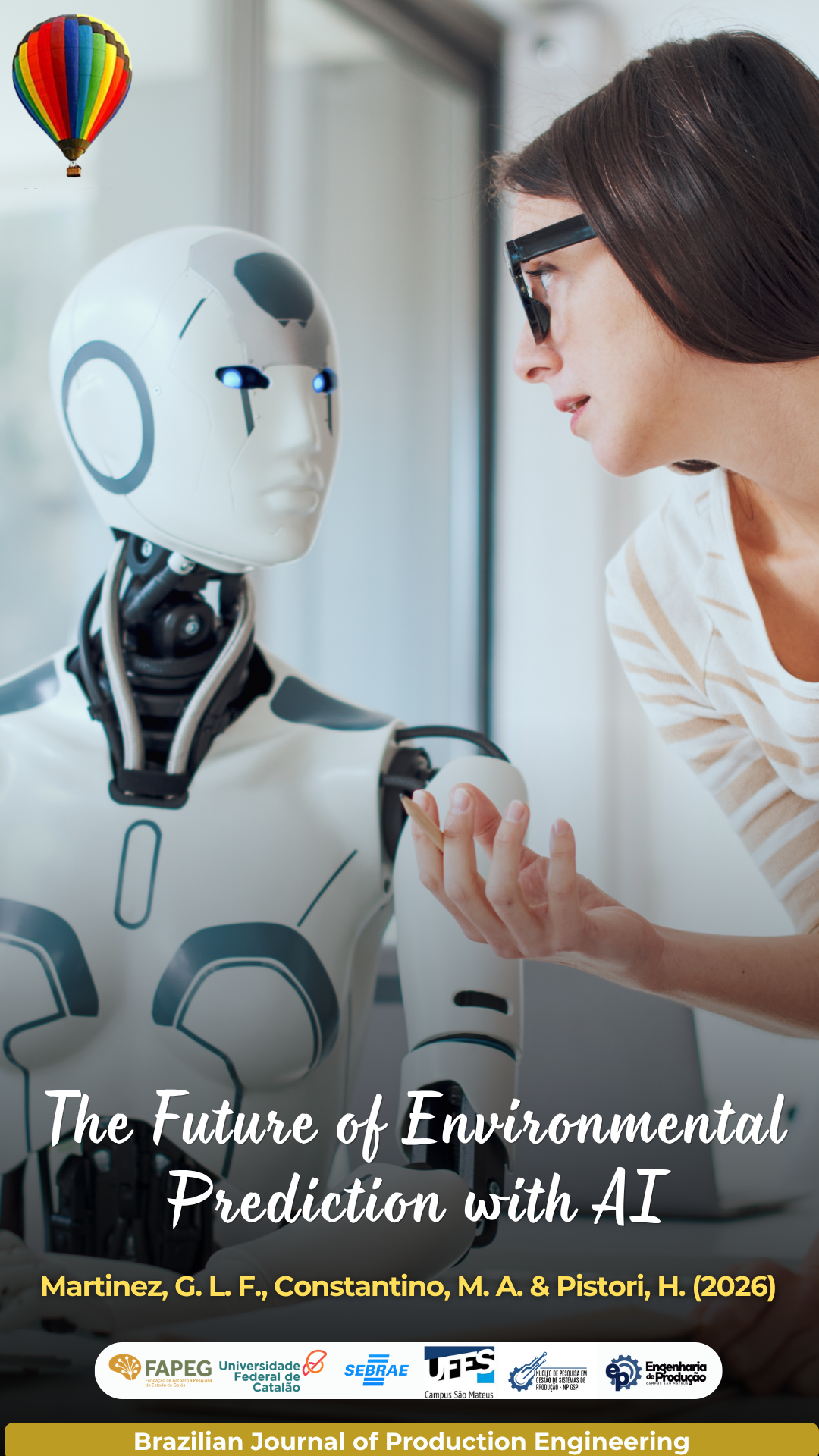
- Cover Image
-
- Downloads
- Published
- 2026-07-20
- Section
- Innovation, Sustainability, and Entrepreneurship: Paths to Transforming Production Engineering
- License
-
Copyright (c) 2026 Martinez, G. L. F., Constantino, M. A. & Pistori, H.

This work is licensed under a Creative Commons Attribution 4.0 International License.
All works published in the Brazilian Journal of Production Engineering (BJPE) are licensed under Creative Commons Attribution 4.0 International (CC BY 4.0). This means that: Anyone can copy, distribute, display, adapt, remix, and even commercially use the content published in the journal; Provided that due credit is given to the authors and to BJPE as the original source; No additional permission is required for reuse, as long as the license terms are respected. This policy complies with the principles of open access, promoting the broad dissemination of scientific knowledge. 🔗 Click here to access the full license
