

2.png)






































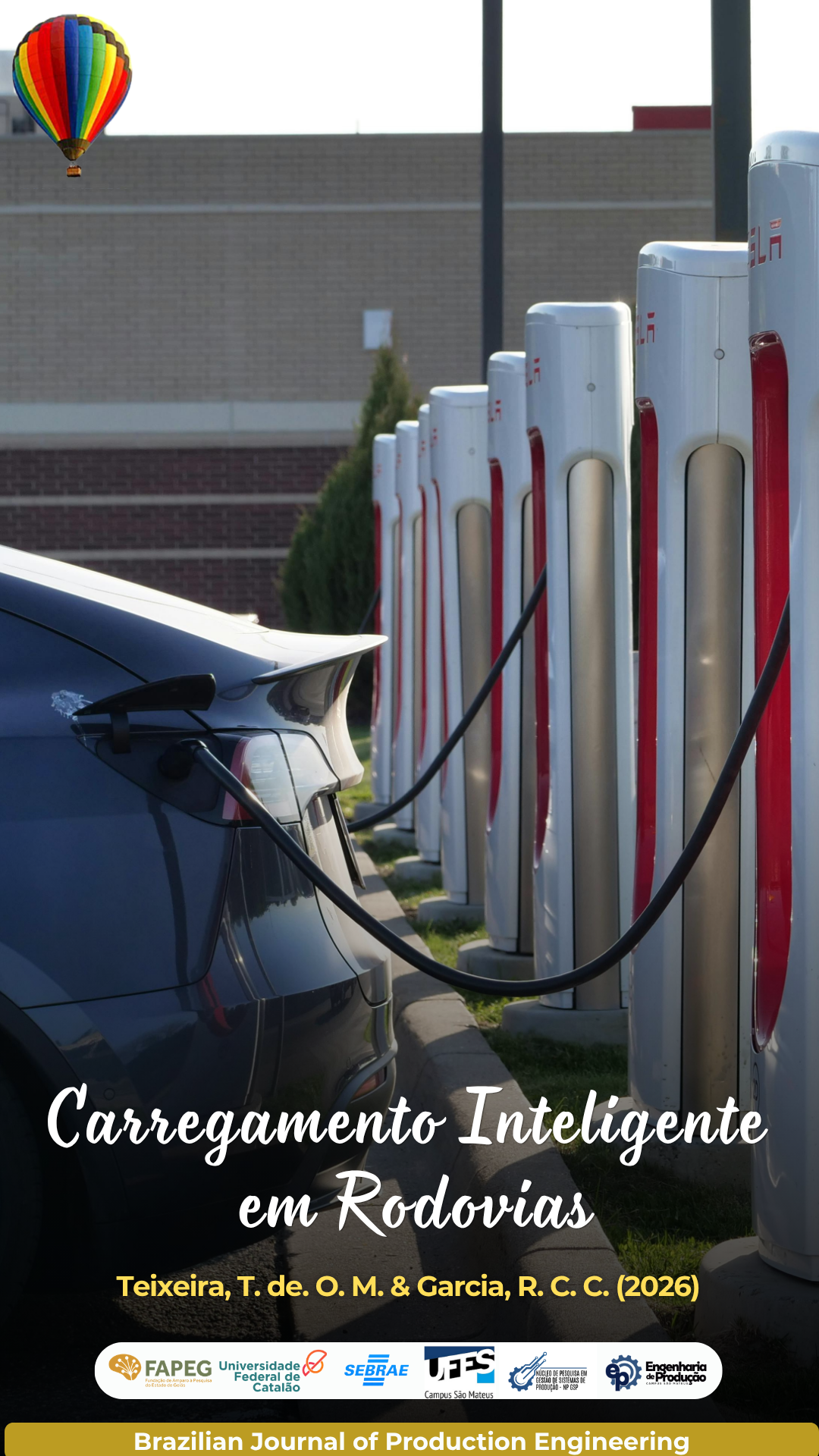
Otimização da instalação de carregadores para veículos elétricos em rodovias não urbanas: um estudo de caso da BR-386, Motiva Viasul, Brasil
- Authors
-
-
Author
-
Author
-
- Keywords:
- Carregamento de veículos elétricos, otimização, algoritmo genético, sistema de informação geográfica, ansiedade de autonomia
- Abstract
-
Este estudo visa encontrar os pontos ótimos para a instalação de carregadores para veículos elétricos (EVs) na rodovia não urbana BR-386, parte da concessão da MOTIVA ViaSul. Este trabalho aplica um modelo de Algoritmo Genético (GA) combinado com o Sistema de Informação Geográfica (GIS) para determinar as localizações ótimas das estações de carregamento. O trabalho foi implementado em três etapas. A primeira etapa consiste na aquisição e limpeza do banco de dados, uma vez que os dados são obtidos de diversas fontes. A segunda etapa consiste na implementação do modelo de GA. Esta fase utiliza os dados aplicados, incluindo o fluxo de tráfego (tanto em 2025 quanto uma estimativa para 2030), a infraestrutura de energia elétrica e as especificações dos EVs. A terceira etapa consiste na aplicação de diferentes cenários para obter a solução ótima para o modelo. O modelo encontrou duas localizações ótimas para a alocação de carregadores de EVs, além do número ideal de carregadores, do tamanho médio da fila e da porcentagem de utilização dos carregadores, dependendo do cenário, seja o de 2025 ou o de 2030.
- Author Biographies
- References
-
Barbosa, W., et al. (2022). Electric vehicles: Bibliometric analysis of the current state of the art and perspectives. Energies, 15(2), 395.
Ghorbani, N., et al. (2018). Optimizing a hybrid wind–PV–battery system using GA-PSO and MOPSO for reducing cost and increasing reliability. Energy, 154, 581–591.
Gnann, T., et al. (2018). Fast charging infrastructure for electric vehicles: Today's situation and future needs. Transportation Research Part D: Transport and Environment, 62, 314–329.
Hassanat, A., et al. (2019). Choosing mutation and crossover ratios for genetic algorithms: A review with a new dynamic approach. Information, 10(12), 390.
Hemavathi, S., & Shinisha, A. (2022). A study on trends and developments in electric vehicle charging technologies. Journal of Energy Storage, 52, Article 105013.
Huang, Y., et al. (2018). Eco-driving technology for sustainable road transport: A review. Renewable and Sustainable Energy Reviews, 93, 596–609.
Hussain, A., et al. (2022). Genetic algorithm with a new round-robin based tournament selection: Statistical properties analysis. PLOS ONE, 17(9), Article e0274456.
Ibrahim, M. A., Mahmood, A. K., & Sultan, N. S. (2019). Optimal PID controller of a brushless DC motor using genetic algorithm. International Journal of Power Electronics and Drive Systems, 10(2), 822–830.
Karnauskas, K. B., Miller, S. L., & Schapiro, A. C. (2020). Fossil fuel combustion is driving indoor CO₂ toward levels harmful to human cognition. GeoHealth, 4(5).
Katoch, S., Chauhan, S. S., & Kumar, V. (2020). A review on genetic algorithm: Past, present, and future. Multimedia Tools and Applications, 80(5), 8091–8126.
Kazemi, H., & Akinci, H. (2018). A land use suitability model for rainfed farming by multi-criteria decision-making analysis (MCDA) and geographic information system (GIS). Ecological Engineering, 116, 1–6.
Kostopoulos, E. D., Spyropoulos, G. C., & Kaldellis, J. K. (2020). Real-world study for the optimal charging of electric vehicles. Energy Reports, 6, 418–426.
Lima, M. A., et al. (2020). Renewable energy in reducing greenhouse gas emissions: Reaching the goals of the Paris Agreement in Brazil. Environmental Development, 33, Article 100504.
Michalewicz, Z. (1996). Genetic algorithms + data structures = Evolution programs (3rd ed.). Springer.
Muratori, M., Kontou, E., & Eichman, J. (2019). Electricity rates for electric vehicle direct current fast charging in the United States. Renewable and Sustainable Energy Reviews, 113, Article 109235.
Neubauer, J., & Wood, E. (2014). The impact of range anxiety and home, workplace, and public charging infrastructure on simulated battery electric vehicle lifetime utility. Journal of Power Sources, 257, 12–20.
Noel, L., et al. (2019). Fear and loathing of electric vehicles: The reactionary rhetoric of range anxiety. Energy Research & Social Science, 48, 96–107.
Papazoglou, G., & Biskas, P. (2023). Review and comparison of genetic algorithm and particle swarm optimization in the optimal power flow problem. Energies, 16(3), 1152.
Pevec, D., et al. (2019). Electric vehicle range anxiety: An obstacle for the personal transportation (R)evolution? In 2019 4th International Conference on Smart and Sustainable Technologies (SpliTech) (pp. xx–xx). IEEE.
Ruan, J., & Song, Q. (2019). A novel dual-motor two-speed direct drive battery electric vehicle drivetrain. IEEE Access, 7, 54330–54342.
Singh, V., Singh, V., & Vaibhav, S. (2020). A review and simple meta-analysis of factors influencing adoption of electric vehicles. Transportation Research Part D: Transport and Environment, 86, Article 102436.
Xu, M., Yang, H., & Wang, S. (2020). Mitigate the range anxiety: Siting battery charging stations for electric vehicle drivers. Transportation Research Part C: Emerging Technologies, 114, 164–188.
Zhou, G., Zhu, Z., & Luo, S. (2022). Location optimization of electric vehicle charging stations: Based on cost model and genetic algorithm. Energy, 247, Article 123437.
- Cover Image
-
- Published
- 2026-07-20
- Section
- Innovation, Sustainability, and Entrepreneurship: Paths to Transforming Production Engineering
- License
-
Copyright (c) 2026 Teixeira, T. de. O. M. & Garcia, R. C. C.

This work is licensed under a Creative Commons Attribution 4.0 International License.
All works published in the Brazilian Journal of Production Engineering (BJPE) are licensed under Creative Commons Attribution 4.0 International (CC BY 4.0). This means that: Anyone can copy, distribute, display, adapt, remix, and even commercially use the content published in the journal; Provided that due credit is given to the authors and to BJPE as the original source; No additional permission is required for reuse, as long as the license terms are respected. This policy complies with the principles of open access, promoting the broad dissemination of scientific knowledge. 🔗 Click here to access the full license
