

2.png)
































El uso de la inteligencia artificial en el contexto de la identificación de víctimas desconocidas mediante la odontología forense: una revisión integrativa
- Autores/as
-
-
Autor/a
-
Autor/a
-
Autor/a
-
Autor/a
-
Autor/a
-
Autor/a
-
Autor/a
-
Autor/a
-
- Palabras clave:
- Inteligencia Artificial, Imagen forense, Antropología Forense
- Resumen
-
Desde la promulgación de la Ley n.º 5.081/66, la Odontología Forense se ha dedicado a la identificación humana en las diferentes fases tanatológicas. Iniciando con estudios antropométricos (edad, sexo, afinidad poblacional y estatura), es posible realizar la aproximación facial para la localización de familiares, quienes pueden aportar datos genéticos y odontológicos. Con el avance tecnológico, la inteligencia artificial (IA) ha emergido como una herramienta innovadora. Esta revisión integradora evaluó los beneficios, las limitaciones y las implicaciones forenses de la IA en la Odontología Forense, destacando sus aplicaciones actuales y futuras. Se seleccionaron 26 artículos publicados entre 2019 y 2026, extraídos de las bases de datos PubMed, Portal de Periódicos CAPES, Scopus, Embase y Google Académico. La IA demostró utilidad en análisis anatómicos, identificación por marcas de mordedura, reconstrucciones 3D, morfología facial y estimación de sexo y edad. Se observó que los sistemas basados en IA presentan una precisión comparable o superior a la de los expertos humanos, reduciendo la subjetividad y aumentando la eficiencia en los procesos de identificación.
- Biografía del autor/a
- Referencias
-
Anees, W., Fatima, R., & Ademir, F. (2024). O uso de inteligência artificial na odontologia forense: Revisão de literatura. Revista Brasileira de Odontologia Legal, 81-95. https://doi.org/10.21117/rbol-v11n22024-546
Araidy, S., George, B., & Roman, M. (2025). Artificial intelligence applications in dentistry: A systematic review. Oral, 5(4), 90. https://doi.org/10.3390/oral5040090
Augustine, J., Singh, K., Saini, A. K., & Mahesh, V. (2024). The role of artificial intelligence in forensic odontology: a narrative review of the current applications, associated challenges, and future directions. 2nd DMIHER International Conference on Artificial Intelligence in Healthcare, Education and Industry (IDICAIEI), 1-6. https://doi.org/10.1109/IDICAIEI61867.2024.10842871
Bal, E. N. & Aylin, Y. S. (2025). Artificial intelligence in forensic science: applications, legal framework and criminal liability regime. International Conference on Artificial Intelligence, Computer, Data Sciences and Applications (ACDSA), 1-7. https://doi.org/10.1109/ACDSA65407.2025.11165965
Balgi, P., Farhin, K., Shishir, S., & Jayakumar, J. (2020). Comparative assessment to determine the accuracy of Demirjian and DARLInG methods of dental age estimation in Western Indian children. Legal Medicine, 42, 101629. https://doi.org/10.1016/j.legalmed.2019.101629
Banjšak, L., Denis, M., & Marko, S. (2020). Implementation of artificial intelligence in chronological age estimation from orthopantomographic x-ray images of archaeological skull remains. Bulletin of the International Association for Paleodontology, 14(2), 122-9. https://hrcak.srce.hr/248479
Bewes, J., Low, A., Morphett, A., Pate, F. D., & Henneberg, M. (2019). Artificial intelligence for sex determination of skeletal remains: application of a deep learning artificial neural network to human skulls. Journal of Forensic and Legal Medicine, 62, 403. https://doi.org/10.1016/j.jflm.2019.01.004
Bhardwaj, S., Lukose, S., & Malik, A. (2021). Establishing individuality using palatal rugae. Indian Journal of Forensic Medicine and Pathology, 14(3), 681-5. https://rfppl.co.in/article
Bjelopavlovic, M., Schmeisser, F., Abou-Ayash, S., et al. (2026). Development and validation of an automated algorithm for palatal rugae matching in forensic identification. Journal of Dentistry, 166, 106311. https://doi.org/10.1016/j.jdent.2025.106311
Carvalho, G. P. D., Teixeira, C. S., Leal, M. D. O. C. D., & Almeida, C. (2022). Importância das selfies para a identificação humana: relato de quatro casos periciais. RBOL, 9(2). https://portalabol.com.br
Chamberlaim, A., Flor, B. D. A., Pereira, E. D. S., Almeida, L. S., & Martins, L. D. (2023). Inteligência artificial (IA) e suas aplicações em exames de imagem: uma nova era para diagnósticos na área da saúde. Cuadernos de Educación y Desarrollo, 15(12), 1760524. https://doi.org/10.55905/cuadv15n12-134
Chopra, A., Anand, G., & Naveen, A. (2025). Artificial intelligence in dental age estimation: Applications, technological advances and legal aspects: a narrative review. Journal of Oral Biology and Craniofacial Research, 15(6), 1534-8. https://doi.org/10.1016/j.jobcr.2025.09.010
Choudhari, S. & Maheswari, T. N. U. (2020). Palatal rugae patterns in forensic identification. Research Journal of Pharmacy and Technology, 13(2), 575. https://doi.org/10.5958/0974-360X.2020.00108.0
Ciconelle, A. C. M., Renan, L. B. da S., & Jun, H. K. (2023). Deep learning for sex determination: Analyzing over 200,000 panoramic radiographs. Journal of Forensic Sciences, 68(6), 2057-64. https://doi.org/10.1111/1556-4029.15376
Clarkson, M. E. & Marsden, P. H. (2022). The application of radiographic imaging in forensic odontology. In G. N. Rutty (Ed.), Essentials of autopsy practice. Springer International Publishing. https://doi.org/10.1007/978-3-031-11541-7_5
Corte-Real, A., Ribeiro, R., Machado, R., Silva, A. M., & Nunes, T. (2024). Digital intraoral and radiologic records in forensic identification: match with disruptive technology. Forensic Science International, 361, 112104. https://doi.org/10.1016/j.forsciint.2024.112104
Costa, R. M. & Maria, N. A. de S. (2022). Fontes de informação em ciências da saúde.
Daruge, E., Daruge, J. E., & Francesquini, J. L. (2019). Tratado de odontologia legal e deontologia. São Paulo: Editora Santos.
Dashti, M., Tara, A., & Farshad, K. (2025). Systematic review and meta-analysis on the accuracy of artificial intelligence algorithms in individuals gender detection using orthopantomograms. International Dental Journal, 75(3), 2157-68. https://doi.org/10.1016/j.identj.2024.12.018
De Aguiar, K. L. F., Rodrigues, V. P., Diniz, R. S., Munoz-Lora, V. R. M., Costa, J. F., & Gonçalves-Soares, L. M. (2025). Impact of hyaluronic acid filler on lip impressions: a cheiloscopic study. Journal of Oral Biology and Craniofacial Research, 15(6), 1378-84. https://doi.org/10.1016/j.jobcr.2025.08.025
De Sena, P. R., Cunha, L. L., de Souza, S. V., & de Oliveira, A. G. (2023). Aplicabilidade da odontologia legal: revisão de literatura. Revista Científica do Tocantins, 3(2), 16. https://itpacporto.emnuvens.com.br/revista
Dioguardi, M., Sanesi, L., Sovereto, D., et al. (2024). Possible uses of Hunter–Schreger bands of dental enamel for automated personal identification. European Journal of Medical Research, 29(1), 99. https://doi.org/10.1186/s40001-024-01698-7
Erol, I., Iskender, P., Ihsan, T. M., & Fatma, Y. (2025). Towards precision dentistry through artificial intelligence and blockchain-based digital twins: Investigating challenges and solution strategies. Technology in Society, 83, 103051. https://doi.org/10.1016/j.techsoc.2025.103051
Eto, N., Junichi, Y., Akiko, T., Naohisa, W., & Noriaki, I. (2022). Development of an artificial intelligence-based algorithm to classify images acquired with an intraoral scanner of individual molar teeth into three categories. PLOS ONE, 17(1), e0261870. https://doi.org/10.1371/journal.pone.0261870
Farhadian, M., Salemi, F., Saati, S., & Nafisi, N. (2019). Dental age estimation using the pulp-to-tooth ratio in canines by neural networks. Imaging Science in Dentistry, 49(1), 19. https://doi.org/10.5624/isd.2019.49.1.19
Faria, L. V., Pinheiro, F. A., Lopes, D. F., Medeiros, Y. L., & Silva, R. H. (2021). O ensino da odontologia legal nos cursos de graduação em odontologia: Um estudo transversal da região sudeste brasileira. Revista Brasileira de Odontologia Legal, 8(1), 13-22. Recuperado de https://portalabol.com.br/rbol
Farronato, M., Begnoni, G., De Boodt, L., Thevissen, P., Willems, G., & Cadenas De Llano-Pérula, M. (2023). Are palatal rugae reliable markers for 3D superimposition and forensic human identification after palatal expansion? A systematic review. Forensic Science International, 351, 111814. https://doi.org/10.1016/j.forsciint.2023.111814
Fauziah, Y. A., Ida, B. N., & Eveline, Y. D. (2025). Integration of advanced technology in forensic odontology: revolutionizing identification and forensic analysis. Research Journal of Pharmacy and Technology, 3250-7. https://doi.org/10.52711/0974-360X.2025.00468
Ferdous, M. d., Saifuddin, M., Tahsin, A. C., Md. Tahmid, H., & Shaikh, A. H. (2025). SST-HID: Scale-aware and shift-invariant teeth feature matching for human identification using OBB and SSIM. Systems and Soft Computing, 200402. https://doi.org/10.1016/j.sasc.2025.200402
Fournier, G., Savall, F., Galibourg, A., Gély, L., Telmon, N., & Maret, D. (2020). Three-dimensional analysis of bitemarks: A validation study using an intraoral scanner. Forensic Science International, 309, 110198. https://doi.org/10.1016/j.forsciint.2020.110198
Franco, A., Ibrahim, E., Canal, R., Silva, R. F., & Heit, O. F. J. (2024). On the forensic value of tattoos for human identification: a literature review. Revista Brasileira de Odontologia Legal, 11(1): 72-82. https://doi.org/10.21117/rbol-v11n12024-531
Franco, A., Porto, L., Heng, D., Murray, J., & Lygate, A. (2022). Diagnostic performance of convolutional neural networks for dental sexual dimorphism. Scientific Reports, 12(1), 17279. https://doi.org/10.1038/s41598-022-21294-1
Frois, A. P. R., Fernandes, G. M. & Carvalho, S. P. (2022). A importância da atuação do cirurgião dentista no instituto médico legal. [Trabalho de Conclusão de curso]. Bacharel em Odontologia. Faculdade de Inhumas FacMais. http://65.108.49.104/xmlui
Galante, N., Cotroneo, R., Furci, D., Lodetti, G., & Casali, M. B. (2023). Applications of artificial intelligence in forensic sciences: Current potential benefits, limitations and perspectives. International Journal of Legal Medicine, 137(2), 445-58. https://doi.org/10.1007/s00414-022-02928-5
Gottumukkala, S. N. V. S., Raju, S., Ramesh, K. S. V., Kumar, M., Rao, B., & Vivek, B. (2024). Dental implant morphological characteristics in forensic identification. Trends in Biomaterials and Artificial Organs, 38(1), 61-3
Han, M.-Q., Jia, S.-X., & Wang, C.-X. (2020). Accuracy of the Demirjian, Willems and Nolla methods for dental age estimation in a northern Chinese population. Archives of Oral Biology, 118, 104875. https://doi.org/10.1016/j.archoralbio.2020.104875
INTERPOL. (2023). Guia de identificação de vítimas de desastres. INTERPOL. https://www.interpol.int
Karcioglu, A., Yilmaz, R. M., Yaganoglu, M., Almohammad, M., & Laloglu, A. (2025). Advancing forensic dentistry: A comprehensive review of machine learning and deep learning applications in dental image analysis. Neural Computing and Applications, 37(30), 24997-25032. https://doi.org/10.1007/s00521-025-11612-9
Karim, K. T., Mohammad, D. A., & Baban, M. T. A. (2026). Sex estimation based on odontometry of maxillary anterior teeth and arch dimensions predicted by machine learning algorithms. Journal of Forensic Sciences. https://doi.org/10.1111/1556-4029.70282
Khan, M. A., Franco, A., & Mânica, S. (2023). Experts’ opinion on the importance of therapeutic features for dental human identification using intraoral radiographs. Forensic Imaging, 32, 200531. https://doi.org/10.1016/j.fri.2022.200531
Khan, M. S., Afridi, U., Ahmed, M. J., Zeb, B., Ullah, I., & Hassan, M. Z. (2024). Comprehensive evaluation of artificial intelligence applications in forensic odontology: a systematic review and meta-analysis. IECE Transactions on Intelligent Systematics, 1(3), 176-89. https://doi.org/10.62762/TIS.2024.818917
Khanagar, S. B., Vishwanathaiah, S., Naik, S., Al-Kheraif, A. A., Divakar, D. D., & Sarode, S. C. (2021). Application and performance of artificial intelligence technology in forensic odontology - A systematic review. Legal Medicine, 48, 101826. https://doi.org/10.1016/j.legalmed.2020.101826
Kim, H.-S., Ha, E.-G., & Lee, A. (2023). Refinement of image quality in panoramic radiography using a generative adversarial network. Dentomaxillofacial Radiology, 52(5), 20230007. https://doi.org/10.1259/dmfr.20230007
Kim, I., Yang, S., Choi, Y., Kwon, H., Lee, C., & Park, W. (2025). Automated sex and age estimation from orthopantomograms using deep learning: a comparison with human predictions. Forensic Science International, 374, 112531. https://doi.org/10.1016/j.forsciint.2025.112531
Lee, S. J., Poon, J., & Jindarojanakul, A.(2025). Artificial intelligence in dentistry: exploring emerging applications and future prospects. Journal of Dentistry, 155, 105648. https://doi.org/10.1016/j.jdent.2025.105648
Lin, G. S. S., Ng, Y. S., & Ghani, N. N. A.(2023). Revolutionising dental technologies: A qualitative study on dental technicians’ perceptions of artificial intelligence integration. BMC Oral Health, 23, 690. https://doi.org/10.1186/s12903-023-03389-x
Lin, Y., Fan, F., & Zhang, J. (2023). DHI-GAN: Improving dental-based human identification using generative adversarial networks. IEEE Transactions on Neural Networks and Learning Systems, 34(12), 9700-12. https://doi.org/10.1109/TNNLS.2022.3159781
Machado, C. E., Deitos, A., Velho, J., & Cunha, E. (2022). Tratado de antropologia forense: Fundamentos e metodologias aplicadas à prática pericial (1ª ed.). Campinas: Editora Millennium.
McGuinness, L. A. & Higgins, J. P. T. (2021). Risk-of-bias VISualization (robvis): an R package and Shiny web app for visualizing risk-of-bias assessments. Research Synthesis Methods, 12, 55-61. https://doi.org/10.1002/jrsm.1411
Moga, L. I., Moca, A. E., Iurcov, R., Slăvescu, D., & Vaida, L. L. (2025). Evaluating the Nolla method for dental age estimation in children from northwestern Romania. Children, 12(1), 69. https://doi.org/10.3390/children12010069
Mohammad, N., Ahmad, R., Kurniawan, A., & Mohd Yusof, M. Y. P. (2022). Applications of contemporary artificial intelligence technology in forensic odontology as primary forensic identifier: a scoping review. Frontiers in Artificial Intelligence, 5, 1049584. https://doi.org/10.3389/frai.2022.1049584
Moraes, C., Lira, J. L., Dias, P. E. M., Machado, M. P. S., Beaini, T. L., & Guimarães, M. A. (2022). A aproximação facial 3D de São Vicente de Paulo. figshare. https://figshare.com
Mouncif, H., Kassimi, A., Gardelle, T. B., Tairi, H., & Riffi, J. (2025). 3D tooth identification for forensic dentistry using deep learning. BMC Oral Health, 25(1), 665. https://doi.org/10.1186/s12903-025-06017-y
Murray, J., Heng, D., Lygate, A., et al. (2024). Applying artificial intelligence to determination of legal age of majority from radiographic data. Morphologie, 108(360), 100723. https://doi.org/10.1016/j.morpho.2023.100723
Namiki, S., Makino, Y., Iwase, H., et al. (2026). Development of a novel method for estimating the missing mandible using three-dimensional homologous models. International Journal of Legal Medicine. https://doi.org/10.1007/s00414-025-03711-y
Navya, N., Radha Krushna, B. R., Sharma, S. C., et al. (2024). Highly efficient Dy3+ activated Sr9Al6O18 nanophosphors for W-LEDs, optical thermometry and deep learning-based intelligent system for personal identification applications. Inorganic Chemistry Communications, 169, 113138. https://doi.org/10.1016/j.inoche.2024.113138
Oliveira, M. L., Yang, S., & Sampaio-Oliveira, M. (2026). Multi-task deep learning for sex and age estimation from panoramic radiographs in a Brazilian young population. International Dental Journal, 76(2), 109381. https://doi.org/10.1016/j.identj.2025.109381
Ouzzani, M., Hammady, H., Fedorowicz, Z., & Elmagarmid, A. (2016). Rayyan-a web and mobile app for systematic reviews. Sys Rev, 5, 210. https://doi.org/10.1186/s13643-016-0384-4
Öztürk, H., İpek, E. D., & Tuzcu, G. (2025). Sex prediction based on mandibular morphometry using machine learning algorithms. Meandros Medical and Dental Journal, 26(4), 481-9. https://doi.org/10.69601/meandrosmdj.1789340
Paris, L. M. L., Moritsugui, D. S., & Melani, R. F. H. (2020). Reconstrução facial forense digital: Uma revisão sobre o emprego da técnica. RBOL, 7(1). https://portalabol.com.br/rbol
Park, S.-J., Yang, S., & Kim, J.-M.(2024). Automatic and robust estimation of sex and chronological age from panoramic radiographs using a multi-task deep learning network: a study on a South Korean population. International Journal of Legal Medicine, 138(4), 1741-57. https://doi.org/10.1007/s00414-024-03204-4
Patil, V., Vineetha, R., Vatsa, S., Shetty, D. K., Raju, A., & Naik, N. (2020). Artificial neural network for gender determination using mandibular morphometric parameters: a comparative retrospective study. Cogent Engineering, 7(1), 1723783. https://doi.org/10.1080/23311916.2020.1723783
Pereira, A. L., Nascimento Neto, C. D., Borges, K. F. L., Souza, C. M., Magioni, M. G. L. K., & Baggieri, B. R. (2019). Inteligência artificial como ferramenta para identificação humana em odontologia legal. Brazilian Journal of Production Engineering, 5(4), 82-96. https://periodicos.ufes.br/bjpe
Pereira, C. P. (2026). AI decision support in forensic dental age assessment: Proposed criteria for living individuals. International Journal of Legal Medicine. https://doi.org/10.1007/s00414-026-03723-2
Pereira, C. P., Carvalho, R., Augusto, D., Almeida, T., Francisco, A. P., & Silva, F. S. E. (2025). Development of artificial intelligence-based algorithms for the process of human identification through dental evidence. International Journal of Legal Medicine. https://doi.org/10.1007/s00414-025-03453-x
Radu, C. C., Hogea, T., Carașca, C., & Radu, C.-M. (2025). Forensic odontology in the digital era: a narrative review of current methods and emerging trends. Diagnostics, 15(20), 2550. https://doi.org/10.3390/diagnostics15202550
Ramnarayan, B. K., Luke, A. M., Vidya, M. A., & Shetty, K. P. (2026). Artificial intelligence–driven dentistry: A systematic review of ethical and legal challenges. International Journal of Dentistry, 2026(1), 1870800. https://doi.org/10.1155/ijod/1870800
Reesu, G. V., Mânica, S., Revie, G. F., Brown, N. L., & Mossey, P. A. (2020). Forensic dental identification using two-dimensional photographs of a smile and three-dimensional dental models: a 2D–3D superimposition method. Forensic Science International, 313, 110361. https://doi.org/10.1016/j.forsciint.2020.110361
Reichenbach, S. E. (2022). GC×GC data visualization, processing, and analysis. In Comprehensive Analytical Chemistry, (96), Elsevier. https://doi.org/10.1016/bs.coac.2021.10.006
Rokhshad, R., Ducret, M., & Chaurasia, A. (2023). Ethical considerations on artificial intelligence in dentistry: a framework and checklist. Journal of Dentistry, 135, 104593. https://doi.org/10.1016/j.jdent.2023.104593
Sabelli, A. F., Chatterjee, P., & Pollo-Cattaneo, M. F. (2021). Predictive modeling toward identification of sex from lip prints—machine learning in cheiloscopy. CEUR Workshop Proceedings (CEUR-WS.org), 29-43. https://ceur-ws.org
Sabelli, A., Chatterjee, P., & Pollo-Cattaneo, M. F. (2022). Predictive modeling toward the design of a forensic decision support system using cheiloscopy for identification from lip prints. In H. Florez & H. Gomez (Eds.), Applied Informatics (1643), Communications in Computer and Information Science). Springer International Publishing. https://doi.org/10.1007/978-3-031-19647-8_26
Sarhan, S., Badran, A., & Ghalwash, D. (2025). Perception, usage, and concerns of artificial intelligence applications among postgraduate dental students: cross-sectional study. BMC Medical Education, 25, 856. https://doi.org/10.1186/s12909-025-07544-6
Silva, A. A. da. (2024). Vieses em modelos de redes neurais do setor financeiro: Uma análise comparativa entre sistemas de IA no Brasil e de Portugal [Tese de doutorado]. Universidade de Coimbra. https://repositorio.pucsp.br/jspui
Siwan, D., Krishan, K., Sharma, V., & Garg, A. K. (2025). A novel approach of developing machine learning based models for the prediction of facial dimensions from dental parameters. Scientific Reports, 15(1), 41047. https://doi.org/10.1038/s41598-025-24926-4
Solomon, A. S. & Vasudevan, P. (2023). BiOCl: Dy3+/Ba2+ nanophosphors: Synthesis, luminescence characteristics and applications in latent fingerprint detection and cheiloscopy. Journal of Photochemistry and Photobiology A: Chemistry, 442, 114767. https://doi.org/10.1016/j.jphotochem.2023.114767
Sousa, K. A. (2019). Conhecimento acadêmico sobre o uso da marca de mordida na identificação humana. http://dspace.sti.ufcg.edu.br:8080/jspui
Sterne, J. A. C., McAleenan, A., Reeves, B. C., & Higgins, J. P. T. (2019). Chapter 25: Assessing risk of bias in a non-randomized study. In J. P. T. Higgins, J. Thomas, J. Chandler, M. Cumpston, T. Li, M. J. Page, & V. A. Welch (Eds.), Cochrane Handbook for Systematic Reviews of Interventions (version 6.0, updated July 2019). Cochrane. https://www.training.cochrane.org/handbook
Supriyadi, M. R., Samah, A. B. A., Majid, H. A., & Muliadi, J. (2024). A systematic review: The utilization of artificial intelligence in forensic odontology. 2024 International Conference on Computer, Control, Informatics and its Applications (IC3INA), 139-44. https://doi.org/10.1109/IC3INA64086.2024.10732863
Thurzo, A., Jančovičová, V., Hain, M., Thurzo, M., Novák, B., & Kosnáčová, H. (2022). Human remains identification using micro-CT, chemometric and AI methods in forensic experimental reconstruction of dental patterns after concentrated sulphuric acid significant impact. Molecules, 27(13), 4035. https://doi.org/10.3390/molecules27134035
Thurzo, A., Kosnáčová, H. S., Kurilová, V., Kosmeľ, S., Beňuš, R., & Moravanský, N.(2021). Use of advanced artificial intelligence in forensic medicine, forensic anthropology and clinical anatomy. Healthcare, 9(11), 1545. https://doi.org/10.3390/healthcare9111545
Toneva, D., Nikolova, S., Agre, G., Zlatareva, D., Hadjidekov, V., & Lazarov, N. (2021). Machine learning approaches for sex estimation using cranial measurements. International Journal of Legal Medicine, 135(3), 951-66. https://doi.org/10.1007/s00414-020-02460-4
Turosz, N., Chęcińska, K., Chęciński, M., Brzozowska, A., Nowak, Z., & Sikora, M. (2023). Applications of artificial intelligence in the analysis of dental panoramic radiographs: an overview of systematic reviews. Dentomaxillofacial Radiology, 52(7), 20230284. https://doi.org/10.1259/dmfr.20230284
Uribe, S. E., Hamdan, M. H., & Valente, N. A. (2025). Evaluating dental AI research papers: key considerations for editors and reviewers. Journal of Dentistry, 160, 105867. https://doi.org/10.1016/j.jdent.2025.105867
Uribe, S. E., Issa, J., & Sohrabniya, F. (2024). Publicly available dental image datasets for artificial intelligence. Journal of Dental Research, 103(13), 1365-74. https://doi.org/10.1177/00220345241272052
Verkhovskiy, A. E., Apresyan, S. V., & Stepanov, A. G. (2024). A review of modern digital personal identification methods using artificial intelligence technology in forensic dentistry. Stomatology, 103(6), 79. https://doi.org/10.17116/stomat202410306179
Vodanović, M., Subašić, M., Milošević, D., Galić, I., & Brkić, H. (2023). Artificial intelligence in forensic medicine and forensic dentistry. The Journal of Forensic Odonto-Stomatology, 41(2), 30. https://www.cochrane.org
Wang, J., Dou, J., Han, J., Li, G., & Tao, J. (2023). A population-based study to assess two convolutional neural networks for dental age estimation. BMC Oral Health, 23(1), 109. https://doi.org/10.1186/s12903-023-02817-2
Yang, S., Kim, K.-D., Ariji, E., & Kise, Y. (2024). Generative adversarial networks in dental imaging: A systematic review. Oral Radiology, 40(2), 93-108. https://doi.org/10.1007/s11282-023-00719-1
Yang, S., Kim, K.-D., Ariji, E., Takata, N., & Kise, Y. (2023). Evaluating the performance of generative adversarial network-synthesized periapical images in classifying C-shaped root canals. Scientific Reports, 13(1), 18038. https://doi.org/10.1038/s41598-023-45290-1
Ziar, N., Pakshir, H. R., Alamdarloo, Y., & Ajami, S. (2023). Characteristic changes of the palatal rugae following orthodontic treatment. Egyptian Journal of Forensic Sciences, 13(1), 14. https://doi.org/10.1186/s41935-023-00334-5
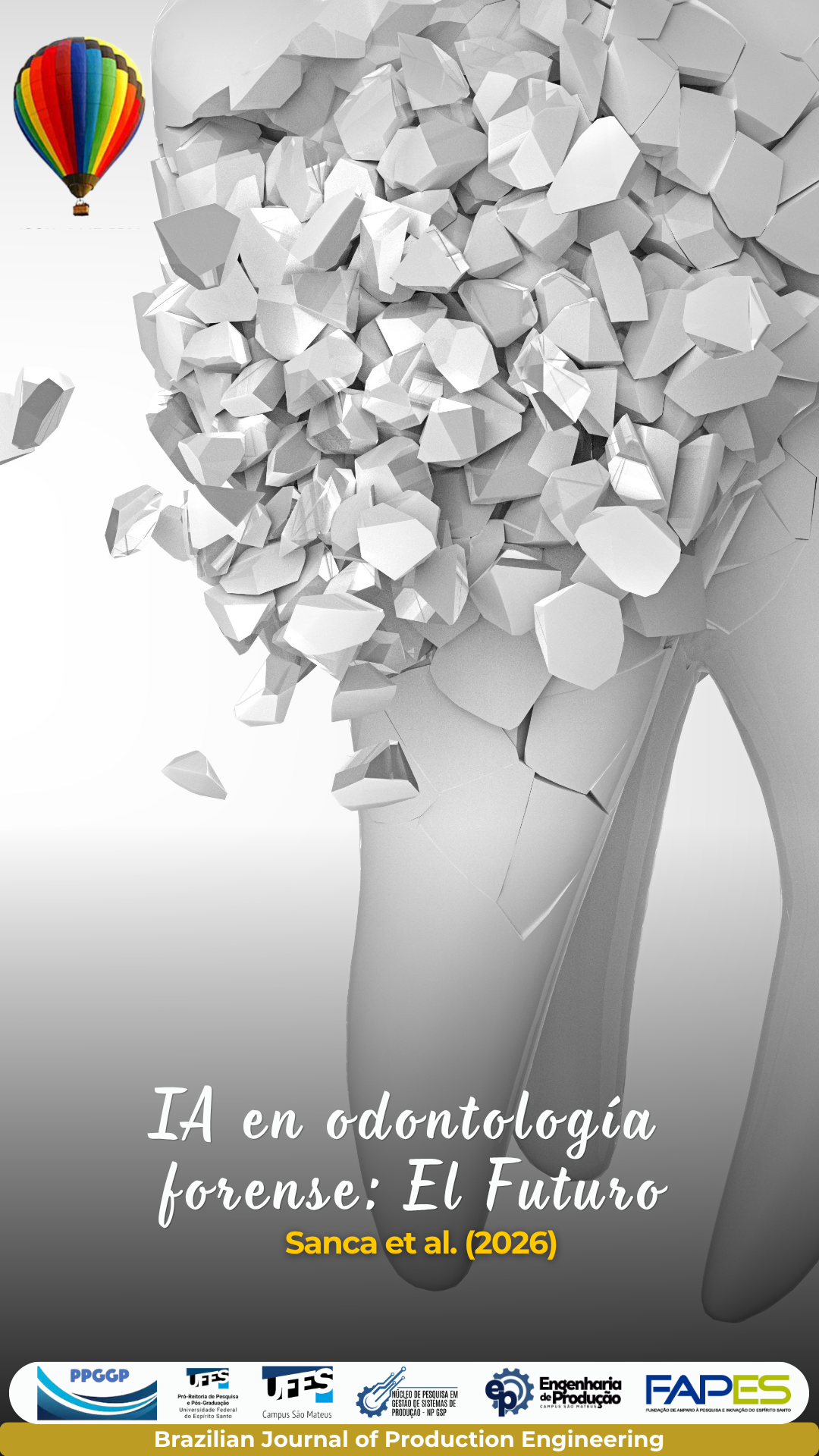
- Cover Image
-
- Descargas
- Archivos adicionales
- Publicado
- 2026-09-16
- Sección
- INFORMACIÓN Y CONOCIMIENTO
- Licencia
-
Derechos de autor 2026 Sanca, V. A., Silva, M. S. A., Monteiro, U. de T., Francesquini, M. A., Line, S. R. P. ...., & Francesquini Jr., L.

Esta obra está bajo una licencia internacional Creative Commons Atribución 4.0.
Todas las obras publicadas en la Revista Brasileña de Ingeniería de Producción (BJPE) están bajo la licencia Creative Commons Atribución 4.0 Internacional (CC BY 4.0). Esto significa que: Cualquier persona puede copiar, distribuir, exhibir, adaptar, remezclar e incluso utilizar comercialmente el contenido publicado en la revista; Siempre que se reconozca debidamente a los autores y a BJPE como fuente original; No se requiere permiso adicional para la reutilización, siempre que se respeten los términos de la licencia. Esta política cumple con los principios de acceso abierto, promoviendo la amplia difusión del conocimiento científico. 🔗 Haga clic aquí para acceder a la licencia completa.
