
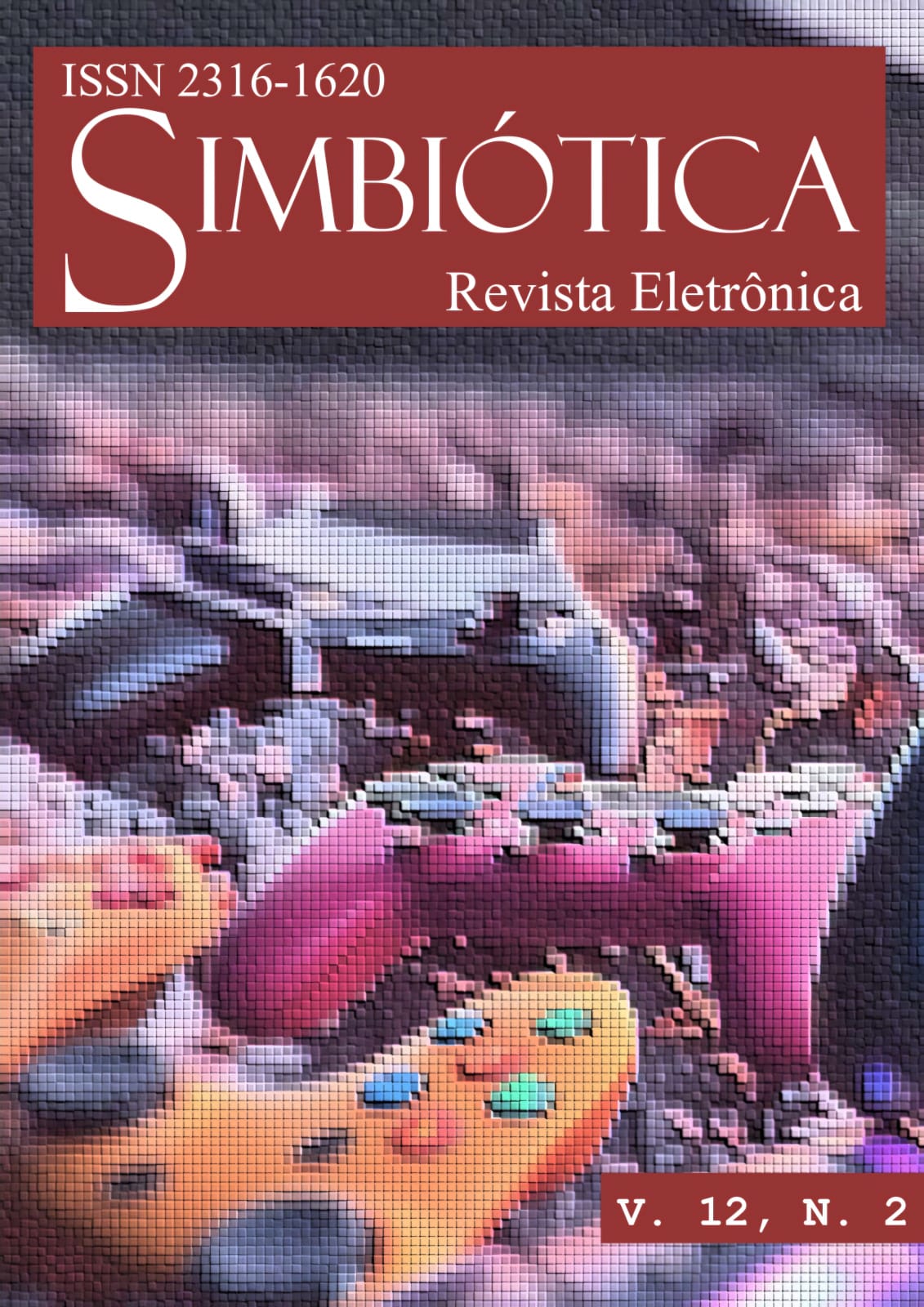
Jogos eletrônicos, cultura e sociedade
DOI:
https://doi.org/10.47456/simbitica.v12i2.49811Palavras-chave:
Jogos Eletrônicos, Videogames, Cultura, SociedadeResumo
Desde a virada do milênio, os videogames se expandiram e diversificaram, consolidando uma posição hegemônica dentro da cultura pop contemporânea. O público que consome games, da mesma forma, também se diversificou. Hoje, estima-se que mais de 40% da população mundial jogue em algum tipo de dispositivo eletrônico. À luz da relevância que os games possuem nas sociedades contemporâneas, o presente dossiê temático teve como foco reunir trabalhos que problematizem a relação entre jogos eletrônicos, cultura e sociedade. As contribuições aqui reunidas, oriundas de diferentes áreas do conhecimento, abordam e aprofundam um conjunto questões intrínsecas ao universo dos videogames. Dessa forma, este dossiê contribui para o fortalecimento dos games studies, sendo uma importante referência àqueles/as que se dedicam a investigação dos jogos.
Referências
ARTIFON, Simone; REBS, Rebeca R.; LORENZATTO, Nalva de L. (2024). “Jogos online como espaço de construção identitária”. Simbiótica, v. 11, n. 3, 2024. [Consult. 04-08-2025]. Disponível em https://doi.org/10.47456/simbitica.v11i3.43333
BISSO-MACHADO, Rafael. (2021). “Dawn of man: Videogames as a tool for science dissemination”. American Journal of Physical Anthropology, v. 176, pp. 726-727. [Consult. 04-08-2025]. Disponível em https://doi.org/10.1002/ajpa.24358
BISSO-MACHADO, Rafael. (2024). “Videogames como ferramenta de divulgação científica e cultural”. Revista de Antropología y Sociología: Virajes, v. 26, n. 1, pp. 189-198. [Consult. 04-08-2025]. Disponível em https://doi.org/10.17151/rasv.2024.26.1.8
CABECINHAS, Rosa. (2022). “Outras histórias. Ativismos mnemónicos, género e interseccionalidades”, in M. Ledo-Andion, M. Pérez-Pereiro, S. Baamonde e M. Barreiro-Gozáles Soliña (orgs.) Co(m)xénero. Cadernos de comunicación e xénero. Vía Láctea, A Coruña, v. 2, pp. 15-35.
CABECINHAS, Rosa. (2024). “Reparar a Comunicação. Despatriarcalizar, Descolonizar e Ecologizar a Cultura Mediática”. Revista Vista, v. 13, e024009. [Consult. 04-08-2025]. Disponível em https://doi.org/10.21814/vista.5597
COSTA, Everton G. (2025). “Potencialidades dos jogos eletrônicos para o ensino de sociologia”. Contrapontos, v. 25, n. 1, pp. 17-30. [Consult. 04-08-2025]. Disponível em https://periodicos.univali.br/index.php/rc/article/view/20544
CUNHA, Magda R. (2011). “A memória na era da reconexão e do esquecimento”. Revista Em Questão, v. 17, n. 2, pp. 101-115. [Consult. 04-08-2025]. Disponível em https://seer.ufrgs.br/index.php/EmQuestao/article/view/22062
DOHERTY, Mordecai; MCGINTY, Alysse; ZAHRADNICK, Dee; LEISEROWITZ, Toby; STEIN, Noah; BISSO-MACHADO, Rafael; STEGMAN, Melanie. (2023). Adaptopia. [Consult. 04-08-2025]. Disponível em https://freakflaggames.itch.io/adaptopia
KERCHE, Francisco; MENDES, Miguel B. (2024). “Caminhos cruzados: uma possível radicalização do YouTube Gamer”. Simbiótica, v. 8, n. 4, pp. 128-152. [Consult. 04-08-2025]. Disponível em https://doi.org/10.47456/simbitica.v8i4.37349
JUUL, Jesper. (2009). A casual revolution: reinventing video games and their players. Cambridge, Massachusetts/ London, England, The MITPress.
MADRUGA WORKS. (2019). Dawn of Man. [Consult. 04-08-2025]. Disponível em http://madrugaworks.com/dawnofman/
MURIEL, Daniel; CRAWFORD, Garry. (2018). Video games as culture. Considering the role and the importance of de the video games in the contemporary society. Nova Iorque, Routledge.
MOJANG STUDIOS. Minecraft. (2011). [Consult. 04-08-2025]. Disponível em https://www.minecraft.net/
MOJANG STUDIOS. Minecraft Education. (2016). [Consult. 04-08-2025]. Disponível em https://education.minecraft.net/en-us
MOJANG STUDIOS; FIOCRUZ. Fiocraft. (2020).
NEWZOO. (2024). Global Games Market Report. [Consult. 04-08-2025]. Disponível em https://best-of-gaming.be/wp-content/uploads/2024/09/2024_Newzoo_Global_Games_Market_Report.pdf
PERANI, Letícia. (2008). “Game Studies Brasil: um panorama dos estudos brasileiros sobre jogos eletrônicos”. XII Colóquio Internacional sobre a Escola Latino-Americana de Comunicação - Celacom. Anais do... São Bernardo do Campo, Universidade Metodista de São Paulo.
SÁ, Alberto. (2004). “Refrescando a memória: arquivo e gestão da informação”. Comunicação apresentada ao II Congresso Ibérico de Ciências da Comunicação, Universidade da Beira Interior, Covilhã.
SMALDONE, Ronald A.; THOMPSON, Christina M.; EVANS, Monica; VOIT, Walter. (2017). “Teaching science through video games”. Nature Chemistry, v. 9, n. 2, pp. 97-102. [Consult. 04-08-2025]. Disponível em https://www.nature.com/articles/nchem.2694
TORRES, Carlos. (2015). “Simular problemas sociales con videojuegos. Algunas claves para el diseño de videojuegos críticos”. Revista Kepes, v. 12, pp. 193-226. [Consult. 04-08-2025]. Disponível em https://doi.org/10.17151/kepes.2015.12.12.10
Downloads
Publicado
Edição
Seção
Licença
Direitos autorais (c) 2025 Everton Garcia da Costa, Rafael Bisso-Machado, Thatiana Aquino

Este trabalho está licenciado sob uma licença Creative Commons Attribution-NonCommercial 4.0 International License.
Autores que publicam nesta revista concordam com os seguintes termos:
a. Autores mantém os direitos autorais e concedem à revista o direito de primeira publicação, com o trabalho simultaneamente licenciado sob a Creative Commons - Atribuição-NãoComercial 4.0 Internacional.
b. Compartilhar - copiar e distribuir o material em qualquer meio ou formato.
Adaptar - remix, transformar e construir sobre o material para qualquer finalidade, inclusive comercial.
c. Autores têm autorização para assumir contratos adicionais separadamente, para distribuição não-exclusiva da versão do trabalho publicada nesta revista (ex.: publicar em repositório institucional ou como capítulo de livro), com reconhecimento de autoria e publicação inicial nesta revista.
d. Autores têm permissão e são estimulados a publicar e distribuir seu trabalho online (ex.: em repositórios institucionais ou na sua página pessoal) a qualquer ponto antes ou durante o processo editorial, já que isso pode gerar alterações produtivas, bem como aumentar o impacto e a citação do trabalho publicado (Veja O Efeito do Acesso Livre).
Authors who publish in this journal agree to the following terms:
a. Authors retain the copyright and grant the magazine the right of first publication, with work simultaneously licensed under the CCreative Commons - Atribuição-NãoComercial 4.0 Internacional.
b. Share - copy and distribute the material in any medium or format.
Adapt - remix, transform and build on the material for any purpose, including commercial.
c. Authors are authorized to take additional contracts separately, for non-exclusive distribution of the version of the work published in this journal (eg, publish in institutional repository or as a book chapter), with acknowledgment of authorship and initial publication in this journal.
d. Authors are allowed and encouraged to publish and distribute their work online (eg.: in institutional repositories or on their personal page) at any point before or during the editorial process, as this can generate productive changes as well as increase the impact and the citation of the published work (See The Effect of Free Access).