

2.png)



































Professional standards as a factor for adapting human resources to industry 4.0: approaches for development and implementation in public administration
- Authors
-
-
Brenda de Jesus Moraes Araújo
Programa de Pós-Graduação em Engenharia de Produção, Universidade Federal do Amazonas - UFAM
Author
-
Author
-
- Keywords:
- Industry 4.0, Skills, Human Resources, Public service
- Abstract
-
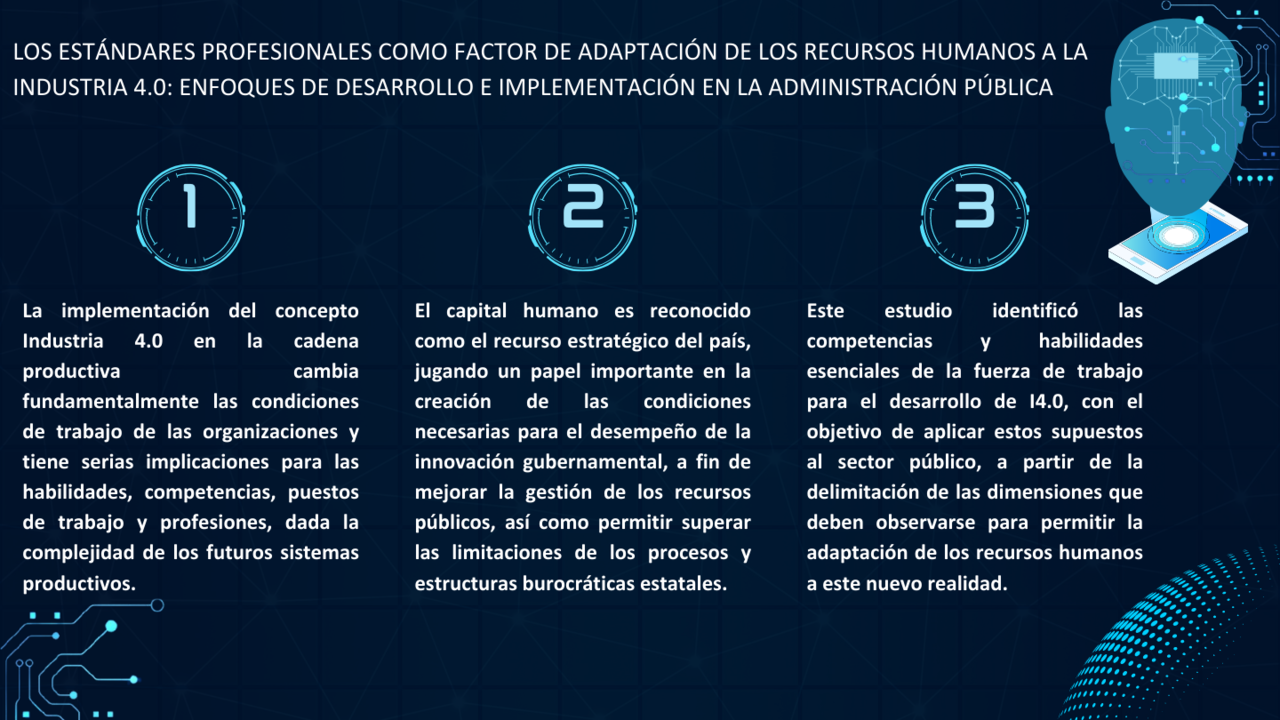
The progressive advances experienced in the production chain throughout history have placed us before the 4th Industrial Revolution, also known as Industry 4.0 (I4.0), marked by the extensive use of the Internet, robotics and digitization. There is a great perspective that governments promote I4.0 technologies in order to improve the management of public resources, as well as to allow overcoming the limitations of processes and state bureaucratic structures. However, the technological transformations introduced by this concept fundamentally change the working conditions of organizations and bring serious implications for jobs and professions. In this sense, the objective of the present study is to investigate the essential skills and abilities of the workforce for the implementation of I4.0 in the public sector. For this, a literature review was carried out in the Google Scholar (GA), Web of Science (WoS) and Scopus database. Content analysis showed that, in addition to the need for technical knowledge, it is imperative that workers have the ability to work under pressure, coordinate and solve complex problems, in addition to personal responsibility in decision-making. In the end, it was possible to derive a synthesized table, which identifies the dimensions that should be considered when evaluating professional standards for adaptation to I4.0.
- References
-
Aires, R. W. do A., Moreira, F. K., Freire, P. de S. (2017). Indústria 4.0: Competências requeridas aos profissionais da quarta revolução industrial. Foz do Iguaçu/PR. [Anais do Congresso Internacioanal de Conhecimento e Inovação-ciki]. Foz do Iguaçu/PR: ciki, 1-15. Recuperado de https://proceeding.ciki.ufsc.br/index.php/ciki/article/view/314%0A.
Al Amiri, N. & Abu Shawali, A. (2021). Talent management strategies of a public uae hospital in the industry 4.0 Era: A qualitative analysis. [S. l.]: LLC CPC Business Perspectives.
Antosz, K. (2018). Maintenance–identification and analysis of the competency gap. Eksploatacja Niezawodność, Rzeszów, Poland, 20(3), 35-959.
Arun, K., Krishnakumar, U., & Das, D. (2020). Convergence of csr and industry 4.0. recent trends in indian public sector enterprises. Detroit, Michigan. Proceedings of the International Conference on Industrial Engineering and Operations Management. Detroit, Michigan: [s. n.]. 3955-3961.
Atzori, L., Iera, A., & Morabito, G. (2010). The Internet of Things: A survey. Computer Networks, [s. l.], 54(15), 2787-2805.
Avitia-carlos, P. et al. (2019). Conditions for the Development of Industry 4.0 from the Human Capital Technological Competences Perspective. Revista de Ciencias Tecnológicas, [s. l.], 2(4), 159-165.
Benešová, A. & Tupa, J. (2017). Requirements for Education and Qualification of People in Industry 4.0. Procedia Manufacturing, [s. l.], 11. 2195-2202.
Chulanova, Z. K. (2019). Professional standards as a factor of adaptation of human resources to the Industry 4.0: approaches to development and implementation. Journal of Human Resource Management, Slovakia, 22(1), 12-20. Recuperado de www.jhrm.eu
Coelho, P. M. N. (2016). Rumo à Indústria 4.0 Towards Industry 4.0. 65 f. Universidade de Coimbra, Coimbra. Recuperado de http://hdl.handle.net/10316/36992
Confederação Nacional da Indústria. (2017). Relações trabalhistas no contexto da indústria 4.0. Brasília: CNI. Recuperado de http://conexaotrabalho.portaldaindustria.com.br/media/publication/files/Relacoes_trabalhistas_web.pdf
Dombrowski, U. Richter, T., & Krenkel, P. (2017). Interdependencies of Industrie 4.0 & Lean Production Systems: A Use Cases Analysis. Procedia Manufacturing, [s. l.], 11, 1061-1068.
Ejsmont, K. (2021). The impact of industry 4.0 on employees—insights from Australia. Sustainability, [s. l.], 13(6), 3095.
Erol, S. et al. (2016). Tangible Industry 4.0: A Scenario-Based Approach to Learning for the Future of Production. Procedia CIRP, [s. l.], 54, 13-18.
Fitsilis, P., Tsoutsa, P., & Gerogiannis, V. (2018). Industry 4.0: Required personnel competences. International Scientific Journal “Industry 4.0”, [s. l.], 3(3), 130-133.
Fredriksson, C., et al. (2017). Big Data in the Public Sector: A Systematic Literature Review. Scandinavian Journal of Public Administration, 21(3), 39-62. Recuperado de http://ovidsp.ovid.com/ovidweb.cgi?T=JS&PAGE=reference&D=emed14&NEWS=N&AN=365050985
Ghobakhloo, M. (2018). The future of manufacturing industry: a strategic roadmap toward Industry 4.0. Journal of Manufacturing Technology Management, 29(6), 910-936.
Grzelczak, A., Kosacka, M., & Werner-lewandowska, K. (2017). Employees competences for industry 4.0 in Poland–preliminary research results. 24th International Conference on Production Research, ICPR 2017, Poznan, Poland, 139-144.
Haleem, A. & Javaid, M. (2019). Additive Manufacturing Applications in Industry 4.0: A Review. Journal of Industrial Integration and Management, 4(4), 1930001.
Hartmann, E. A. & Bovenschulte, M. (2013). Skills Needs Analysis for “Industry 4.0” based on Roadmaps for Smart Systems. Using Technology Foresights for Identifying Future Skills Needs. Global Workshop Proceedings, Moscow, 24-36. Recuperado de http://www.bmbf.de/pubRD/Umsetzungsempfehlungen_Industrie4_0.pdf
Hecklau, F., et al. (2016). Holistic Approach for Human Resource Management in Industry 4.0. Procedia CIRP, [s. l.], 54, 1-6.
Hermann, M., Pentek, T., & Otto, B. (2016). Design principles for industrie 4.0 scenarios. 49th Hawaii international conference on system sciences (HICSS), [s. l.], 3928-3937. Recuperado de www.snom.mb.tu-dortmund.de
Imran, F. & Kantola, J. (2019). Review of industry 4.0 in the light of sociotechnical system theory and competence-based view: A future research agenda for the evolute approach. Advances in Intelligent Systems and Computing. [S. l.]: Springer Verlag. 118-128.
Jerman, A., Bach, M. P., & Bertoncelj, A. (2018). A bibliometric and topic analysis on future competences at smart factories. Machines, 6(3), 41.
Kagermann, H., Wahlster, W., & Helbig, J. (2013). Securing the future of German manufacturing industry recommendations for implementing the strategic initiative industrie 4.0. Germany: Federal Ministry of edu-cation and research, Final report of the Industrial 4.0 working group. Frankfurt.
Kagermann, H., Wahlster, W., & Helbig, J. (2013). Recommendations for implementing the strategic initiative industrie 4.0: Securing the future of German manufacturing industry. Final report of the Industrie 4.0 Working Group. Berlim, Germany: Forschungsunion.
Karre, H., et al. (2017). Transition towards an Industry 4.0 State of the LeanLab at Graz University of Technology. Procedia Manufacturing, 9, 206-213.
Knies, E., et al. (2015). Special issue of international journal of human resource management, strategic human resource management and public sector performance. The International Journal of Human Resource Management, [s. l.], 26(3), 421-424.
Kusmin, K. L., Tammets, K., & Ley, T. (2018). University-industry Interoperability Framework for Developing the Future Competences of Industry 4.0. Interaction Design and Architecture(s), 38, 28-45.
Li, C. H. & Lau, H. K. (2019). A critical review of maturity models in information technology and human landscapes on industry 4.0. IEEE International Conference on Industrial Technology (ICIT). [S. l.]: IEEE. 1575–1579.
Liao, Y., et al. (2018). The impact of the fourth industrial revolution: A cross-country/region comparison. Production, [s. l.], 28.
Long, C. K., et al. (2021). A big data framework for E-Government in Industry 4.0. [S. l.]: Walter de Gruyter GmbH.
Malhotra, C., Anand, R., & Soni, V. (2020). Creating Public Services 4.0: Sustainable Digital Architecture for Public Services in India. Indian Journal of Public Administration, [s. l.], 66(3), 327-342.
Mohelska, H. & Sokolova, M. (2018). Management approaches for industry 4.0 – The organizational culture perspective. Technological and Economic Development of Economy, [s. l.], 24(6), 2225-2240.
Müller, J. M., Buliga, O., & Voigt, K. I. (2018). Fortune favors the prepared: How SMEs approach business model innovations in Industry 4.0. Technological Forecasting and Social Change, [s. l.], 132, 2-17.
OECD (2018), Digital Government Review of Brazil: Towards the Digital Transformation of the Public Sector. OECD Digital Government Studies, OECD Publishing, Paris, Recuperado de https://doi.org/10.1787/9789264307636-en
Oesterreich, T. D. & Teuteberg, F. (2016). Understanding the implications of digitisation and automation in the context of Industry 4.0: A triangulation approach and elements of a research agenda for the construction industry. [S. l.]: Elsevier B.V.
Pwc. (2016). Indústria 4.0: Construir a empresa digital. Portugal: PricewaterhouseCoopers. Recuperado de www.pwc.pt/industria40
Romero, D., et al. (2016). The operator 4.0: Human cyber-physical systems & adaptive automation towards human-automation symbiosis work systems. IFIP Advances in Information and Communication Technology, Springer, Cham, 488, 677-686.
Rother, E. T. (2007). Revisão sistemática X revisão narrativa. Rev. Acta Paulista de Enfermagem. 20(2), v-vi.
Rübel, S., et al. (2018). A maturity model for business model management in industry 4.0. Lüneburg, Germany: Leuphana Universität Lüneburg, Institut für Wirtschaftsinformatik.
Rüssmann, M., et al. (2015). Industry 4.0: The Future of Productivity and Growth in Manufacturing Industries. Boston consulting group, [s. l.], 9(1), 54-89.
Sacomano, J. B., et al. (2018). Indústria 4.0: conceitos e fundamentos. São Paulo: Blücher.
Sakurai, R. & Zuchi, J. D. (2018). As revoluções industriais até a indústria 4.0. Revista Interface Tecnológica, [s. l.], 15(2), 480-491.
Santos, K., et al. (2017). Opportunities Assessment of Product Development Process in Industry 4.0. Procedia Manufacturing, [s. l.], 11, 1358-1365.
Schwab, K. (2019). A Quarta Revolução Industrial. [S. l.]: Edipro.
Shevyakova, A., et al. (2021). Competence development for Industry 4.0: Qualification requirements and solutions. Insights into Regional Development, [s. l.], 3(1), 124-135.
Stern, S., et al. (2018) Public Services Government 4.0–the public sector in the digital age, Leading in a disruptive World. [S. l.]: McKinsey & Company Visual.
Tortorella, G. L. & Fettermann, D. (2018). Implementation of industry 4.0 and lean production in brazilian manufacturing companies. International Journal of Production Research, 56(8), 2975-2987.
Van Laar, E., et al. (2020). Determinants of 21st-Century Skills and 21st-Century Digital Skills for Workers: A Systematic Literature Review. [S. l.]: SAGE Publications Inc.
World Economic Forum. (2016). The future of jobs: Employment, skills and workforce strategy for the fourth industrial revolution.Global Challenge Insight Report. Geneva, Switzerland: WEF. Recuperado de http://www3.weforum.org/docs/WEF_Future_of_Jobs.pdf
- Cover Image
-
- Downloads
- Published
- 2023-08-17
- Section
- PUBLIC MANAGEMENT
- License
-
Copyright (c) 2023 Brazilian Journal of Production Engineering

This work is licensed under a Creative Commons Attribution 4.0 International License.
All works published in the Brazilian Journal of Production Engineering (BJPE) are licensed under Creative Commons Attribution 4.0 International (CC BY 4.0). This means that: Anyone can copy, distribute, display, adapt, remix, and even commercially use the content published in the journal; Provided that due credit is given to the authors and to BJPE as the original source; No additional permission is required for reuse, as long as the license terms are respected. This policy complies with the principles of open access, promoting the broad dissemination of scientific knowledge. 🔗 Click here to access the full license
