

2.png)
































Contextualizing chemistry teaching: awareness and traffic safety from an educational approach using the breathalyzer test
- Authors
-
-
Jonathan Pereira Viana
Universidade Federal do Espírito Santo, CEUNES - Centro Universitário Norte do Espírito Santo.
Author
-
Felipe dos Santos Silva
Universidade Federal do Espírito Santo, CEUNES - Centro Universitário Norte do Espírito Santo.
Author
-
Ana Nery Furlan Mendes
Universidade Federal do Espírito Santo, CEUNES - Centro Universitário Norte do Espírito Santo.
Author
-
- Keywords:
- CTSA, Breathalyzer, Chemistry teaching
- Abstract
-
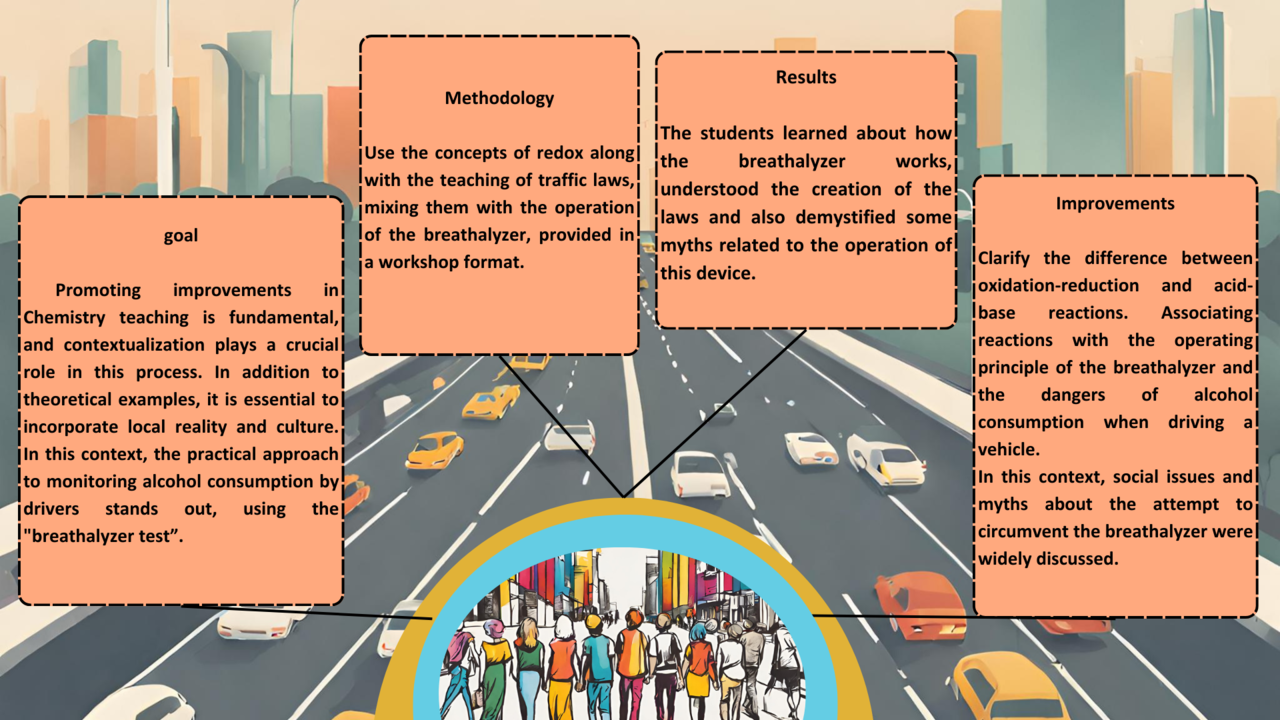
In order to promote improvements in chemistry teaching, the contextualization of content plays a fundamental role in the teaching-learning process. Thus, the importance of contextualizing the content worked on in the classroom goes beyond simple theoretical examples and applications of knowledge, as it is necessary to incorporate local reality and culture into the school context. In this sense, the approach to monitoring alcohol consumption by drivers, using the so-called "breathalyzer test", stands out as an example of integrating Science, Technology, Society and Environment (STSA) into chemistry teaching. In this work, we proposed the creation of didactic material that was presented to the students of a state public school in São Mateus/ES in the form of a workshop, which simulates how a breathalyzer works. The workshop was developed in two parts, the first of which was a round table discussion about how breathalyzers work and the harmful effects of alcohol consumption, and the second part was a breathalyzer test experiment. The workshop made it possible to work on chemical concepts, discuss social issues and build up knowledge together with the students about the health and social implications of excessive alcohol consumption.
- References
-
Andrade, J. C., de, & Coscione, A. R. (2018). Simulação de um bafômetro. Revista Chemkeys, (5), 1-14. https://doi.org/10.20396/chemkeys.v0i5.9620
Azevedo, D. & Ribeiro, S. P. S. S. (2013) Detran-RJ - Se beber, não dirija!.Intercom - Sociedade Brasileira de Estudos Interdisciplinares da Comunicação XX Prêmio Expocom 2013 - Exposição da Pesquisa Experimental em Comunicação. [s.l: s.n.]. https://www.portalintercom.org.br/anais/sudeste2013/expoco m/EX38-1022-1.pdf.
Marconi, M. A. & Lakatos, E. M. (2003). Fundamentos da Metodologia Científica. 5a ed. São Paulo: Editora Atlas.
Martins, R. H. G., et al. (2013) A lei seca cumpriu sua meta em reduzir acidentes relacionados à ingestão excessiva de álcool? Revista do Colégio Brasileiro de Cirurgiões, 40(6), 438–442.
Pereira, B. S. A., Menezes, J. M. S., & do Carmo, D. F. M. (2021). Contextualização no ensino de química: concepções e prática de professores da educação básica no interior do Amazonas. Revista Cocar, 15(33), 1-15.
- Cover Image
-
- Downloads
- Additional Files
- Published
- 2023-12-15
- Section
- Edição Especial "Semana de Química do Norte do Espírito Santo
- License
-
Copyright (c) 2023 Brazilian Journal of Production Engineering

This work is licensed under a Creative Commons Attribution 4.0 International License.
All works published in the Brazilian Journal of Production Engineering (BJPE) are licensed under Creative Commons Attribution 4.0 International (CC BY 4.0). This means that: Anyone can copy, distribute, display, adapt, remix, and even commercially use the content published in the journal; Provided that due credit is given to the authors and to BJPE as the original source; No additional permission is required for reuse, as long as the license terms are respected. This policy complies with the principles of open access, promoting the broad dissemination of scientific knowledge. 🔗 Click here to access the full license
