

2.png)


































Rigid polyurethane foams made from chemically recycled pet and pcbjpe modelo de artículo
- Authors
-
-
Kamilly S. Souza
EEEFM Wallace Castelo Dutra – ES
Author
-
Luiz H. Bigles
EEEFM Wallace Castelo Dutra – ES
Author
-
Luiz H. de Lima
EEEFM Wallace Castelo Dutra – ES
Author
-
Author
-
Author
-
David Manuel Costa Passinhas
Universidade Federal do Espírito Santo, CEUNES - Centro Universitário Norte do Espírito Santo.
Author
-
Breno Nonato Melo
Universidade Federal do Espírito Santo, CEUNES - Centro Universitário Norte do Espírito Santo.
Author
-
- Keywords:
- Chemical recycling, Plastics, Polyurethanes
- Abstract
-
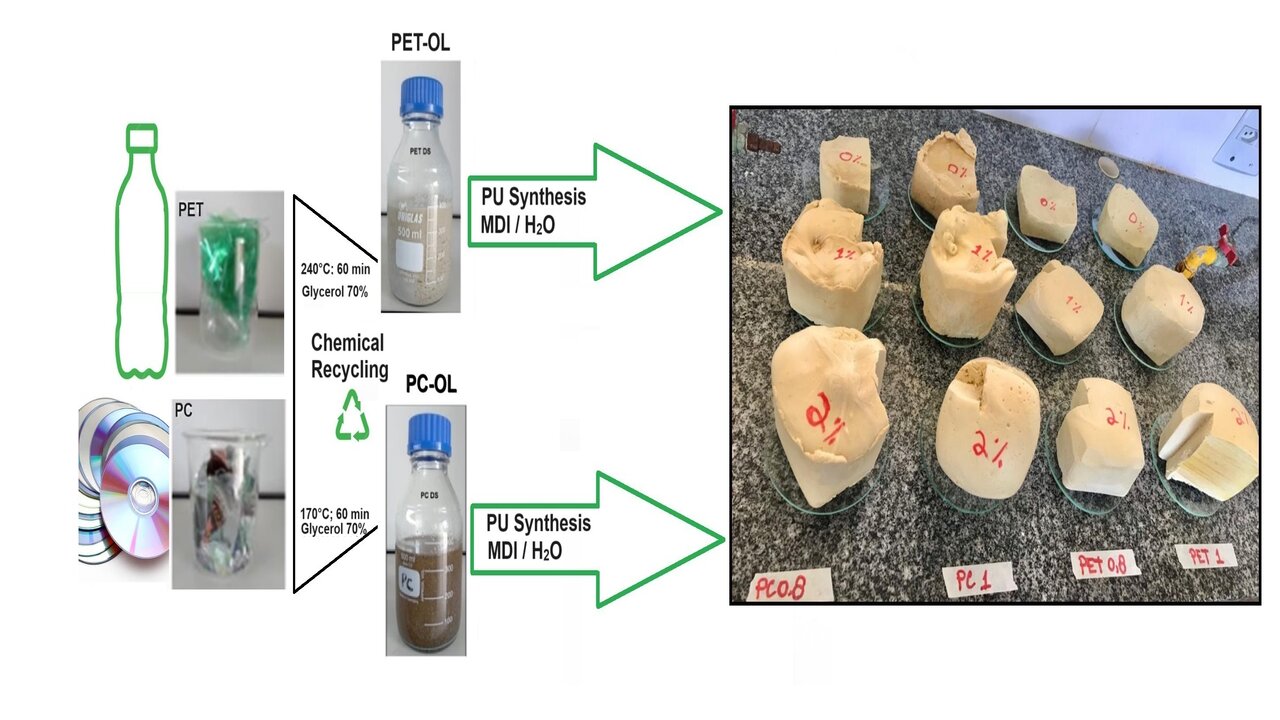
Polyethylene terephthalate (PET) and polycarbonate (PC) reacted with glycerol produce polyol precursors for polyurethanes. Polyurethanes were synthesized from PET and PC depolymerized in glycerol reacted with 4,4'-diphenylmethane diisocyanate (MDI) in ratios of 0.8 and 1.0 using water as a blowing agent at 0%, 1% and 2%. The hydroxyl content was 287 ± 10 mgKOH/g for the polyol from PET (PET-OL) and 520.99 ± 11.62 mgKOH/g for the polyol from PC (PC-OL). The FTIR spectra of the synthesized PUs showed the typical PU bands (1730 cm-1) and those synthesized from PC-OL showed remnant MDI seen by the band at 2270 cm-1. They had apparent densities of less than 0.6 g/cm3, typical of thermal insulators. The density decreased as the water content increased, as did the NCO/OH ratio. In addition, the materials synthesized with PET-OL are denser than those synthesized with PC-OL. The optical microscopy images of the PU topographies indicate homogeneous materials containing more closed cells than open ones. PU’s made with PC-OL absorb more water than those made with PET-OL.
- Author Biographies
- References
-
Thakur, V. K. (2015). Recycled Polymers: Properties and Applications, UK, Smithers Rapra, v.2.
Rosa, D. P, Araújo, L. V, Araújo, R. C. S., Paterno, L. G., Mol, A. R., Pasa, V. M. D., & Melo, B. N. (2019). PET-OL uma nova classe de polóis na síntese de poliuretanos, 15º CBPOL, Bento Gonçalves, Brasil.
Kao, C. Y., Cheng, W. H., & Wan, B. Z. (1997). lnvestigation of catalystic glycolysis to polyethylene terephthalate by differential scanning calorimetry. Thermochimica Acta, 292, 95-104. Recuperado de https://scholars.lib.ntu.edu.tw/bitstream/123456789/66867/1/08.pdf
Giovanella, J., Janczkowski, R., Soares, G. C., Serafim, C. E., Ramos, T. O. B., Silva, C. W., da, Molinari, E. J., & Conti, D. S. (2008). Reciclagem de materiais: estudo das propriedades mecânicas de policarbonato reciclado de discos compactos, Revista Matéria, 13(4), 643-649. Recuperado de https://www.scielo.br/j/rmat/a/tL3Lyz7Pv7MtTFbktdzC7QC/?format=pdf&lang=pt
- Cover Image
-
- Downloads
- Additional Files
- Published
- 2023-12-15
- Section
- Edição Especial "Semana de Química do Norte do Espírito Santo
- License
-
Copyright (c) 2023 Brazilian Journal of Production Engineering

This work is licensed under a Creative Commons Attribution 4.0 International License.
All works published in the Brazilian Journal of Production Engineering (BJPE) are licensed under Creative Commons Attribution 4.0 International (CC BY 4.0). This means that: Anyone can copy, distribute, display, adapt, remix, and even commercially use the content published in the journal; Provided that due credit is given to the authors and to BJPE as the original source; No additional permission is required for reuse, as long as the license terms are respected. This policy complies with the principles of open access, promoting the broad dissemination of scientific knowledge. 🔗 Click here to access the full license
