Geographies of tourism knowledge: scientific networks and territorial inequalities in public universities of Andalusia, Spain (2010-2023)
DOI:
https://doi.org/10.47456/geo.v5i41.48819Keywords:
geographies of knowledge, scientific production, academic networks, tourism, Andalusia, SpainAbstract
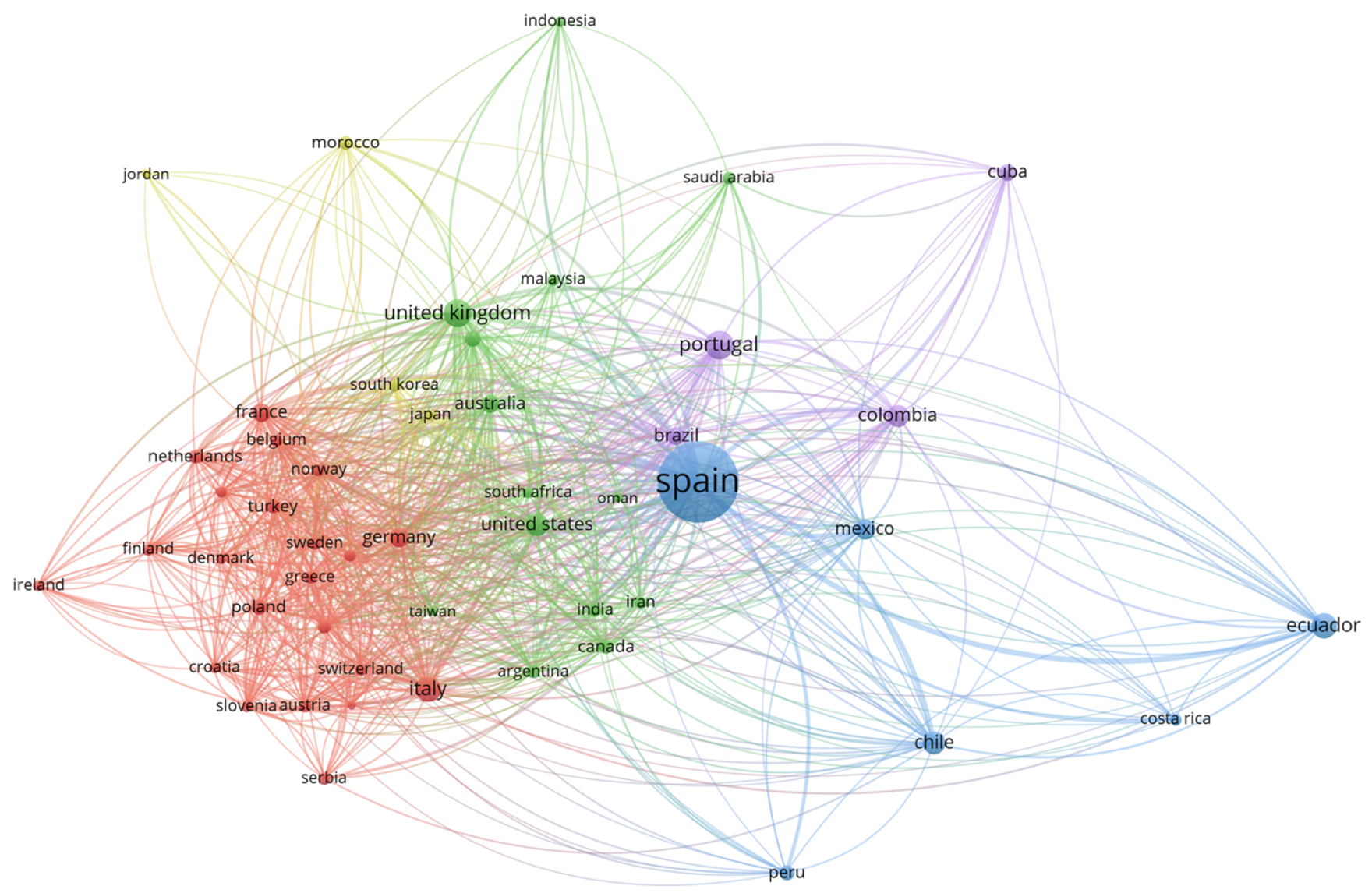
This study analyzes the institutionalization and scientific production of Tourism degree programs in public universities of Andalusia between 2010 and 2023, from the perspective of Geographies of Knowledge. To this end, a methodological design is adopted that combines institutional sources, bibliometric indicators, and academic network analysis. The results reveal that the location of universities conditions their capacity to attract students, faculty precariousness constrains the accumulation of scientific capital, and research output growth remains uneven across institutions. These findings confirm that tourism knowledge is mainly produced in specific territories and framed within power relations, where universities act as epistemic nodes embedded in global hierarchies. International collaborations, oriented towards Ibero-America and marginally towards Africa, reinforce the idea that knowledge circulates in selective geographic circuits, combining cultural affinity with asymmetries in academic access and production.
Downloads
References
ALTBACH, Philip G. "Patterns in higher education development: Toward the year 2000”. The Review of Higher Education, v. 14, n.3, p.293-315, 1991. DOI: https://doi.org/10.1353/rhe.1991.0015.
ARENCIBIA, Jorge, R., & DE MOYA, Anegón, F. La evaluación de la investigación científica: Una aproximación teórica desde la cienciometría. Acimed, v. 17, n. 4, p. 00, 2008. Disponível em: http://scielo.sld.cu/scielo.php?script=sci_arttext&pid=S1024-94352008000400004. Acesso em: 10 de maio de 2024.
BAAS, J., SCHOTTEN, M., PLUME, A., CÔTÉ, G., & KARIMI, R. Scopus as a curated, high-quality bibliometric data source for academic research in quantitative science studies. Quantitative Science Studies, v. 1, n. 1, p. 377-386, 2020. DOI: https://doi.org/10.1162/qss_a_00019.
BENCKENDORFF, Pierre; ZEHRER, Anitta. A network analysis of tourism research. Annals of Tourism Research, v. 43, 121-149, 2013. DOI: https://doi.org/10.1016/j.annals.2013.04.005.
BOURDIEU, Pierre. O campo científico. In: ORTIZ, Renato. Bourdieu - Sociologia. São Paulo: Ática, p. 1-34, 1983.
BOURDIEU, Pierre. Para uma sociologia da Ciência. Lisboa: Edições 70, 2001.
BURKE, Peter. Uma história social do conhecimento. De Gutenberg a Diderot. Rio de Janeiro: Zahar, 2003.
CLARK, Burton. R. Creating Entrepreneurial Universities: Organizational Pathways of Transformation. London: Emerald Publishing Limited, 1998.
COOPER, Chris. Knowledge management and tourism. Annals of Tourism Research, v. 33, n.1, p. 47- 64, 2006. DOI: https://doi.org/10.1016/j.annals.2005.04.005.
DELGADO, Emilio; REPISO, Rafael. El impacto de las revistas de comunicación: Comparando Google Scholar Metrics, Web of Science y Scopus. Comunicar, v. 21, n. 41, p. 45-52, 2013. DOI: https://doi.org/10.3916/C41-2013-04.
DONTHU, Naveen; KUMAR, Satish; MUKHERJEE, Debmalya; PANDEY, Nitesh; LIM, Weng Marc. How to conduct a bibliometric analysis: An overview and guidelines. Journal of Business Research, v. 133, p. 285- 296, 2021. DOI: https://doi.org/10.1016/j.jbusres.2021.04.070
DREDGE, Diane; SCHOTT, Christian. Academic agency and the sustainability of tourism higher education. Journal of Teaching in Travel & Tourism, v. 13, n. 3, p. 241-260, 2013. DOI: https://doi.org/10.1080/15313220.2013.786312.
EKOWITZ, Henri; LEYDESDORFF, Leat. The dynamics of innovation: From National Systems and “Mode 2” to a Triple Helix of university–industry–government relations. Research Policy, v. 29, n. 2, 109-123, 2000. DOI: https://doi.org/10.1016/S0048-7333(99)00055-4.
MEUSBURGER, PETER; FUNKE, Joachim; WUNDER, Edgar. Milieus of creativity: An interdisciplinary approach to spatiality of creativity. Dordrecht: Springer, 2009.
JAFARI, Jafar. The scientification of tourism. In: WAHAB, Salah; COOPER, Chris. (Eds.), Tourism in the Age of Globalisation. London: Routledge, 2001, p. 28-42.
Livingstone, David N. Putting Science in its Place: Geographies of Scientific Knowledge. Chicago: University of Chicago Press, 2003.
LIVINGSTONE, David N.; AGNEW, Jon. The SAGE handbook of geographical knowledge. London: London Press, 2011.
LORENZEN, Mark. Introduction: knowledge and geography. Industry and Innovation, 2005, v. 12, n. 4, p. 399-407, 2005. DOI: https://doi.org/10.1080/13662710500381484.
MUNCH, Richard. Academic capitalism: Universities in the global struggle for excellence. London: Routledge, 2020.
OLIVA, Miguel; LONARDI, Pablo. Metodología de la investigación social aplicada al turismo. Madrid: Ugerman Editor, 2017.
ORDORIKA, Imanol. Power and politics in university governance: Organization and change at the Universidad Nacional Autónoma de México. London: Routledge, 2015.
RIBEIRO, Manuel Alector; WOOSNAM, Kyle Maurice. Methodological advancements in social impacts of tourism research. London: Routledge, 2024.
RUEGG, Walter. A history of the university in Europe: Volume 3, universities in the nineteenth and early twentieth centuries (1800-1945). Cambridge: Cambridge University Press, 2005.
SLAUGHTER, Sheila; RHOADES, Gary. Academic capitalism and the new economy: Markets, state, and higher education. Baltimore: John Hopkins University Press, 2004.
TRIBE, John. Tribes, territories and networks in the tourism academy. Annals of Tourism Research, v. 37, n. 1, p. 7-33, 2010. DOI: https://doi.org/10.1016/j.annals.2009.05.001.
TRIBE, John.; LIBURD, Janne. The tourism knowledge system. Annals of Tourism Research, v. 57, p. 44-61, 2016. DOI: https://doi.org/10.1016/j.annals.2015.11.011.
VAN ECK, Ness Jan; WALTMAN, Ludo. Software survey: VOSviewer, a computer program for bibliometric mapping. Scientometrics, n. 84, v. 2, p. 523-538, 2010. DOI: https://doi.org/10.1007/s11192-009-0146-3.
ZOMER, Arend; BENNEWORTH, Paul. The rise of the university’s third mission. In: ENDERS, Jurgen; DE BOER, Harry (Eds.). Reform of Higher Education in Europe. London: Springer, 2011, p. 81-101.
Published
Issue
Section
License
Copyright (c) 2025 The Author(s)

This work is licensed under a Creative Commons Attribution 4.0 International License.
Authors who publish in the journal agree with the following terms:
- Authors will keep their copyrights and grant the journal the right to their first publishing, simultaneously licenced under Creative Commons Attribution License which allows sharing their work with authorship recognition and initial release through this journal.
- Authors may sign additional contracts separately diffusing a non-exclusively version of the paper published in this journal (i.g. publishing in institutional repository or as a book chapter), once citing the authorship and initial release through this journal.
- Authors are encouraged to publicize and diffuse their paper online, for example onto institutional repositories or on their personal websites.
The effect of open access and downloads ('hits') on citation impact: a bibliography of studies