

2.png)



































A bibliometric analysis on the relationship between the use of Lean tools and 4.0 technologies on the product development process
- Keywords:
- Product Development Process, Industry 4.0, Smart Manufacturing, Lean Manufacturing, Lean Production.
- Abstract
-
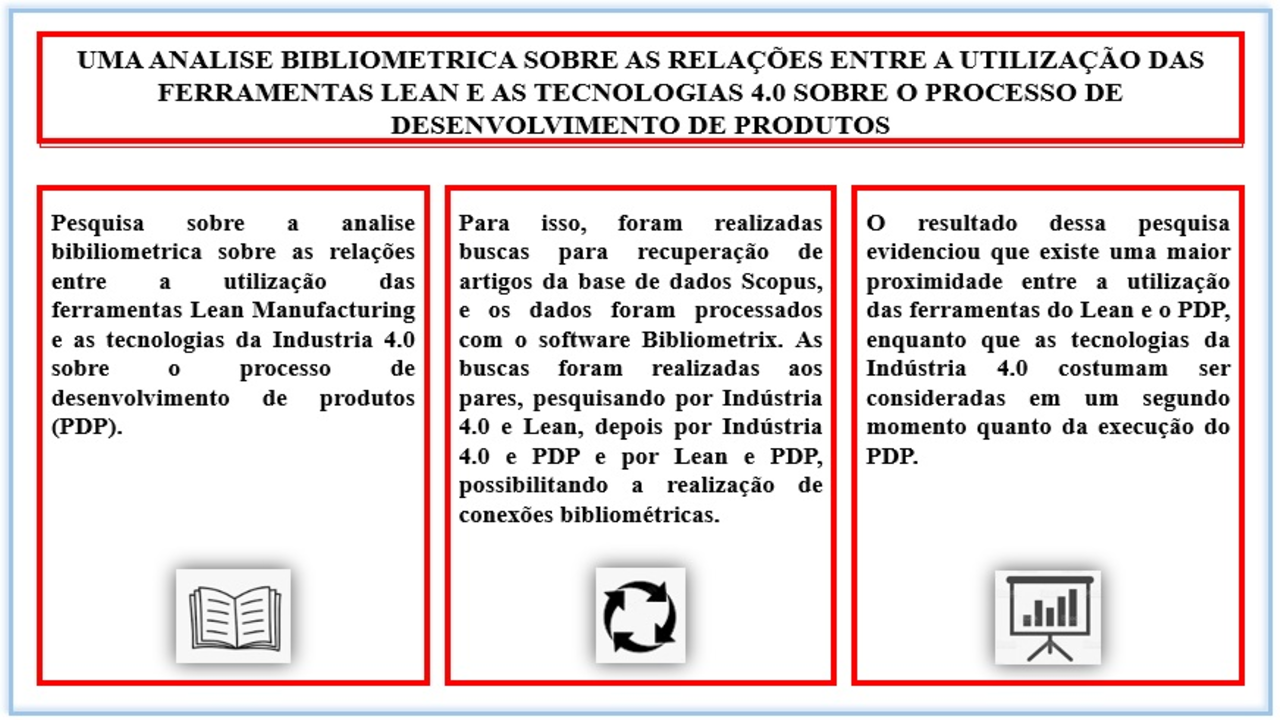
The Product Development Process (PDP) takes place and depends on a series of integrated steps, incorporating different technologies and adapting to production standards. In this sense, the use of Lean tools can help to continuously improve processes in a systematic way, ensuring that all these processes really add value to the product. Allied to this, the implementation of Industry 4.0 technologies can help improve these production processes, enabling companies to obtain competitive advantages. Therefore, this research aims to map, correlate and analyze the existing scientific knowledge on PDP, Industry 4.0 and Lean Manufacturing. For this, searches will be carried out to retrieve articles from the Scopus database, and the data will be processed with the bibliometrix software. The results obtained show that there is a greater proximity between PDP and Lean Manufacturing, connected a priori and with a later connection with Industry 4.0. With this, it is possible to affirm that researchers and managers have a view that Lean tools are directly connected to the PDP, continuously helping for its success, while Industry 4.0 technologies are usually considered in a second moment regarding the execution of the PDP.
- Author Biographies
- References
-
Abramo, G., Costa, C., & D’Angelo, C. A. (2014). A multivariate stochastic model to assess research performance. Scientometrics, 102(2), 1755–1772. https://doi.org/10.1007/s11192-014-1474-5
Achanga, P., Shehab, E., Roy, R., & Nelder, G. (2006). Critical success factors for lean implementation within SMEs. Journal of Manufacturing Technology Management, 17(4), 460-471. https://doi.org/10.1108/17410380610662889/FULL/XML
Amaral, D. C., Toledo, J. C., Silva, S. L., Alliprandini, D. H., & Scalice, R. K. (2006). Gestão de Desenvolvimento de Produto: uma referência para a melhoria do processo. Saraiva.
Aria, M. & Cuccurullo, C. (2017). bibliometrix: An R-tool for comprehensive science mapping analysis. Journal of Informetrics, 11(4), 959-975. https://doi.org/10.1016/J.JOI.2017.08.007
Kamarul Bahrin, M. A., Othman, M. F., Nor Azli, N. H., & Talib, M. F. (2016). Industry 4.0: a review on industrial automation and robotic. Jurnal Teknologi, 78(6-13). https://doi.org/10.11113/jt.v78.9285
Contreras, J. D., David, J., & Pastrana, D. (2017). Developing of Industry 4.0 Applications. International Journal of Online Engineering. https://doi.org/10.3991/ijoe.v13i10.7331
Dalenogare, L. S., Benitez, G. B., Ayala, N. F., & Frank, A. G. (2018). The expected contribution of Industry 4.0 technologies for industrial performance. International Journal of Production Economics, 204, 383-394. https://doi.org/10.1016/J.IJPE.2018.08.019
Santos, L. M. A. L., dos., da Costa, M. B., Kothe, J. V., Benitez, G. B., Schaefer, J. L., Baierle, I. C., & Nara, E. O. B. (2020). Industry 4.0 collaborative networks for industrial performance. Journal of Manufacturing Technology Management. https://doi.org/10.1108/JMTM-04-2020-0156
Fuchs, C. & Gutmann, T. (2022). How Technical Market Segmentation Can Help Build Products Your Customers Really Need. IEEE Engineering Management Review, 50(1), 17-19. https://doi.org/10.1109/EMR.2022.3140715
Gagné, D. (2018). La révolution 4.0 : le retour du pendule pour les travailleurs et travailleuses du XXIe siècle? Ad Machina, 2, 52-72. https://doi.org/10.1522/RADM.NO1.914
Glönkler, V., Reick, B., Stetter, R., Till, M., & Pfeil, M. (2022). A Contribution to Sustainable Product Development Using the Example of Battery Electric Vehicles. Sustainability, 14(7), 3729. https://doi.org/10.3390/SU14073729
Hughes, L., Dwivedi, Y. K., Rana, N. P., Williams, M. D., & Raghavan, V. (2020). Perspectives on the future of manufacturing within the Industry 4.0 era. Production Planning & Control - The Management of Operations, 33(2-3), 138-158. https://doi.org/10.1080/09537287.2020.1810762
Kennedy, M. N. (2004). The Toyota product development system. Machine Design, 76(9), 152. https://doi.org/10.4324/9781482293746/TOYOTA-PRODUCT-DEVELOPMENT-SYSTEM-JAMES-MORGAN-JEFFREY-LIKER
Krishnan, K. (2013). Data warehousing in the age of big data. A volume in MK Series on Business Intelligence. Elsevier. ISBN 978-0-12-405891-0. https://doi.org/10.1016/C2012-0-02737-8
Maddikunta, P. K. R., Pham, Q. V., B, P., Deepa, N., Dev, K., Gadekallu, T. R., Ruby, R., & Liyanage, M. (2022). Industry 5.0: A survey on enabling technologies and potential applications. Journal of Industrial Information Integration, 26, 100257. https://doi.org/10.1016/J.JII.2021.100257
Martínez, M. A., Cobo, M. J., Herrera, M., & Herrera-Viedma, E. (2015). Analyzing the Scientific Evolution of Social Work Using Science Mapping. Research on Social Work Practice, 25(2), 257-277. https://doi.org/10.1177/1049731514522101
Mayr, A., Weigelt, M., Kühl, A., Grimm, S., Erll, A., & Cirp, M. P. (2018). Lean 4.0-A conceptual conjunction of lean management and Industry 4.0. Procedia CIRP, 72, 622-628.
Nicoletti, B. (2013). Lean and automate manufacturing and logistics. IFIP Advances in Information and Communication Technology, 415, 278-285. https://doi.org/10.1007/978-3-642-41263-9_34/COVER
Olczyk, M. (2016). Bibliometric approach to tracking the concept of international competitiveness. Journal of Business Economics and Management, 17(6), 945-959. https://doi.org/10.3846/16111699.2016.1236035
Rosenfeld, H., Forcellini, A. F., Amaral, D. C., Toledo, J. C., Silva, S. L.,da, Alliprandini, D. H., & Sacalice, R. K. (2010). Gestão de Desenvolvimento de Produto - Uma referência para melhoria dos processos. Saraiva.
Sanders, A., Karthik, K. R., Redlich, T., & Wulfsberg, J. P. (2017). Industry 4.0 and lean management – synergy or contradiction?: A systematic interaction approach to determine the compatibility of industry 4.0 and lean management in manufacturing environment. IFIP Advances in Information and Communication Technology, 514, 341-349. https://doi.org/10.1007/978-3-319-66926-7_39/FIGURES/3
Sartal, A., Llach, J., & León-Mateos, F. (2022). “Do technologies really affect that much? exploring the potential of several industry 4.0 technologies in today’s lean manufacturing shop floors”. Operational Research, 22(5), 6075-6106. https://doi.org/10.1007/S12351-022-00732-Y/TABLES/5
Synnes, E. L. & Welo, T. (2016). Enhancing Integrative Capabilities through Lean Product and Process Development. Procedia CIRP, 54, 221-226. https://doi.org/10.1016/J.PROCIR.2016.05.090
Tripathi, V., Chattopadhyaya, S., Mukhopadhyay, A. K., Sharma, S., Li, C., Singh, S., Saleem, W., Salah, B., & Mohamed, A. (2022). Recent Progression Developments on Process Optimization Approach for Inherent Issues in Production Shop Floor Management for Industry 4.0. Processes, 10(8), 1587. https://doi.org/10.3390/PR10081587
Venugopal, V. & Saleeshya, P. G. (2019). Manufacturing system sustainability through lean and agile initiatives, 12(3), 159-173. https://doi.org/10.1080/19397038.2019.1566411
Womack, J. & Jones, D. (2003). Lean Thinking. Simon and Schuster.
Womack, JP, Jones, D., & Roos, D. (2007). The machine that changed the world: The story of lean production--Toyota’s secret weapon in the global car wars that is now revolutionizing world industry.
Yin, Y., Stecke, K. E., & Li, D. (2017). The evolution of production systems from Industry 2.0 through Industry 4.0. International Journal of Production Research, 56(1-2), 848-861. https://doi.org/10.1080/00207543.2017.1403664
- Cover Image
-
- Downloads
- Published
- 2023-05-18
- Section
- PRODUCT ENGINEERING
- License
-
Copyright (c) 2023 Brazilian Journal of Production Engineering

This work is licensed under a Creative Commons Attribution 4.0 International License.
All works published in the Brazilian Journal of Production Engineering (BJPE) are licensed under Creative Commons Attribution 4.0 International (CC BY 4.0). This means that: Anyone can copy, distribute, display, adapt, remix, and even commercially use the content published in the journal; Provided that due credit is given to the authors and to BJPE as the original source; No additional permission is required for reuse, as long as the license terms are respected. This policy complies with the principles of open access, promoting the broad dissemination of scientific knowledge. 🔗 Click here to access the full license
