

2.png)

































Análisis bibliométrico y tendencias de investigación sobre la determinación en la industria petrolera
- Autores/as
-
-
Autor/a
-
Maria de Fátima Pereira dos Santos
Universidad Federal de Espírito Santo - UFES
Autor/a
-
Maristela Araújo Vicente
Universidad Federal de Espírito Santo - UFES
Autor/a
-
- Palabras clave:
- Cloruros inorgánicos, Petróleo, bibliometría
- Resumen
-
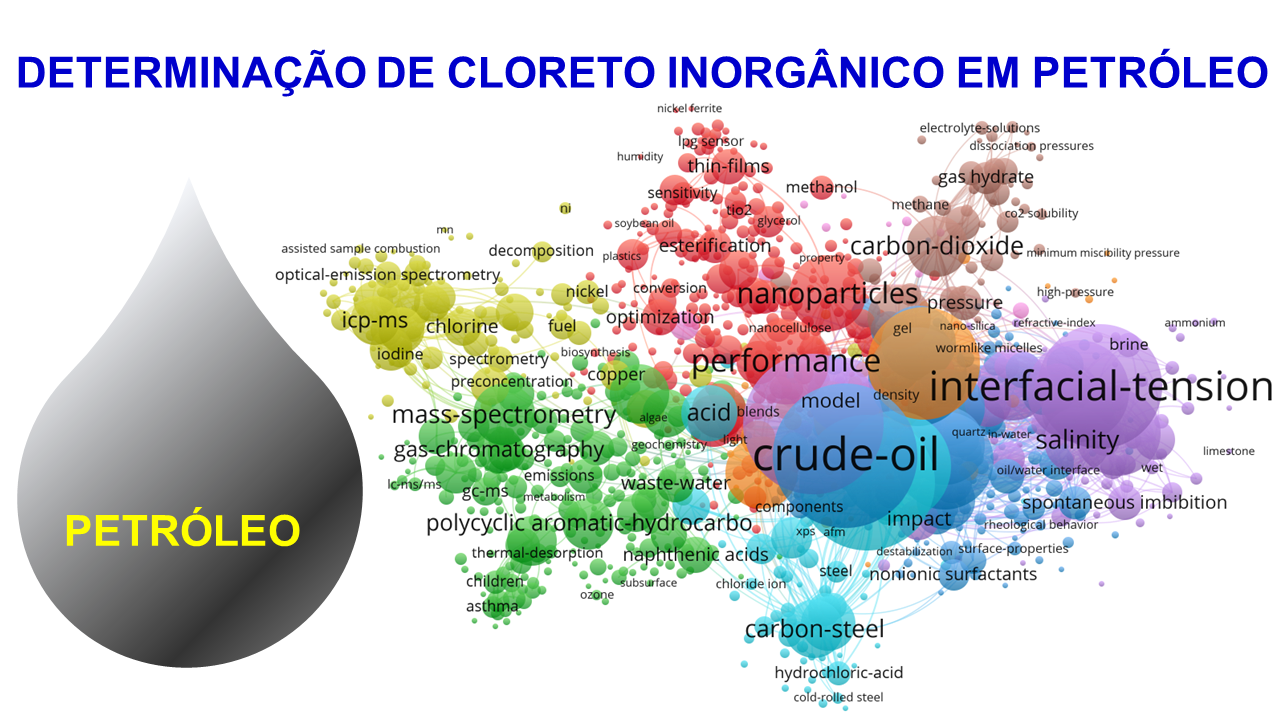
La presencia de cloruros inorgánicos, incluso en bajas concentraciones en el petróleo, está asociada a una serie de problemas operativos. La determinación de cloruros inorgánicos juega un papel importante en la industria del petróleo. En este estudio se realizó un análisis bibliométrico utilizando la aplicación gratuita VOSviewer y la base de datos Web of Science para brindar una visión general en el campo de la determinación de cloruros en el petróleo. Se analizaron un total de 3117 artículos sobre diversos aspectos de las características de las publicaciones, como producción de publicaciones, países, instituciones, revistas, artículos muy citados y palabras clave. El número de publicaciones en este campo ha aumentado constantemente durante los últimos 23 años. Estados Unidos fue el responsable del mayor número de publicaciones (798), seguido de Inglaterra (705). China jugó un papel central en la red de colaboración entre los países más productivos. La Universidad Federal de Santa María (UFSM) fue la institución con mayor fuerza de vinculación (88). Energy & Fuels fue el periódico más productivo (173). Las palabras clave tensión superficial, líquidos iónicos, emulsión, demulsificación, adsorción, potencial zeta y humectabilidad se consideran puntos críticos de investigación futura.
- Biografía del autor/a
- Referencias
-
Adeyemo, D. J., Umar, I. M., Funtua, I. I., Thomas, S. A. & Agbaji, E. B. (2006). Trace Multielement Content of Some Crude Oils by Instrumental Neutron Activation Analysis Techniques. Instrumentation Science & Technology, 32(6), 681–687. https://doi.org/10.1081/CI-200037038
Agência Nacional de Petróleo. (2022, 29. July). Anuário Estatístico 2022. https://www.gov.br/anp/pt-br/centrais-de-conteudo/dados-abertos/anuario-estatistico-2022
Aguiar, D. V. A. de, da Silva Lima, G., da Silva, R. R., Júnior, I. M., Gomes, A. de O., Mendes, L. A. N. & Vaz, B. G. (2022). Comprehensive composition and comparison of acidic nitrogen- and oxygen-containing compounds from pre- and post-salt Brazilian crude oil samples by ESI (-) FT-ICR MS. Fuel, 326(July), 125129. https://doi.org/10.1016/j.fuel.2022.125129
Aria, M. & Cuccurullo, C. (2017). bibliometrix: An R-tool for comprehensive science mapping analysis. Journal of Informetrics, 11(4), 959–975. https://doi.org/10.1016/J.JOI.2017.08.007
American Society for Testing and Materials. ASTM D3230-19. (2019). Standard Test Method for Salts in Crude Oil (Electrometric Method). https://www.astm.org/Standards/D3230.htm
American Society for Testing and Materials. ASTM D512-12. (2021). Standard Test Methods for Chloride Ion in Water. https://doi.org/10.1520/D0512-12.2
American Society for Testing and Materials. ASTM D6470-99. (2020). Standard Test Method for Salt in Crude Oils (Potentiometric Method). https://doi.org/10.1520/D6470-99R20
Biresselioglu, M. E., Demir, M. H., Solak, B., Kayacan, A. & Altinci, S. (2020). Investigating the trends in arctic research: The increasing role of social sciences and humanities. Science of The Total Environment, 729, 139027. https://doi.org/10.1016/J.SCITOTENV.2020.139027
Bueno, C. da S., Sattamini, S. R., Santa Anna, L. M. M., Silveira, J. M. F. J. da, Buainain, A. M. & Poz, M. E. S. D. (2017). Rede de cooperação tecnológica da petrobras e universidades e das suas áreas de tecnologia: panorama atual e perspectivas. Revista Iniciativa Econômica, 3(1), 66–89. Recuperado de https://periodicos.fclar.unesp.br/iniciativa/article/view/10970/7483
Campos, A. F., Cassella, A. R. & Cassella, R. J. (2020). Microwave-Assisted Extraction of Chloride Followed by Ion Chromatography as an Alternative to the ASTM D6470 Method for the Determination of Crude Oil Salinity. Energy and Fuels, 34(6), 6844–6850. https://doi.org/10.1021/acs.energyfuels.0c00425
Cardoso, A. L., Neves, S. C. G. & da Silva, M. J. (2008). Esterification of Oleic Acid for Biodiesel Production Catalyzed by SnCl2: A Kinetic Investigation. Energies 2008, Vol. 1, Pages 79-92, 1(2), 79–92. https://doi.org/10.3390/EN1020079
Coutinho, D. M., França, D., Vanini, G., Gomes, A. O. & Azevedo, D. A. (2022). Understanding the molecular composition of petroleum and its distillation cuts. Fuel, 311(November 2021), 122594. https://doi.org/10.1016/j.fuel.2021.122594
Delfino, R. J., Gong, H., Linn, W. S., Hu, Y. & Pellizzari, E. D. (2003). Respiratory symptoms and peak expiratory flow in children with asthma in relation to volatile organic compounds in exhaled breath and ambient air. Journal of Exposure Science & Environmental Epidemiology, 13(5), 348–363. https://doi.org/10.1038/sj.jea.7500287
Deyab, M. A. (2007). Effect of cationic surfactant and inorganic anions on the electrochemical behavior of carbon steel in formation water. Corrosion Science, 49(5), 2315–2328. https://doi.org/10.1016/J.CORSCI.2006.10.035
Doyle, A., Saavedra, A., Tristão, M. L. B., Nele, M. & Aucélio, R. Q. (2011). Direct chlorine determination in crude oils by energy dispersive X-ray fl uorescence spectrometry : An improved method based on a proper strategy for sample homogenization and calibration with inorganic standards. Spectrochimica Acta Part B: Atomic Spectroscopy, 66(5), 368–372. https://doi.org/10.1016/j.sab.2011.05.001
Enders, M. S. P., Anschau, K. F., Doneda, M., Druzian, G. T., Gomes, A. O., Guimaraes, R. C. L., Flores, E. M. M. & Muller, E. I. (2020). Characterization of Inorganic Solids Present in Brazilian Crude Oil Emulsions Using Scanning Electron Microscopy (SEM) with Energy-Dispersive X-ray Spectrometry (EDS): Evaluation of the Effect of Solvents. Energy and Fuels, 34(2), 1309–1316. https://doi.org/10.1021/acs.energyfuels.9b03087
Fernandes, H. A., Zanelato, L. N., Decote, P. A. P., Santos, H. N., Senger, C. M., Dias, F. C., Muller, E. I., Flores, E. M. M., Mendes, L. A. N., Vicente, M. A. & Santos, M. F. P. (2022). Effects of calcium, magnesium, and strontium chlorides in determining the total acid number using potentiometric titration. Fuel, 311(1), 122522. https://doi.org/10.1016/J.FUEL.2021.122522
Fu, H. Z., Wang, M. H. & Ho, Y. S. (2013). Mapping of drinking water research: A bibliometric analysis of research output during 1992–2011. Science of The Total Environment, 443, 757–765. https://doi.org/10.1016/J.SCITOTENV.2012.11.061
Gab-Allah, M. A., Goda, E. S., Shehata, A. B. & Gamal, H. (2020). Critical Review on the Analytical Methods for the Determination of Sulfur and Trace Elements in Crude Oil. Critical Reviews in Analytical Chemistry, 50(2), 161–178. https://doi.org/10.1080/10408347.2019.1599278
Gajdosechova, Z., Dutta, M., Lopez-Linares, F., de Azevedo Mello, P., Dineck Iop, G., Moraes Flores, E. M., Mester, Z. & Pagliano, E. (2021). Determination of chloride in crude oil using isotope dilution GC–MS: A comparative study. Fuel, 285, 119167. https://doi.org/10.1016/j.fuel.2020.119167
Gazulla, M. F., Ventura, M. J., Orduña, M., Rodrigo, M. & Torres, A. (2022). Determination of trace metals by ICP-OES in petroleum cokes using a novel microwave assisted digestion method. Talanta Open, 6, 100134. https://doi.org/10.1016/J.TALO.2022.100134
Gorrepati, E. A., Wongthahan, P., Raha, S. & Fogler, H. S. (2010). Silica precipitation in acidic solutions: Mechanism, pH effect, and salt effect. Langmuir, 26(13), 10467–10474. https://doi.org/10.1021/LA904685X
Granatelli, L. (1957). Determination of Organically Bound Chlorine in Petroleum Fractions with Oxyhydrogen Burner. Analytical Chemistry, 29(2), 238–241. https://doi.org/10.1021/AC60122A017
Hezave, A. Z., Dorostkar, S., Ayatollahi, S., Nabipour, M. & Hemmateenejad, B. (2013). Dynamic interfacial tension behavior between heavy crude oil and ionic liquid solution (1-dodecyl-3-methylimidazolium chloride ([C12mim][Cl] + distilled or saline water/heavy crude oil)) as a new surfactant. Journal of Molecular Liquids, 187, 83–89. https://doi.org/10.1016/J.MOLLIQ.2013.05.007
Holkem, A. P., Voss, M., Schlesner, S. K., Helfer, G. A., Costa, A. B., Barin, J. S., Müller, E. I. & Mello, P. A. (2021). A green and high throughput method for salt determination in crude oil using digital image-based colorimetry in a portable device. Fuel, 289(December 2020), 119941. https://doi.org/10.1016/j.fuel.2020.119941
Katona, R., Krójer, A., Locskai, R., Bátor, G. & Kovács, T. (2021). Comparison of analytical methods for measuring chloride content in crude oil. Applied Radiation and Isotopes Journal, 170, 109594. https://doi.org/10.1016/j.apradiso.2021.109594
Kondash, A. J., Lauer, N. E. & Vengosh, A. (2018). The intensification of the water footprint of hydraulic fracturing. Science Advances, 4, 1–8. https://doi.org/10.1126/SCIADV.AAX8764
Lashkarbolooki, M., Ayatollahi, S. & Riazi, M. (2014). The impacts of aqueous ions on interfacial tension and wettability of an asphaltenic-acidic crude oil reservoir during smart water injection. Journal of Chemical and Engineering Data, 59(11), 3624–3634. https://doi.org/10.1021/JE500730E
Li, N., Han, R. & Lu, X. (2018). Bibliometric analysis of research trends on solid waste reuse and recycling during 1992–2016. Resources, Conservation and Recycling, 130, 109–117. https://doi.org/10.1016/J.RESCONREC.2017.11.008
Mello, P. A., Pereira, J. S. F., Mesko, M. F., Barin, J. S. & Flores, E. M. M. (2012). Sample preparation methods for subsequent determination of metals and non-metals in crude oil — A review. Analytica Chimica Acta, 746, 15–36. https://doi.org/10.1016/j.aca.2012.08.009
Mitra, S., Sulakhe, S., Shown, B., Mandal, S. & Das, A. K. (2022). Organic chlorides in petroleum crude oil: Challenges for refinery and mitigations. ChemBioEng Reviews, 9(3), 319–332. https://doi.org/10.1002/CBEN.202100046
Nelson, J. & Lopez-linares, F. (2019). Determination of chloride in crude oils by direct dilution using inductively coupled plasma tandem. J. Anal. At. Spectrom., 34, 1433–1438. https://doi.org/10.1039/c9ja00096h
Pagliano, E., Gajdosechova, Z., Lopez-Linares, F. & Mester, Z. (2021). Conversion of inorganic chlorides into organochlorine compounds during crude oil distillation: Myth or reality? Energy and Fuels, 35(1), 894–897. https://doi.org/10.1021/ACS.ENERGYFUELS.0C03702
Parra-Barraza, H., Hernández-Montiel, D., Lizardi, J., Hernández, J., Herrera Urbina, R. & Valdez, M. A. (2003). The zeta potential and surface properties of asphaltenes obtained with different crude oil/n-heptane proportions☆. Fuel, 82(8), 869–874. https://doi.org/10.1016/S0016-2361(03)00002-4
Pereira, J. S. F., Mello, P. A., Moraes, D. P., Duarte, F. A., Dressler, V. L., Knapp, G. & Flores, É. M. M. (2009). Chlorine and sulfur determination in extra-heavy crude oil by inductively coupled plasma optical emission spectrometry after microwave-induced combustion. Spectrochimica Acta - Part B Atomic Spectroscopy, 64(6), 554–558. https://doi.org/10.1016/j.sab.2009.01.011
Robaina, N. F., Feiteira, F. N., Cassella, A. R. & Cassella, R. J. (2016). Determination of chloride in brazilian crude oils by ion chromatography after extraction induced by emulsion breaking. Journal of Chromatography A, 1458, 112–117. https://doi.org/10.1016/j.chroma.2016.06.066
Santana, A. P. R., Nascimento, P. D. A., Guimarães, T. G. S., Menezes, I. M. N. R., Andrade, D. F., Oliveira, A. & Gonzalez, M. H. (2022). ( Re ) thinking towards a sustainable analytical chemistry : Part I : Inorganic elemental sample treatment , and Part II : Alternative solvents and extraction techniques ( Re ) thinking towards a sustainable analytical chemistry : Part I : Inorganic eleme. Trends in Analytical Chemistry, 152, 116596. https://doi.org/10.1016/j.trac.2022.116596
Schutte, G. R. (2021). A economia política do conteúdo local no setor petrolífero de Lula a Temer. Economia e Sociedade, 30(1), 115–140. https://doi.org/10.1590/1982-3533.2020V30N1ART06
Seeger, T. S., Muller, E. I., Mesko, M. F. & Duarte, F. A. (2019). Magnesium and calcium determination in desalted crude oil by direct sampling graphite furnace atomic absorption spectrometry. Fuel, 236, 1483–1488. https://doi.org/10.1016/j.fuel.2018.09.108
Shishkova, I., Stratiev, D., Kolev, I. V., Nenov, S., Nedanovski, D., Atanassov, K., Ivanov, V. & Ribagin, S. (2022). Challenges in petroleum characterization—A review. Energies, 15(20), 7765. https://doi.org/10.3390/en15207765
Silva, F. A., Rigui, B. R., Andriolli, C. R., Flores, E. M. M., Mello, P. A. & Picoloto, R. S. (2023). A miniaturized liquid-liquid extraction method for further Na, K, Ca, and Mg determination in crude oil by FAAS. Talanta, 257, 124297. https://doi.org/10.1016/J.TALANTA.2023.124297
Soares, A. S. F., da Costa Marques, M. R. & da Cunha Costa, L. (2022). Physical-chemical characterization and leaching studies involving drill cuttings generated in oil and gas pre-salt drilling activities. Environmental Science and Pollution Research, 1, 1–16. https://doi.org/10.1007/S11356-022-23398-7
Souza, M. O., Ribeiro, M. A., Carneiro, M. T. W. D., Athayde, G. P. B., Castro, E. V. R. de, Silva, F. L. F., Matos, W. O. & Ferreira, R. de Q. (2015). Evaluation and determination of chloride in crude oil based on the counterions Na, Ca, Mg, Sr and Fe, quantified via ICP-OES in the crude oil aqueous extract. Fuel, 154, 181–187. https://doi.org/10.1016/j.fuel.2015.03.079
Speight, J. G. (2014). The chemistry and technology of petroleum (5th ed.). Cengage Learning.
Stratiev, D., Shishkova, I., Dinkov, R., Nenov, S., Sotirov, S., Sotirova, E., Kolev, I., Ivanov, V., Ribagin, S., Atanassov, K., Stratiev, D., Yordanov, D. & Nedanovski, D. (2023). Prediction of petroleum viscosity from molecular weight and density. Fuel, 331(P1), 125679. https://doi.org/10.1016/j.fuel.2022.125679
Suliman, M. A., Olarewaju, A., Basheer, C. & Lee, H. K. (2021). Microextraction and its app lication for petroleum and crude oil samples. Journal of Chromatography A, 1636, 461795. https://doi.org/10.1016/j.chroma.2020.461795
Synnestvedt, M. B., Chen, C. & Holmes, J. H. (2005). CiteSpace II: visualization and knowledge discovery in bibliographic databases. AMIA ... Annual Symposium Proceedings / AMIA Symposium. AMIA Symposium, February, 724–728. recuperado de https://www.ncbi.nlm.nih.gov/pmc/articles/PMC1560567/
Van Eck, N. J. & Waltman, L. (2010). Software survey: VOSviewer, a computer program for bibliometric mapping. Scientometrics, 84(2), 523–538. https://doi.org/10.1007/S11192-009-0146-3/FIGURES/7
Wu, B., Li, Y., Li, X., Zhu, J., Ma, R. & Hu, S. (2018). Organochlorine compounds with a low boiling point in desalted crude oil: Identification and conversion. Energy and Fuels, 32(6), 6475–6481. https://doi.org/10.1021/ACS.ENERGYFUELS.8B00205
Xu, Q., Chen, C., Rosswurm, K., Yao, T. & Janaswamy, S. (2016). A facile route to prepare cellulose-based films. Carbohydrate Polymers, 149, 274–281. https://doi.org/10.1016/J.CARBPOL.2016.04.114
Yao, T. C. & Porsche, F. W. (1959). Determination of sulfur and chlorine in petroleum liquids by X-Ray fluorescence. Analytical Chemistry, 31(12), 2010–2012. https://doi.org/10.1021/ac60156a038
Zeinolabedini Hezave, A., Dorostkar, S., Ayatollahi, S., Nabipour, M. & Hemmateenejad, B. (2013). Effect of different families (imidazolium and pyridinium) of ionic liquids-based surfactants on interfacial tension of water/crude oil system. Fluid Phase Equilibria, 360, 139–145. https://doi.org/10.1016/J.FLUID.2013.09.025
- Cover Image
-
- Descargas
- Publicado
- 2023-07-04
- Sección
- ENERGÍA
- Licencia
-
Derechos de autor 2023 Brazilian Journal of Production Engineering

Esta obra está bajo una licencia internacional Creative Commons Atribución 4.0.
Todas las obras publicadas en la Revista Brasileña de Ingeniería de Producción (BJPE) están bajo la licencia Creative Commons Atribución 4.0 Internacional (CC BY 4.0). Esto significa que: Cualquier persona puede copiar, distribuir, exhibir, adaptar, remezclar e incluso utilizar comercialmente el contenido publicado en la revista; Siempre que se reconozca debidamente a los autores y a BJPE como fuente original; No se requiere permiso adicional para la reutilización, siempre que se respeten los términos de la licencia. Esta política cumple con los principios de acceso abierto, promoviendo la amplia difusión del conocimiento científico. 🔗 Haga clic aquí para acceder a la licencia completa.
