

2.png)





































Life cycle assessment of freight railroads: a critical analysis and guideline proposal
- Autores
-
-
Bernardo Bicalho Carvalhaes
Department of Environmental Engineering, Federal University of Espírito Santo (UFES), Vitória Campus
Autor
-
João Luiz Calmon
Department of Environmental Engineering, Federal University of Espírito Santo (UFES), Vitória Campus
Autor
-
Darli Rodrigues Vieira
Management Department, Université du Québec à Trois-Rivières
Autor
-
Alencar Soares Bravo
Université du Québec à Trois-Rivières (Canada)
Autor
-
- Palavras-chave:
- life cycle assessment, LCA, freight railroads, guidelines
- Resumo
-
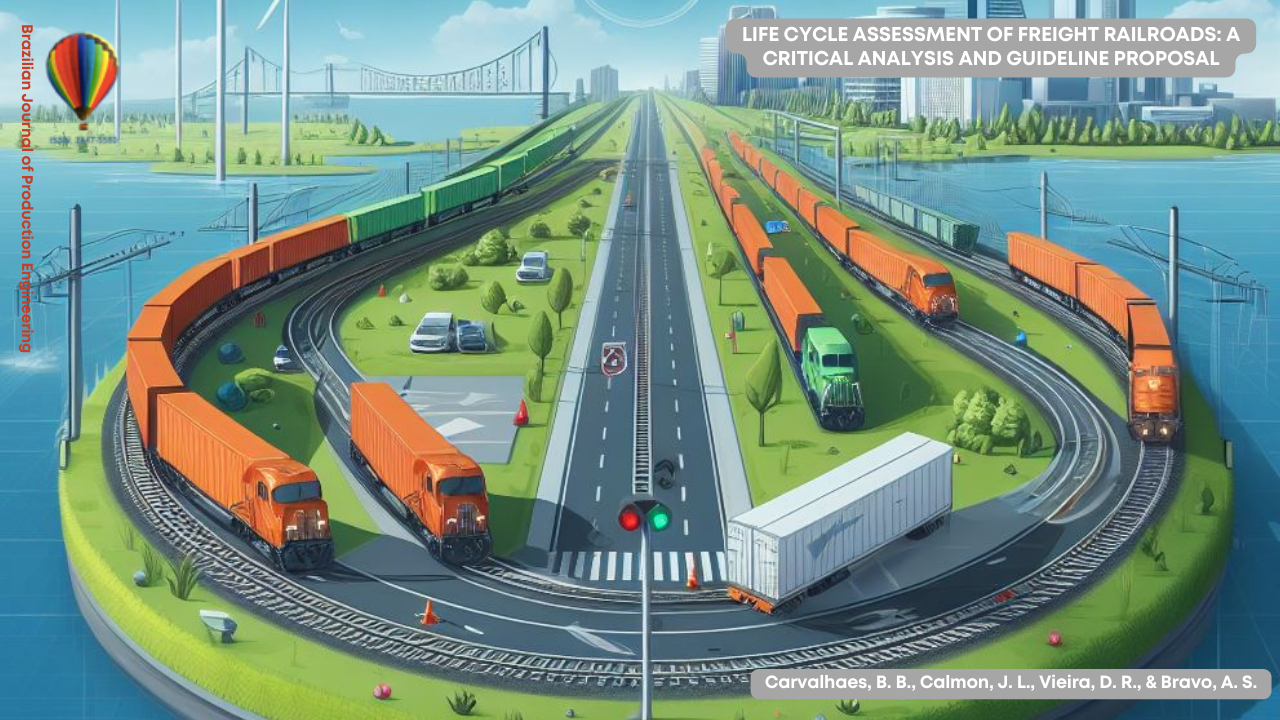
This study conducts a review of several articles inside the context of railroads, where the life cycle assessment methodology (LCA) is applied. Using the ProKnow-C methodology, seven review and 85 original papers applying the LCA methodology to railroads are analyzed, and several important gaps were identified, mainly concerning the lack of disclosure of information about parameters, software and other important decisions made during the works that would allow other researchers to replicate the results in order to compare them to other railroads or different circumstances. Currently, there are no ISO standards addressing the LCA of railroads, so this work seeks to provide an initial set of guidelines facilitating the elaboration of such a norm and providing support and direction for researchers in the field.
- Biografia do Autor
- Referências
-
Aria, M. & Cuccurullo, C. (2017). bibliometrix: An R-tool for comprehensive science mapping analysis. Journal of informetrics, 11(4), 959-975.
Association of American Railroads. (2023). Association of American Railroads. Freight rail & climate change 2023 Retrieved from https://www.aar.org/issue/freight-rail-climate-change/
Baitz, M., Albrecht, S., Brauner, E., Broadbent, C., Castellan, G., Conrath, P., & Fullana Palmer, P. (2013). LCA’s theory and practice: like ebony and ivory living in perfect harmony? In (Vol. 18, pp. 5-13): Springer.
Brander, M. & Wylie, C. (2011). The use of substitution in attributional life cycle assessment. Greenhouse Gas Measurement and Management, 1(3-4), 161-166.
Diaz, M. A. H., Scouse, A., & Kelley, S. S. (2022). Environmental full cost accounting of alternative materials used for railroad ties: Treated-wood and concrete case study. Journal of Cleaner Production, 364, 132536.
Dincer, I. & Zamfirescu, C. (2016). A review of novel energy options for clean rail applications. Journal of Natural Gas Science and Engineering, 28, 461-478.
Du, G. & Karoumi, R. (2014). Life cycle assessment framework for railway bridges: literature survey and critical issues. Structure and Infrastructure Engineering, 10(3), 277-294.
Earles, J. M. & Halog, A. (2011). Consequential life cycle assessment: a review. The international journal of life cycle assessment, 16, 445-453.
Edelen, A. & Ingwersen, W. W. (2018). The creation, management, and use of data quality information for life cycle assessment. The international journal of life cycle assessment, 23, 759-772.
Ekvall, T. & Finnveden, G. (2001). Allocation in ISO 14041—a critical review. Journal of Cleaner Production, 9(3), 197-208.
Ekvall, T. & Weidema, B. P. (2004). System boundaries and input data in consequential life cycle inventory analysis. The international journal of life cycle assessment, 9, 161-171.
Ensslin, L., Ensslin, S. R., Lacerda, R. T. d. O., & Tasca, J. E. (2010). ProKnow-C, Knowledge Development Process–Constructivist: processo técnico com patente de registro pendente junto ao INPI. Brasil:[sn].
Fridell, E., Bäckström, S., & Stripple, H. (2019). Considering infrastructure when calculating emissions for freight transportation. Transportation Research Part D: Transport and Environment, 69, 346-363.
ISO. (2006a). 14040. Environmental management—life cycle assessment - principles and framework.
ISO. (2006b). 14044. Environmental management—Life cycle assessment—Requirements and guidelines.
ISO. (2014). 13315-2. Environmental management for concrete and concrete structures. Part 2: System boundary and inventory data
ISO. (2020). 22888. Railway applications — Concepts and basic requirements for the planning of railway operation in the event of earthquakes.
ISO. (2022). 23054-1. Railway applications — Track geometry quality. Part 1: Characterization of track geometry and track geometry quality.
ISO. (2024). 13315-1. Environmental management for concrete and concrete structures. Part 1: General principles.
Jiang, C., Wan, Y., Yang, H., & Zhang, A. (2021). Impacts of high-speed rail projects on CO2 emissions due to modal interactions: A review. Transportation Research Part D: Transport and Environment, 100, 103081.
Olugbenga, O., Kalyviotis, N., & Saxe, S. (2019). Embodied emissions in rail infrastructure: a critical literature review. Environmental Research Letters, 14(12), 123002.
Pagani, R. N., Kovaleski, J. L., & Resende, L. M. (2015). Methodi Ordinatio: a proposed methodology to select and rank relevant scientific papers encompassing the impact factor, number of citation, and year of publication. Scientometrics, 105, 2109-2135.
Olugbenga, O., Kalyviotis, N., & Saxe, S. (2019). Embodied emissions in rail infrastructure: a critical literature review. Environmental Research Letters, 14(12), 123002.
Rebello, T. A., Roque, R. P., Gonçalves, R. F., Calmon, J. L., & Queiroz, L. M. (2021). Life cycle assessment of urban wastewater treatment plants: a critical analysis and guideline proposal. Water Science and Technology, 83(3), 501-514.
Scopus (2023). http://www..scopus.com
Trevisan, L. & Bordignon, M. (2020). Screening Life Cycle Assessment to compare CO2 and Greenhouse Gases emissions of air, road, and rail transport: An exploratory study. Procedia CIRP, 90, 303-309.
Vaz, C. R., Tasca, J. E., Ensslin, L., Ensslin, S. R., & Selig, P. M. (2012). Avaliação de desempenho na gestão estratégica organizacional: seleção de um referencial teórico de pesquisa e análise bibliométrica. Revista Gestão Industrial, 8(4).
Vieira, D. R., Calmon, J. L., & Coelho, F. Z. (2016). Life cycle assessment (LCA) applied to the manufacturing of common and ecological concrete: A review. Construction and Building Materials, 124, 656-666.
Weidema, B. P., Pizzol, M., Schmidt, J., & Thoma, G. (2018). Attributional or consequential life cycle assessment: a matter of social responsibility. Journal of Cleaner Production, 174, 305-314.
Xiao, X., Cai, D., Lou, L., Shi, Y., & Xiao, F. (2021). Application of asphalt-based materials in railway systems: A review. Construction and Building Materials, 304, 124630.
Web of Science (2023). http://www.webofscience.com
Zang, Y., Li, Y., Wang, C., Zhang, W., & Xiong, W. (2015). Towards more accurate life cycle assessment of biological wastewater treatment plants: a review. Journal of Cleaner Production, 107, 676-692.
- Cover Image
-
- Downloads
- Publicado
- 07.06.2024
- Seção
- ENGENHARIA AMBIENTAL E SUSTENTABILIDADE
- Licença
-
Direitos autorais (c) 2024 Bernardo Bicalho Carvalhaes, João Luiz Calmon, Darli Rodrigues Vieira, Alencar Soares Bravo (Autor)

Este trabalho está licenciado sob uma licença Creative Commons Attribution 4.0 International License.
Qualquer pessoa pode copiar, distribuir, exibir, adaptar, remixar e até utilizar comercialmente os conteúdos publicados na revista; Desde que sejam atribuídos os devidos créditos aos autores e à BJPE como fonte original; Não é exigida permissão adicional para reutilização, desde que respeitados os termos da licença. Esta política está em conformidade com os princípios do acesso aberto, promovendo a ampla disseminação do conhecimento científico. 🔗 CC BY 4.0
