

2.png)



































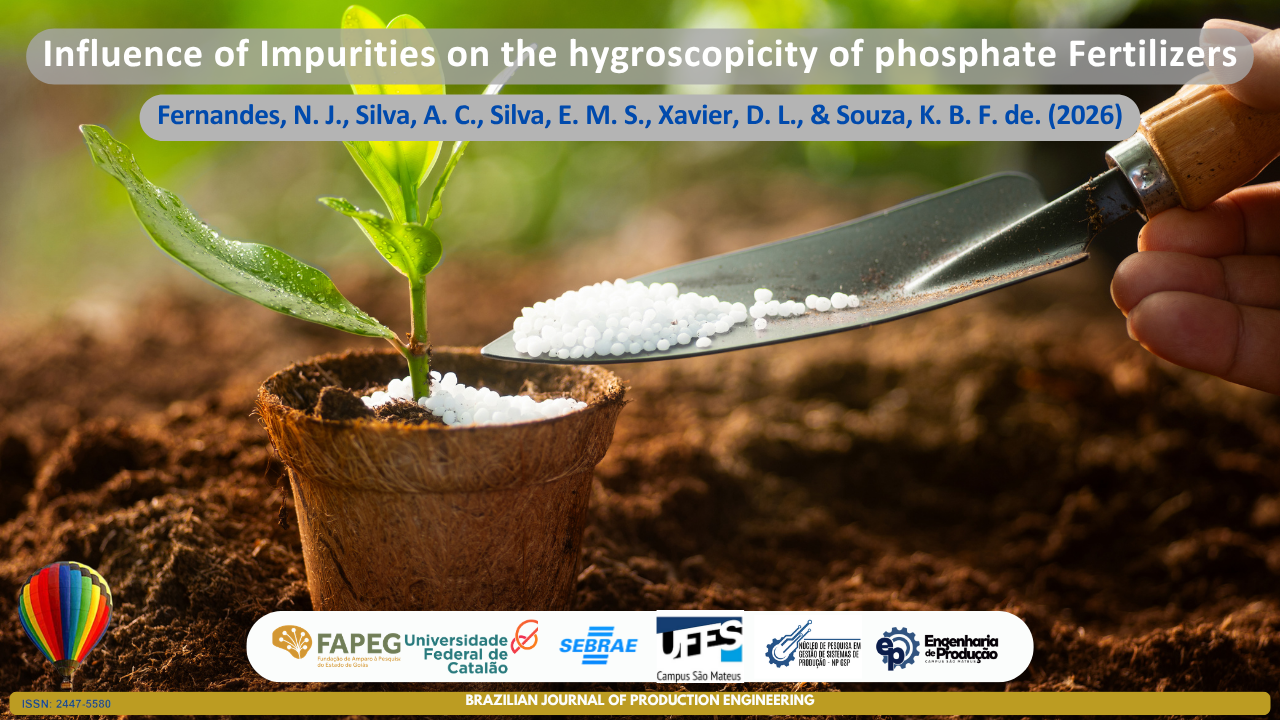
Influence of Impurities on the hygroscopicity of phosphate Fertilizers
- Authors
-
-
Nilson José Fernandes
Universidade Federal de Goiás, UFG - Regional Catalão, Engenharia de Produção
Author
-
André Carlos Silva
Faculdade de Engenharia / Universidade Federal de Catalão
Author
-
Elenice Maria Schons Silva
Universidade Federal de Catalão, Unidade Acadêmica Especial de Engenharia
Author
-
Davi Lucio Xavier
Graduação em andamento em Engenharia Mecânica. Universidade Federal de Catalão, UFCAT, Brasil.
Author
-
Kevim Braham Fernandes de Souza
Graduação em andamento em Engenharia Mecânica. Universidade Federal de Goiás, UFG, Brasil.
Author
-
- Keywords:
- Fertilizers, triple superphosphate, residual acidity, impurities, hygroscopicity
- Abstract
-
The growing demand for phosphate fertilizers highlights the need to assess physicochemical parameters that determine product quality, particularly hygroscopicity, which directly affects storage, transport, and agricultural application. This study evaluated the influence of iron, aluminum, and magnesium impurities on the hygroscopicity of granular triple superphosphate (GTSP). Bench-scale experiments were performed using TSP with different impurity levels, following an orthogonal central composite design (α = 1.41). Samples were granulated in a disc pelletizer under controlled conditions and subjected to hygroscopicity tests at 80% relative humidity for 24, 48, and 144 hours. Moisture uptake ranged from 4% to 7%, values sufficient to induce caking. Among the impurities, iron exhibited the greatest effect, followed by aluminum and magnesium. However, results showed that the key factor influencing hygroscopicity was the increase in residual phosphoric acidity, resulting from lower conversion rates during solubilization reactions. The study concludes that GTSP hygroscopicity is strongly linked to residual acidity control, emphasizing the relevance of industrial practices such as neutralization processes, improved mineral beneficiation, and the use of anti-caking additives.
- Author Biographies
- References
-
Alcarde, J. C., Malavolta, E., Borges, A. L., Muniz, A. S., Veloso, C. A., Fabrício, A. C., & Viegas, I. de J. M. (1992). Avaliação da higroscopicidade de fertilizantes e corretivos. Scientia Agricola, 137-144. https://doi.org/10.1590/S0103-90161992000400018
Associação dos Misturadores de Adubo do Brasil. AMA. (2015). Associação Brasileira do Agronegócio: relatórios técnicos. AMA.
Associação Nacional para Difusão de Adubos. ANDA. (2010). Phosphate fertilizers in Brazil: fertilizantes fosfatados Brasil. Uberlândia, MG: [s.n.]
Centro de Excelência em Fertilizantes. CEF. (2010). Workshop sobre tecnologias de produção de fertilizantes: apresentação. Uberlândia, MG: [s.n.]
Costa, L. M. & Silva, M. F. O. (2012). A indústria química e o setor de fertilizantes. BNDES 60 anos: perspectivas setoriais, (12-60). Rio de Janeiro: Banco Nacional de Desenvolvimento Econômico e Social. Recuperado de https://web.bndes.gov.br/bib/jspui/bitstream/1408/2025/1/A%20ind%C3%BAstria%20qu%C3%ADmica%20e%20o%20setor%20de%20fertilizantes_P_A.pdf
Loureiro, F. E. L., Monte, M. B. M., & Marisa, N. (2008). Agrominerais-Fosfato. In: Luz, A. B. & Lins, F. A. F. (Orgs.). Rochas e minerais industriais: usos e especificações. Capítulo 7: Rio de Janeiro: CETEM/MTC. Recuperado de https://mineralis.cetem.gov.br/handle/cetem/522
Ministério da Agricultura, Pecuária e Abastecimento. MAPA. (2017). Manual de métodos analíticos oficiais para fertilizantes e corretivos (240p.). MAPA. Recuperado de https://www.gov.br/agricultura/pt-br
Oliveira, N. F., Fernandes, N. J., & Guimarães, R. R. S. (2017). Influências de impurezas no fator de granulação. Anais do Simpósio de Engenharia de Produção, UFG, Catalão, GO. Recuperado de https://files.cercomp.ufg.br/weby/up/1012/o/RAFAEL_ROSA_DA_SILVA_GUIMARAES.pdf
Potafos. (2005). Arquivo Agrônomo nº 10: Nutri-fatos (24p.). POTAFOS. Recuperado de http://www.ppi.ppic.org
Silva, R. M. (1994). Minerais associados às apatitas: Análise de sua influência na produção de ácido fosfórico e fertilizantes fosfatados (Dissertação de Mestrado). Universidade de São Paulo (USP). Recuperado de https://teses.usp.br/teses/disponiveis/3/3134/tde-24062024-114004/pt-br.html
Sinden, J. (2010). Workshop sobre tecnologia de produção de fertilizantes: artigos fertilizantes. Uberlândia, MG: [s.n.]
- Cover Image
-
- Downloads
- Published
- 2026-06-08
- Section
- Innovation, Sustainability, and Entrepreneurship: Paths to Transforming Production Engineering
- License
-
Copyright (c) 2026 Fernandes, N. J., Silva, A. C., Silva, E. M. S., Xavier, D. L., & Souza, K. B. F. de.

This work is licensed under a Creative Commons Attribution 4.0 International License.
All works published in the Brazilian Journal of Production Engineering (BJPE) are licensed under Creative Commons Attribution 4.0 International (CC BY 4.0). This means that: Anyone can copy, distribute, display, adapt, remix, and even commercially use the content published in the journal; Provided that due credit is given to the authors and to BJPE as the original source; No additional permission is required for reuse, as long as the license terms are respected. This policy complies with the principles of open access, promoting the broad dissemination of scientific knowledge. 🔗 Click here to access the full license
