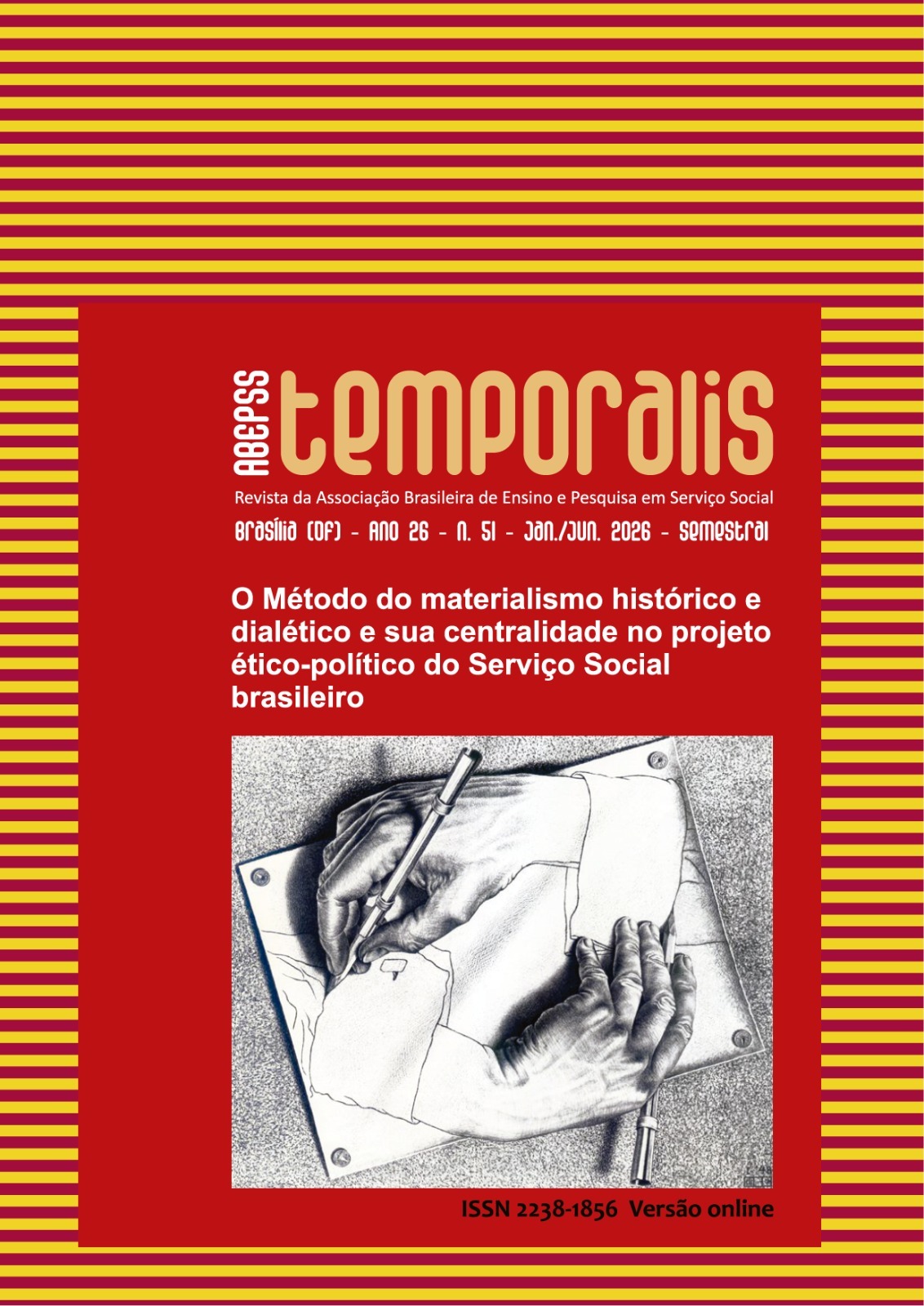
The method of historical and dialectical materialism and its centrality in the ethical-political project of the Brazilian Social Service
DOI:
https://doi.org/10.22422/temporalis.2026v26n51p9-20Keywords:
Method, Historical and Dialectical Materialism, Social Work, Ethical-Political ProjectAbstract
This issue of Temporalis presents the thematic dossier "The method of historical and dialectical materialism and its centrality in the ethical-political project of the Brazilian Social Service". The dossier reaffirms the theoretical and methodological basis of the Marxist tradition in teaching, research, extension and political-professional organization of the Social Service. Highlights the work of Karl Marx (1818-1883) as a central reference for the appropriation of critical social theory and the method of investigation of reality, incorporated into the academic circles of the profession since the 1980s. This incorporation occurs both by the critical review of its theory and historical-social knowledge, as well as by the applicability of the method of historical and dialectical materialism in apprehending the social meaning of the profession. The dossier contributes to the deepening of the critical understanding of the Marxist dialectical method as an ontological foundation for the analysis of social reality, highlighting its centrality in the Social Service for training (graduate and post-graduate), professional work, research, the production of knowledge, extension, internationalization and political militancy. This centrality is manifested in the support of the struggles against exploitation and oppression, particularly in the current context of aggravated crisis of capital, recrudescence of expressions of "social question", dismantling of social rights, advance of the extreme right and environmental crisis. Finally, it demonstrates the theoretical and methodological advances that have enabled the profession to incorporate such foundations into social praxis, locating itself in the socio-sexual and racial division of work and instituting mediations capable of contributing to the materialization of fundamental categories to the apprehension of the real, in the very movement of concrete reality.
Downloads
References
BATISTONI, Maria R. O Movimento de Reconceituação no Brasil: o Projeto Profissional da Escola de Serviço Social da Universidade Católica de Minas Gerais (1964-1980). Em Pauta, v. 15, n. 40, p. 136–150, 2017. DOI: https://doi.org/10.12957/rep.2017.32745. Disponível em: https://www.e-publicacoes.uerj.br/revistaempauta/article/view/32745/23545. Acesso em: 10 fev. 2026.
COUTINHO, Carlos N. Marxismo y política: La dualidad de poderes y otros ensayos. Traducción: Paula Vidal Molina. Santiago: LOM Ediciones, 2011.
COUTINHO, Carlos N. Pluralismo: dimensões teóricas e políticas. Cadernos ABESS, n. 4, p. 5–17, 1991. Disponível em: https://media.webfans.com.br/abepss/arquivos/anexos/pluralismo-dimensoes-teoricas-e-politicas-carlos-nelson-coutinho-201609020227248416940.pdf. Acesso em 10 fev. 2026.
GRAMSCI, Antonio. Concepção dialética da história. 7. ed. Tradução: Carlos Nelson Coutinho. Rio de Janeiro: Civilização Brasileira, 1987.
IAMAMOTO, Marilda V. O Serviço Social na contemporaneidade: trabalho e formação profissional. 27. ed. São Paulo: Cortez, 2020.
IAMAMOTO, Marilda Villela; CARVALHO, Raul de. Relações sociais e serviço social no Brasil: esboço de uma interpretação histórico-metodológica. São Paulo: Cortez, 1982.
KOSIK, Karel. A dialética do concreto. 2. ed. Tradução: Célia Neves e Alderico Toríbio. Rio de Janeiro: Paz e Terra, 1995.
MARX, Karl. Cadernos de Paris & Manuscritos econômico-filosóficos de 1844. Tradução: José Paulo Netto e Maria Antónia Pacheco. São Paulo: Expressão Popular, 2015.
MARX, Karl. Contribuição à crítica da economia política. Tradução: Maria Helena Barreiro Alves. 2. ed. São Paulo: Martins Fontes, 1983.
MARX, Karl. O Capital: crítica da economia política: Livro 1: o processo de produção do capital. Tradução: Rubens Enderle. São Paulo: Boitempo, 2013.
MÉSZÁROS, István. Estrutura social e formas de consciência: a determinação social do método. São Paulo: Boitempo, 2009.
NETTO, José P. Cinco notas a propósito da “questão social”. Temporalis, n. 3, p. 41–50, 2001. Disponível em: https://www.abepss.org.br/arquivos/anexos/temporalis_n_3_questao_social-201804131245276705850.pdf. Acesso em: 10 fev. 2026.
NETTO, José P. Ditadura e Serviço Social: uma análise do Serviço Social no Brasil pós-64. São Paulo: Cortez, 1991.
NETTO, José P. Introdução ao estudo do método de Marx. São Paulo: Expressão Popular, 2011.
NETTO, José P. O Serviço Social e a tradição marxista. Serviço Social & Sociedade, v. 10, n. 30, p. 89–102, 1989.
RODRIGUES, Vicente A. C.; STAMPA, Inez. Superexploração, dependência e autoritarismo no Brasil após a transição democrática. In: SANTOS, Tatiane V. C. dos et al. Violências no Brasil. Rio de Janeiro: Mórula Editorial, 2024. p. 19–45. Disponível em: https://morula.com.br/produto/violencias-no-brasil/. Acesso em: 10 fev. 2026.
Downloads
Published
Issue
Section
License
Copyright (c) 2026 Temporalis

This work is licensed under a Creative Commons Attribution 4.0 International License.
Copyright (c) 2026 Temporalis

This work is licensed under a Creative Commons Attribution 4.0 International License.

