

2.png)


































Análisis del destino final del aceite lubricante usado o contaminado en Manaus - AM
- Autores/as
-
-
Autor/a
-
Autor/a
-
Autor/a
-
- Palabras clave:
- Logística inversa, Re-refinación, Residuos sólidos, Impacto ambiental, región amazónica
- Resumen
-
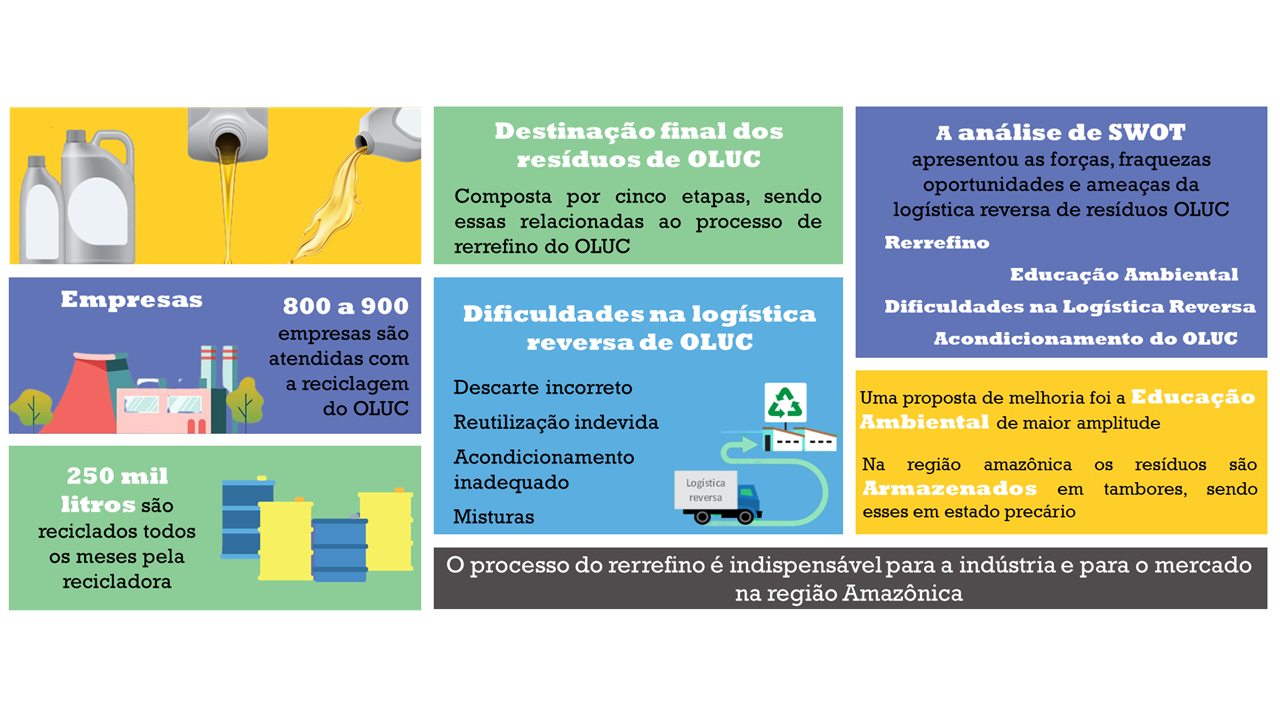
La generación de residuos sólidos está relacionada con la urbanización y el crecimiento de la población. Se usa uno de los desechos sólidos más preocupantes el Aceite Lubricante Usado o Contaminado (ALUC) debido a su nivel de peligrosidad. El presente estudio buscó analizar la gestión de los desechos ALUC administrado por una empresa de reciclaje en Manaus - AM. Las visitas en el sitio se realizaron entre junio y julio de 2022 en un reciclador, con la observación de la operación, solicitud de cuestionario y el proceso de destino final, así como un diagnóstico al señalar las principales observaciones y sugerencias de mejoras que se pueden implementar en el proceso de inversa logística. Se han observado factores que dificultan el destino final de ALUC. Además, fue posible resaltar la viabilidad y la importancia del proceso Re-refinación en la región de Amazonas. Posteriormente, se propusieron medidas de retorno rápidas para el reciclaje y la logística inversa de ALUC. Finalmente, el manejo de ALUC contribuye al camino de la sostenibilidad, ya que ALUC se puede usar en tiempos infinitos, sin proporcionar ningún riesgo de contaminación al medio ambiente, lo que contribuye a un equilibrio entre el modo de operación y el desarrollo de la sociedad.
- Biografía del autor/a
- Referencias
-
Arantes, H. & Uehara, S. C. S. A. (2021). Conhecimento e prática dos professores de ensino básico em Educação Ambiental e saúde. Revista Brasileira De Educação Ambiental (RevBEA), 16(4), 169-190. https://doi.org/10.34024/revbea.2021.v16.11429
Ardoin, N. M., Bowers, A. W., & Gaillard, E. (2020). Environmental education outcomes for conservation: A systematic review. Biological Conservation, 241, 108224. https://doi.org/10.1016/j.biocon.2019.108224
Associação Brasileira de Normas Técnicas (ABNT). (1992). NBR 12.235: Armazenamento de resíduos sólidos perigosos. Recuperado de https://www.normas.com.br/visualizar/abnt-nbr-nm/6118/nbr12235-armazenamento-de-residuos-solidos-perigosos-procedimento
Associação Brasileira de Normas Técnicas (ABNT). (2004). NBR 10.004: Resíduos Sólidos – Classificação. Recuperado de https://www.normas.com.br/visualizar/abnt-nbr-nm/170/abnt-nbr10004-residuos-solidos-classificacao
Bayer, N. M., Uranga, P. R. R., & Fochezatto, A. (2022). A curva ambiental de Kuznets na produção de resíduos sólidos domicialres nos municípios brasileiros, 2011-2015. Economia e Sociedade, Campinas, 31(1), 129-142. http://dx.doi.org/10.1590/1982-3533.2022v31n1art06
Brasil. (2005). Resolução de nº 362, de 23 de junho de 2005. Dispõe sobre as regras de recolhimento, coleta e destinação final do óleo lubrificante usado ou contaminado. Recuperado de https://www.legisweb.com.br/legislacao/?id=102246
Capello, A., Paula, A, M. A., Pradella, A. M., & Grando, M. L. (2015). Reaproveitamento do óleo lubrificante: Uma solução para o futuro. Revista Tecnológica, 3(2), 268-283.
Comper, I. C., Souza, F. O., & Chaves, G. L. D. (2016). Caracterização e Desafios da Logística Reversa de Óleos Lubrificantes. Revista em Gestão, Inovação e Sustentabilidade - Brasília, 2(1), 131-155.
Demajorovic, J., & Sencovici, L. A. (2015). Entraves e perspectivas para a logística reversa do óleo lubrificante e suas embalagens. Revista de Gestão Ambiental e Sustentabilidade – GeAS, 4(2), 83-101. https://doi.org/10.5585/geas.v4i2.167
Figueiredo, G. J. O. (2015). A logística reversa e o ciclo de vida de óleos básicos na produção de lubrificantes automotivos. Cadernos UNISUAM de Pesquisa e Extensão, 5(4), 60-69.
Gil, A. C. (2008). Métodos e técnicas de pesquisa social. 6. ed. São Paulo: Atlas.
Gonzaga, N. C., Silva, R. N., & Andrade, L. P. (2021). Gerenciamento de resíduos do óleo lubrificante: uma revisão sistemática da literatura. RGSA – Revista de Gestão Social e Ambiental, 15, 1-16. https://doi.org/10.24857/rgsa.v15.2812
Guimarães, G. A. & Batista, M. M. (2021). Avaliação do potencial de reciclagem dos resíduos sólidos urbanos na região central do município de Itacoatiara/Am. Revista Gestão e Sustentabilidade Ambiental, 10(3), 260-276. https://doi.org/10.19177/rgsa.v10e32021260-276
Guven, B. (2020). The integration of strategic management and intrapreneurship: Strategic intrapreneurship from theory to practice. Business and Economics Research Journal, 11(1), 229-245. https://dx.doi.org/10.20409/berj.2020.247
Hadjichambis, A. C. & Reis, P. (2020). Introduction to the Conceptualisation of Environmental Citizenship for Twenty-First-Century Education. Cap. 1, 1-14pp. Switzerland: Springer Nature.
Inhuma, Y. G., Guimarães, G. A., Kuwano, R. T., & Batista, M. M. (2021). Segregação dos resíduos de serviço de saúde: Educação Ambiental em um hospital público do município de Itacoatiara (AM). Revista Brasileira De Educação Ambiental (RevBEA), 16(5), 217-232. https://doi.org/10.34024/revbea.2021.v16.11595
Instituto Brasileiro de Geografia E Estatística (IBGE). (2023). Censo 2010. Recuperado de https://www.ibge.gov.br/cidades-e-estados/am/manaus.html
Izza, H., Abdessalam, S. B., Bouida, M., & Haddad, A. (2018). Recycling of used motor oil as an alternative method for production feedstock for the conversion processes. Petroleum Science and Technology, 36(19), 1511-1515. https://doi.org/10.1080/10916466.2018.1458126
Larsen, I., Weinschutz, R., & Kolicheski, M. B. (2019). Logística reversa dos óleos residuais em Curitiba: Estudo de caso em santa felicidade e projeto de educação à reciclagem. Revista Gestão & Sustentabilidade Ambiental, 8(1), 973-993. https://dx.doi.org/10.19177/rgsa.v8e12019973-993
Leal, M. C. & Danelichen, P. S. (2020). A inserção da educação ambiental no contexto do ensino fundamental. Ambiente & Educação, 25(2), 725-744. https://doi.org/10.14295/ambeduc.v25i2.7960
Machado, R. L., Pasqualetto, A., Morais, J., & Rocha, W. S. (2019a). Resíduos de filtros lubrificantes e OLUC (óleo lubrificante usado e contaminado) em automóveis da marca Honda, Goiânia, Go. Revista Gestão & Sustentabilidade Ambiental, 8(2), 562-577. https://doi.org/10.19177/rgsa.v8e22019562-577
Machado, G. C., Feres, P. P., & Gonçalves, M. F. S. (2019b). Reverse logistics: feasibility analysis of the collection and restitution of lubricating oil used or contaminated. Journal of Engineering and Technology for Industrial Applications, 5(17), 62-67. https://dx.doi.org/10.5935/2447-0228.20190009
Mendez, G. P., Mahler, C. F., & Taquette, S. R. (2021). Investigação Qualitativa em período de distanciamento social: O desafio da realização de entrevistas remotas. New Trends in Qualitative Research, 9, 336-343. https://doi.org/10.36367/ntqr.9.2021.336-343
Minayo, M. C. S. (2009). Pesquisa social: teoria, método e criatividade. 28 ed. Editora Vozes. Petrópolis, RJ.
Miranda, D. L., Mendonça, A. T., Melo, M. C., & Melo, E. D. (2021). Educação Ambiental a partir da Agenda 2030: experiências da conscientização e do uso racional da água na educação municipal de Varginha (MG). Revista Brasileira De Educação Ambiental (RevBEA), 16(2), 174-190. https://doi.org/10.34024/revbea.2021.v16.10951
Mota, A. K. V. & Figueiredo, G. L. A. (2017). A destinação do óleo lubrificante usado ou contaminado oluc nas oficinas mecânicas em uma pequena cidade localizada no norte do Estado do Tocantins. JNT - Facit Business and Techonology Jounal, 1(3), 3-15.
Oliveira, J. L., Santos, M. L., Moreira, M. C., & Ropa, T. V. R. (2019). Logística reversa do óleo lubrificante: Um estudo sobre a atuação dos postos especializados em troca de óleo na região de Jundiaí/SP. INOVAE - Journal of Engineering, Architecture and Technology Innovation, 7(1), 255-268.
Pascoal, E. T., Ribeiro, L. N. M., & Mendes, R. (2020). Proposta de melhoria no processo de logística reversa dos óleos lubrificantes usados ou contaminados. REP - Revista de Engenharia de Produção, 2(3), 51-70.
Pozzeti, V. C. & Caldas, J. N. (2019). O descarte de resíduos sólidos no âmago da sustentabilidade. Revista de Direito Econômico e Socioambiental, Curitiba, 10(1), 183-205. http://dx.doi.org/10.7213/rev.dir.econ.soc.v10i1.24021
Ribeiro, J. J. K., Chaves, G. L. D., & Muniz, E. P. (2018). Avaliação da Coleta de Óleo Lubrificante Usado e Contaminado no Município de São Mateus. Revista Gestão & Tecnologia, 18(1), 269-282. https://doi.org/10.20397/2177-6652/2018.v18i1.1192
Rosa, C. N. (2022). Estudo sobre derramamentos de óleos nas vias públicas e seus impactos no meio ambiente. Revista Ibero-Americana de Humanidades, Ciências e Educação. São Paulo, 8(6), 988-998. https://doi.org/10.51891/rease.v8i6.5990
Sampaio, A. J., Barbosa, H. C. R., Maggioni, L. G., & Menezes, J. D. S. (2020). Gestão dos filtros de óleo lubrificantes automotivos pós-consumo: estudo de caso nos pontos de trocas de óleo na cidade de Alagoinhas –BA. R. Gestão Industrial, Ponta Grossa, 16(3), 22-40. https://doi.org/10.3895/gi.v16n3.11634
Sistema Nacional de Informações sobre a gestão de Resíduos Sólidos (SINIR). (2021). Óleos lubrificantes usados ou contaminados. Recuperado de https://sinir.gov.br/perfis/logistica-reversa/logistica-reversa/oleos-lubrificantes-usados-ou-contaminhados-oluc/
Stocker, E., Samoel, J. O. B., Heringer, E., & Stocker, F. (2020). O processo da logística reversa e práticas de desenvolvimento sustentável: O caso da rerrefinação de óleo. Delos: desarrollo local sostenible, 13(36), 383-398.
Wahyuningrum, T., Fitriana, G. F., Bahtiar, A. R., Azalea, A., & Darwan. (2022). Simultaneous Importance-Performance Analysis based on SWOT in the Service Domain of Electronic-based Government Systems. (IJACSA) International Journal of Advanced Computer Science and Applications, 13(8), 314-319. https://dx.doi.org/10.14569/IJACSA.2022.0130837
- Cover Image
-
- Descargas
- Publicado
- 2023-03-29
- Sección
- INGENIERÍA AMBIENTAL Y SOSTENIBILIDAD
- Licencia
-
Derechos de autor 2023 Brazilian Journal of Production Engineering

Esta obra está bajo una licencia internacional Creative Commons Atribución 4.0.
Todas las obras publicadas en la Revista Brasileña de Ingeniería de Producción (BJPE) están bajo la licencia Creative Commons Atribución 4.0 Internacional (CC BY 4.0). Esto significa que: Cualquier persona puede copiar, distribuir, exhibir, adaptar, remezclar e incluso utilizar comercialmente el contenido publicado en la revista; Siempre que se reconozca debidamente a los autores y a BJPE como fuente original; No se requiere permiso adicional para la reutilización, siempre que se respeten los términos de la licencia. Esta política cumple con los principios de acceso abierto, promoviendo la amplia difusión del conocimiento científico. 🔗 Haga clic aquí para acceder a la licencia completa.
