

2.png)





































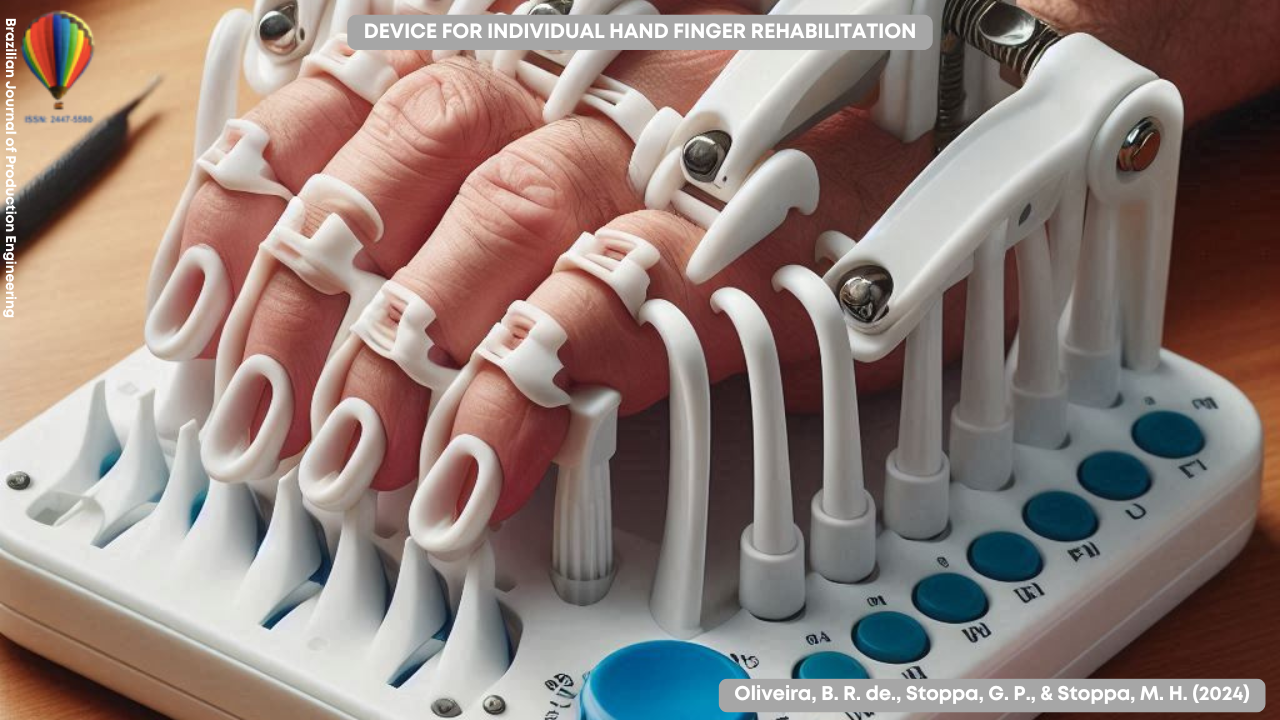
Device for individual hand finger rehabilitation
- Autores
-
-
Bruno Rodrigues de Oliveira
Instituto Federal do Triângulo Mineiro
Autor
-
Gabriel Percival Stoppa
Universidade Federal de Catalão
Autor
-
Marcelo Henrique Stoppa
Universidade Federal de Catalão, Instituto de Matemática e Tecnologia.
Autor
-
- Palavras-chave:
- Fingers, Rehabilitation, Assistive technology
- Resumo
-
Hands are indispensable when carrying out various everyday tasks. Situations such as car, work or vascular accidents impair mobility and hand maneuverability, forcing individuals to seek rehabilitation methods. This study proposes a low-cost device for finger rehabilitation that facilitates flexion/extension movements while respecting the physiological limits of each joint. The model utilizes a system of linear actuators to move the phalanges of the index finger, mimicking natural flexion. The study leverages mathematical modeling to determine the index finger's trajectory during flexion, considering joint angles and phalanx dimensions. This modeling led to the development of a 3D prototype using free software, ensuring that the dimensions and movement of the mechanism respect the anatomical characteristics of the finger. The results demonstrate that the prototype achieves the working space limits of the index finger, performing controlled and precise flexion movements. The study also proves the feasibility of the device construction through 3D printing of parts and preliminary testing. Future steps include developing a mechanism control system, a patient safety system with an interface for programming movement repetitions and applied force, and expanding functionality to include other hand movements. This model shows promise as a finger rehabilitation tool, offering controlled and safe flexion movements.
- Biografia do Autor
- Referências
-
Couto, H. D. A. (1995). Ergonomia aplicada ao trabalho: o manual técnico da máquina humana. Belo Horizonte: Ergo, 1, 353.
Cutkosky, M. R. (1989). On grasp choice, grasp models, and the design of hands for manufacturing tasks. Robotics and Automation, IEEE Transactions on, 5(3), 269-279.
Dellon, B. & Matsuoka, Y. (2007). Prosthetics, exoskeletons, and rehabilitation. IEEE Robotics and Automation magazine, Citeseer, 14(1), 30.
Engelberg, A. M. A. (1990). Guides to the evaluation of permanent impairment. American Medical Association Press.
Freivalds, A. (2011). Biomechanics of the upper limbs: mechanics. Modeling and musculoskeletal injuries. CRC Press.
Gaspar, H. M. da S. (2010). Estudo da Biomecânica da Mão por aplicação do Método dos Elementos Finitos. Tese (Doutorado) - Universidade do Porto.
Graaff, K. V. D., (1991). Human Anatomy. McGraw-Hill Higher Education. ISBN 9780697078964.
Hall, S. J. (2000). Biomecânica básica. [S.l.]: Grupo Gen-Guanabara Koogan, 2000.
Heo, P., et al. (2011). Current hand exoskeleton technologies for rehabilitation and assistive engineering. International Journal of Precision Engineering and Manufacturing, 13(5), 807-824.
Kapandji, A. (2002). Fisiologia articular: esquemas comentados de mecânica humana. ISBN 9788530300425.
Levangie, P. & Norkin, C. (2005). Joint structure and function. a comprehensive analysis. FA Davis Co.
Moraes, A. D. & Mont’alvao, C. (2000). Ergonomia – Conceitos e Aplicações. Metodologia Ergonômica. ISBN 9788590286240, 2AB Editora.
Netter, F. H., et al. (2006). Atlas of human anatomy. v. 11.
Napier, J. R. (1956). The prehensile movements of the human hand. Bone & Joint Journal, 38(4), 902-913.
Polis, J. E. (2009). Projeto e construção de parte estrutural de prótese de mão humana com movimentos. Biblioteca Digital da Unicamp.
Santana, V., et al. (2003). Acidentes de trabalho não fatais: diferenças de gênero e tipo de contrato de trabalho non-fatal occupational injuries: gender and job contract differences. Cad. Saúde pública, SciELO Brasil, 19(2), 481-493.
Silva, A. L. (2011). Development of a System for Finger Rehabilitation. 109 f. Dissertação (Mestrado em Engenharias) - Universidade Federal de Uberlândia
Sobotta, J. (2006). Atlas de anatomia humana. Guanabara-Koogan. ISBN 9788527711944.
Tubiana, R. (1981). Architecture and functions of the hand. The hand, WB Saunders Philadelphia, 1, 19-93.
Turner, J. A., Franklin, G., & Turk, D. C. (2000). Predictors of chronic disability in injured workers: a systematic literature synthesis. American journal of industrial medicine, Wiley Online Library, 38(6), 707-722.
- Cover Image
-
- Downloads
- Publicado
- 05.12.2024
- Seção
- Edição Especial "VI Simpósio de Engenharia de Produção (SIENPRO)"
- Licença
-
Direitos autorais (c) 2024 Bruno Rodrigues de Oliveira, Gabriel Percival Stoppa, Marcelo Henrique Stoppa (Autor)

Este trabalho está licenciado sob uma licença Creative Commons Attribution 4.0 International License.
Qualquer pessoa pode copiar, distribuir, exibir, adaptar, remixar e até utilizar comercialmente os conteúdos publicados na revista; Desde que sejam atribuídos os devidos créditos aos autores e à BJPE como fonte original; Não é exigida permissão adicional para reutilização, desde que respeitados os termos da licença. Esta política está em conformidade com os princípios do acesso aberto, promovendo a ampla disseminação do conhecimento científico. 🔗 CC BY 4.0
