Análise comparativa do impacto dos radares de velocidade na redução de sinistros de trânsito em vias urbanas do Rio de Janeiro
DOI:
https://doi.org/10.47456/bjpe.v12i1.51095Palavras-chave:
Radares, Métricas, Sinistros de trânsitoResumo
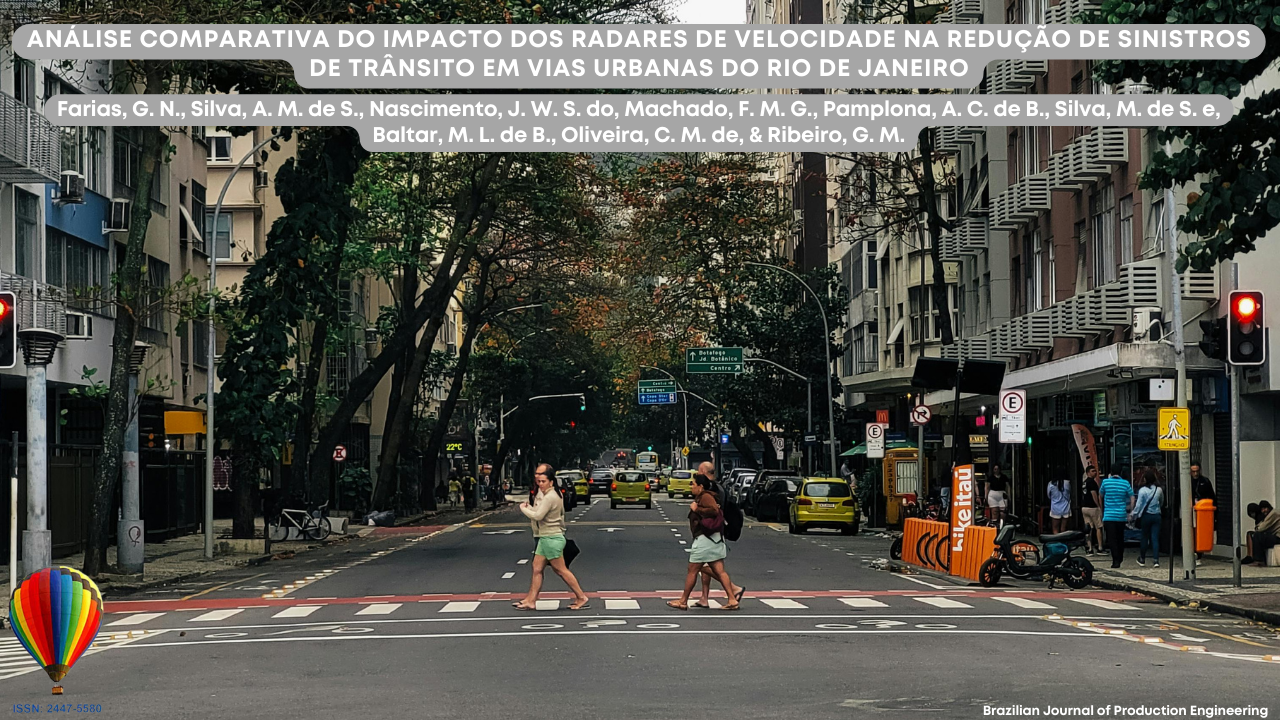
A segurança viária é um componente essencial da mobilidade urbana, uma vez que está diretamente associada à preservação de vidas, à mitigação de riscos e à eficiência do sistema de transporte. Nesse contexto, o presente estudo tem como objetivo analisar a efetividade dos radares em trechos urbanos com elevada taxa de sinistros por quilômetro na capital fluminense, com o intuito de compreender a correlação entre o posicionamento dos dispositivos de fiscalização eletrônica e a incidência de sinistros nas vias em que estão instalados. Para a análise estatística dos dados, utilizou-se o método Bootstrap, uma técnica de reamostragem não paramétrica que permite estimar a variabilidade de medidas sem a necessidade de pressupor distribuições específicas. Essa abordagem foi operacionalizada por meio da linguagem de programação Python, possibilitando a simulação de múltiplas amostras a partir dos dados observados. Os resultados apontam que, embora não tenha sido encontrada correlação estatisticamente significativa entre a proximidade do radar e a variação dos intervalos médios de acidentes, observou-se redução na frequência de incidentes em um raio de 150 metros dos dispositivos. Isso sugere um possível efeito localizado de radares de velocidade na dinâmica de acidentes rodoviários.
Downloads
Referências
Farias, G. N. et al. (2024) Implementação de modelo matemático para otimizar a localização de radares de velocidade em vias urbanas no Rio de Janeiro. In Anais do 21º Congresso Rio de Transportes. Rio de Janeiro: Unicast, 1(1), 1-12.
Farias, G. N. et al. (2025a) Utilização de modelo matemático de otimização para determinar a localização de radares de velocidade em vias urbanas no Rio de Janeiro. Cadernos do IME - Série Informática, 51(1), 11-23. https://doi.org/10.12957/cadinf.2025.90230
Farias, G. N. et al. (2025b) Análise multicritério para alocação eficiente de radares de velocidade em vias urbanas do Rio de Janeiro. In Anais do 39º Congresso de Pesquisa e Ensino em Transportes, 1(1), 807-811.
Farias, G. N. et al. (2025c) Abordagem multicritério para identificação estratégica de segmentos críticos em via expressa do Rio de Janeiro: Análise de altas velocidades, fiscalização eletrônica e ocorrência de sinistros de trânsito. In Anais do 22º Congresso Rio de Transportes. Rio de Janeiro: Unicast, 1(1), 1-12.
Gargoum, S. A.; El-Basyouny, K.; Kim, A. (2016) Towards setting credible speed limits: Identifying factors that affect driver compliance on urban roads. Accident Analysis & Prevention, 95(1), 138-148. https://doi.org/10.1016/j.aap.2016.07.001
Goralzik, A.; Vollrath, M. (2017) The effects of road, driver, and passenger presence on drivers' choice of speed: a driving simulator study. Transportation Research Procedia, 25(1), 2061-2075. https://doi.org/10.1016/j.trpro.2017.05.400
ITDP (2017) Moderação de tráfego e sua importância na construção de cidades mais humanas e inclusivas. Rio de Janeiro: Instituto de Políticas de Transporte e Desenvolvimento.
Mohit, B.; Rosen, Z.; Muennig, P. A. (2018) The impact of urban speed reduction programmes on health system cost and utilities. Injury Prevention, 24(4), 262-266. https://doi.org/10.1136/injuryprev-2017-042340
Montella, A. et al. (2015) Effects on speed and safety of point-to-point speed enforcement systems: Evaluation on the urban motorway A56 Tangenziale di Napoli. Accident Analysis & Prevention, 75(1), 164-178. https://doi.org/10.1016/j.aap.2014.11.022
Nascimento, J. W. S. do. et al. (2023) The role of occupational safety in road works: Implementation of preliminary risk analysis in the execution of asphalt resurfacing. Research, Society and Development, 12(11), e129121143778. https://doi.org/10.33448/rsd-v12i11.43778
Nascimento, J. W. S. do. et al. (2025a) An integrated intelligent routing approach for the sustainable optimization of urban freight transport in Rio de Janeiro. In Anais do Congresso Técnico Científico da Engenharia e da Agronomia. Vitória: CONTECC, 80ª SOEA, 1(11), 1-5.
Nascimento, J. W. S. do. et al. (2025b) Otimização multiobjetivo de roteamento sustentável do transporte de cargas com aplicação de SIG e NSGA-III na malha viária do Rio de Janeiro. In Anais do 39º Congresso de Pesquisa e Ensino em Transportes, 1(1), 986-990.
Downloads
Publicado
Edição
Seção
Licença
Copyright (c) 2026 Farias, G. N., Silva, A. M. de S., Nascimento, J. W. S. do, Machado, F. M. G., Pamplona, A. C. de B., Silva, M. de S. e, Baltar, M. L. de B., Oliveira, C. M. de, & Ribeiro, G. M.

Este trabalho está licenciado sob uma licença Creative Commons Attribution 4.0 International License.

Todos os trabalhos publicados na Brazilian Journal of Production Engineering (BJPE) estão licenciados sob a Creative Commons Atribuição 4.0 Internacional (CC BY 4.0).
Isso significa que:
-
Qualquer pessoa pode copiar, distribuir, exibir, adaptar, remixar e até utilizar comercialmente os conteúdos publicados na revista;
-
Desde que sejam atribuídos os devidos créditos aos autores e à BJPE como fonte original;
-
Não é exigida permissão adicional para reutilização, desde que respeitados os termos da licença.
Esta política está em conformidade com os princípios do acesso aberto, promovendo a ampla disseminação do conhecimento científico.


2.png)