Análise da gestão da manutenção de equipamentos de soldagem em uma fábrica de máquinas agrícolas
DOI:
https://doi.org/10.47456/bjpe.v9i3.40839Palavras-chave:
Manutenção, benchmarking, indicadoresResumo
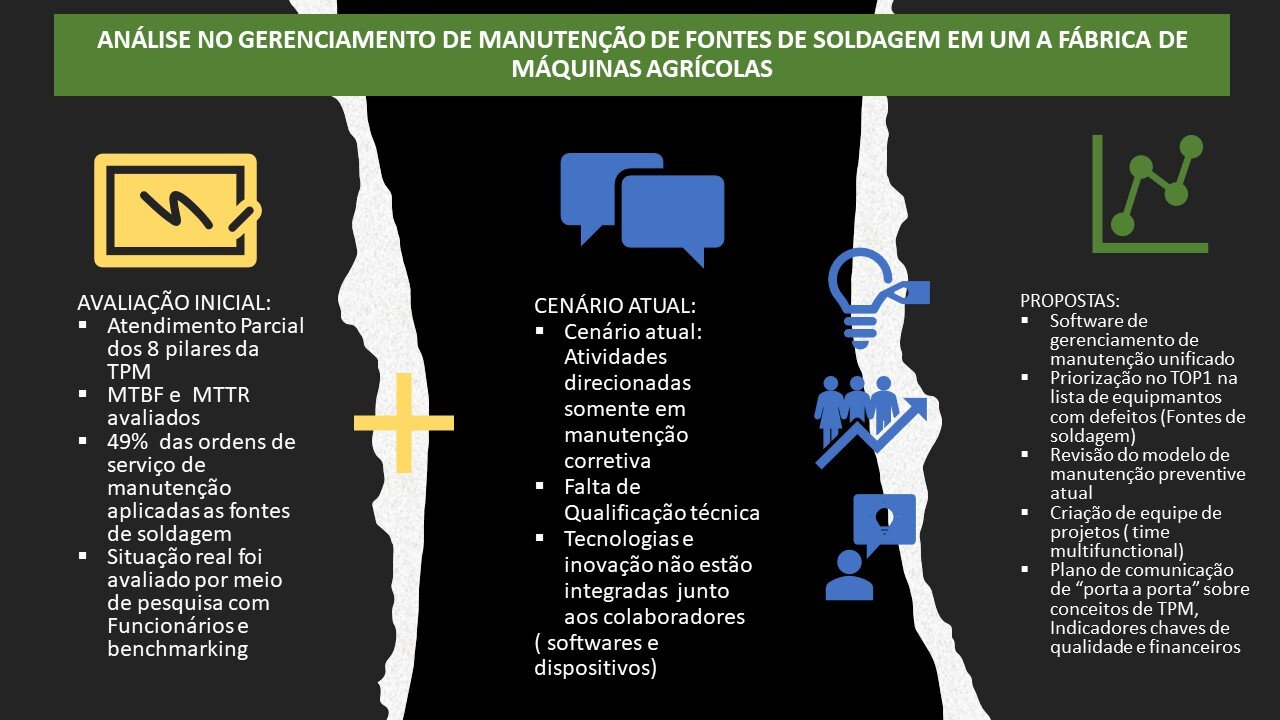
A gestão da manutenção impacta diversos setores de uma organização, especialmente, o de produção. Em fábricas em que ocorre o processo de soldagem, a boa gestão da manutenção é importante para que os equipamentos tenham o desempenho adequado e não afete de forma negativa a produção. Diante desse contexto, o presente trabalho foi desenvolvido com o objetivo geral de analisar o processo de manutenção do setor de soldagem de uma fábrica de máquinas agrícolas para gerar propostas de melhorias. Para tanto, foi desenvolvido uma pesquisa participante, em que foram realizadas entrevistas com diversos colaboradores da organização que estão envolvidos no processo de manutenção e de soldagem. Dados foram coletados por meio do banco de dados da organização e um benchmarking interno foi realizado. Como resultado, observou-se que a TPM (manutenção produtiva total, sigla em inglês) não é desenvolvida de forma consistente no setor analisado e possíveis melhorias foram identificadas. Portanto, conclui-se que a análise da manutenção produtiva total proporciona a identificação de melhorias para a organização.
Downloads
Referências
Associação brasileira de normas técnicas. (1994). NBR 5462: Confiabilidade e mantenabilidade. São Paulo, p. 37.
Bhutta, K. S. & Huq, F. (1999) Benchmarking - best practices: an integrated approach. Benchmarking: An International Journal, 6(3). 254-268. # MCB University. Press, 1463-5771. https://doi.org/10.1108/14635779910289261 DOI: https://doi.org/10.1108/14635779910289261
Chikwendu, O. C., Chima, A. S., & Edith, M.C. (2020) The optimization of overall equipment effectiveness factors in a pharmaceutical company. Heliyon, 6, 03796. https://doi.org/10.1016/j.heliyon.2020.e03796 DOI: https://doi.org/10.1016/j.heliyon.2020.e03796
Demmon, S., Bhargava, S., Ciolek, D., Halley, J., Jaya, N., Joubert, M. K., Koepf, E., Smithg, P., Trexler-Schmidt, M., & Tsa, P. (2020) A cross-industry forum on benchmarking critical quality attribute identification and linkage to process characterization studies. Biologicals, 67, 9-20. https://doi.org/10.1016/j.biologicals.2020.06.008 DOI: https://doi.org/10.1016/j.biologicals.2020.06.008
Franciosi, C, Voisin, A, Miranda, S., Riemma, S., & Iung, B. (2020). Measuring maintenance impacts on sustainability of manufacturing industries: from a systematic literature review to a framework proposal. Journal of Cleaner Production. 260 (121065). https://doi.org/10.1016/j.jclepro.2020.121065 DOI: https://doi.org/10.1016/j.jclepro.2020.121065
Gestão da manutenção: o mercado, as oportunidades e os desafios. ENGETELES, 2018, Brasília. Recuperado de https://engeteles.com.br/gestao-da-manutencao-o-mercado
Gil, A. C. (2008). Métodos e Técnicas de Pesquisa Social (6 ed.). São Paulo: Atlas.
Horenbeek, A. V. & Pintelon, L. (2014). Development of a maintenance performance measurement framework using the analytic network process (ANP) for maintenance performance indicator selection. Omega, 42, 33-46. https://doi.org/10.1016/j.omega.2013.02.006 DOI: https://doi.org/10.1016/j.omega.2013.02.006
Kardec, A. & Nascif, J. (2012) Manutenção: Função Estratégica. (4.ed). Rio de Janeiro: Qualitymark Editora.
Kumar, U., Galar, D., Aditya, P., & Stenstro¨m, C. (2013) Maintenance performance metrics: a state-of-the-art review. Journal of Quality in Maintenance Engineering, 19, 233-277. https://doi.org/10.1108/JQME-05-2013-0029 DOI: https://doi.org/10.1108/JQME-05-2013-0029
Lafraia, J. R. B (2001). Manual de confiabilidade, mantenabilidade e disponibilidade. (374 p) Rio de Janeiro: Qualitymark.
Liu, Q, Dong, M., Chen, F. F., Liu, W., & Ye, C. (2020). Multi-objective imperfect maintenance optimization for production system with an intermediate buffer. Journal of Manufacturing Systems, 56, 452-462. https://doi.org/10.1016/j.jmsy.2020.07.002 DOI: https://doi.org/10.1016/j.jmsy.2020.07.002
Manutenção de equipamentos de solda. Sonic System, Itupeva, SP. Recuperado de https://www.sonicsystem.com.br/manutencaoequipamentos-solda
Martins, P. & L, F. (1999). Administração da produção. São Paulo: Saraiva.
Mobley, R. K., Higgins, L. R., & Wikoff, D. J. (2008) Maintenance Engineering Handbook. 7.ed. New York: McGraw Hill.
Prodanov, C. C. & Freitas, E. C. (2013) Metodologia do Trabalho Científico: Métodos e Técnicas da Pesquisa e do Trabalho Acadêmico. 2.ed. Novo Hamburgo: Editora Feevale
Shin, W, Han, J., & Rhee, W. (2021) AI-assistance for predictive maintenance of renewable energy systems. Energy, 221, 119775. https://doi.org/10.1016/j.energy.2021.119775 DOI: https://doi.org/10.1016/j.energy.2021.119775
Singh, R., Gohil, A. M., Shah, D. B., & Desai, S. (2013) Total Productive Maintenance (TPM) Implementation in a Machine Shop: A Case Study. Procedia Engineering, 51, 592–599. https://doi.org/10.1016/j.proeng.2013.01.084 DOI: https://doi.org/10.1016/j.proeng.2013.01.084
The Welding Institute. TWI, Cambridge, Inglaterra. Recuperado de https://www.twi-global.com/who-we-are
Um quarto das empresas não possuem um setor de Planejamento e Controle de Manutenção (PCM). (2020). Revista Manutenção: Gestão, Estratégia e Inovação. 07 de set. de 2020. Recuperado de https://www.revistamanutencao.com.br/noticias/manutencao/um-quarto-das-empresas-nao-possuem-um-setor-de-planejamento-e-controle-de-manutencao-pcm.html
Van Harten, W. H, Van Bokhorst, L., & Van Luenen, H. G. A. M. (2010) Benchmarking biology research organizations using a new, dedicated tool. Molecular Oncology, 4, 12-18. https://doi.org/10.1016/j.molonc.2009.09.002 DOI: https://doi.org/10.1016/j.molonc.2009.09.002
Weber, A. & Thomas, R. (2005). Key performance indicators: measuring and managing the maintenance function. Ivara Corporation, Canadá. Recuperado de https://www.plant-maintenance.com/articles/KPIs.pdf
Wind, A. & Van Harten, W. H. (2017) Benchmarking specialty hospitals, a scoping review on theory and practice. BMC Health Services Research, 17:245. https://doi.org/10.1186/s12913-017-2154-y DOI: https://doi.org/10.1186/s12913-017-2154-y
Yin, R. K. (1994). Pesquisa Estudo de Caso - Desenho e Métodos (2 ed.). Porto Alegre: Bookman.
Zonta, T., Costa, C. A., Righ, R. R., Lima, M. J., Trindade, E. S., da., & Li, G. P. (2020) Predictive maintenance in the Industry 4.0: A systematic literature review. Computers & Industrial Engineering, 150, 106889. https://doi.org/10.1016/j.cie.2020.106889 DOI: https://doi.org/10.1016/j.cie.2020.106889
Downloads
Publicado
Edição
Seção
Licença
Copyright (c) 2023 David da Silva Borges, André Alves de Resende, Aline Gonçalves dos Santos (Autor)

Este trabalho está licenciado sob uma licença Creative Commons Attribution 4.0 International License.

Todos os trabalhos publicados na Brazilian Journal of Production Engineering (BJPE) estão licenciados sob a Creative Commons Atribuição 4.0 Internacional (CC BY 4.0).
Isso significa que:
-
Qualquer pessoa pode copiar, distribuir, exibir, adaptar, remixar e até utilizar comercialmente os conteúdos publicados na revista;
-
Desde que sejam atribuídos os devidos créditos aos autores e à BJPE como fonte original;
-
Não é exigida permissão adicional para reutilização, desde que respeitados os termos da licença.
Esta política está em conformidade com os princípios do acesso aberto, promovendo a ampla disseminação do conhecimento científico.


2.png)