Case study: causes related to the losses of raw material in a flexible packaging industry
DOI:
https://doi.org/10.47456/bjpe.v9i5.42734Keywords:
Polymers, Flexible packaging, ImprovementAbstract
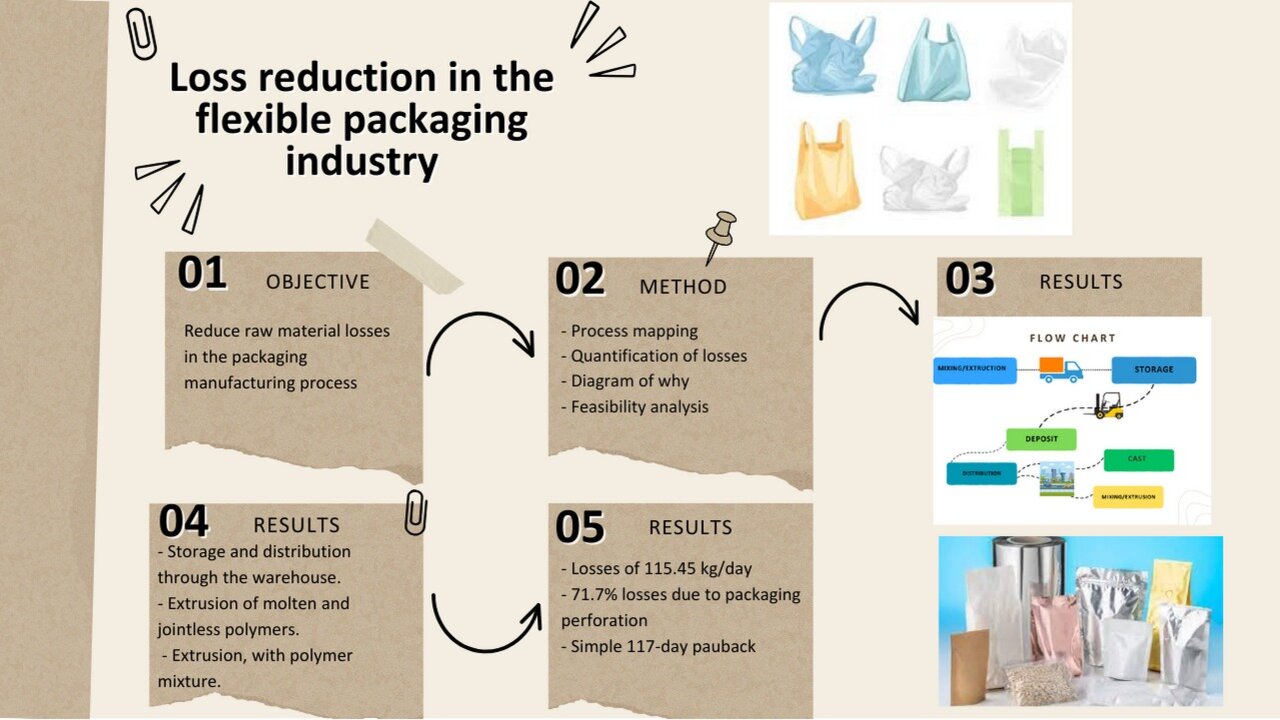
The flexible packaging segment has major importance as they have vast possibility of application as containment, protection, and communication of products with the consumer. As the cost of packaging is incorporated to the final value of the product offered to the customer, companies have sought to reduce losses in the process to offer products with competitive prices. The present research aimed to map and quantify the losses of raw material in the productive process of obtaining flexible packaging and based on the results, present improvement proposals. For this, it was evaluated the historic of losses of the company in a period of ten months in wasted mass values in the warehouse sectors, cast and mixing/extrusion, sequentially the losses were valued in real and the 5 whys tool was used to diagnose the main causes of losses. It ended with the financial viability analysis of implantation of the improvement proposal presented. The results showed that the company had a loss of approximately R$ 321.363,56 in the period studied and that the main cause (71,7%) was the perforation of bags by the fork-lift forks in the warehouse sector. The study showed that application of the improvement proposal is viable, and that the total investment of R$ 24.957 will return in three months and twenty days.
Downloads
References
ABIEF. Associação Brasileira da Industria de Embalagens Plásticas Flexíveis. Recuperado de www.abief.com.br/noticias
Evangelista, J. (2003) Tecnologia de Alimentos. São Paulo: Atheneu, 652p.
Martins, E. (2010). Contabilidade de custos. – 9. Ed. – São Paulo: Atlas.
Poças, M. F. F. & Moreira, R. (2003). Segurança alimentar e embalagem. In: Castro, A. G.; Pouzada, A. S. Embalagens para indústria alimentar. (2003). 1ª ed. Lisboa: Piaget, 610p.
Downloads
Published
Issue
Section
License
Copyright (c) 2023 Brazilian Journal of Production Engineering

This work is licensed under a Creative Commons Attribution 4.0 International License.

All works published in the Brazilian Journal of Production Engineering (BJPE) are licensed under Creative Commons Attribution 4.0 International (CC BY 4.0).
This means that:
Anyone can copy, distribute, display, adapt, remix, and even commercially use the content published in the journal;
Provided that due credit is given to the authors and to BJPE as the original source;
No additional permission is required for reuse, as long as the license terms are respected.
This policy complies with the principles of open access, promoting the broad dissemination of scientific knowledge.


2.png)